Raichur fort inscription of Gona Vithala
Inscription of November 1294 on a slab in the rampart of Raichur fort. It records that Vithala-natha, guardian of the realm of Prataparudra's commander Gona Gannaya-reddi, took Adoni, Tumbalam, Manvi and Haluva, entered Raichur and built its stone fort. It is among the earliest dated records of Prataparudra's reign.
What it is
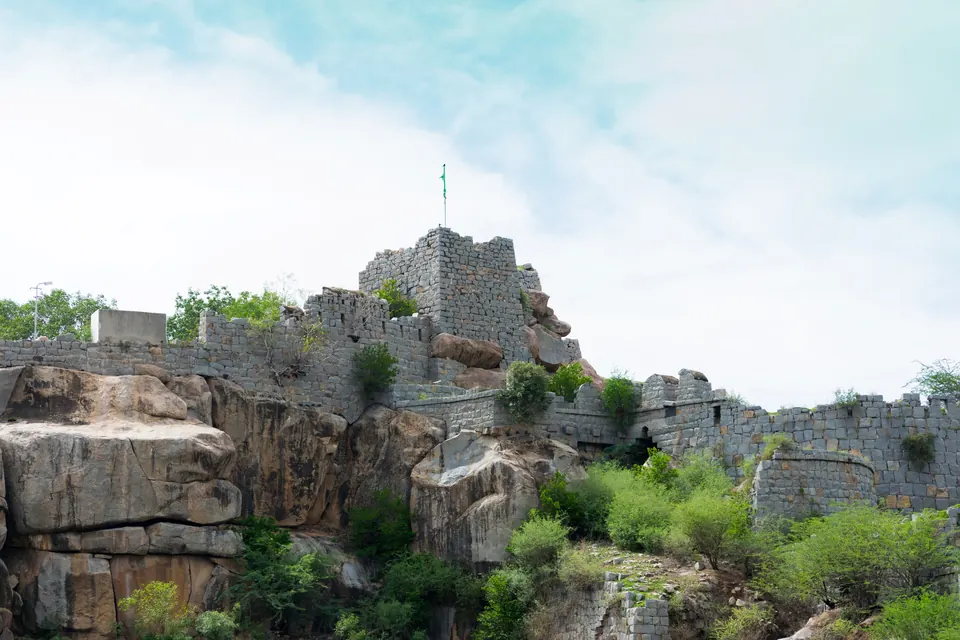
The inscription is carved on a large slab set up in the rampart wall of the fort of Raichur.1 It records that Vithala built the stone fort of Raichur.1 Vithala was an officer of Gona Gannaya-reddi, a subordinate of the Kakatiya king Prataparudra of Warangal.1 P. Sreenivasachar edited it for the Hyderabad Archaeological Department.1 He valued it for what it shows of the politics and geography of the Kakatiya kingdom at the end of the 13th century.1
Date
The record is dated Saka 1216 (Saka is an Indian way of counting years), the cyclic year Jaya, the seventh day of the bright fortnight of Margasira.1 Sreenivasachar gave the equivalent only roughly, as November 1294.1 The 1961 Kannada Inscriptions of Andhra Pradesh adds that the day was a Thursday.2 It converts the date to 25 November 1294.2
H. Krishna Sastri noted the inscription on the fort wall at Raichur in 1908.3 He noted that it names a chief of Vardhamananagari as a feudatory of Prataparudra.3 He called its date of 1294 “the earliest date for Prataparudra derived from inscriptions”.3
Contents
Most of the text is a long string of titles of Gona Gannaya-reddi, and Sreenivasachar translated them in full.4 Gannaya-reddi is styled lord of the city of Kudupuluru and the sun of the Manuma family.4 He is also the man who equipped the Kakatiya army and the right arm of Rudradeva, that is, of Prataparudra.4
The titles boast that he cut off the heads of these enemies:4
- Maili of Kosagi4
- Soma of Uppula4
- king Pandi4
- Akki-nayaka4
- Kacheya-nayaka of Medipali4
- Kesi-naya of Kanduru4
He is said to have been a fire to Bhima of Rapaka and to have looted the stables of Beda Cheluki-naya.4 He took the horse and coronation thread of Choda Odaya.4 The 1961 summary adds the defeat of the Lata and Chola princes.2 Gannaya-reddi was ruling from the town of Vardhamana when the inscription was cut.4
Then comes Vithala-natha, the guardian of Gannaya-reddi’s kingdom and a worshipper of Narayana.42 He took the forts of Adavani, Tumbulamu, Manuva and Haluva and entered the town of Racuru.42 On the date given, he built a stone fort there for the protection of the people of all the provinces.42
Places
Sreenivasachar identified the places named:5
- Adavani with Adoni5
- Manuva with Dodda Manvi, about 20 miles west of Raichur5
- Haluva with a village on the south bank of the Tungabhadra5
He placed Tumbulamu in the Adoni taluk and Kosagi 24 miles south of Raichur.5 He identified Vardhamanapuram, Gannaya-reddi’s seat, with Vaddaman, 15 miles east of Wanaparthy, where there are many ruins.5 He noted that the town is also named in the Anmakonda inscription of Rudradeva.5
In 1908 Krishna Sastri had considered two places for Vardhamananagari.3 One was Vardhannapet, about 20 miles south-west of Anmakonda.3 The other was Waddamarri, about 50 miles south-west of it in the direction of Kalyana.3
The Gona family
Sreenivasachar linked the record with the Gona family known from Telugu literature.1 The colophon (closing note) of the Ranganatha Ramayanamu makes Gona Buddhaya the son of Gona Gannaya.1 It says that Buddhaya’s sons Vitthala and Kachaya finished the poem.1 In another passage, though, Buddhaya calls his own father Vithala.1
Among Gannaya-reddi’s titles is one that makes him an ornament to his brother’s deeds.1 The inscription also gives Vithala an unusually high place as protector of Gannaya’s kingdom.1 Sreenivasachar therefore suggested that Vithala and Gannaya may have been brothers.1 He thought this would explain why the two literary sources name Buddhaya’s father differently.1
He treated as certain that this Gannaya was the warrior Gona Gannaya of the Ranganatha Ramayanamu.15 But he left the full history of the family open until more of its inscriptions were published.15 He also noted that the Bothpur inscriptions of the Malyala family mention the Gona family.1
Script and language
Sreenivasachar described both the language and the script as Telugu.56 He thought the scribe knew no Kannada, since the Kannada titles in the text are written with many mistakes.56 He also pointed to the early form raddi for the later reddi.56 The 1961 volume nevertheless included the record in its collection of Kannada inscriptions and printed the text in Kannada characters.7 The sources consulted here do not settle which script the slab actually uses.
Editions
Sreenivasachar’s note appeared as an appendix to the Hyderabad Archaeological Department’s report for 1935-36.1 It gives the text, a translation and a table of the places named.1 The 1961 Kannada Inscriptions of Andhra Pradesh gives an English summary and the text again.27
Footnotes
-
P. Sreenivasachar, “Note on the Raichur Inscription of Vithala-natha, dated Saka 1216 (c. 1294 A.D.)”, Annual Report of the Archaeological Department of H.E.H. the Nizam’s Dominions, 1935-36 (1939), Appendix E, p. 32 (archive.org (opens in a new tab)). Paraphrased. ↩ ↩2 ↩3 ↩4 ↩5 ↩6 ↩7 ↩8 ↩9 ↩10 ↩11 ↩12 ↩13 ↩14 ↩15 ↩16 ↩17 ↩18 ↩19 ↩20
-
P. Sreenivasachar, N. Ramesan and P. B. Desai (eds.), Kannada Inscriptions of Andhra Pradesh (1961), p. 31, No. 78 (archive.org (opens in a new tab)). Paraphrased. ↩ ↩2 ↩3 ↩4 ↩5 ↩6 ↩7
-
H. Krishna Sastri, “Anmakonda Inscription of Prola; the Chalukya-Vikrama Year Forty-Two”, Epigraphia Indica IX (1908), p. 261, note (archive.org (opens in a new tab)). ↩ ↩2 ↩3 ↩4 ↩5 ↩6
-
Sreenivasachar, “Note on the Raichur Inscription” (1939), p. 35, translation (archive.org (opens in a new tab)). Paraphrased. ↩ ↩2 ↩3 ↩4 ↩5 ↩6 ↩7 ↩8 ↩9 ↩10 ↩11 ↩12 ↩13 ↩14 ↩15 ↩16
-
Sreenivasachar, “Note on the Raichur Inscription” (1939), p. 33 (archive.org (opens in a new tab)). Paraphrased. ↩ ↩2 ↩3 ↩4 ↩5 ↩6 ↩7 ↩8 ↩9 ↩10 ↩11 ↩12
-
Sreenivasachar, “Note on the Raichur Inscription” (1939), p. 34 (archive.org (opens in a new tab)). Paraphrased. ↩ ↩2 ↩3
-
Sreenivasachar, Ramesan and Desai, Kannada Inscriptions of Andhra Pradesh (1961), p. 101, text (archive.org (opens in a new tab)). ↩ ↩2
Photos
References
Notes (0)
Sources (3)
Spotted an error on this page? Tell us
Last updated: