Andhra Patrika
The Telugu newspaper of Kasinadhuni Nageswara Rao. It began as a weekly at Bombay in 1908, moved to Madras in 1914 and became a daily. It supported the Home Rule and non-cooperation movements, printed literary work such as Panuganti's Sakshi, and by the 1940s was the most widely read Telugu paper.
Download
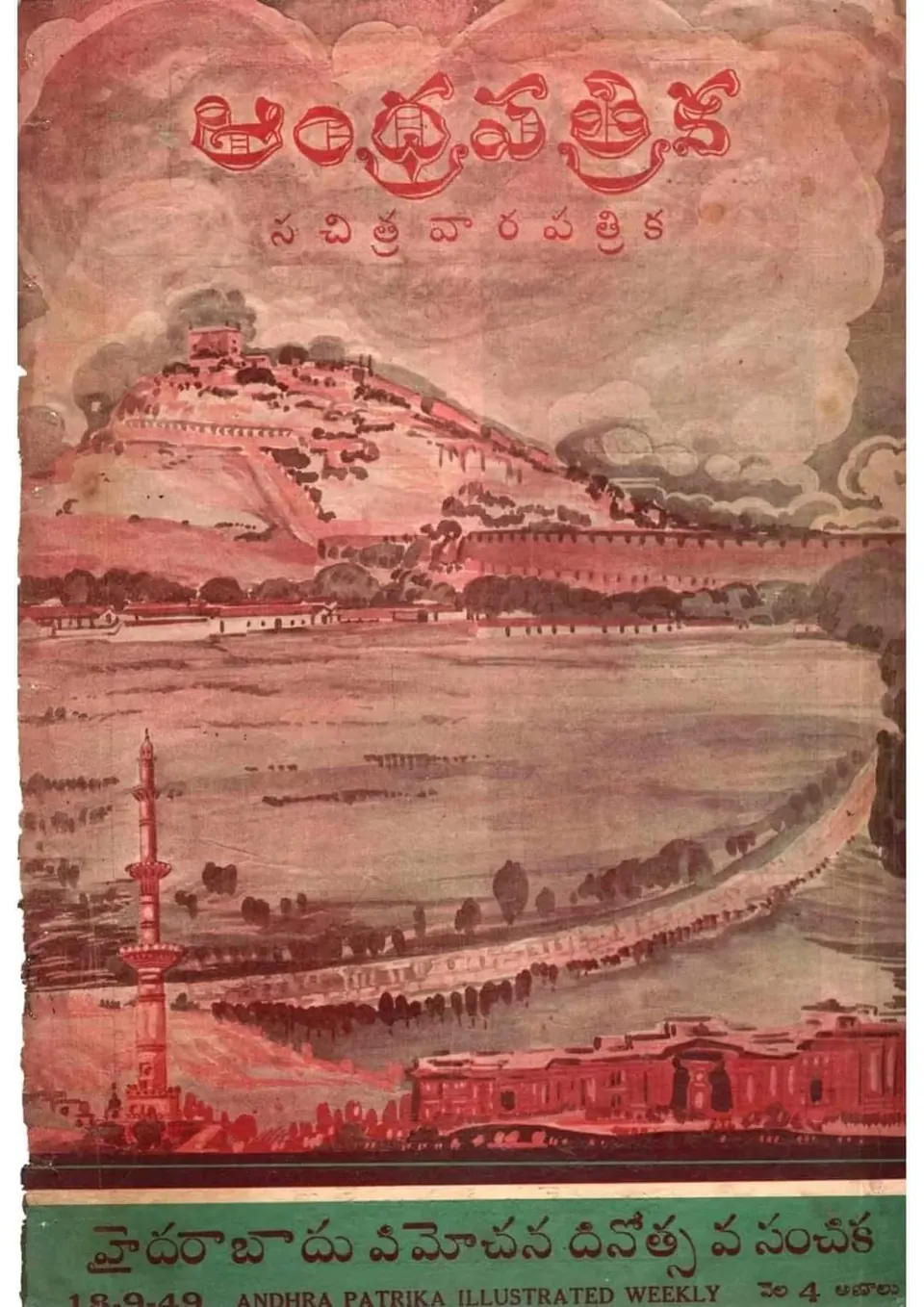
The Andhra Patrika was a Telugu newspaper founded by Kasinadhuni Nageswara Rao.1 It began as a weekly at Bombay in 1908 and became a daily at Madras in 1914.12 For decades it was one of the main voices of the national movement and of Telugu writing.234 Its story is part of Telugu newspapers and journals.
A weekly in Bombay, 1908–1914
Nageswara Rao made his money in Bombay from a medicine he invented, Amrutanjan.1 The Who’s Who of Freedom Struggle (1980) says he started the Andhra Patrika there as a Telugu weekly in 1908.1 K. Sitaramaiya wrote in 1943 that at first the paper also served to advertise his business.5
Starting a Telugu paper in Bombay was hard. The 1961 census handbook of Krishna district says the city had no Telugu presses, so he brought his workers, from compositors to sub-editors, from Madras and Vijayawada.6 It says he spent his Amrutanjan earnings on the weekly.6
A Madras daily, 1914 onwards
In 1914 he moved the paper to Madras and made it a daily.2 Sitaramaiya explains why. The Telugu people of Madras wanted a Telugu daily, and some of them planned to start one through a company.5 When Nageswara Rao heard of this, he moved his own paper to Madras, and the daily did very well.5
The census handbook says the paper’s sales grew during the First World War.6 Every Telugu new year’s day it brought out an annual number, with special articles on Telugu culture and the national movement.6 The issue of 9 May 1924 is marked Volume 11, Number 33, and calls itself a paper published every day at Madras.7
The paper and the national movement
Sarojini Regani writes that the Andhra Patrika spread the ideas of Home Rule in the Telugu districts.8 The Who’s Who says it gave strong support to the non-cooperation movement of 1920.2 During the no-tax campaign, Regani adds, Nageswara Rao was one of three leaders sent to see how the campaign at Pedanandipadu was going.9
Even before it moved to Madras, the paper took part in the Andhra movement, the demand for a separate province for the Telugu districts. P. Krishna Moorthy names the Andhra Patrika, then a weekly from Bombay, among the papers that helped to start that movement.10 They wrote about the position of the Telugu people and why they lagged behind others in the Madras Presidency.10
A paper for Telugu writing
Sitaramaiya says the paper gave Telugu literature a new home.511 Besides literary articles every day, it brought out a literary supplement once a week.11 Panuganti Lakshminarasimha Rao’s essays, Sakshi, came out in this supplement week by week and were very popular.11
In 1928 P. Chenchiah and Raja M. Bhujanga Rao called it the “premier Telugu daily”.3 They said it supported the new movements in Telugu literature.3 In 1924 Nageswara Rao started a monthly from the same office, Bharati.2
The largest Telugu paper
P. T. Raju wrote in 1944 that the Andhra Patrika came out both as a daily and as a weekly.4 He called it the most widely read Telugu newspaper.4 Decades later it was still widely read. The East Godavari gazetteer of 1979 reports 4,887 copies of it in that district, more than of any other Telugu daily.12
Where the sources disagree
The sources give two different starting years:
- the Who’s Who (1980) and the 1961 census handbook say the paper began at Bombay in 190816
- Regani’s history says it was founded in 1914, the year it moved to Madras82
Krishna Moorthy’s description of it as a weekly from Bombay before 1914 agrees with the earlier date.10
Footnotes
-
Sarojini Regani (ed.), Who’s Who of Freedom Struggle in Andhra Pradesh, Vol. II (1980), p. 213 (archive.org (opens in a new tab)). Cite-only; paraphrased. ↩ ↩2 ↩3 ↩4 ↩5
-
Regani (ed.), Who’s Who, Vol. II (1980), p. 214 (archive.org (opens in a new tab)). Cite-only; paraphrased. ↩ ↩2 ↩3 ↩4 ↩5 ↩6
-
P. Chenchiah and Raja M. Bhujanga Rao, A History of Telugu Literature (1928), p. 119 (archive.org (opens in a new tab)). ↩ ↩2 ↩3
-
P. T. Raju, Telugu Literature (1944), p. 87 (archive.org (opens in a new tab)). Cite-only; paraphrased. ↩ ↩2 ↩3
-
K. Sitaramaiya, A Hand Book of Telugu Literature (1943), p. 85 (archive.org (opens in a new tab)). Cite-only; paraphrased. ↩ ↩2 ↩3 ↩4
-
Census of India 1961, Andhra Pradesh: District Census Handbook, Krishna District (1966), p. xviii. Cite-only; paraphrased. ↩ ↩2 ↩3 ↩4 ↩5
-
Andhra Patrika, Vol. 11, No. 33 (Madras, 9 May 1924), p. 1, masthead (archive.org (opens in a new tab)). ↩
-
Sarojini Regani, Highlights of the Freedom Movement in Andhra Pradesh (1956), p. 51 (archive.org (opens in a new tab)). Cite-only; paraphrased. ↩ ↩2
-
Regani, Highlights (1956), p. 93 (archive.org (opens in a new tab)). Cite-only; paraphrased. ↩
-
P. Krishna Moorthy, Unification of Andhra Pradesh (Ph.D. thesis, Karnatak University, 1987), p. 30 (archive.org (opens in a new tab)). Cite-only; paraphrased. ↩ ↩2 ↩3
-
Sitaramaiya, A Hand Book of Telugu Literature (1943), p. 86 (archive.org (opens in a new tab)). Cite-only; paraphrased. ↩ ↩2 ↩3
-
N. Ramesan, Andhra Pradesh District Gazetteers: East Godavari (1979), p. 234 (archive.org (opens in a new tab)). Cite-only; paraphrased. ↩
Photos
References
Notes (0)
Sources (9)
Spotted an error on this page? Tell us
Last updated: