Telugu literature, age by age
The ages of Telugu literature as two literary historians divided them, from the poets before Nannaya to Sri Sri: the Telugu Mahabharata, the Saiva poets, Srinatha, the court of Krishnadeva Raya, the southern courts, the satakas, women poets, the new drama and the new poetry.
Download
Telugu literature runs for about a thousand years, from the Telugu Mahabharata of the 11th century to the poems and plays of the 20th.1 Its historians have divided that long story into ages in different ways. This page sets out one such division, then follows the ages in turn, adding what the general page Language & literature leaves out.2
The ages at a glance
Pingali Lakshmikantam headed the Telugu department of Andhra University, and wrote his history of Telugu literature from years of teaching it to M.A. students. It was printed only after his death, in 1974.3 He divided the literature into ten ages, and named most of them after their leading poets:2
| Age (Pingali’s name) | Years CE | Some of its writers |
|---|---|---|
| Before Nannaya | to 1000 | inscriptions and songs |
| Nannaya | 1000–1100 | Nannaya |
| Saiva poets (Sivakavi) | 1100–1225 | Nannechoda, Panditaradhya, Palkuriki Somanatha |
| Tikkana | 1225–1320 | Tikkana |
| Errapragada | 1320–1400 | Errana |
| Srinatha | 1400–1500 | Srinatha |
| Rayalu (Krishnadeva Raya) | 1500–1600 | Krishnadeva Raya, Mohanangi, Molla |
| Southern Andhra, or the Nayaka kings | 1600–1775 | the poets of Thanjavur, such as Muddupalani |
| Decline (kshina) | 1775–1875 | Subhadramma, Tarigonda Venkamma |
| Modern (adhunika) | from 1875 | Veeresalingam, Gurajada, Sri Sri |
The names and years in the first two columns are Pingali’s.2 The writers in the third column are placed by the sources cited in the sections below.
Before Nannaya
Nannaya is usually called the first Telugu poet. But Telugu verse is older than his Mahabharata: inscriptions of the 9th and 10th centuries already contain Telugu poems (see the script lesson).4
One poet’s date is still argued over. Chenchiah and Bhujanga Rao tell how Manavalli Ramakrishniah searched the country for Telugu works older than Nannaya. They called his discovery and publication of Nannechoda’s Kumarasambhava “a literary event of capital importance”.5 Pingali reports that Ramakrishna Kavi held Nannechoda to be much older than Nannaya, and pointed to three inscriptions of the 10th century.6 The sources do not agree on this; see “Where the sources disagree” below.
The age of translation: the Telugu Mahabharata
Chenchiah and Bhujanga Rao called the first five centuries of Telugu literature the Purana yuga, the age of translation. In this age three great Sanskrit works were put into Telugu: the Mahabharata, the Ramayana and the Bhagavata Purana.1 The Telugu Mahabharata alone took three centuries.7
Nannaya began it in the 11th century. Tikkana continued it in the 13th, and Errana finished it in the 14th. Later generations honoured the three together as the Kavitraya, “the Great Three”.7 No later poet, they wrote, began a poem without praising these three masters.7
The Saiva poets and the couplet
Pingali gave the 12th century to three Saiva poets: Nannechoda, Panditaradhya and Palkuriki Somanatha. In their age, he wrote, a Saiva faith that knew no god but Shiva rose and spread.8
Palkuriki Somanatha also wrote in the dvipada, a metre of two-line couplets.9 Chenchiah and Bhujanga Rao saw it as a form made for ordinary listeners, easy to remember.10 All three epics were put into dvipada, among them the Ramayana of Ranganatha. Srinatha’s ballad Palnati Vira Charitra is in the same metre.9
Srinatha and the lost Sivaratri Mahatmyamu
The poet Srinatha held an office in the kingdom of the Reddi kings.4 An inscription of 1410 at Phirangipuram, partly in Telugu verse, names him as its composer.114
In his Kasikhandam, Srinatha listed the books he had written. Another of his poems, the Sivaratri Mahatmyamu, was not on that list, and nobody had seen or heard of it.12 Then the Andhra Sahitya Parishat, searching for old manuscripts, found a copy in the house of the Vasireddy family at Jonnalagadda, in Nandigama taluk of Krishna district.12
It was the only copy, on palm leaves so old that they were crumbling to dust. A note at the end of the second canto said that one Venkanna of Gudimetla had copied it in 1674.13 It has only four cantos, and a line at the end of the fourth seems to begin a fifth.13 But the editor argued that the poem is complete, because the story it promised at the start ends there. If more was meant, he added, it was because Srinatha died before going on, not because a copyist left part out.14
The age of Krishnadeva Raya
When A. D. Campbell wrote in 1816, nearly all the Telugu books in use, apart from Nannaya’s and a few others, dated from after the founding of Vijayanagara.15 He found Krishnadeva Raya famous in the Telugu country “chiefly for his munificent encouragement of Teloogoo literature”. Many books of his reign were still kept in the libraries of the local chiefs (poligars).16
Campbell also heard of poems cut on “some thousand sheets of copper”, kept by a family of Brahmins at the temple of Tirupati. He sent a man to look. Apart from a grammar, they held only hymns in praise of the god.16 Campbell does not name the poets. A century later, S. Krishnaswami Aiyangar wrote that copper plates holding the songs of the Tallapaka family were still kept in the Tirupati temple (see Annamacharya).17
The court poets of this age, and the long story-poems called prabandhas, are described on the page Language & literature. One more name belongs here. Chenchiah and Bhujanga Rao record a tradition that the king’s daughter, Mohanangi, wrote a love poem, the Marichi Parinaya, and read it to the court. The book is lost.18
The southern courts
After the fall of Vijayanagara, Telugu kings ruled at Thanjavur and Madurai in the Tamil country. Pingali called the years 1600–1775 the “Southern Andhra” age, or the age of the Nayaka kings.2 Much of this literature was nearly lost. In 1928 Chenchiah and Bhujanga Rao credited the Andhra Sahitya Parishat with recovering “many hundreds of volumes” of the southern school.5
The southern poets wrote many plays. Chenchiah and Bhujanga Rao found them more prolific in drama than the north, though they doubted the literary worth of most of the plays.19 One southern work is by a woman. Muddupalani of the court of Pratapasimha of Thanjavur wrote the Radhika Svantam.20 See also The Nayaka kingdoms of the South.
Satakas, dandakas and songs
Beside the court poems ran a literature for everyone. Chenchiah and Bhujanga Rao counted about six hundred satakas, poems of a hundred verses. Most were original, not translations.9 Each verse ends with the same word or phrase, the makuta (“crown”), usually the name of a god or a person.9 More than three-quarters of them teach devotion or good conduct.9
They traced the sataka from its beginning in the 12th century to its height in the 17th. Its widest range came in the 18th and 19th centuries.21 The earliest they knew was Palkuriki Somanatha’s Vrishadhipa Sataka of 1180.21 Popular devotional satakas included the Kalahastisvara Sataka of Dhurjati and the Dasarathi Sataka of Kancherla Gopanna.2122
Two other popular forms were meant to be heard. A dandaka is a long, rushing hymn of praise, half sung and half recited. Songs for singing (geyamulu) include kirtanas, harikathas and women’s songs for the dawn, for festivals and for the cradle.22 Chenchiah and Bhujanga Rao regretted that most of this literature was still oral and unprinted in 1928.23 The performing traditions are on the page Telugu folk arts.
Women poets
Chenchiah and Bhujanga Rao gave a chapter to women poets. They noted that women also shaped literature as patrons, like the Kakatiya queen Rudramadevi.24 Their list includes these poets:1820
- Molla, a potter woman of the early 16th century, whose Ramayana they called the most widely read of all Telugu Ramayanas
- Mohanangi, daughter of Krishnadeva Raya, whose poem is lost
- Muddupalani of Thanjavur, author of the Radhika Svantam
- Tarigonda Venkamma of the 19th century, whose works include the Venkatachala Mahatyam
- Subhadramma, of about 1781, a writer of satakas and dandakas20
The modern age begins
One part of the modern age was the work of recovering and recording the past. Kandukuri Veeresalingam’s Andhra Kavula Charitra, the lives of the Telugu poets, became “a standard work of reference”.5 Old manuscripts were collected by C. P. Brown, Colin Mackenzie and the Government Oriental Library at Madras.5
New forms came too, above all the drama. Telugu had long had popular plays: “daylight plays” (pagati veshamulu) and street plays (vidhi natakamulu).2519 Srinatha even names a famous actor of women’s parts, Butchigadu.19 The modern Telugu stage grew from Shakespeare’s plays, the visit of the Dharwar drama company and the Parsi theatre.19
Kanyasulkam: a play in spoken Telugu
The best-known play of the new stage is Gurajada Apparao’s Kanyasulkam (“bride-price”).26 In his preface to the first edition, Gurajada explained why he wrote it.27
On the orders of the Maharaja of Vizianagaram, a list had been made of Brahmin marriages with a bride-price in the Visakhapatnam (then Vizagapatnam) district. In three years it recorded 1,034 such marriages. Ninety-nine of the girls were five years old, and three were only one.27 Since most people could not read, Gurajada thought only the stage could change minds.27
He wrote the play in the spoken dialect. It was easier for the public to follow, and he believed it was “the proper comic diction for Telugu”.27 The second edition, printed at Madras in 1909, was dedicated to the Maharaja of Vizianagaram.28
New poetry: Sri Sri’s Mahaprasthanam
In poetry the great break came with Sri Sri (Srirangam Srinivasa Rao). In a preface he wrote in 1980, he explained how his Mahaprasthanam (“the great journey”) came to be.29
He wrote nearly all its poems in the 1930s, a decade of world-wide hunger and war. Two came in 1941 and one in 1947.29 The book was not printed until 1950, when a friend paid for it.29 With his poem of 1933 he said “goodbye” to the bookish (grandhika) style and to fixed metres. He called this “Gurajada’s footstep”: Gurajada had turned Telugu poetry onto a new road, and he had widened it.29
Where the sources disagree
When Nannechoda lived. C. Sivaramamurti wrote that Nannechoda, author of the Telugu Kumarasambhava, lived a century before Nannaya.4 Ramakrishna Kavi, as Pingali reports, took him to be a Nannechoda named in an inscription as killed in battle in 940.6 Pingali Lakshmikantam placed him in the age of the Saiva poets, after 1100.82
How to divide the ages. Chenchiah and Bhujanga Rao named their ages by kinds of writing, such as the age of translation and the prabandha age.1 Pingali rejected such names. Original works, he pointed out, were written in the “age of translation”, and prabandhas in the “age of Puranas”. Ages of several hundred years also hide many changes.30 He chose shorter ages named after poets, because kings and dynasties pass away while poets live on in their books.30
Footnotes
-
P. Chenchiah and Raja M. Bhujanga Rao, A History of Telugu Literature (1928), p. 41 (archive.org (opens in a new tab)). ↩ ↩2 ↩3
-
Pingali Lakshmikantam, Andhra Sahitya Charitra (1974), p. 10 (archive.org (opens in a new tab)). Paraphrased. ↩ ↩2 ↩3 ↩4 ↩5
-
Devulapalli Ramanuja Rao, foreword (“Toli paluku”, 1 August 1974) to Pingali Lakshmikantam, Andhra Sahitya Charitra (Hyderabad: Andhra Pradesh Sahitya Akademi, 1974) (archive.org (opens in a new tab)). Paraphrased. ↩
-
C. Sivaramamurti, Indian Epigraphy and South Indian Scripts (1st ed. 1948), pp. 54–55 (archive.org (opens in a new tab)). ↩ ↩2 ↩3 ↩4
-
Chenchiah and Bhujanga Rao (1928), p. 110 (archive.org (opens in a new tab)). ↩ ↩2 ↩3 ↩4
-
Pingali Lakshmikantam, Andhra Sahitya Charitra (1974), p. 73, reporting the arguments of Manavalli Ramakrishna Kavi (archive.org (opens in a new tab)). Paraphrased. ↩ ↩2
-
Chenchiah and Bhujanga Rao (1928), p. 42 (archive.org (opens in a new tab)). ↩ ↩2 ↩3
-
Pingali Lakshmikantam, Andhra Sahitya Charitra (1974), p. 70 (archive.org (opens in a new tab)). Paraphrased. ↩ ↩2
-
Chenchiah and Bhujanga Rao (1928), p. 98 (archive.org (opens in a new tab)). ↩ ↩2 ↩3 ↩4 ↩5
-
Chenchiah and Bhujanga Rao (1928), p. 97 (archive.org (opens in a new tab)). ↩
-
Sivaramamurti, Indian Epigraphy and South Indian Scripts (1948), p. 218 (archive.org (opens in a new tab)). ↩
-
“Prathama mudrana pithika” (preface to the first edition), in Srinatha, Sivaratri Mahatmyamu (Sukumara Charitramu), 2nd ed. (Kakinada: Andhra Sahitya Parishat, 1930), p. i (archive.org (opens in a new tab)). ↩ ↩2
-
Preface to the first edition, Sivaratri Mahatmyamu (1930), p. ii (archive.org (opens in a new tab)). ↩ ↩2
-
Preface to the first edition, Sivaratri Mahatmyamu (1930), p. iii (archive.org (opens in a new tab)). ↩
-
A. D. Campbell, A Grammar of the Teloogoo Language (1816), Introduction, p. xiii (archive.org (opens in a new tab)). ↩
-
Campbell, Grammar of the Teloogoo Language (1816), Introduction, p. xv and note (archive.org (opens in a new tab)). ↩ ↩2
-
S. Krishnaswami Aiyangar, A History of Tirupati, Vol. II (1941), p. 216 (archive.org (opens in a new tab)). Paraphrased. ↩
-
Chenchiah and Bhujanga Rao (1928), p. 103 (archive.org (opens in a new tab)). ↩ ↩2
-
Chenchiah and Bhujanga Rao (1928), p. 114 (archive.org (opens in a new tab)). ↩ ↩2 ↩3 ↩4
-
Chenchiah and Bhujanga Rao (1928), p. 104 (archive.org (opens in a new tab)). ↩ ↩2 ↩3
-
Chenchiah and Bhujanga Rao (1928), p. 99 (archive.org (opens in a new tab)). ↩ ↩2 ↩3
-
Chenchiah and Bhujanga Rao (1928), p. 100 (archive.org (opens in a new tab)). ↩ ↩2
-
Chenchiah and Bhujanga Rao (1928), p. 101 (archive.org (opens in a new tab)). ↩
-
Chenchiah and Bhujanga Rao (1928), p. 102 (archive.org (opens in a new tab)). ↩
-
Chenchiah and Bhujanga Rao (1928), p. 113 (archive.org (opens in a new tab)). ↩
-
Chenchiah and Bhujanga Rao (1928), p. 115 (archive.org (opens in a new tab)). ↩
-
Gurajada Apparao, preface to the first edition of Kanyasulkamu, in Kanyasulkamu, 2nd ed. (1909), re-typed text, PDF pp. 8–9. ↩ ↩2 ↩3 ↩4
-
Gurajada Apparao, Kanyasulkamu: hasyarasa pradhanamagu natakamu, 2nd ed. (Madras: G. Ramaswami Chetty’s press, 1909), title page and dedication, re-typed text, PDF pp. 4–7. ↩
-
Sri Sri, “Na mata” (preface to the handwritten London edition, 1980), in Mahaprasthanam, e-text of a later edition, PDF pp. 6–8. Paraphrased. ↩ ↩2 ↩3 ↩4
-
Pingali Lakshmikantam, Andhra Sahitya Charitra (Hyderabad: Andhra Pradesh Sahitya Akademi, 1974), p. 9 (archive.org (opens in a new tab)). Paraphrased. ↩ ↩2
Related
People
C. P. Brown
1817–1855 CE
Charles Philip Brown was an officer of the Madras Civil Service from 1817 to 1855 who spent his best years in the Telugu districts. He collected and corrected Telugu manuscripts, printed the verses of Vemana with an English translation in 1829, and wrote a Telugu grammar and large Telugu–English and English–Telugu dictionaries. He gave his collection of about 2,440 manuscripts to the Madras Literary Society.
Kattamanchi Ramalinga Reddy
1880–1951 CE
Sir Kattamanchi Ramalinga Reddy, known as C. R. Reddy (1880–1951), was born at Kattamanchi in Chittoor district. An educationist, critic and poet, he studied at Cambridge, served in education in Baroda and Mysore, and was the first Vice-Chancellor of Andhra University from 1926. His Musalamma Maranamu (1900) and Kavitva Tattva Vicharamu helped begin modern Telugu criticism.
Adivi Bapiraju
1895–1952 CE
Adivi Bapiraju (1895–1952), born at Bhimavaram, was a Telugu novelist, poet and painter. He learned painting at the National College, Machilipatnam, went to jail in 1922 during the freedom movement, wrote the prize-winning novel Narayana Rao, worked as an art director in Telugu films, and edited the Telugu daily Meezan in Hyderabad in the 1940s.
Duvvuri Ramireddy
1895–1947 CE
Duvvuri Ramireddy (1895–1947), known by the title Kavi Kokila ('the poet cuckoo'), was a Telugu poet of Pemmareddipalem in Nellore district. One of the romantic poets (bhavakavis) of the early 20th century, he wrote Krishivaludu (The Cultivator) and Panasala, a Telugu version of Omar Khayyam's Rubaiyat, and some of his poems appeared in English as Voice of the Reed.
Gurram Jashuva
1895–1971 CE
Gurram Jashuva (1895–1971) was a Telugu poet from Vinukonda in Guntur district. Born into a Dalit Christian family, he faced untouchability all his life, and made caste and poverty the subject of his poems, above all Gabbilam (The Bat, 1941). He was honoured with the titles Kavi Chakravarti and Padma Bhushan, and won the Central Sahitya Akademi award in 1966.
Manavalli Ramakrishna Kavi
Manavalli Ramakrishna Kavi was a Telugu scholar of the early 20th century who searched the country for old manuscripts. He found and printed Nannechoda's Kumarasambhava (1909 and 1914) and first printed old works such as Baddena's Nitisastra Muktavali and Madiki Singana's Sakalaniti Sammatamu. His bold views on their dates and authors started long debates.
Rangajamma
Rangajamma was a Telugu woman poet at the court of Vijayaraghava Nayaka of Thanjavur in the 17th century. She wrote the Ushaparinayamu and the Mannarudasa Vilasamu, a play in praise of the king. She claimed to write poetry in eight languages. Writers disagree on whether she was one of Vijayaraghava's queens or a court poet of the courtesan class.
Sri Sri
Sri Sri (Srirangam Srinivasa Rao) was a Telugu poet of the 20th century. His book Prabhava had made him known by 1944, and the poems of Mahaprasthanam, written in the 1930s and printed in 1950, broke with bookish Telugu and fixed metres. Admirers called it the great poem of the century; later critics argued about how modern or how Marxist he really was.
Veturi Prabhakara Sastri
Veturi Prabhakara Sastri was a Telugu poet, critic and researcher of the early 20th century. A pupil of the poet Venkata Kavi of the Tirupati Venkata Kavulu, he worked at the Government Oriental Manuscripts Library in Madras, collected old chatu (stray) verses, wrote on Srinatha, and edited old works such as the life of Annamacharya for the Tirupati temple.
Institutions
Vignana Chandrika Mandali
1906 CE
A Telugu publishing society founded by Komarraju Lakshmana Rao with the help of the Raja of Munagala. It began in Hyderabad, where Regani dates it to 1906, and moved to Madras in 1908 when the Nizam's government grew suspicious of it. It published novels, histories and the first Telugu books on several sciences, began a Telugu encyclopaedia and held examinations in Telugu.
Andhra Patrika
1908 CE
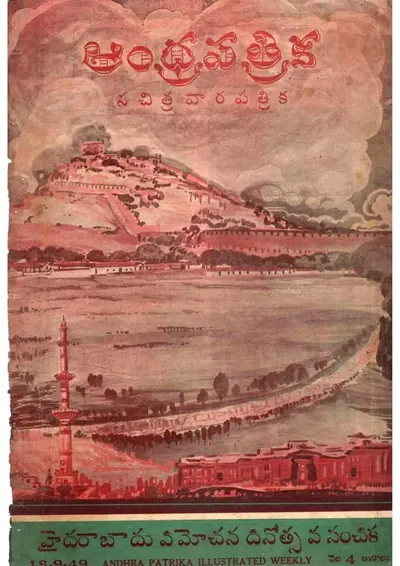
The Telugu newspaper of Kasinadhuni Nageswara Rao. It began as a weekly at Bombay in 1908, moved to Madras in 1914 and became a daily. It supported the Home Rule and non-cooperation movements, printed literary work such as Panuganti's Sakshi, and by the 1940s was the most widely read Telugu paper.
Andhra Sahitya Parishat
1911 CE
A Telugu literary society founded at Madras in April 1911, with the Maharajas of Pithapuram and Venkatagiri as founders and Jayanti Ramayya Pantulu as the head of its executive committee. It defended the old literary style of Telugu against the spoken-Telugu movement, collected and printed old works, published a journal, and began the large Suryaraya Telugu dictionary. Later it was based at Kakinada.
Bharati (Telugu monthly)
1924 CE
The Telugu literary monthly started by Kasinadhuni Nageswara Rao from the Andhra Patrika office at Madras in January 1924. Its first issue promised coloured pictures and illustrated articles on Andhra's sculpture, and offered to study old unprinted works sent in by readers. Writers of the 1920s called it a high-class literary magazine and the most popular Telugu monthly, and it was still coming out in the 1980s.
Themes
Women in Telugu history
Telugu women from the queens and donors of the inscriptions and the women poets of the courts to the reformers, writers and freedom fighters of the 20th century. The page covers what the census found about child marriage, widowhood and literacy, the women's journals and Mahila Sabhas, women in the salt satyagraha and the picketing of 1932, and women in the Andhra Mahasabha and the Telangana struggle.
Dalit history: Malas, Madigas and the Adi-Andhra movement
The history of the Mala and Madiga communities and other Dalits of the Telugu lands from the 1860s to the 1950s: their place in village work and land, the Christian mass movements, the special schools opened after 1893, the Adi-Andhra and Adi-Hindu movements and their fight for a respectful name, the laws that opened wells, streets and temples, and the first Dalit writers in Telugu.
References
Notes (0)
Sources (8)
Spotted an error on this page? Tell us
Last updated: