Telugu newspapers and journals, 1832–1956
How Telugu newspapers and journals began in Madras and Bellary in the 1830s, how reformers such as Kandukuri Veeresalingam used them from the 1870s, and how the Krishna Patrika, the Andhra Patrika and the monthly Bharati became voices of the national and Andhra movements. The page also covers journals for women, the slow and closely watched Telugu press of the Nizam's Hyderabad State, and the Telugu papers of the 1950s.
Download
Telugu newspapers began in Madras in the 1830s, more than a hundred years before Andhra Pradesh was formed.1 At first they were few and short-lived.1 By the 1920s Telugu dailies and monthlies reached readers across the Telugu districts.23 They carried the debates of the social reformers, the freedom movement and the demand for an Andhra province, so their story is part of the story of modern Telugu life.456
About the sources. Many early papers survive only as names in later books. This page uses the British Museum’s catalogue of Telugu books (1912), the Madras education reports, Sarojini Regani’s history of the freedom movement (1956), the Hyderabad State committee’s history (1957) and articles in the Kakatiya Journal of Historical Studies.78491 For printing and publishing, see Printing and Telugu books. For reading rooms and libraries, see The library movement. The schools that made these readers are the subject of Schools, colleges and universities, 1800–1956.
The first Telugu papers, 1832–1870
The first papers in South India were in English and were read by the British.1 G. Samba Siva Reddy, writing in 2010, quotes G. N. Reddy for the next step. In 1832 some people of Madras started the Karnatic Chronicle in English, Tamil and Telugu, but no copy of it survives.1 In 1834 the government’s Fort St. George Gazette printed a notice in Telugu.1
Christian missionaries soon used Telugu print to spread their faith.1 In 1835 the Bellary Tract Society started the Satyadoota (“messenger of truth”) in spoken Telugu.1 Regani says this missionary journal is believed to be the first Telugu journal of all.4 To answer the missionaries, the Veda Samaj of Madras started the Tathwa Bodhini in 1864.4
The Vrittantini came out at Madras from 1838.1 Its editor, Mandigala Venkataraya Sastry, came from Kadapa district.1 It closed some time after 15 February 1841, because it had too little money and support.1
The British Museum in London collected Telugu papers that reached it. Its catalogue of 1912 lists two from Madras:7
- the Dina-vartamani, “a daily newspaper” edited by Peter Percival, of which it holds issue no. 272, dated 18617
- the Hitavadi, an illustrated Telugu magazine printed at the American Mission Press in 18627
S. Mahaboob Basha (2009) names other early journals, such as the Vartamanatarangini (1842), the Sujanaranjani (1864) and the Andhra Bhashasanjivani (1871).10 Away from Madras, the first paper of Rayalaseema was the Sri Yakshini, a fortnightly started at Bellary in 1864.1 Samba Siva Reddy counts about forty papers started in Rayalaseema under British rule.1
Reformers and their journals, 1870–1900
Kandukuri Veeresalingam made the journal a tool of social reform.4 His biographer D. Anjaneyulu says he began the Vivekavardhini (incentive to wisdom) as a monthly, and soon made it a fortnightly.1112 He used it to expose bribery among officials and the parties with dancing girls held by the rich.13
The first issues were printed in Madras, at the press of the Andhra Bhasha Sanjivani.12 That journal was edited by Kokkonda Venkataratnam, who upheld the old customs that Veeresalingam attacked.1214 Regani writes that such rival journals were started to counter Veeresalingam’s teachings.14 Soon Veeresalingam and a few friends set up their own press at Rajahmundry.12
Basha calls the Purusharthapradayini (1872) a forward-looking journal that criticised caste and idol worship.10 In 1874, Regani notes, it attacked the bishops of Calcutta, Madras and Bombay for trying to convert Hindus.15 Before 1905, she adds, Telugu papers wrote mostly about social, economic and educational questions.15
The British Museum catalogue shows journals spreading beyond Madras:1617
- the Amudrita-grantha-chintamani (“jewel of unprinted books”), a monthly of old Telugu literature, at Nellore, 1885–190417
- the Sathya samvarthani, organ of the Prarthana Samaj, at Rajahmundry, 1891–190117
- the Manju-vani, a literary magazine edited by Raja M. Bhujanga Rao, at Eluru (then Ellore), 1898–190516
- the Saraswati, a monthly started at Rajahmundry in 1898 and later printed at Kakinada (then Cocanada)17
The Madras education report for 1892–93 noticed the change. It said that more books had been registered partly because “a few new magazines” had begun in the Telugu districts.8 The Godavari gazetteer of 1907 found five printing presses at Kakinada and five at Rajahmundry.18 One press at Kakinada printed Telugu books and two Telugu periodicals, one weekly and one monthly.18
Political papers, 1885–1920
The weekly Andhra Prakasika, started at Madras in 1885, was the first Telugu political newspaper.14 Its editor, A. P. Parthasarathy Naidu, ran it for more than twenty-five years.14 Samba Siva Reddy finds it reporting the troubles of farmers and village officers in Rayalaseema.19
After 1900 Telugu papers began to criticise the government more openly.15 In 1901 the Gautami objected to an advertisement that asked for a Muslim clerk in the chief police office.15 In 1902 the Sasilekha attacked the money spent on the coronation of Edward VII.15 The same year the Krishna Patrika asked why Indians in South Africa were not treated as equal subjects.15
The government answered with laws. Under the Press Act, the security money of an English weekly run by Gadicherla Harisarvottama Rao was forfeited (taken by the government).5 Chilakamarti Lakshmi Narasimham’s Telugu paper Desamata was asked to pay a security deposit.5 Regani adds that the Andhra Patrika and the Krishna Patrika spread the ideas of Home Rule.5
The papers also argued for a separate Andhra province.6 On 19 July 1913 the Krishna Patrika printed a cartoon about the Rayalaseema districts, which were slow to join the demand.6 It showed them as a mountain of snow in the sea, blocking the ship of the Andhra movement.6
The Andhra Patrika and the Bharati, 1908–1947
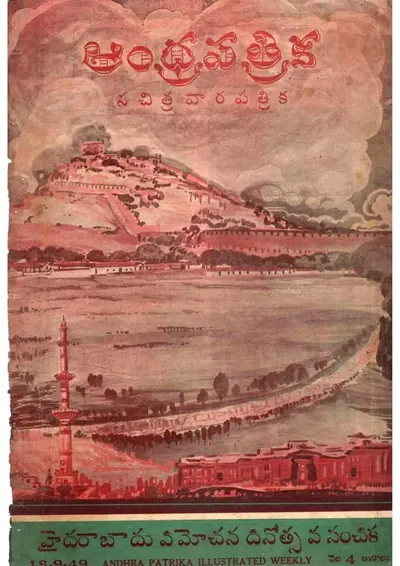
Kasinadhuni Nageswara Rao started the Andhra Patrika as a weekly at Bombay in 1908.20 The 1961 census handbook of Krishna district says Bombay had no Telugu presses, so he brought his staff from Madras and Vijayawada.21 In 1914 he moved the paper to Madras and made it a daily.22 K. Sitaramaiya wrote in 1943 that the daily quickly became a great success.23
The issue of 9 May 1924 describes itself, on its front page, as a paper published every day at Madras.24 In 1928 P. Chenchiah and Raja M. Bhujanga Rao called it the “premier Telugu daily” and a supporter of new movements in literature.3 P. T. Raju wrote in 1944 that it was the most widely read Telugu newspaper.2
In January 1924 Nageswara Rao also started the monthly Bharati.2225 Its first issue promised coloured pictures and illustrated articles on Andhra’s sculpture, and asked readers to send in old works that had never been printed.25 Chenchiah and Bhujanga Rao called it a “high-class literary magazine”.3
Raju names other papers of the early 1940s:2
- the Krishna Patrika, a popular weekly edited by Mutnuri Krishna Rao2
- the Andhra Prabha, a daily of Ramnath Goenka, publisher of the Indian Express2
- the Grihalakshmi of Dr K. N. Kesari, a monthly for women2
Chenchiah and Bhujanga Rao saw why these papers mattered. “The printing press,” they wrote, “has transferred the power of patronage from the king and the zamindar to a reading public.”3 Writers now looked to readers, not to kings, and the papers judged their work.3
Editors still took risks. Krovvidi Linga Raju was prosecuted for two articles he wrote in 1931 in the Telugu weekly The Congress, praising heroes such as Alluri Sitarama Raju and Bhagat Singh.26 He told the court he was proud to be charged.26
Journals for women
Veeresalingam’s Satihitabodhini, started at Rajahmundry in April 1883, was the first Telugu journal only for women.10 Its articles were almost all written by men.27 The second was the Telugu Zenana, begun at Guntur in July 1893.27
Women soon edited their own journals. The Hindu Sundari, started in April 1902, was the first Telugu journal for women to be edited by women.28 Basha counts twenty-one journals edited by women by 1947, among them the Savitri, the Anasuya, the Grihalakshmi and the Andhra Mahila.27
The press in Hyderabad State
In the Nizam’s state, Telugu papers came late. The Hyderabad State committee’s history notes that in 1901 the state had only fourteen papers and periodicals.9 Twelve were in Urdu and two in Marathi; not one was in Telugu.9
Papers there needed the government’s licence.29 In 1891 the Home Department told editors not to print anything that might “threaten an injury to a Government servant”.30 The Urdu paper Shaukat-ul-Islam refused to sign this pledge and was closed down.3029 A paper that spoke for the government argued that, with no Press Act, the power that gave a licence could take it back.29
The committee’s history says that in the years before 1920 Telugu journalism in Hyderabad began, with the Nilagiri Patrika of Nalgonda and the Telugu Patrika of Warangal.3132 Later they supported the Andhra Jana Sangham, a Telugu association, and the Golconda Patrika joined them.33 Suravaram Pratapa Reddy founded it at Hyderabad in 1925 and edited it until 1949.34 Its Telugu new-year number of 1928 thanks patrons such as the estates of Gadwal, Jatprolu and Wanaparthy.35
The government still kept watch. Its report for 1932–33 says new presses needed its sanction, and it gave licences for two Urdu weeklies and eight journals that year.36 None of them was in Telugu.36 In 1947–48, Regani writes, most Hyderabad papers took Pakistan’s side, but the Imroze, the Payam and the Telugu nationalist papers did not.37
After 1947
The Telugu press grew fast in the new state. Andhra Pradesh counted 620 newspapers and periodicals (not counting dailies) in 1957–58, and 1,650 in 1960–61.38 The East Godavari gazetteer of 1979 gives the circulation of dailies in that district.39 It reports 4,887 copies of the Andhra Patrika, 4,228 of the Andhra Prabha, 2,585 of the Visalandhra and 2,502 of the Andhra Jyothi.39
Where the sources disagree
The first Telugu paper. The sources name three different papers:
- Regani says the first Telugu journal is believed to be the Satyadoota of Bellary.4
- Samba Siva Reddy, following G. N. Reddy, gives the three-language Karnatic Chronicle of 1832.1
- Basha calls the Vrittantini (1838–1842) the first known Telugu journal.10
Early dates. Samba Siva Reddy says the Vrittantini closed soon after 15 February 1841, while Basha dates it to 1842.110 Basha dates the Dinavarthamani to 1862, but the British Museum holds its issue no. 272 of 1861.107 Basha dates the Sri Yakshini to 1863, Samba Siva Reddy to 1864.101
The Andhra Patrika. The Who’s Who of Freedom Struggle (1980) and the 1961 census handbook say it began at Bombay in 1908.2021 Regani’s history says it was founded in 1914, the year it moved to Madras.522
The Krishna Patrika. Regani says Konda Venkatappayya started it in 1902.15 The census handbook says it was started by the Krishna District Committee.40
The Vivekavardhini. Regani calls it a weekly started in 1874.4 Anjaneyulu says it began as a monthly and became a fortnightly.1112
The Telugu Patrika of Warangal. The Hyderabad State committee and Regani place it in the years before 1920.3132 The Warangal district gazetteer (1976) places it in the 1920s and 1930s.41
Footnotes
-
G. Samba Siva Reddy, “Role of Press in Promotion of Socio-Political Awareness in Rayalaseema (1858–1947)”, Kakatiya Journal of Historical Studies, Vol. V (2010), p. 112 (archive.org (opens in a new tab)). Cite-only; paraphrased. ↩ ↩2 ↩3 ↩4 ↩5 ↩6 ↩7 ↩8 ↩9 ↩10 ↩11 ↩12 ↩13 ↩14 ↩15 ↩16
-
P. T. Raju, Telugu Literature (1944), p. 87 (archive.org (opens in a new tab)). Cite-only; paraphrased. ↩ ↩2 ↩3 ↩4 ↩5 ↩6
-
P. Chenchiah and Raja M. Bhujanga Rao, A History of Telugu Literature (1928), p. 119 (archive.org (opens in a new tab)). ↩ ↩2 ↩3 ↩4 ↩5
-
Sarojini Regani, Highlights of the Freedom Movement in Andhra Pradesh (1956), p. 18 (archive.org (opens in a new tab)). Cite-only; paraphrased. ↩ ↩2 ↩3 ↩4 ↩5 ↩6 ↩7
-
Regani, Highlights (1956), p. 51 (archive.org (opens in a new tab)). Cite-only; paraphrased. ↩ ↩2 ↩3 ↩4 ↩5
-
P. Krishna Moorthy, Unification of Andhra Pradesh (Ph.D. thesis, Karnatak University, 1987), p. 64 (archive.org (opens in a new tab)). Cite-only; paraphrased. ↩ ↩2 ↩3 ↩4
-
Barnett, Catalogue of the Telugu Books (1912), col. 151, “Periodical Publications” (archive.org (opens in a new tab)). ↩ ↩2 ↩3 ↩4 ↩5
-
Report on Public Instruction in the Madras Presidency for 1892–93, p. 94, in the bound volume for 1891–95 (archive.org (opens in a new tab)). ↩ ↩2
-
The Freedom Struggle in Hyderabad, Vol. III (1957), p. 29 (archive.org (opens in a new tab)). ↩ ↩2 ↩3
-
S. Mahaboob Basha, “Sculpturing a ‘New Woman’ with Print Culture in Colonial Andhra: A Biography of Telugu Zenana, 1893–1907”, Kakatiya Journal of Historical Studies, Vol. IV (2009), p. 125 (archive.org (opens in a new tab)). Cite-only; paraphrased. ↩ ↩2 ↩3 ↩4 ↩5 ↩6 ↩7
-
D. Anjaneyulu, Kandukuri Veeresalingam (1976), p. 15 (archive.org (opens in a new tab)). Cite-only; paraphrased. ↩ ↩2
-
Anjaneyulu, Kandukuri Veeresalingam (1976), p. 16 (archive.org (opens in a new tab)). Cite-only; paraphrased. ↩ ↩2 ↩3 ↩4 ↩5
-
Anjaneyulu, Kandukuri Veeresalingam (1976), pp. 18–19 (archive.org (opens in a new tab)). Cite-only; paraphrased. ↩
-
Regani, Highlights (1956), p. 19 (archive.org (opens in a new tab)). Cite-only; paraphrased. ↩ ↩2 ↩3 ↩4
-
Regani, Highlights (1956), p. 20 (archive.org (opens in a new tab)). Cite-only; paraphrased. ↩ ↩2 ↩3 ↩4 ↩5 ↩6 ↩7
-
L. D. Barnett, A Catalogue of the Telugu Books in the Library of the British Museum (1912), col. 150, “Periodical Publications” (archive.org (opens in a new tab)). ↩ ↩2
-
Barnett, Catalogue of the Telugu Books (1912), col. 152, “Periodical Publications” (archive.org (opens in a new tab)). ↩ ↩2 ↩3 ↩4
-
F. R. Hemingway, Madras District Gazetteers: Godavari, Vol. I (1907), p. 110 (archive.org (opens in a new tab)). ↩ ↩2
-
Samba Siva Reddy, “Role of Press in Rayalaseema”, KJHS V (2010), p. 113 (archive.org (opens in a new tab)). Cite-only; paraphrased. ↩
-
Sarojini Regani (ed.), Who’s Who of Freedom Struggle in Andhra Pradesh, Vol. II (1980), p. 213 (archive.org (opens in a new tab)). Cite-only; paraphrased. ↩ ↩2
-
Census of India 1961, Andhra Pradesh: District Census Handbook, Krishna District (1966), p. xviii. Cite-only; paraphrased. ↩ ↩2
-
Regani (ed.), Who’s Who, Vol. II (1980), p. 214 (archive.org (opens in a new tab)). Cite-only; paraphrased. ↩ ↩2 ↩3
-
K. Sitaramaiya, A Hand Book of Telugu Literature (1943), p. 85 (archive.org (opens in a new tab)). Cite-only; paraphrased. ↩
-
Andhra Patrika, Vol. 11, No. 33 (Madras, 9 May 1924), p. 1, masthead (archive.org (opens in a new tab)). ↩
-
Bharati, Vol. 1, No. 1 (January 1924), notice of the magazine’s plan, PDF p. 5 (archive.org (opens in a new tab)). ↩ ↩2
-
Regani, Highlights (1956), p. 128 (archive.org (opens in a new tab)). Cite-only; paraphrased. ↩ ↩2
-
Basha, “Telugu Zenana”, KJHS IV (2009), p. 126 (archive.org (opens in a new tab)). Cite-only; paraphrased. ↩ ↩2 ↩3
-
S. Mahaboob Basha, “Flagging off the Marathon: Print Culture and Women’s Intellectual Movement in Colonial Andhra: Story of the Hindu Sundari, 1902–1947”, Kakatiya Journal of Historical Studies, Vol. V (2010), p. 77 (archive.org (opens in a new tab)). Cite-only; paraphrased. ↩
-
Freedom Struggle in Hyderabad, Vol. III (1957), p. 41 (archive.org (opens in a new tab)). ↩ ↩2 ↩3
-
Freedom Struggle in Hyderabad, Vol. III (1957), p. 40 (archive.org (opens in a new tab)). ↩ ↩2
-
Freedom Struggle in Hyderabad, Vol. III (1957), p. 236 (archive.org (opens in a new tab)). ↩ ↩2
-
Regani, Highlights (1956), p. 174 (archive.org (opens in a new tab)). Cite-only; paraphrased. ↩ ↩2
-
Regani, Highlights (1956), p. 179 (archive.org (opens in a new tab)). Cite-only; paraphrased. ↩
-
Regani (ed.), Who’s Who, Vol. II (1980), p. 385 (archive.org (opens in a new tab)). Cite-only; paraphrased. ↩
-
Golconda Patrika, Vibhava new-year number (Hyderabad, 1928), list of patrons, PDF p. 9 (archive.org (opens in a new tab)). ↩
-
Report on the Administration of H.E.H. the Nizam’s Dominions for 1342 Fasli (1932–33) (1935), p. 116 (archive.org (opens in a new tab)). ↩ ↩2
-
Regani, Highlights (1956), p. 213 (archive.org (opens in a new tab)). Cite-only; paraphrased. ↩
-
Statistical Abstract, Andhra Pradesh, 1961 (1963), p. 341, table 26.7 (archive.org (opens in a new tab)). ↩
-
N. Ramesan, Andhra Pradesh District Gazetteers: East Godavari (1979), p. 234 (archive.org (opens in a new tab)). Cite-only; paraphrased. ↩ ↩2
-
Census of India 1961: District Census Handbook, Krishna District (1966), p. xix. Cite-only; paraphrased. ↩
-
M. V. Rajagopal, Andhra Pradesh District Gazetteers: Warangal (1976), p. 205 (archive.org (opens in a new tab)). Cite-only; paraphrased. ↩
Related
People
Sattiraju Sitaramaiah
1864–1945 CE
Sattiraju Sitaramaiah (1864–1945) was a lawyer and journalist of the Godavari country who founded the Hindu Sundari at Eluru in April 1902, the first Telugu journal for women to be edited by women. He also ran a law fortnightly and a weekly, the Deshopakari, and put the educated women of the Andhra country in touch with one another.
K. N. Kesari
1875–1953 CE
Dr K. N. Kesari (1875–1953) rose from a poor family to wealth by his own effort in Madras, and spent much of it on public causes. On 1 March 1928 he founded the Gruhalakshmi, a Telugu monthly for women, which he edited until his death and which gave an award to women writers. His memoir, Naa Chinnanati Muchchatlu, came out in 1953.
Ayyanki Venkataramanayya
c. 1890–1979 CE
Ayyanki Venkataramanayya of Vijayawada, called Grandhalaya Pithamaha (grandfather of libraries), led the library movement of the Andhra country for about fifty years. He started the journal Andhra Bharati in 1910 and the Indian Library Journal in 1924, helped to found library associations from the district to the all-India level, received the Padma Shri in 1972 and died in 1979.
Institutions
Vivekavardhini
1874–1890 CE
The Telugu journal of the reformer Kandukuri Veeresalingam, begun in 1874 and printed at Rajahmundry. It attacked bribery among officials, the dancing-girl parties of the rich and harmful customs, and argued for simple, clear Telugu. Basha writes that with it Telugu journalism came of age. Veeresalingam stopped it in 1890.
Andhra Prakasika
1885 CE
A Telugu weekly of Madras, started in 1885 and called the first Telugu political newspaper. Its editor, A. P. Parthasarathy Naidu, ran it for more than twenty-five years. It reported the troubles of farmers and village officers, criticised officials who took bribes, and spoke against the insults that Indians suffered from Europeans.
Hindu Sundari
1902 CE
A Telugu journal for women, started at Eluru in April 1902 by Sattiraju Sitaramaiah. It was the first Telugu women's journal to be edited by women, among them Mosalikanti Ramabayamma, and from 1913 it was run by the Kakinada Vidyarthini Samajamu. It argued for girls' education and widow remarriage, and printed the speeches of the women's conferences.
Krishna Patrika
1902 CE
A Telugu nationalist paper of Machilipatnam, started in 1902. Mutnuri Krishna Rao edited it for most of its life and made it a voice of the Vandemataram, Home Rule and Andhra movements. In 1913 it printed a well-known cartoon about the Rayalaseema districts and the demand for an Andhra province.
Andhra Patrika
1908 CE
The Telugu newspaper of Kasinadhuni Nageswara Rao. It began as a weekly at Bombay in 1908, moved to Madras in 1914 and became a daily. It supported the Home Rule and non-cooperation movements, printed literary work such as Panuganti's Sakshi, and by the 1940s was the most widely read Telugu paper.
Bharati (Telugu monthly)
1924 CE
The Telugu literary monthly started by Kasinadhuni Nageswara Rao from the Andhra Patrika office at Madras in January 1924. Its first issue promised coloured pictures and illustrated articles on Andhra's sculpture, and offered to study old unprinted works sent in by readers. Writers of the 1920s called it a high-class literary magazine and the most popular Telugu monthly, and it was still coming out in the 1980s.
Golconda Patrika
1925 CE
A Telugu paper of Hyderabad, founded in 1925 by Suravaram Pratapa Reddy and edited by him until 1949. It came out twice a week and criticised the Nizam's government at a time when that was hard and risky. It supported the Andhra Jana Sangham and the Andhra Mahasabha, and spoke for Telugu as a language of schooling.
Themes
References
Notes (0)
Sources (22)
Spotted an error on this page? Tell us
Last updated: