Lesson 3
Letters, vowel signs and conjuncts
Before you can read an inscription you need to know how the script builds a syllable. The good news is that the Telugu-Kannada script, ancient or modern, works on one simple principle. Arden calls the result a “compound letter”: a consonant and a vowel sign written together.1 Once you have it, an inscription stops being a row of strange shapes and becomes a string of syllables you can sound out. This lesson uses A. H. Arden’s Progressive Grammar of the Telugu Language (1873) for the modern letters. Burnell’s and Bühler’s handbooks show what was different in the old ones.
One sign, one syllable
Telugu, Arden explains, is written from left to right.2 The basic unit is the syllable, not the single letter. Each vowel has two forms:
- an initial form, used when the vowel begins a word, such as అ (a) or ఇ (i);
- a secondary form (a vowel sign), used everywhere else, which is “never written by itself” but always joined to a consonant.3
A consonant, in turn, “is never written by itself (except in a few instances)”, but always together with one of these vowel signs, “so that the two together make but one compound letter”.4 Arden counts thirteen vowels in common use and thirty-five consonants.5 He adds a small circle called sunna, “which stands for N or M”.4
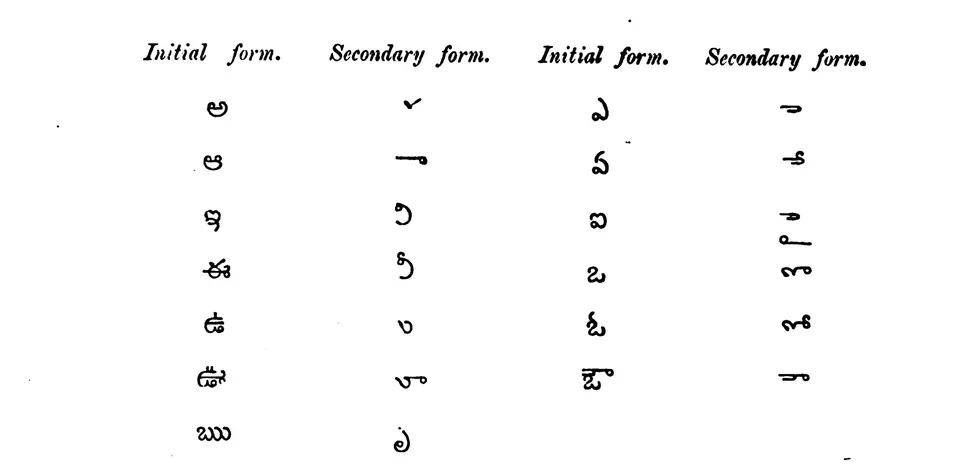
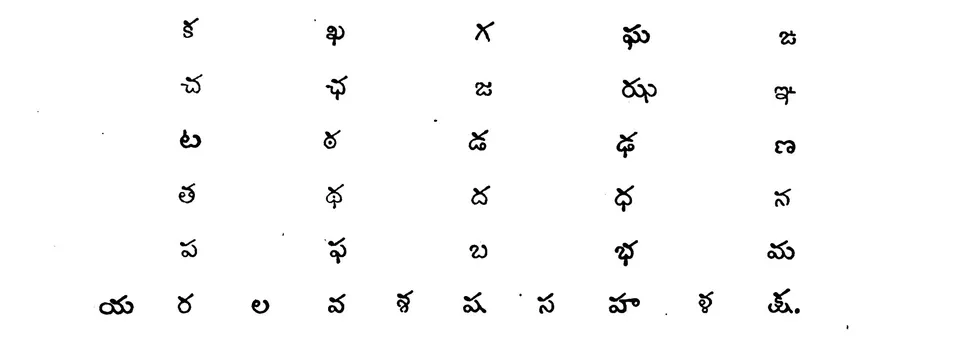
Arden’s table of initial and secondary vowel forms, and of the consonants.4
The little tick on top
Most modern Telugu consonants carry a small tick on top. Arden treats it as the vowel sign for a: to sound the consonants in the alphabet, he says, “the secondary form of అ” is used, although for eight letters it is “only sounded, but not written”.4 Burnell disagreed. As the lesson on the script explains, he saw the mark as the descendant of an old cross-stroke at the top of the letter, and he criticised the Telugu grammars, Arden’s 1873 grammar among them, for calling it a form of a.6 Bühler, too, took these angles over the letters to be a stylus-writer’s replacement for the “wedges” of earlier inscriptions.7 For reading, the practical point is the same: in inscriptions from the 11th century on, a consonant with this mark and no other vowel sign is read with a.7
When a consonant must stand with no vowel at all, as at the end of some Sanskrit or foreign words, Arden says that a special sign is put in place of the vowel sign “to denote that a secondary vowel form is wanting”.8
Where the vowel signs go
Arden gives the modern rules. Most vowel signs are written above the consonant; a few are written to its right on the same line, one partly beneath, and one partly above and partly below.9 His table of compound letters shows every consonant with every vowel sign.10
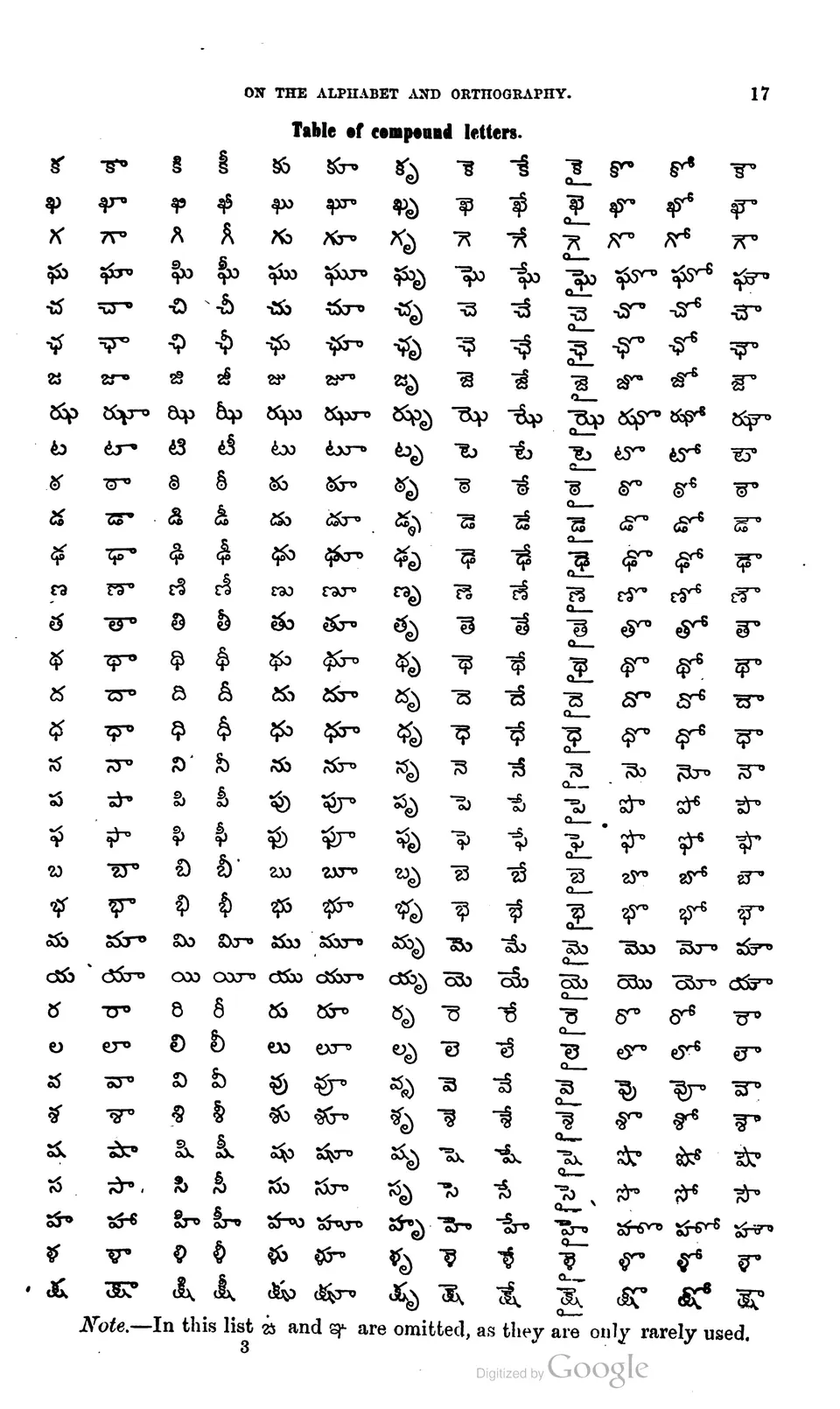
In inscriptions some signs sit elsewhere, and their position helps to date the record:
- The u-sign. The modern u is a hook to the right of the consonant. Burnell found that it begins to appear in the 11th century and prevails “nearly universally” in the 12th. Older inscriptions write u underneath the consonant.11
- e and ai. By the 11th and 12th centuries these were written at the top of the consonant, while in the earliest forms they stood on its left side.11 The modern sign for e came in during the 14th century and was the only form used by 1550–1600.12
- Short and long vowels. From the 10th century the old way of telling short i from long ī was “almost lost”.13 The present Telugu way of distinguishing short and long e and o does not appear until the 17th century.14 So an old inscription may not show vowel length at all, and editors supply it from the sense.
- Aspirates. In the Old Telugu of about 1300 there was often no distinction between d and dh, p and ph and some other pairs; marking aspirates became usual again in the 17th century.14 (Modern Telugu marks most aspirates with a small stroke beneath the letter.15)
Stacked consonants (conjuncts)
When two consonants come together with no vowel between them, the second is written underneath the first. Arden calls it a subscribed consonant. It never takes a vowel sign of its own, and eight consonants change their shape when written beneath another.16 The consonant on the line is pronounced first.17 Stacking consonants is very old: Burnell found groups such as dv, pt, mh and st already written one above the other in Asoka’s edict at Girnar.18
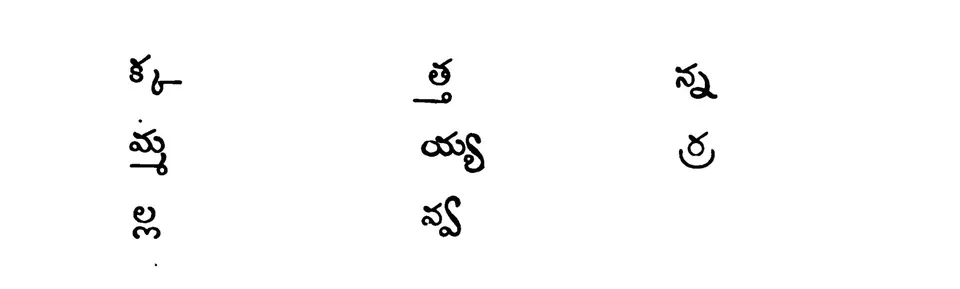
One stack behaves differently in old inscriptions. When r comes before another consonant (as in karma), modern Telugu writes it after that consonant. Burnell found that in inscriptions r was written above the following consonant until about 1300. After 1350 it is always written on the right-hand side.12
Sunna and visarga
The sunna (anusvāra), a small circle, stands for a nasal sound. Burnell found that after the 12th or 13th century it is always written on the line in South Indian scripts. He also found that the later the inscription, “the more incorrect and indiscriminate is its use”.19 The visarga, two small circles, marks an h sound at the end of Sanskrit words. In inscriptions, he warned, its use “is generally incorrect”, and before a sibilant it is usually replaced by that sibilant, “a common source of error in reading S. Indian inscriptions”.20
Worked example: the first line at Hanamkonda
Here is the first line of the Thousand Pillar Temple inscription of 1163, from J. F. Fleet’s plate. Fleet called its letters “well executed and well preserved Old-Canarese characters”.21

Fleet transcribes the line as follows:22
Ôṃ Svasti Śrīr=vvijayaś=ch=âbhyudayaś=cha bhavatu || Svasti Samadhigatapaṃchama-
and translates its opening “Om! Hail! Let there be good fortune and victory and prosperity! Hail!”23 Now match the shapes to the syllables, from the left:
- The opening symbol. The line begins with an ornamental sign, which Fleet transcribes as Ôṃ.22
- Sva-sti. Two syllables, each a stack: sa with va beneath it, then sa with ta beneath it and the i-sign on top.
- Śrīr vvi. Śrī is śa with ra beneath it and the long-ī sign. Fleet’s double vv tells you that the scribe wrote the consonant after r twice, a habit explained in the lesson on Sanskrit charters.
- ja ya ś cha. Simple syllables. Ja and ya have no vowel sign of their own, so they are read with a.
- â bhyu da ya ś cha. Abhyudaya, “prosperity”. The bhyu is a stack: bha with ya beneath it, and the u-sign.
- bha va tu. “Let there be”. Three syllables; only the last carries a vowel sign, the u of tu.
- || marks the end of the sentence, and a second Svasti begins the next one.
Try it yourself
Use Fleet’s transcription above and the image of line 1.
- How many syllables (aksharas) does the word abhyudayaś have, and which of them is a stack of two consonants?
- In bhavatu, which syllables are read with the vowel a, and how can you tell?
- Line 6 of the same inscription contains the word varshamulu, “years”.24 It has the Telugu plural ending -mulu. Where would you expect the u-signs of mu and lu to be written in an inscription of 1163: under the consonant, or to its right?
Answer
- Five: a-bhyu-da-ya-ś(cha). In the inscription the final ś is joined to the following cha as a stack, as Fleet’s ś=ch shows. The stack inside the word is bhyu, made of bha and ya with the u-sign.22
- Bha and va. They have no vowel sign of their own, so they are read with a. Only tu has a vowel sign, the u.22
- To the right, most likely. Burnell found that the modern u-sign, written to the right of the consonant, began in the 11th century and prevailed “nearly universally” in the 12th, although the older form under the consonant “is by no means entirely disused”.11 So check the plate: both forms are possible in 1163.
Footnotes
-
Arden, Progressive Grammar (1873), p. 7, para. 26 (archive.org (opens in a new tab)). ↩
-
A. H. Arden, A Progressive Grammar of the Telugu Language (1873), p. 11, para. 31 (archive.org (opens in a new tab)). ↩
-
Arden, Progressive Grammar (1873), p. 6, paras. 23–24 (archive.org (opens in a new tab)), and p. 13, para. 42 (archive.org (opens in a new tab)). ↩
-
Arden, Progressive Grammar (1873), p. 14, paras. 43–44 (archive.org (opens in a new tab)). ↩ ↩2 ↩3 ↩4
-
Arden, Progressive Grammar (1873), p. 11, para. 34 (archive.org (opens in a new tab)), and p. 14, para. 44 (archive.org (opens in a new tab)). ↩
-
A. C. Burnell, Elements of South-Indian Palaeography, 2nd ed. (1878), p. 17 and nn. 1–2 (archive.org (opens in a new tab)). ↩
-
G. Bühler, Indian Palaeography, tr. J. F. Fleet (Appendix to the Indian Antiquary XXXIII, 1904), p. 68, § 29 C (archive.org (opens in a new tab)). ↩ ↩2
-
Arden, Progressive Grammar (1873), p. 6, para. 25 (archive.org (opens in a new tab)), and p. 16, para. 58 (archive.org (opens in a new tab)). ↩
-
Arden, Progressive Grammar (1873), p. 18, para. 61 (archive.org (opens in a new tab)). ↩
-
Arden, Progressive Grammar (1873), p. 17, “Table of compound letters” (archive.org (opens in a new tab)). ↩
-
Burnell, Elements of South-Indian Palaeography (1878), p. 27 (archive.org (opens in a new tab)). ↩ ↩2 ↩3
-
Burnell, Elements of South-Indian Palaeography (1878), p. 31 (archive.org (opens in a new tab)). ↩ ↩2
-
Burnell, Elements of South-Indian Palaeography (1878), p. 26 (archive.org (opens in a new tab)). ↩
-
Burnell, Elements of South-Indian Palaeography (1878), p. 29 (archive.org (opens in a new tab)) and p. 30 (archive.org (opens in a new tab)). ↩ ↩2
-
Arden, Progressive Grammar (1873), p. 15, para. 51 (archive.org (opens in a new tab)). ↩
-
Arden, Progressive Grammar (1873), p. 21, paras. 67–68 (archive.org (opens in a new tab)), and p. 22, paras. 70–71 (archive.org (opens in a new tab)). ↩
-
Arden, Progressive Grammar (1873), p. 22, para. 69 (archive.org (opens in a new tab)). ↩
-
Burnell, Elements of South-Indian Palaeography (1878), p. 13 (archive.org (opens in a new tab)). ↩
-
Burnell, Elements of South-Indian Palaeography (1878), p. 30 (archive.org (opens in a new tab)). ↩
-
Burnell, Elements of South-Indian Palaeography (1878), p. 31 (archive.org (opens in a new tab)). ↩
-
J. F. Fleet, “Sanskrit and Old-Canarese Inscriptions, No. CXVIII”, Indian Antiquary XI (1882), p. 9 (archive.org (opens in a new tab)), and Plate I, lines 1–20 (archive.org (opens in a new tab)). ↩
-
Fleet, “Sanskrit and Old-Canarese Inscriptions, No. CXVIII” (1882), p. 12, text line 1 (archive.org (opens in a new tab)). ↩ ↩2 ↩3 ↩4
-
Fleet, “Sanskrit and Old-Canarese Inscriptions, No. CXVIII” (1882), p. 16, translation (archive.org (opens in a new tab)). ↩
-
Fleet, “Sanskrit and Old-Canarese Inscriptions, No. CXVIII” (1882), p. 12, text line 6 (archive.org (opens in a new tab)); F. Kielhorn, “Chikkulla Plates of Vikramendravarman II”, Epigraphia Indica IV (1897), p. 197, n. 2 (archive.org (opens in a new tab)). ↩
References
Notes (0)
Sources (5)
Spotted an error on this page? Tell us
Last updated: