Lesson 4
Numbers in inscriptions
Inscriptions are full of numbers: years of a reign or an era, days of the month, the number of plates, the measure of land granted. They can be written in three quite different ways, and a reader needs to recognise all three. A. C. Burnell, summing up South Indian practice in 1878, wrote that numeral figures “are only used in comparatively modern inscriptions”. In the older ones, and in many modern ones, numbers are written “by words or letters”.1
1. Old number-symbols, with no zero
The oldest system has a separate sign for each unit, for each ten, for a hundred and for a thousand, and no zero. Bühler, describing this system in the Brahmi inscriptions, explains that 1 to 3 are written with horizontal strokes, while 4 to 9, the tens from 10 to 90, 100 and 1000 each have a separate sign. Larger numbers are made by putting the smaller signs to the right of the bigger one.2 So 25 is written as “20” followed by “5”, not as “2” followed by “5”. Burnell describes the same system in early inscriptions from Mathura, where “twenty-five” is the sign for twenty followed by that for five, and “there is not the least trace of the use of the cipher”.3
You have already met these strokes in the Brahmi lesson: the Kodavali inscription of the Satavahana king Chandasati writes the year of the reign as horizontal strokes, which its editor read as 2.4
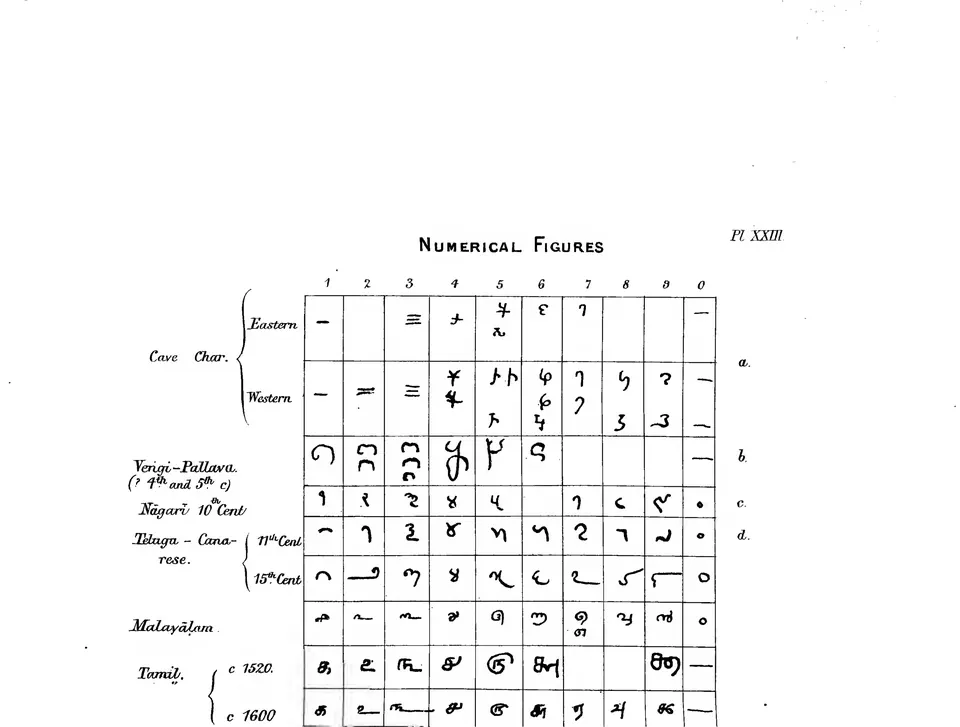
In the Telugu country this system lasted into the early centuries of the southern alphabets. Burnell noted that two grants of the Vengi kings before the Eastern Chalukyas have their plates numbered with such signs, up to three in one and up to four in the other, and that Pallava inscriptions give the signs for five and six. By then the horizontal strokes had become semicircles.5 Burnell’s Plate XXIII sets these “Vengi-Pallava” numerals beside the cave numerals of western India and the later Telugu-Kannada figures.6 Ojha’s Plate 71 charts the old-style numerals 1 to 9 in many scripts.7
Worked example 1: the date of the Chikkulla plates
The Chikkulla plates of the Vishnukundin king Vikramendravarman II give their date in line 26. F. Kielhorn noticed that this line contains “the numerical symbols for 5, 8 and 10”.8 He reads it:9
Vi[ja]yarājya-saṃvassarambul 10 māsa-pakkam 8 gihma 5

Line 26 of the Chikkulla plates.10
Read it in three steps:
- Vijayarājya-saṃvassarambul 10: “the years of the victorious reign: 10”. The sign after saṃvassarambul is the old symbol for ten, a single sign, not a “1” followed by a “0”. Kielhorn drew special attention to it as a developed form of the older symbol for 10.8
- pakkam 8: “fortnight 8”. The next symbol is 8.
- gihma 5: “summer, (day) 5”. The last symbol is 5.
Kielhorn explained that the scribe’s māsa (“month”) is “quite meaningless” here. What he meant was the 10th year, the 8th fortnight of summer, the 5th day.11 He also used the numerals themselves as evidence of date. Grants with numerical symbols that could be dated with certainty were all earlier than 800 CE, so he concluded that this record was “not later than about the end of the 8th century”.12
2. Decimal figures, with a zero
The second system is the one we use today: nine figures and a zero, with the value of each figure depending on its place. In South India, Burnell found, dates in figures are wanting from the 5th century “till about the year 1000 A.D.”, and from then on the figures have place value and a zero.13 The Telugu-Kannada figures, he wrote, “appear in common use about 1300 A. D.”. The zero “is always represented in S. Indian documents by a small circle”, because on palm leaves a dot was not distinct enough.14
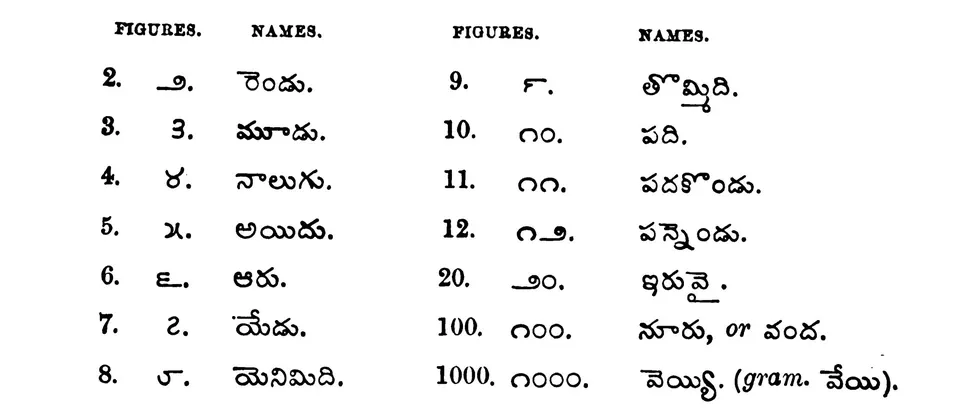
Burnell’s earliest specimens were on the outer rims of the plates of a grant of 1087, which do not go beyond nine. He added that the Telugu-Kannada numerals are “almost identical in all the inscriptions across the peninsula”, that the 5 of Telugu inscriptions sometimes lacks its middle stroke, and that the 3 is generally upright in them.14 His Plate XXIII gives the Telugu-Kannada figures of the 11th and 15th centuries.6 Ojha’s Plate 76 charts the new-style figures with zero, and his Plate 80 includes the modern Telugu numerals.15 Arden lists the modern Telugu figures beside their names, from 1 (౧) to 1000.16
Worked example 2: Saka 1084 at Hanamkonda
Line 6 of the Thousand Pillar Temple inscription at Hanamkonda gives its year in figures. J. F. Fleet reads it:17
… Śaka-varshamulu 1084 vunemṭi Chitra-
“the Saka years being 1084”. The rest of the date, the cyclic year Chitrabhanu and the month and day, follows in line 7.17

The right-hand part of line 6, from Fleet’s Plate I.18
After the word varshamulu come four figures. Read them with Burnell’s Plate XXIII beside you:
- A rounded arch: 1.
- A small circle: 0, the zero of the South Indian scripts.14
- A hooked figure: 8.
- A looped figure: 4.
So the year is 1084, as Fleet reads it, and it is written with place value: the small circle is the zero of the South Indian scripts.1714 To turn Saka 1084 into a date in the Common Era, see Dates and eras.
Burnell was cautious about dates in figures before 1300. He suspected that some copyists of 11th-century inscriptions had written figures where the original had the number spelled out in words.19 The Hanamkonda plate, printed from an ink impression, shows that figures were indeed being cut on stone in 1163.18
3. Numbers written as words
The third way is the commonest in old dated inscriptions. Burnell found that the earliest South Indian inscriptions dated in an era write the date in words. After the 7th century most dates are expressed by “significant words”, and after the 10th century this is always done. From 600 to 1300, he reckoned, “nine out of ten inscriptions that bear dates” use this style.20
In this system an ordinary word stands for a number. The words for zero, for example, all mean “blank”, “vacancy” or “sky”.21 Burnell gives a long list, built on the list of the scholar Al-Biruni (1031) and on C. P. Brown’s Cyclic Tables. Here is a selection:2022
| Number | Some words used for it |
|---|---|
| 0 | śūnya, kha, gagana, ākāśa, ambara |
| 1 | indu, śaśin, candra, bhū, dharā |
| 2 | netra, locana, bāhu, pakṣa |
| 3 | agni, dahana, pāvaka, guṇa, loka |
| 4 | veda, samudra, sāgara, yuga |
| 5 | bāṇa, śara, iṣu, indriya |
| 6 | rasa, ṛtu, aṅga, darśana, śāstra |
| 7 | aga, adri, naga, parvata, muni, ṛṣi |
| 8 | vasu, gaja, nāga |
| 9 | graha, aṅka, nanda, randhra |
The rule for putting them together is the reverse of ours: the units come first, then the tens, then the hundreds.22 Burnell’s example is ṛṣi-nāga-kha-indu: 7, 8, 0, 1, which read backwards gives the year 1087.22 He warns that the list can never be complete, because any synonym of such a word can be used.22 Ordinary number-words are often mixed in, and in some recent inscriptions the words follow the same order as the figures.22
Letters as numbers. Burnell describes other systems in which letters of the alphabet stand for numbers. One, used for chronograms, was found “almost exclusively in Malabar, Travancore and the S. Tamil country”. Another, using the consonants in order (ka = 1, kha = 2 and so on), numbered the leaves of manuscripts in Malabar “and also occasionally in the Telugu country”.23 For chronograms in Persian inscriptions, see Hijri, Fasli and chronograms.
Numbers on copper plates
Copper-plate grants often number their plates. The Chejerla grant of the Vijayanagara king Devaraya II (1428–29) in Nellore district is written in Nandinagari, but “the plates are numbered at the top in Telugu figures”.24 Burnell made the same observation about all the Nandinagari copper plates and palm-leaf manuscripts he had seen.25
Try it yourself
Burnell gives two more years written in number-words:22
- guṇa-śāstra-kha-indu
- dahana-adri-kha-indu
Using the table above, work out the year that each one stands for. Remember to read the numbers in reverse order.
Answer
- guṇa = 3, śāstra = 6, kha = 0, indu = 1. Read backwards: 1063.
- dahana = 3, adri = 7, kha = 0, indu = 1. Read backwards: 1073.
Burnell gives both results: guṇaśāstrakhendu = 1063 and dahanādrikhendu = 1073.22
Footnotes
-
A. C. Burnell, Elements of South-Indian Palaeography, 2nd ed. (1878), p. 70, note (archive.org (opens in a new tab)). ↩
-
G. Bühler, Indian Palaeography, tr. J. F. Fleet (Appendix to the Indian Antiquary XXXIII, 1904), pp. 77–78, § 34 A (archive.org (opens in a new tab)). ↩
-
Burnell, Elements of South-Indian Palaeography (1878), p. 60 (archive.org (opens in a new tab)). ↩
-
H. Krishna Sastri, “The Kodavali Rock-Inscription of Chandasati”, Epigraphia Indica XVIII (1926), p. 318, text line 3 and n. 2 (archive.org (opens in a new tab)). ↩
-
Burnell, Elements of South-Indian Palaeography (1878), p. 67 (archive.org (opens in a new tab)). ↩
-
Burnell, Elements of South-Indian Palaeography (1878), Pl. XXIII, “Numerical Figures” (archive.org (opens in a new tab)). ↩ ↩2
-
Gaurishankar Hirachand Ojha, Bharatiya Prachin Lipimala, 2nd ed. (1918), Plate 71, “old-style numerals of Brahmi and the scripts derived from it (1 to 9)” (archive.org (opens in a new tab)). ↩
-
F. Kielhorn, “Chikkulla Plates of Vikramendravarman II”, Epigraphia Indica IV (1897), p. 194 and n. 1 (archive.org (opens in a new tab)). ↩ ↩2
-
Kielhorn, “Chikkulla Plates” (1897), p. 197, text line 26 (archive.org (opens in a new tab)). ↩
-
Kielhorn, “Chikkulla Plates” (1897), plate (fourth plate, second side) (archive.org (opens in a new tab)). ↩
-
Kielhorn, “Chikkulla Plates” (1897), p. 197, n. 2 (archive.org (opens in a new tab)). ↩
-
Kielhorn, “Chikkulla Plates” (1897), p. 195 and n. 4 (archive.org (opens in a new tab)). ↩
-
Burnell, Elements of South-Indian Palaeography (1878), p. 61 (archive.org (opens in a new tab)). ↩
-
Burnell, Elements of South-Indian Palaeography (1878), p. 69 (archive.org (opens in a new tab)). ↩ ↩2 ↩3 ↩4
-
Ojha, Bharatiya Prachin Lipimala (1918), Plate 76, “numerals of the scripts derived from Brahmi and of Kharoshthi”, with the new-style numerals 1 to 9 and 0 (archive.org (opens in a new tab)), and Plate 80, “present-day Telugu, Kannada and Grantha scripts” (archive.org (opens in a new tab)). ↩
-
A. H. Arden, A Progressive Grammar of the Telugu Language (1873), p. 67, para. 172, and p. 68, para. 173 (archive.org (opens in a new tab)). ↩
-
J. F. Fleet, “Sanskrit and Old-Canarese Inscriptions, No. CXVIII”, Indian Antiquary XI (1882), p. 12, text lines 6–7 (archive.org (opens in a new tab)). ↩ ↩2 ↩3
-
Fleet, “Sanskrit and Old-Canarese Inscriptions, No. CXVIII” (1882), Plate I, lines 1–20, “From an ink impression” (archive.org (opens in a new tab)). ↩ ↩2
-
Burnell, Elements of South-Indian Palaeography (1878), p. 69, n. 1 (archive.org (opens in a new tab)). ↩
-
Burnell, Elements of South-Indian Palaeography (1878), p. 77 (archive.org (opens in a new tab)). ↩ ↩2
-
Burnell, Elements of South-Indian Palaeography (1878), p. 62, n. 3 (archive.org (opens in a new tab)). ↩
-
Burnell, Elements of South-Indian Palaeography (1878), p. 78 (archive.org (opens in a new tab)). ↩ ↩2 ↩3 ↩4 ↩5 ↩6 ↩7
-
Burnell, Elements of South-Indian Palaeography (1878), p. 79 (archive.org (opens in a new tab)) and p. 80 (archive.org (opens in a new tab)). ↩
-
Alan Butterworth and V. Venugopaul Chetty, A Collection of the Inscriptions on Copper-Plates and Stones in the Nellore District, Part I (1905), Copper-plate No. 18, p. 149 (archive.org (opens in a new tab)). ↩
-
Burnell, Elements of South-Indian Palaeography (1878), p. 56 (archive.org (opens in a new tab)). ↩
References
Notes (0)
Sources (8)
Spotted an error on this page? Tell us
Last updated: