Lesson 2
What inscriptions were written on
Before you can read an inscription you have to know what you are looking at. Is it a rock face, a pillar, a sheet of copper or a palm leaf? Each material shaped how the text was laid out, how long it survived and how it reaches us today. Burnell noted, for example, that South Indian copper plates were long strips because they copied the shape of palm-leaf books.1 This lesson goes through the materials found in the Telugu country, with examples from records on this site, and ends with how scholars copy inscriptions for study.
Stone
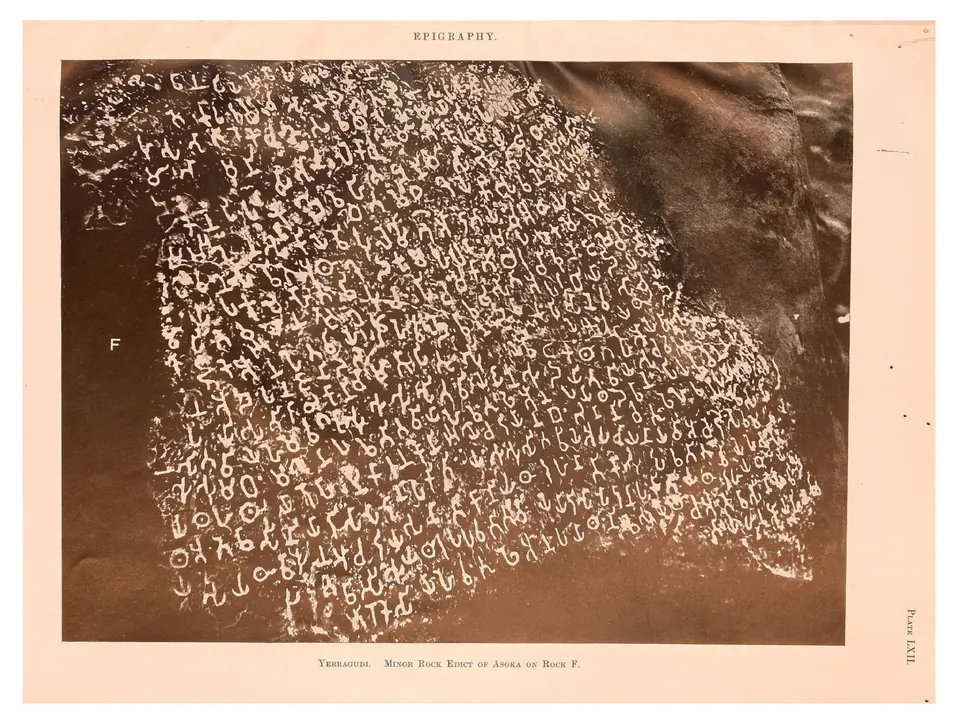
Stone was the material of the earliest proclamations in India and remained in use ever since.2 A. C. Burnell described three kinds of stone surface: the natural face of a rock or boulder, a slab prepared for the purpose “much like an old-fashioned English tomb-stone”, and, in early times, pillars. In South India, he added, grants were recorded chiefly on temple walls, pavements and the pillars of halls.3
- Pillars. The Motupalli edict runs around the four sides of a pillar in a temple hall.5 The Palampet inscription is on the four faces of a pillar of polished black basalt, topped by a small spire; above the text on each face is a carved panel showing a linga, a cow and calf, the sun and moon, and Ganesha.6
- Temple walls and slabs. Gifts by ordinary donors fill the walls of South Indian temples.7
The letters on stone were always cut into the surface.3 Burnell warned that the stone of South India is easily fractured and, being coarse and uneven in grain, “soon perishes if exposed to the weather”, so the older inscriptions “have suffered much, and are often legible with difficulty.”3 G. Bühler listed rough blocks and smoothed slabs of basalt or trap, carved columns of sandstone and even prisms of crystal among the stones used.8 G. H. Ojha mentions small inscriptions on precious stones such as agate and crystal, and Buddhist texts cut into bricks.9
Copper plates
For land grants the favourite material was copper. Burnell wrote that “the vast majority of S. Indian inscriptions are written on such plates”, and Bühler that copper plates served the recipients of land as title-deeds.10 Ojha says that such charters were called dānapatra, tāmrapatra, tāmraśāsana or śāsanapatra.11
Shape and size
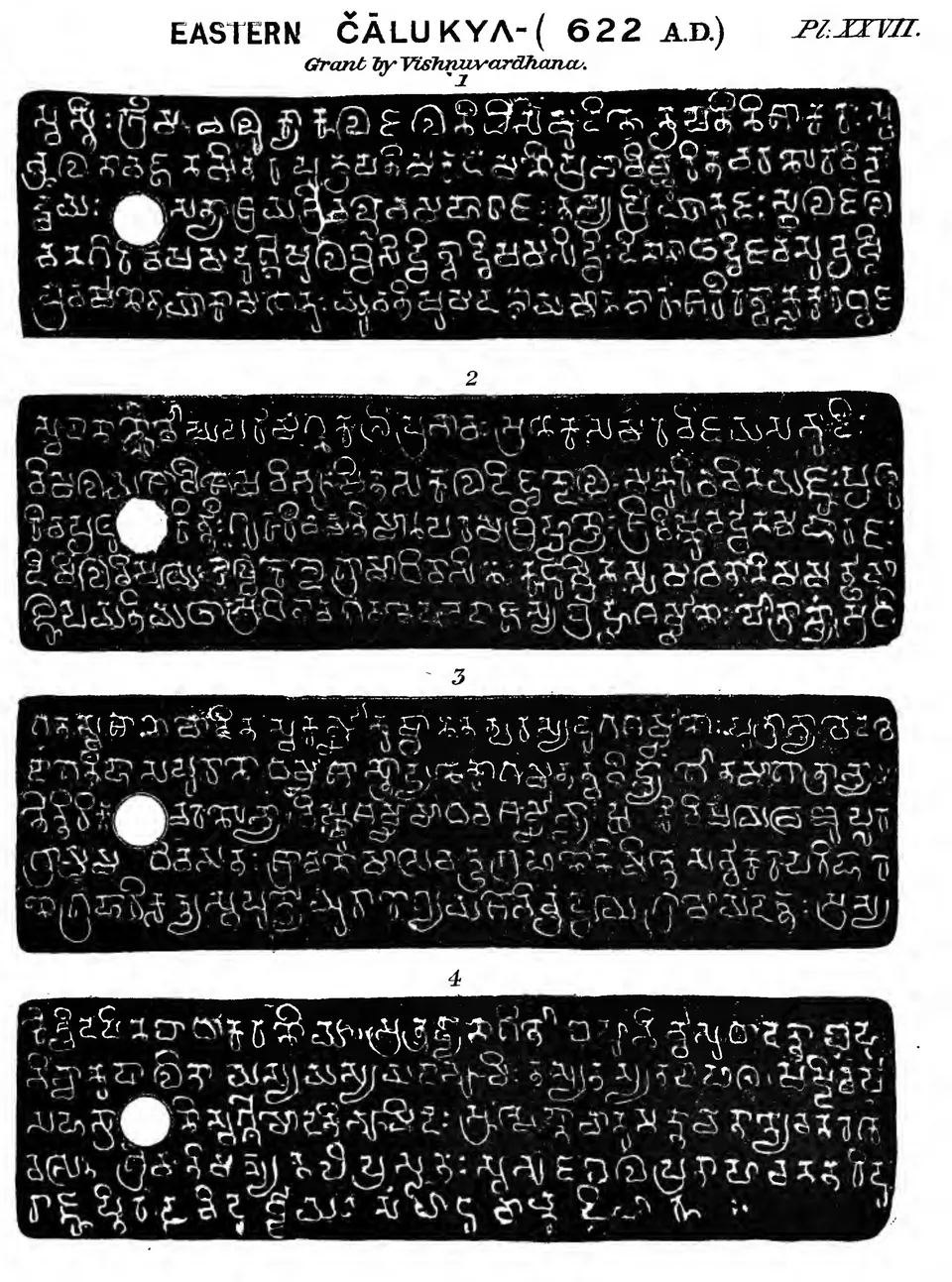
Burnell and Bühler both noticed that plates were cut to the shape of the writing material used locally for books. In the north, where birch-bark was used, plates are broad, almost square; in the south, where palm leaves were used, the early plates are long, narrow strips with the lines running along their length.1 Burnell found that from the 6th to the 14th century the usual shape in South India was a rectangle about twice as long as it was broad, and that the Vijayanagara kings brought in plates written across the narrow side, with rounded and often ornamented tops.12
Two charters on this site show the range:
- The Chikkulla plates of the Vishnukundin king Vikramendravarman II are five plates, each about 7⅜ inches by 2¼ inches.13
- The Nandamapundi plates of the Eastern Chalukya king Rajaraja I (1053) are five plates, each about 10¼ inches by 5 inches.14
Charters grew longer over time. Burnell found that early grants fitted on three or four small plates, while by the 11th century eight or nine large plates were needed.12 Ojha notes that a single South Indian grant could run to many plates: a Vijayanagara grant of Saka 1508 (1586) is on nine plates, and a grant of the 23rd year of the Chola king Rajendra, kept at Leiden, on twenty-one.15
The ring and the seal
A set of plates was held together by a copper ring passed through a hole in each plate, so that the set opened like a small book.16 On South Indian grants the ring and its seal were joined so that no plate could be added or taken out: Burnell thought the ends of the ring were riveted and the seal cast over the joint.17 Bühler noted that the seals seem to have been cast, with their emblems and legends raised on a sunken surface.18
- On the Chikkulla plates the ends of the ring are soldered into the bottom of a round seal bearing a lion in relief.13
- On the Nandamapundi plates the seal carries, across the middle, the legend śrī-Tribhuvanāṅkuśa in raised Telugu letters, with a boar, the sun and the crescent moon between two fly-whisks, a conch, a drum and an elephant-goad.19
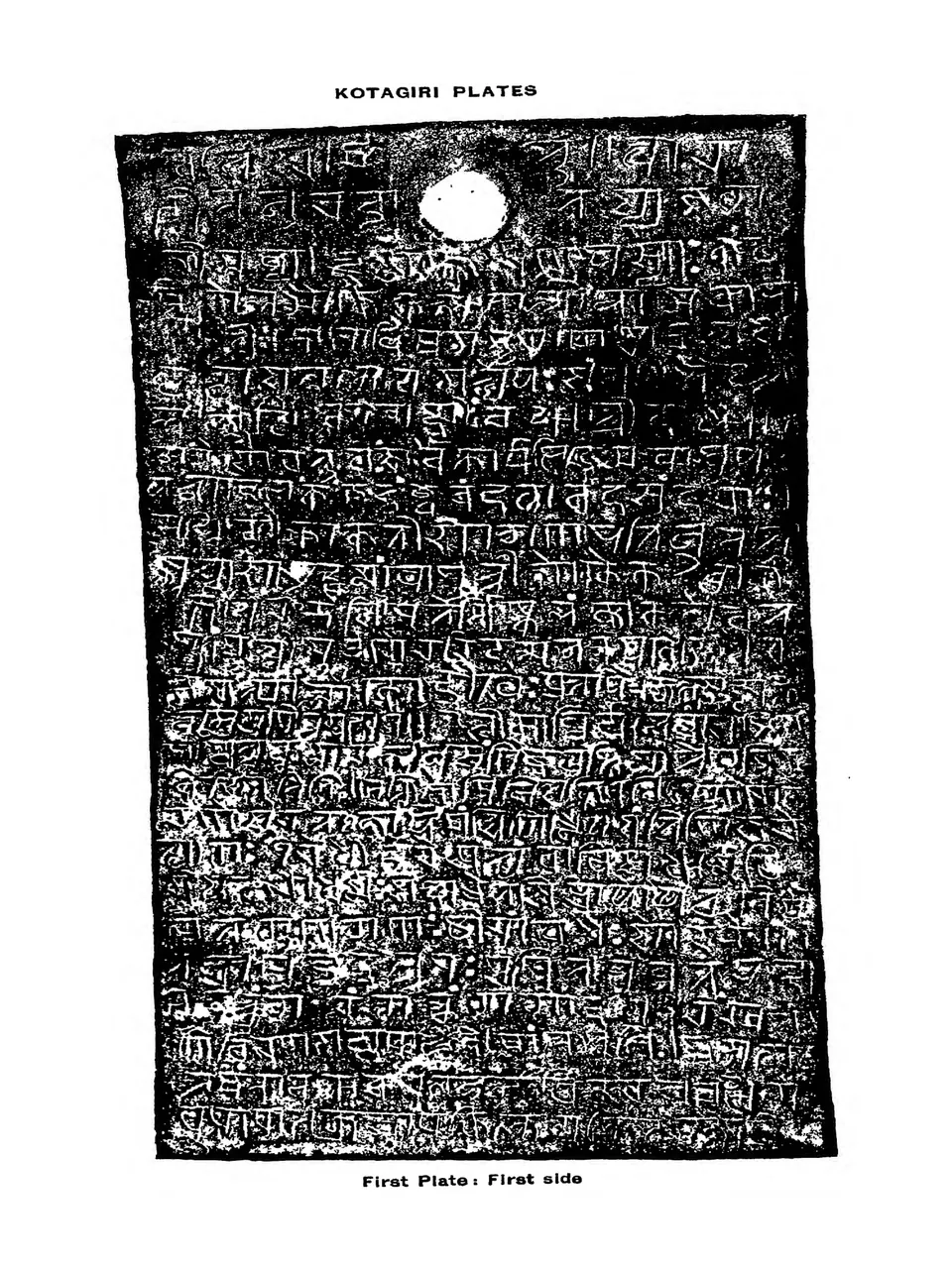
- On the Kotagiri plates of 1273 the figure of a boar, the emblem of the Kakatiyas, is carved in relief on the joint of the ring.20
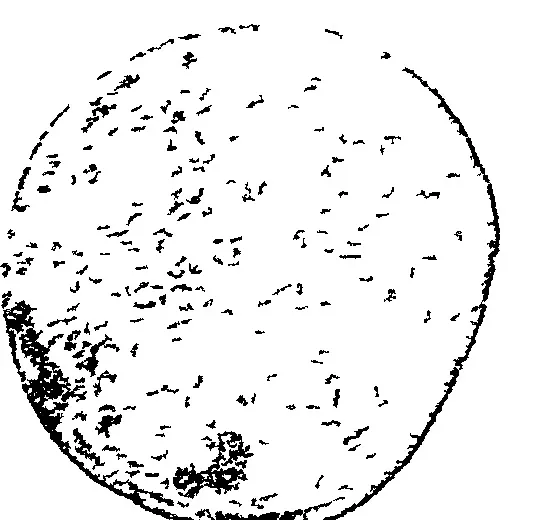
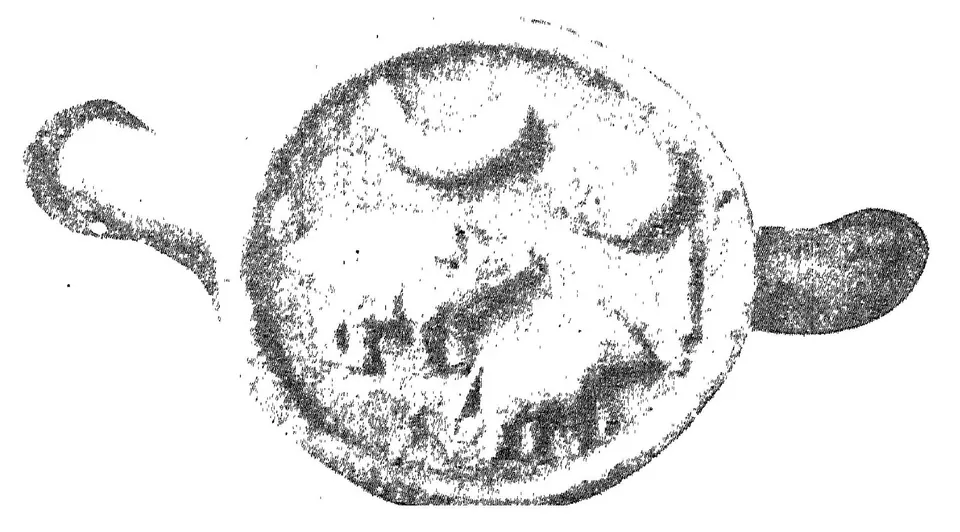
Burnell traced how seals changed: small, with little more than a figure or a motto, up to the 10th century; larger, with a motto and several emblems, from the 10th to the 14th; smaller again and without a motto from the 14th to the early 17th century.21 He took the sun and moon on seals and plates from the stock phrase that a gift should last “as long as the sun and moon” endure.22
Blank faces, rims and numbers
The outer face of the first plate and of the last plate was usually left blank, to protect the writing.1216 Both the Chikkulla and the Nandamapundi plates follow this rule; the Kotagiri plates are an exception, with writing on both sides of all three plates.131420 From about the 9th or 10th century the edges of plates were often beaten up into raised rims, again to protect the writing; the Nandamapundi plates have high rims, while the earlier Chikkulla plates have none.121314 Plates were sometimes numbered.23
How the plates were made
The sheets were beaten out with a hammer, and many show the marks of the blows.1624 The letters were cut with a chisel-like tool; on very thin plates they were scratched with a stylus.12 Ojha describes the process: an official or a scholar composed the text, a clerk wrote it out in ink on the copper, and a goldsmith, coppersmith, blacksmith or other craftsman engraved it.11 Mistakes were hammered flat and the correct letters cut on the smoothed spot.2425 The Nandamapundi plates show how far this could go: Kielhorn found that their first three plates had come from an older grant, and that the last lines of the third plate had been beaten in and engraved afresh.26
How plates are found
Because a copper-plate charter was the owner’s title to land, plates were often hidden and turn up by chance. Bühler found that they had been walled into houses or buried in the fields they granted, and that finders often sold them.27 The Chikkulla plates were dug up at a village tank, and the Kotagiri plates were found by a fisherman in a tank and handed in by the police as unclaimed property.2829 A speaker before the Andhra Historical Research Society in 1926 warned that copper plates found in excavations were sometimes melted down and made into drinking vessels.30
Silver, gold, crystal and caskets
Precious metals were rare. Burnell knew of a grant on a single silver plate, in Telugu, by which the last Nayak of Tanjore gave Negapatam to the Dutch, and of a letter on a gold plate sent by the king of Vijayanagara to the Portuguese in 1514.31 Bühler and Ojha both mention a small inscribed silver piece from the stupa at Bhattiprolu.32
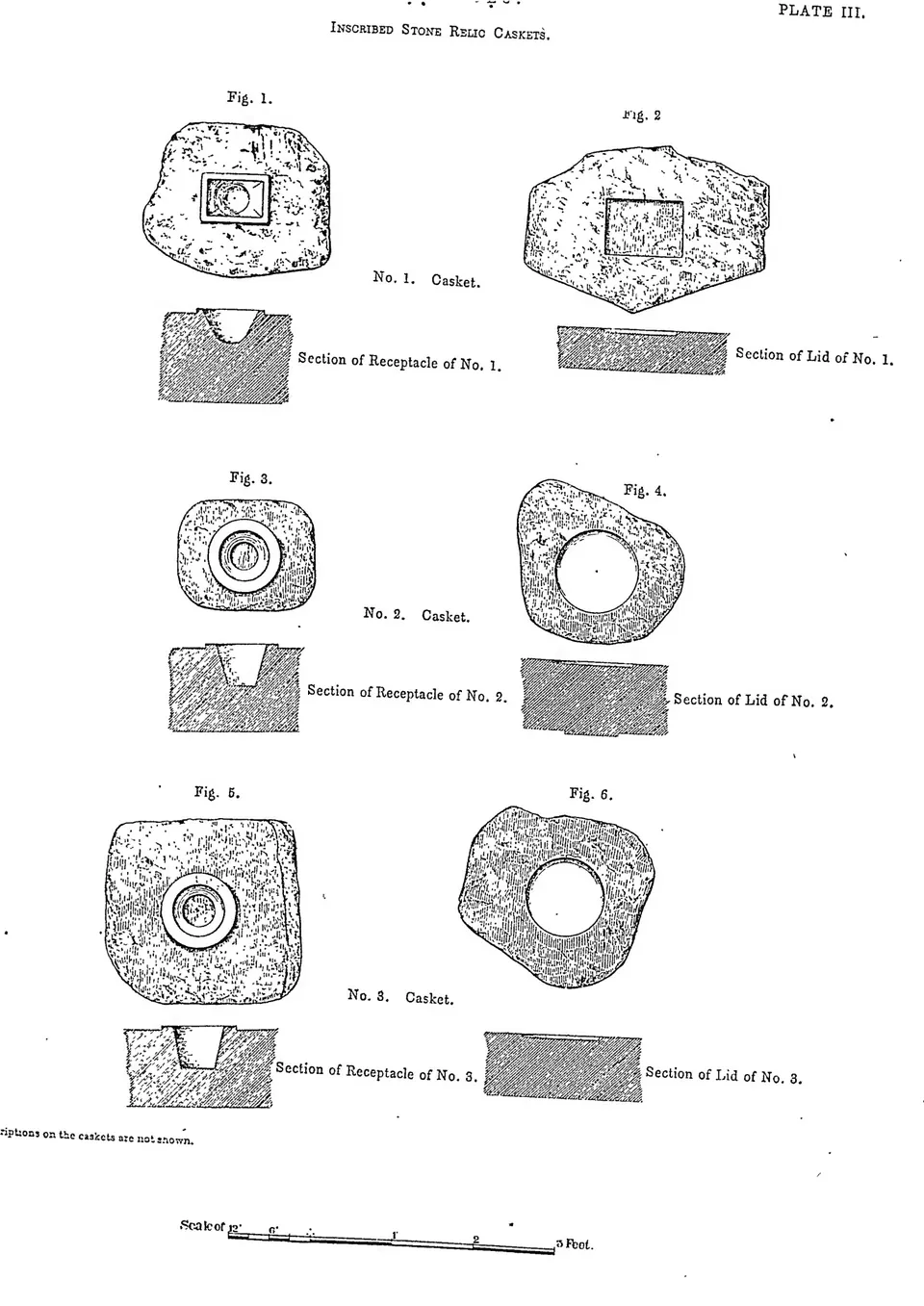
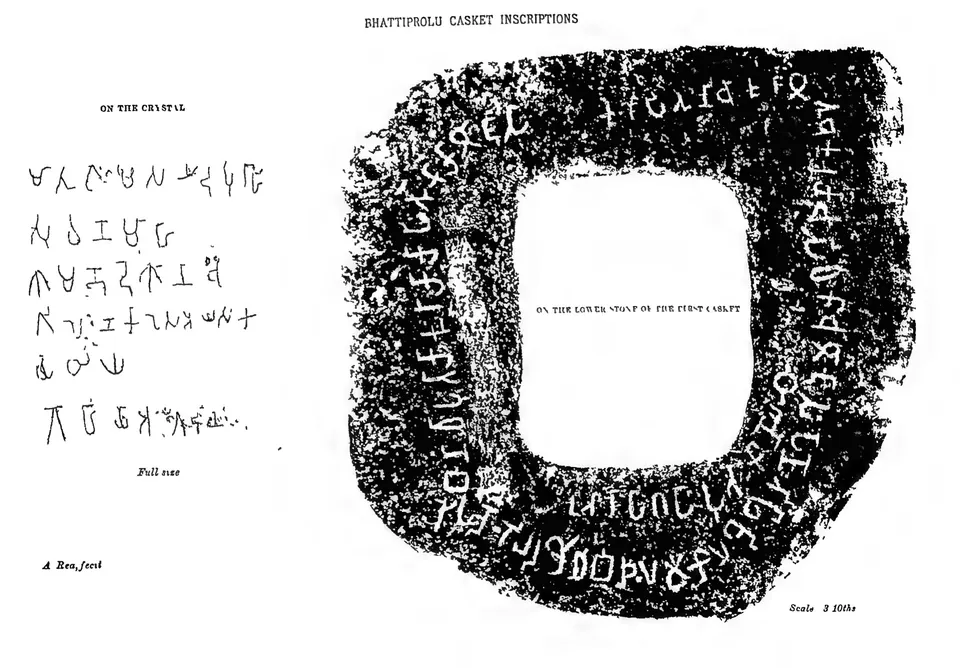
The Bhattiprolu relic caskets show another kind of object: inscriptions cut around heavy stone caskets and on their lids, with letters filled in with white, and one lightly scratched on the faces of a six-sided crystal.33
Palm leaves
Palm leaves were the chief material for books in South India. Burnell explains the usual way of writing on them: the letters were scratched with a stylus and then made visible by rubbing in powdered charcoal or lamp-black with a juicy plant stalk.34 Bühler confirms that in the Dravidian districts and in Orissa the letters were incised with a stylus and blackened with soot or charcoal, and that leaves were held together by strings passed through one hole in the middle or two holes, one at each side.35 The oldest South Indian palm-leaf manuscript of this kind known to Burnell was a Kannada manuscript of 1428.36
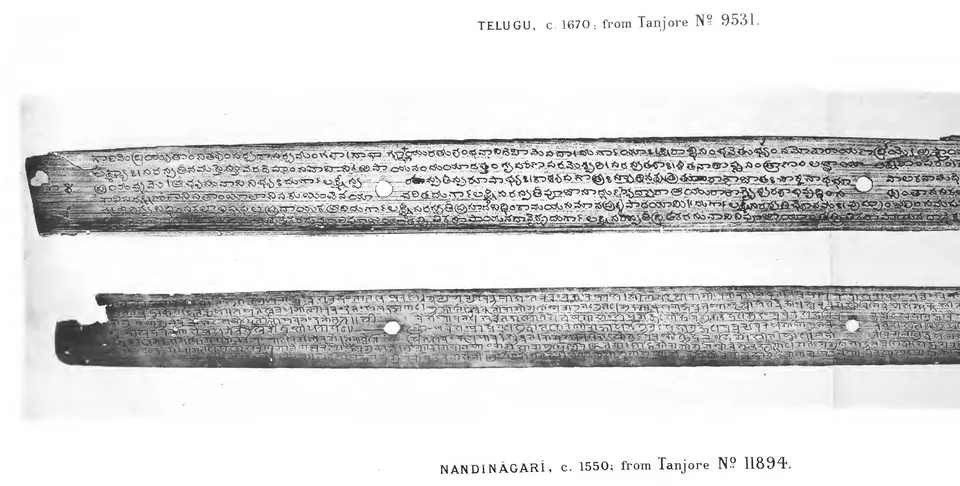
The upper leaf in the plate above is a Telugu manuscript of about 1670 from the Tanjore library; the lower one is in Nandinagari, of about 1550.37 Palm leaves were used for letters too: a strip was cut, coloured with turmeric, folded into a ring and tied with a thread.38 Burnell found that some 11th-century Tamil grants said they followed palm-leaf orders of the king, but he had met no early public document actually on a palm leaf.39
Cloth, paper, ink and pens
Merchants in the Kannada country wrote accounts on kadatam, cotton cloth blackened with a paste of tamarind seed and charcoal and written on with chalk or a steatite pencil, so that the letters were white on black.40 Paper came late: Burnell thought it was used in India only after the 11th century and was almost unknown in South India until recent times, much of it imported from Portugal in the 16th to 18th centuries.41 Bühler attributed its introduction to the Muslims.42 The Indian word for ink, masi, meant a powder; reed pens were used where ink was used, and the stylus of South India was called śalākā.43
How inscriptions are copied
Scholars rarely work from the stones and plates themselves. Burnell advised that copper plates be copied by “impressions … easily made with printing ink”, and stone inscriptions by photography or, best of all, by “‘estampages’ or impressions on moist paper”; he warned that hand-made copies had misled even distinguished scholars.44 Robert Sewell recommended “estampages or rubbings according to the depth of the letters”, and warned against colouring the letters on the stone to help photography.45 A speaker before the Andhra Historical Research Society in 1926 told members that all they needed were a few brushes and dabbers, a good supply of printing paper, and ink made from lamp-black.30
Most of the inscription plates on this site are reproductions of such impressions. E. Hultzsch edited the Motupalli pillar from “a set of excellent inked estampages”, and F. Kielhorn the Nandamapundi grant from impressions sent to him.514 In these impressions the cut letters show pale against the inked surface, so they look like white writing on a black ground, as on the first plate of the Kotagiri grant.46
Try it yourself
Here are two descriptions written by F. Kielhorn in Epigraphia Indica IV (1897).
Set 1. “These are five copper-plates, each of which measures about 7⅜” broad by 2¼” high, and of which the first and last plates are inscribed on one side only … The plates are strung on a copper ring … which passes through a hole in the lower proper right corner of each plate. The ends of the ring are soldered into the lower part of a circular seal which … bears in relief on a slightly countersunk surface a well-executed lion … Although the plates have no raised margins, the writing on them nearly throughout is in an excellent state of preservation.”13
Set 2. “These are five copper-plates, the first and last of which are inscribed on one side only, and each of which measures about 10¼” broad by 5” high. Their edges are raised into high rims, and the writing, in consequence, is well preserved throughout.”14
- How many inscribed faces does each set have?
- Which faces carry no writing, and why?
- What is on the seal of Set 1, and how is the seal fixed to the ring?
- Which set has raised rims, and what difference does Kielhorn say they made?1314
Answer
Set 1 is the Chikkulla plates of the Vishnukundin king Vikramendravarman II, and Set 2 the Nandamapundi plates of the Eastern Chalukya king Rajaraja I.1314
- Eight each: five plates have ten faces, and the first and last plates are inscribed on one side only.1314
- The outer face of the first plate and of the last plate. Burnell explains that these were left blank to preserve the writing from injury.12
- A lion, standing to its right with its right forepaw raised. The ends of the ring are soldered into the lower part of the seal.13
- Set 2. The high rims kept the writing well preserved, but Kielhorn notes that they were so high that perfect impressions could not be taken. Set 1 has no raised margins, yet its writing is still in excellent condition.1314
Further reading
- A. C. Burnell, Elements of South-Indian Palaeography, 2nd ed. (1878), Chapter V, “The writing materials used in India, and especially in the South”, pp. 84–93 (archive.org (opens in a new tab)).34
- G. Bühler, Indian Palaeography, tr. J. F. Fleet (1904), §§37–39, “Writing materials, libraries, and writers”, pp. 92–102 (archive.org (opens in a new tab)).23
- Gaurishankar Hirachand Ojha, Bharatiya Prachin Lipimala, 2nd ed. (1918), chapter “Lekhan-samagri”, from p. 142 (in Hindi) (archive.org (opens in a new tab)).11
- Previous lesson: How an inscription is built.
Footnotes
-
Burnell, Elements of South-Indian Palaeography (1878), p. 91 (archive.org (opens in a new tab)); Bühler, Indian Palaeography (1904), p. 96 (archive.org (opens in a new tab)). ↩ ↩2
-
A. C. Burnell, Elements of South-Indian Palaeography, 2nd ed. (1878), p. 90 (archive.org (opens in a new tab)). ↩
-
Burnell, Elements of South-Indian Palaeography (1878), p. 91 (archive.org (opens in a new tab)). ↩ ↩2 ↩3
-
D. C. Sircar, “Erragudi Edicts of Asoka”, Epigraphia Indica XXXII (1959), p. 1; paraphrased (archive.org (opens in a new tab)). ↩
-
E. Hultzsch, “Motupalli Pillar-Inscription of Ganapatideva”, Epigraphia Indica XII (1914), p. 188 (archive.org (opens in a new tab)). ↩ ↩2
-
L. D. Barnett, Inscriptions at Palampet and Uparpalli (1919), p. 1 (archive.org (opens in a new tab)). ↩
-
Burnell, Elements of South-Indian Palaeography (1878), p. 116 (archive.org (opens in a new tab)). ↩
-
G. Bühler, Indian Palaeography, tr. J. F. Fleet, appendix to Indian Antiquary XXXIII (1904), p. 96 (archive.org (opens in a new tab)). ↩
-
Gaurishankar Hirachand Ojha, Bharatiya Prachin Lipimala, 2nd ed. (1918), p. 151 (archive.org (opens in a new tab)). ↩
-
Burnell, Elements of South-Indian Palaeography (1878), p. 91 (archive.org (opens in a new tab)); Bühler, Indian Palaeography (1904), p. 95 (archive.org (opens in a new tab)). ↩
-
Ojha, Bharatiya Prachin Lipimala (1918), p. 152 (archive.org (opens in a new tab)). ↩ ↩2 ↩3
-
Burnell, Elements of South-Indian Palaeography (1878), p. 92 (archive.org (opens in a new tab)). ↩ ↩2 ↩3 ↩4 ↩5 ↩6
-
F. Kielhorn, “Chikkulla Plates of Vikramendravarman II”, Epigraphia Indica IV (1897), p. 194 (archive.org (opens in a new tab)). ↩ ↩2 ↩3 ↩4 ↩5 ↩6 ↩7 ↩8 ↩9 ↩10
-
F. Kielhorn, “Nandamapundi Grant of Rajaraja I”, Epigraphia Indica IV (1897), pp. 300–301 and n. 1 (archive.org (opens in a new tab)). ↩ ↩2 ↩3 ↩4 ↩5 ↩6 ↩7 ↩8 ↩9
-
Ojha, Bharatiya Prachin Lipimala (1918), p. 153 (archive.org (opens in a new tab)). ↩
-
Bühler, Indian Palaeography (1904), p. 96 (archive.org (opens in a new tab)). ↩ ↩2 ↩3
-
Burnell, Elements of South-Indian Palaeography (1878), p. 107 (archive.org (opens in a new tab)). ↩
-
Bühler, Indian Palaeography (1904), p. 96 (archive.org (opens in a new tab)). ↩
-
Kielhorn, Epigraphia Indica IV (1897), p. 301 (archive.org (opens in a new tab)). ↩
-
S. Hanumant Rao and Lakshmi Kanta Sastri, The Kotagiri Plates of the Reign of the Kakatiya Queen Rudramamba, A.D. 1273 (1925), p. 1 (archive.org (opens in a new tab)). ↩ ↩2
-
Burnell, Elements of South-Indian Palaeography (1878), p. 108 (archive.org (opens in a new tab)). ↩
-
Burnell, Elements of South-Indian Palaeography (1878), p. 106 (archive.org (opens in a new tab)); Bühler, Indian Palaeography (1904), p. 91 (archive.org (opens in a new tab)). ↩
-
Bühler, Indian Palaeography (1904), p. 92 (archive.org (opens in a new tab)); Ojha, Bharatiya Prachin Lipimala (1918), p. 153 (archive.org (opens in a new tab)). ↩ ↩2
-
Ojha, Bharatiya Prachin Lipimala (1918), p. 153 (archive.org (opens in a new tab)). ↩ ↩2
-
Bühler, Indian Palaeography (1904), p. 91 (archive.org (opens in a new tab)). ↩
-
Kielhorn, Epigraphia Indica IV (1897), p. 301 (archive.org (opens in a new tab)). ↩
-
Bühler, Indian Palaeography (1904), pp. 99–100 (archive.org (opens in a new tab)). ↩
-
Kielhorn, Epigraphia Indica IV (1897), pp. 193–194 (archive.org (opens in a new tab)). ↩
-
Hanumant Rao and Lakshmi Kanta Sastri, The Kotagiri Plates (1925), Resolution, p. v (archive.org (opens in a new tab)). ↩
-
Journal of the Andhra Historical Research Society, Vol. I, pt. 2 (1926), p. 12 (archive.org (opens in a new tab)). ↩ ↩2
-
Burnell, Elements of South-Indian Palaeography (1878), p. 90 (archive.org (opens in a new tab)), and p. 93, n. 2 (archive.org (opens in a new tab)). ↩
-
Bühler, Indian Palaeography (1904), p. 95 (archive.org (opens in a new tab)); Ojha, Bharatiya Prachin Lipimala (1918), p. 152 (archive.org (opens in a new tab)). ↩
-
Alexander Rea, South Indian Buddhist Antiquities (1894), p. 11 (archive.org (opens in a new tab)), p. 13 (archive.org (opens in a new tab)). ↩
-
Burnell, Elements of South-Indian Palaeography (1878), pp. 84–85 (archive.org (opens in a new tab)). ↩ ↩2
-
Bühler, Indian Palaeography (1904), pp. 94–95 (archive.org (opens in a new tab)). ↩
-
Burnell, Elements of South-Indian Palaeography (1878), p. 86 (archive.org (opens in a new tab)). ↩
-
Burnell, Elements of South-Indian Palaeography (1878), Pl. XXXI (archive.org (opens in a new tab)). ↩
-
Burnell, Elements of South-Indian Palaeography (1878), p. 89 (archive.org (opens in a new tab)); Bühler, Indian Palaeography (1904), p. 100 (archive.org (opens in a new tab)). ↩
-
Burnell, Elements of South-Indian Palaeography (1878), p. 93 (archive.org (opens in a new tab)). ↩
-
Burnell, Elements of South-Indian Palaeography (1878), pp. 87–88 (archive.org (opens in a new tab)); Bühler, Indian Palaeography (1904), p. 93 (archive.org (opens in a new tab)). ↩
-
Burnell, Elements of South-Indian Palaeography (1878), p. 88 (archive.org (opens in a new tab)). ↩
-
Bühler, Indian Palaeography (1904), p. 97 (archive.org (opens in a new tab)). ↩
-
Bühler, Indian Palaeography (1904), pp. 97–98 (archive.org (opens in a new tab)). ↩
-
Burnell, Elements of South-Indian Palaeography (1878), p. 123 (archive.org (opens in a new tab)). ↩
-
Robert Sewell, Report on the Amaravati Tope, and Excavations on its Site in 1877 (1880), p. 61 (archive.org (opens in a new tab)). ↩
-
Hanumant Rao and Lakshmi Kanta Sastri, The Kotagiri Plates (1925), facsimile of the first plate, first side, PDF p. 20 (archive.org (opens in a new tab)). ↩
References
Notes (0)
Sources (11)
Spotted an error on this page? Tell us
Last updated: