Lesson 6
Brahmi and Prakrit: the oldest writing
The oldest writing in the Telugu country is in Brahmi, the script of the emperor Asoka, and the language is Prakrit, a group of everyday languages related to Sanskrit. The Buddhist pillars at Nagarjunakonda, for example, carry inscriptions “in Prakrit and in Brahmi characters”.1 This lesson shows you how Brahmi works, what makes the local variety from Bhattiprolu special, and how to read a short Prakrit gift record. You will need no more than a dozen letters to begin.
Brahmi in a nutshell
Brahmi is written from left to right. Bühler noted that the other old Indian script, Kharoshthi, was “the writing running from the right to the left”.2 Like modern Telugu, Brahmi is a syllable-script. Each consonant sign carries a built-in vowel a: the sign for k is read ka. To write another vowel after the consonant, a small stroke is added to the consonant. In Asoka’s edicts, e is a short stroke, ai two parallel strokes, and i an angle, which gains an extra stroke to become long ī.3
When two consonants come together with no vowel between them, Brahmi stacks them one above the other. Burnell pointed out that this already happens in Asoka’s Girnar edict, with groups such as dv, pt, mh, vy and st, “just as is done now”.4
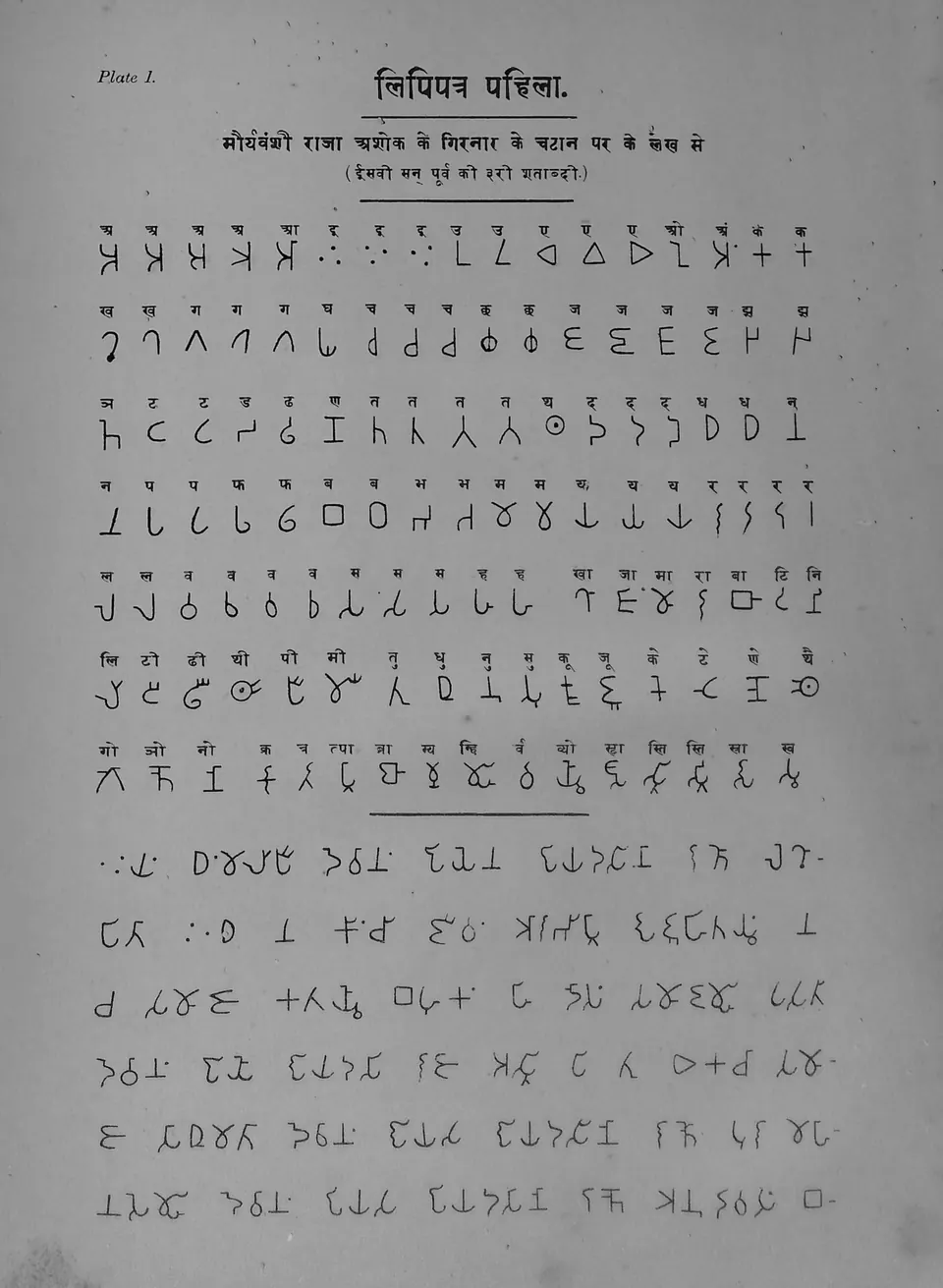
Ojha’s first plate shows the full alphabet of Asoka’s rock edict at Girnar.5 You can see the shapes of thirteen common letters, side by side with their later forms, in the character table in The Telugu-Kannada script through the centuries.
Write it in Brahmi
Telugu and Brahmi letters correspond one to one, because Telugu grew out of Brahmi. Type a word in Telugu (or Kannada) to see it in Brahmi letters.
𑀢𑁂𑀮𑀼𑀕𑀼
Shown in a modern font (Noto Sans Brahmi, SIL Open Font Licence) that draws Asokan-style letters; real inscriptions vary by place and period. Brahmi has one e and one o, so Telugu’s short and long e and o look the same.
Asoka’s edicts at Erragudi and Rajula-Mandagiri
Asoka’s edicts at Erragudi in Kurnool district and at Rajula-Mandagiri are written in Brahmi. Erragudi has a surprise for the reader. On one boulder, some lines or parts of lines run from right to left, some groups of letters are cut in the wrong line, and some words are missing. D. C. Sircar suggested that the engraver came from the north-west and was used to Kharoshthi.6 When D. R. Sahni first described it in 1929, he called it written partly in boustrophedon, that is, with lines running alternately left to right and right to left.7
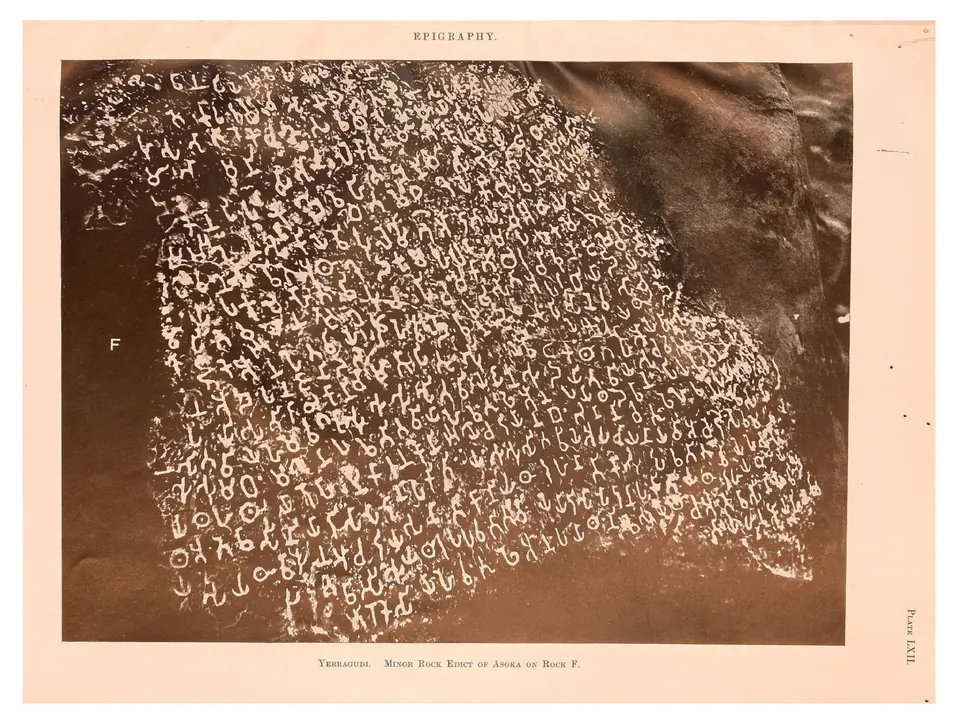
Tip. If a Brahmi line seems to make no sense, check whether it might run backwards, as some lines at Erragudi do.6
The Bhattiprolu alphabet
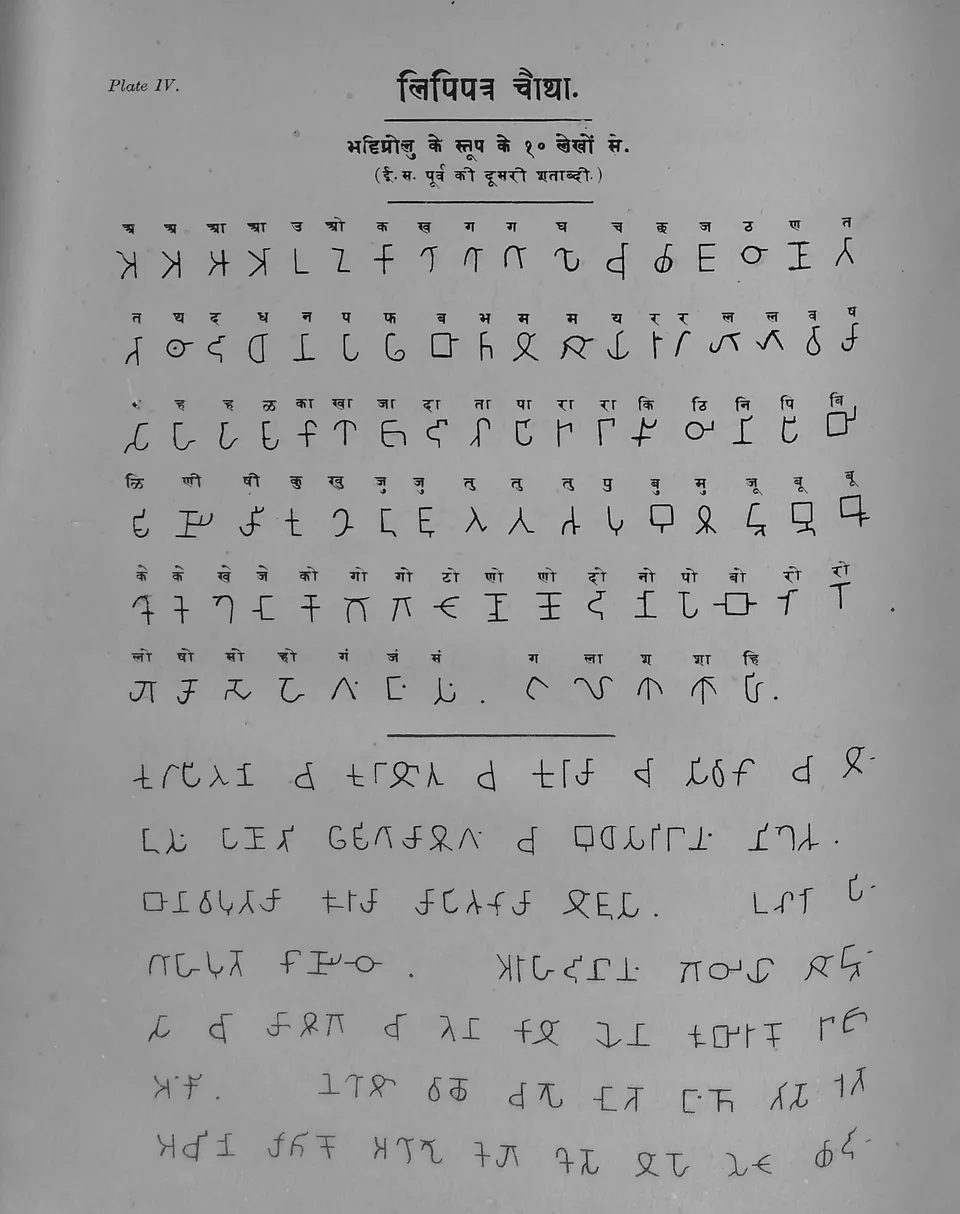
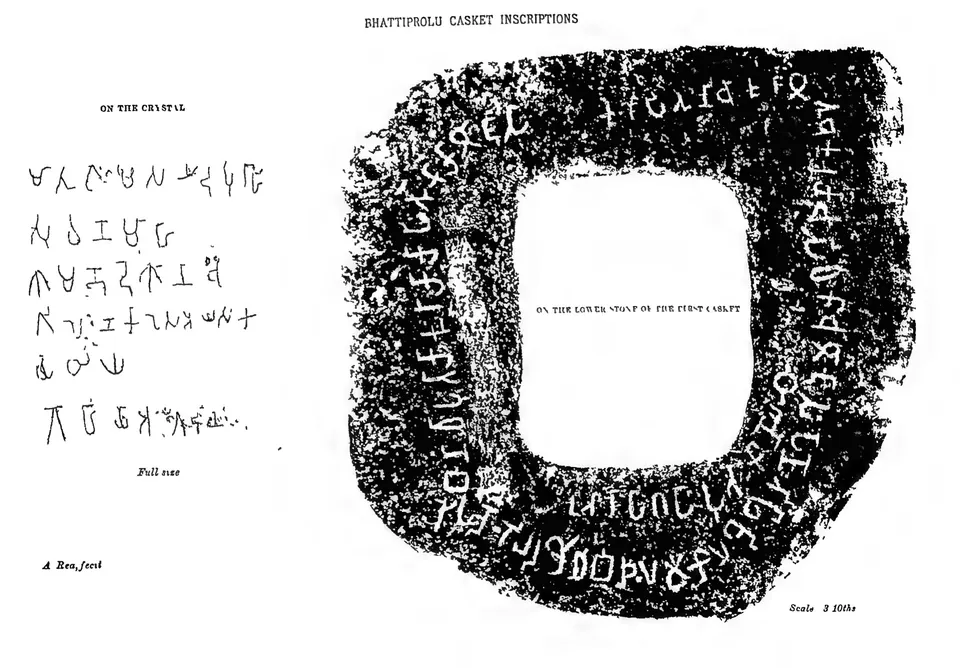
The ten short inscriptions on the relic caskets from Bhattiprolu in the Krishna delta use a variety of Brahmi found nowhere else. Bühler, who edited them, found that twenty-three of their letters agree with the southern form of Asoka’s alphabet, but that five letters are “entirely abnormal” and that there is an extra letter for a retroflex ḷ.8 He thought that this local alphabet might be the dravidi named in old Jaina and Buddhist lists of scripts.9
Two features matter most for a reader:
- The vowels work differently. In Bhattiprolu writing a bare consonant has no built-in a. The stroke that means long ā in Asoka’s script means short a here, and long ā has a new sign, a horizontal stroke with a vertical one hanging from its end. Bühler thought this was invented to avoid writing groups of consonants.10
- The sibilants are mixed up. Bühler noticed that in many Prakrit records, the Bhattiprolu vases among them, the signs for the different s-sounds are used interchangeably. He explained it by clerks learning an alphabet made for Sanskrit, which had more s-sounds than their own speech.11
Not every Bhattiprolu record uses the local alphabet. The inscription on the crystal (No. X) is in ordinary Brahmi, except for a da that opens to the right, so Bühler concluded that the two alphabets were used side by side.12 He dated the caskets to about 200 BCE, judging by the letters that agree with Asoka’s Brahmi.12 Ojha’s Plate 4 charts the Bhattiprolu letters.13
Prakrit records of the Satavahanas and Ikshvakus
Under the Satavahanas and the Ikshvakus, Buddhist gifts at Amaravati, Jaggayyapeta and Nagarjunakonda were recorded in Prakrit. J. Ph. Vogel described the Nagarjunakonda pillars as carrying inscriptions “in Prakrit and in Brahmi characters”.1 The script grew more ornamental. Bühler described the Jaggayyapeta inscriptions of the Ikshvaku king Sirivira Purisadata, and some Amaravati inscriptions, as written in a “still more ornamental alphabet”. Its hallmark is the very long downward strokes of some letters and of the vowel signs i, ī and u.14 Ojha’s Plate 12 charts these letters.15
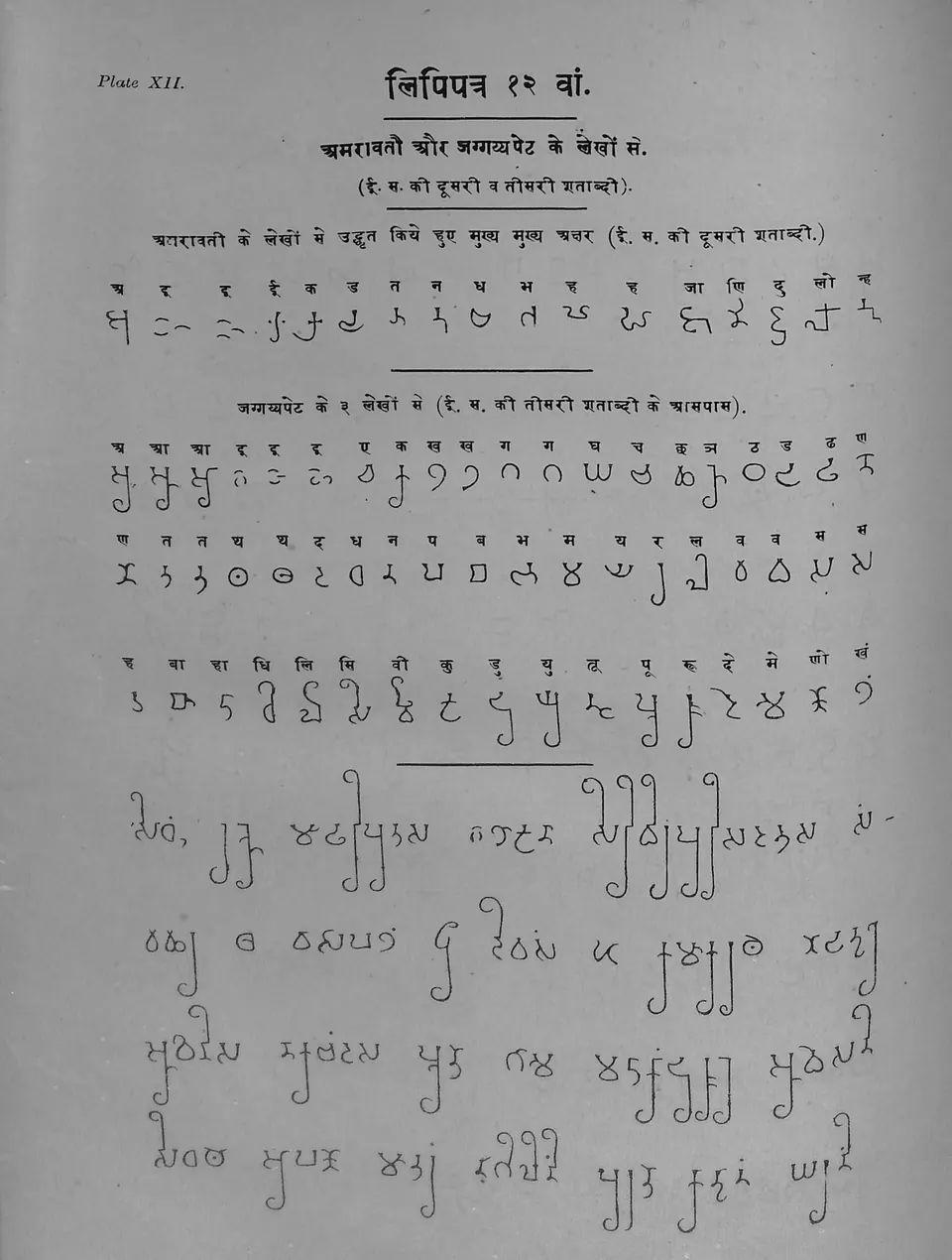
Later Ikshvaku records begin to use Sanskrit. The Pushpabhadrasvamin pillar at Nagarjunakonda, dated in the 16th year of King Ehuvula Chamtamula, is in the usual Brahmi of the Ikshvaku records. Its editors found its language to be Sanskrit with Prakrit spellings.16
Prakrit spellings to expect. Prakrit simplifies Sanskrit sounds, and editors often write the “correct” Sanskrit beside the Prakrit. Burnell noted that in Prakrit inscriptions a doubled consonant is sometimes shown only by a dot before it.4 At Kodavali, the Satavahana king’s name appears as Chamdasati, which the editor took to be a Prakrit form of Chandasvati. The year of the reign is introduced by the word vachhare.17
Worked example: a pillar at Amaravati
James Burgess found a small broken stone in the south-east part of the Amaravati stupa. He describes it as bearing a fragment “in letters of the Mauryan type”, that is, the Brahmi of Asoka’s time, and he reads it:18
… Senagopasa Mudakutalasa thabho …
“A pillar of the General Mudakutala”

Amaravati inscription No. 4, from Burgess’s Plate LVI, as published in 1887.19
Now read it letter by letter, from left to right. The first letter is broken, so start with the second.
- ⊥ is na: an upright stroke on a flat base.
- ∧ with little strokes on top is go: the Brahmi ga is an upside-down V, and the two strokes add the vowel o.
- ⊔, here leaning, is pa.
- The next letter is sa. With it, the first word is complete: (Se)nagopasa, “of the general”. Both names in this record end in -sa, which Burgess’s translation renders as “of”.18
- Mu, ḍa (the hooked letter like a figure 2), ku (a cross with a tail for the u), ta (shaped like λ), la and sa spell Muḍakutalasa, “of Mudakutala”.
- The circle with a dot inside is tha, and the last letter, bho, completes thabho, “pillar”. The rest of the stone is too damaged to read.
You have just read one of the earliest labels from the stupa. Burgess thought that letters this early showed that the great chaitya “dates originally from perhaps about 200 B.C.”18
Try it yourself
The Kodavali rock inscription of the Satavahana king Chandasati has six lines. Here is the editor’s text of its first three lines:20
1 Sidham [|*] Rano Vasithi- 2 putasa sami-siri- 3 Chamdasat[i][sa] [ra]ji-vachhare 2
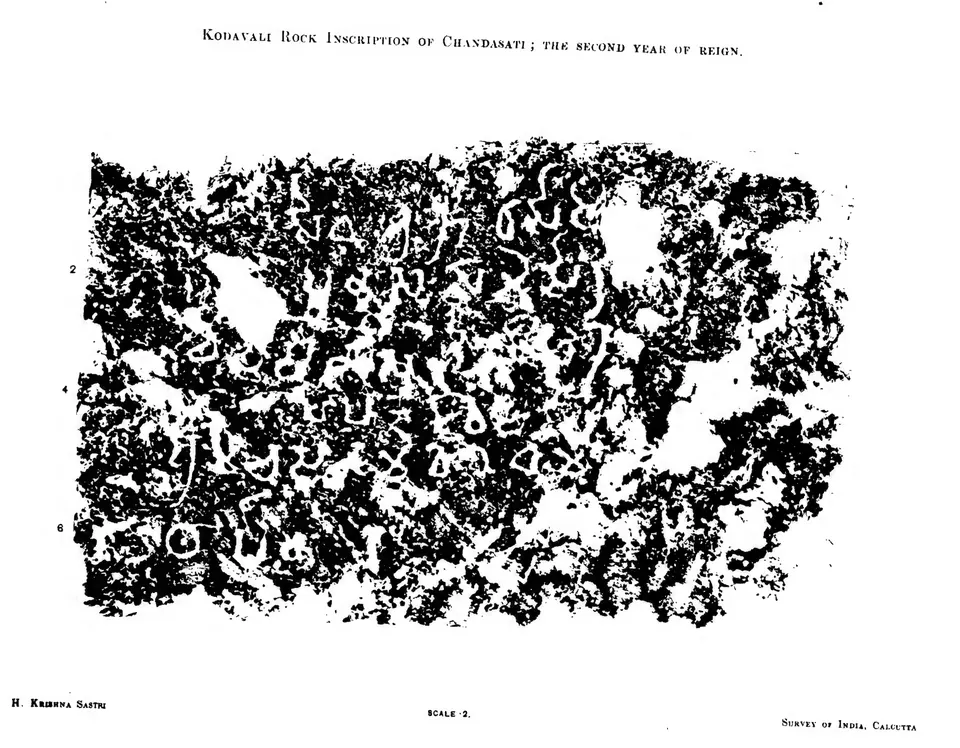
- In line 1, the engraver left spaces between words. After which word does the first space come?
- At the end of line 3 is the year of the reign, written as a number, not a word.20 What would you expect a Brahmi “2” to look like, and why might a reader see a “3” instead?
Answer
- After Sidham (“Success!”). The editor H. Krishna Sastri notes that spaces are left after complete words, such as Sidham and Rano.21
- In Brahmi, 1, 2 and 3 are written as one, two or three horizontal strokes.22 At Kodavali three thick horizontal marks can be seen. Krishna Sastri read the number as 2, because the topmost mark is above the line and not directly over the other two.21 Sten Konow had earlier read the date quite differently, and the two scholars still disagreed after comparing notes.23 This is a good example of how much a single scratch on a rock can matter.
Footnotes
-
J. Ph. Vogel, “Prakrit Inscriptions from a Buddhist Site at Nagarjunikonda”, Epigraphia Indica XX (1933), p. 1 (archive.org (opens in a new tab)). ↩ ↩2
-
G. Bühler, Indian Palaeography, tr. J. F. Fleet (Appendix to the Indian Antiquary XXXIII, 1904), p. 2 (archive.org (opens in a new tab)). ↩
-
Bühler, Indian Palaeography (1904), p. 15, § 5 (archive.org (opens in a new tab)). ↩
-
A. C. Burnell, Elements of South-Indian Palaeography, 2nd ed. (1878), p. 13 (archive.org (opens in a new tab)). ↩ ↩2
-
Gaurishankar Hirachand Ojha, Bharatiya Prachin Lipimala, 2nd ed. (1918), Plate 1, “from the rock inscription of the Maurya king Asoka at Girnar (3rd century BCE)” (archive.org (opens in a new tab)). ↩
-
D. C. Sircar, “Erragudi Edicts of Asoka”, Epigraphia Indica XXXII (1959), p. 4 (public domain in India; paraphrased) (archive.org (opens in a new tab)). ↩ ↩2
-
D. R. Sahni, “The Yerragudi Rock Edicts of Asoka”, Annual Report of the Archaeological Survey of India 1928–29 (1933), pp. 164–165 (archive.org (opens in a new tab)). ↩
-
G. Bühler, “The Bhattiprolu Inscriptions”, Epigraphia Indica II (1894), pp. 323–324 (archive.org (opens in a new tab)). ↩
-
Bühler, Indian Palaeography (1904), p. 2 (archive.org (opens in a new tab)). ↩
-
Bühler, Indian Palaeography (1904), p. 15, § 5 (2) (archive.org (opens in a new tab)). ↩
-
Bühler, Indian Palaeography (1904), p. 31 (archive.org (opens in a new tab)). ↩
-
Bühler, Indian Palaeography (1904), pp. 38–39, § 17 (archive.org (opens in a new tab)). ↩ ↩2
-
Ojha, Bharatiya Prachin Lipimala (1918), Plate 4, “from the ten inscriptions of the Bhattiprolu stupa (2nd century BCE)” (archive.org (opens in a new tab)). ↩
-
Bühler, Indian Palaeography (1904), p. 43, § 20 C (archive.org (opens in a new tab)). ↩
-
Ojha, Bharatiya Prachin Lipimala (1918), Plate 12, “from the inscriptions of Amaravati and Jaggayyapeta (2nd and 3rd centuries CE)” (archive.org (opens in a new tab)). ↩
-
D. C. Sircar and K. G. Krishnan, “Two Inscriptions from Nagarjunikonda”, Epigraphia Indica XXXIV (1963), p. 17 (public domain in India; paraphrased) (archive.org (opens in a new tab)). ↩
-
H. Krishna Sastri, “The Kodavali Rock-Inscription of Chandasati”, Epigraphia Indica XVIII (1926), p. 317 (archive.org (opens in a new tab)) and p. 318 (archive.org (opens in a new tab)). ↩
-
James Burgess, The Buddhist Stupas of Amaravati and Jaggayyapeta (1887), p. 101, No. 4 (archive.org (opens in a new tab)). ↩ ↩2 ↩3
-
Burgess, The Buddhist Stupas of Amaravati and Jaggayyapeta (1887), Pl. LVI, No. 4 (left half of the folding plate) (archive.org (opens in a new tab)). ↩
-
Krishna Sastri, “The Kodavali Rock-Inscription of Chandasati” (1926), p. 318, text lines 1–3 (archive.org (opens in a new tab)). ↩ ↩2
-
Krishna Sastri, “The Kodavali Rock-Inscription of Chandasati” (1926), p. 318, notes 2 and 4 (archive.org (opens in a new tab)). ↩ ↩2
-
Bühler, Indian Palaeography (1904), p. 77, § 34 A (archive.org (opens in a new tab)). ↩
-
Krishna Sastri, “The Kodavali Rock-Inscription of Chandasati” (1926), p. 318 (archive.org (opens in a new tab)) and postscript, p. 319 (archive.org (opens in a new tab)). ↩
References
Notes (0)
Sources (10)
Spotted an error on this page? Tell us
Last updated: