Husain Sagar
Large artificial lake between Hyderabad and Secunderabad, formed by a dam that the Golconda chronicle counts among the works of Ibrahim Qutb Shah. The Imperial Gazetteer dates it to about 1575. Bilgrami gives AH 970 (1562) and credits it to Husain Shah Wali, the king's son-in-law, after whom it is named. A tradition printed by Hastings Fraser in 1865 tells how the tank stood empty until Neknam Khan cut a channel from the Musi.
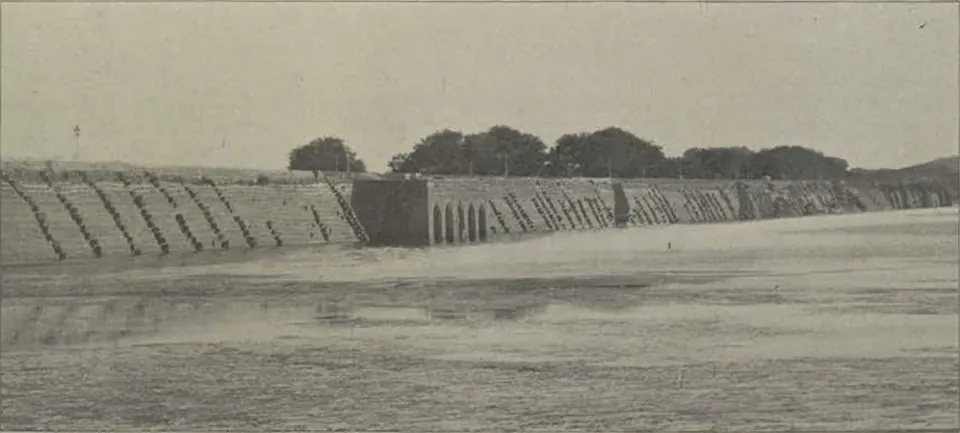
The Husain Sagar is the great lake that lies between Hyderabad and Secunderabad. The Imperial Gazetteer of 1909 describes it as “a large sheet of water, which when full extends over an area of 8 square miles”.1 It supplied water to the Residency and the suburbs north of the Musi.1 Its dam carried the road joining the northern suburbs with the city.1 T. W. Haig (1907) gives its circumference as nearly eleven miles and calls it “older than Haidarabad”.2
Builder and date
The Golconda chronicle translated by John Briggs lists “the Tank called Hoossein Sagur” among the buildings of Ibrahim Qutb Shah (1550–1580).3 It names it with the walls of Golconda and the tank at Ibrahimpatnam.3 The later works agree that it was made in his reign, but they differ on the year and on whose work it was:
- About 1575, by the king. The gazetteer says the dam “was built by Sultan Ibrahim Kutb Shah, in about 1575, at a cost of 2½ lakhs”.1 Haig says it was “constructed by Ibrahim Qutb Shah”.2 A. Claude Campbell (1898) says the bund (dam) “was constructed by Ebrahim Kutub Shah during the sixteenth century, at a cost of Rs. 254,636”.4
- AH 970 (1562; AH is the Islamic way of counting years), by Husain Shah Wali. Syed Ali Asgar Bilgrami (1927) writes that Hazrat Husain Shah Wali, a son-in-law of Ibrahim Qutb Shah, “built the Husain Sagar tank in 970 A.H. (1562 A.D.)”.5 His tomb stands near Golconda fort.5
A tradition of its making
Hastings Fraser printed in 1865 a “Tradition concerning the Construction of the great Hoossain Saugor Tank near Secunderabad”.678 It says that Ibrahim kept at his court a holy man, Khajah Hoossain Shawullee, a descendant of the saint of Gulbarga.678 The king asked him to undertake the tank.678 It was “completed in three years, seven months, and nineteen days”, at a cost of “Rs. 2,54,636-12-3”.678 But “the tank continued almost empty for four years succeeding its completion”.678
The king then ordered a nobleman, Nek Nam Khan, “to cause a channel to be made from the river Moossey”, and the experiment succeeded.678 Later the king visited the tank and was told that it was called “Hoossain Sahib Cherroo” after the holy man, not after himself.678 So he went on to mark out another tank at Ibrahimpatnam to bear his own name.678
Campbell quoted the same tradition.4 He added that the lake was fed mainly by a canal about thirty-six miles long from the Musi.4 The story is a tradition, and its cost figure is the one Campbell gives as fact.
Later history
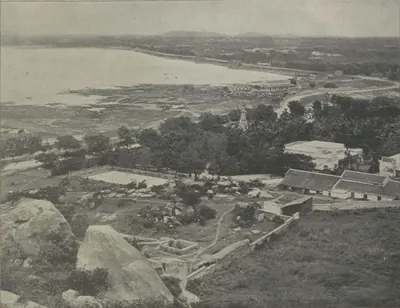
The Mughal army of 1656 camped by the Husain Sagar while Hyderabad was sacked.9 Bilgrami says that Prince Sultan Muhammad, Aurangzeb’s son, pitched his camp near the tank before the siege of Golconda.9 Campbell describes the dam in the 1890s as “a direct highway” about two miles long.4 It was the favourite evening drive of the residents and was lit at night, with mills and an ice factory below it.4 His book has photographs of the lake and the bund.10
Footnotes
-
Imperial Gazetteer of India: Hyderabad State (1909), p. 118 (archive.org (opens in a new tab)). ↩ ↩2 ↩3 ↩4
-
T. W. Haig, Historic Landmarks of the Deccan (1907), p. 217 (archive.org (opens in a new tab)). ↩ ↩2
-
Golconda chronicle, in Muhammad Qasim Ferishta, tr. John Briggs, History of the Rise of the Mahomedan Power in India, Vol. III (1829), p. 446 (archive.org (opens in a new tab)). ↩ ↩2
-
Campbell, Glimpses of the Nizam’s Dominions (1898), p. 199 (archive.org (opens in a new tab)). ↩ ↩2 ↩3 ↩4 ↩5
-
Syed Ali Asgar Bilgrami, Landmarks of the Deccan (1927), p. 110 (archive.org (opens in a new tab)). ↩ ↩2
-
Hastings Fraser, Our Faithful Ally, the Nizam (1865), p. 494, Appendix KK (archive.org (opens in a new tab)). ↩ ↩2 ↩3 ↩4 ↩5 ↩6 ↩7 ↩8
-
Fraser, Our Faithful Ally (1865), p. 495 (archive.org (opens in a new tab)). ↩ ↩2 ↩3 ↩4 ↩5 ↩6 ↩7 ↩8
-
Fraser, Our Faithful Ally (1865), p. 496 (archive.org (opens in a new tab)). ↩ ↩2 ↩3 ↩4 ↩5 ↩6 ↩7 ↩8
-
Bilgrami, Landmarks of the Deccan (1927), p. 159 (archive.org (opens in a new tab)). ↩ ↩2
-
A. Claude Campbell, Glimpses of the Nizam’s Dominions (1898), p. 198 (archive.org (opens in a new tab)). ↩
Photos
References
Notes (0)
Sources (6)
Spotted an error on this page? Tell us
Last updated: