Purana Pul
The 'old bridge' of stone across the Musi at the western end of old Hyderabad, on the road to Golconda. Bilgrami (1927) dates it by two chronograms to AH 986 (1578), under Ibrahim Qutb Shah, fourteen years before the city. He gives its Qutb Shahi name as Pul-i Narva, from the Telugu word for a causeway. The Imperial Gazetteer and Campbell date it to 1593 under Muhammad Quli. Tavernier compared it with the Pont Neuf. Its only inscription records the rebuilding after the flood of 1820.
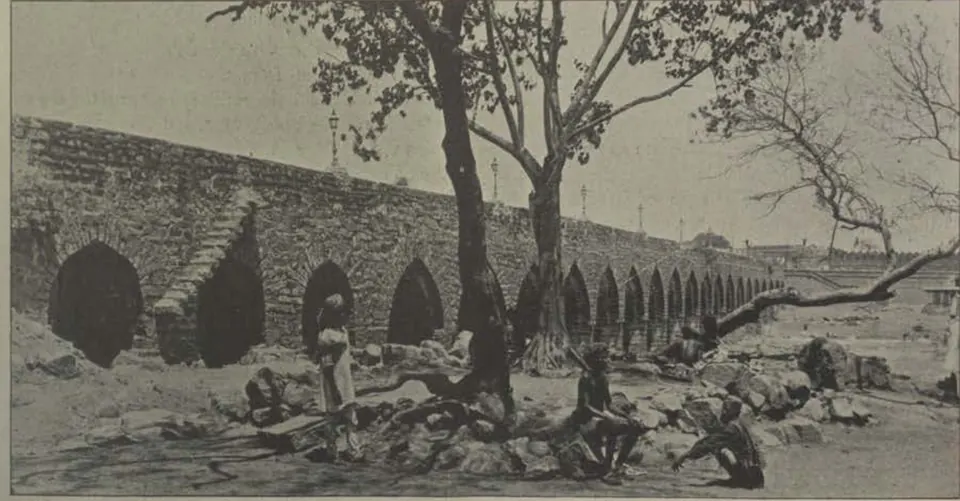
The Purana Pul (“old bridge”) carries the road from the old city of Hyderabad across the Musi towards Karwan and Golconda. In 1909 it was the westernmost of the four bridges over the river.12 It “connects the city with the Karvan road to Golconda”.12 Syed Ali Asgar Bilgrami, writing in 1927, called it “one of the oldest examples of Qutb Shahi architecture in the city of Hyderabad”.34 He found it “still in the best state of preservation”.34
Date: 1578 or 1593?
The sources disagree by fifteen years, and with it on which king built the bridge.
- AH 986 (1578; AH is the Islamic way of counting years), Ibrahim Qutb Shah. Bilgrami says the bridge was built “Fourteen years previous to the foundation of the new city of Hyderabad”, in the reign of Ibrahim Qutb Shah.53 He gives two chronograms (phrases whose letters add up to a date).53 One, for the start of the work, is “Sira-tu-hul Mustaqim” (“its path is straight”).53 The other, for its completion, is a verse ending in Guzargah-i ma, “our passage”, which he reads as AH 986.53 He cites the manuscript Tuzuk-i Qutbshahi for the statement that it was finished in eight months at a cost of one lakh, and the Gulzar-i Asafiya for the year.53
- 1593, Muhammad Quli Qutb Shah. The Imperial Gazetteer of 1909 and A. Claude Campbell’s Glimpses of the Nizam’s Dominions (1898) both give 1593.62 Campbell says it was “built by King Mahomed Kuli Kutub Shah in 1593”.6 The gazetteer counts it among the buildings of Muhammad Quli.2 Sha Rocco (1929) also gives it to Muhammad Quli, built in the same year as the Gulzar Hauz.7
Neither date comes from an inscription on the bridge.5 The only inscription Bilgrami recorded there is that of the rebuilding of 1820.5
The story of Bhagmati
Bilgrami connects the bridge with the story of Prince Muhammad Quli and Bhagmati. He writes that the bridge was built “chiefly with a view to afford easy egress” (an easy way across).53 It was also meant “to avoid the risk of life which attended the nocturnal visits of Prince Muhammad Quli to Bhagmathi” (his visits by night).53 She was “a courtesan, who resided in the village of Chichlam”.53 When the prince rode across the flooded Musi to visit her, his father “forthwith ordered the construction of this bridge”.53
G. Yazdani told a version without the bridge, in the Hyderabad Archaeological Department’s report for 1924–25.8 In it the king’s secret visit was exposed when the Musi overflowed and delayed his return.8 He gave it as one of the anecdotes “prevalent to this day” in Hyderabad.8 He noted that contemporary writers “have refrained from describing the incidents relating to the romantic lives of the Hindu consorts of the Qutb Shahi kings”.8 The story is a tradition. On Bhagmati and the name of the city, see the Qutb Shahis.
Name and structure
Bilgrami says that “Purana Pul (Old Bridge) is the name given to it during the Asaf Jahi reign”.4 He adds that “in the Qutb Shahi period it was called Pul-e-Narva (Narva Bridge)”, citing the Tawarikh-i Farkhunda of Ghulam Qadir Khan of Bidar.4 In a note he explains that “In Telugu language Narva means a causeway”.4
Bilgrami counted 22 arches and gave the dimensions as 600 ft long, 36 ft wide and 42 ft deep.3 The gazetteer and Campbell both give 23 arches, a length of 600 feet, a breadth of 33 feet and a height of 54 feet above the river-bed.26
The French jeweller Jean-Baptiste Tavernier knew Hyderabad in the 1640s and 1650s.910 He crossed the river “by a grand stone bridge, which is scarcely less beautiful than the Pont Neuf at Paris”.910 Before reaching it, he writes, “you traverse a large suburb called Aurangabad, a coss in length, where all the merchants, brokers, and artisans dwell”.910 It was “through the same suburb that you go from the town to the fortress of Golconda”.910 Campbell, quoting an older translation of the same passage, notes the decayed mosque and tomb of Khaja Mushk opposite the bridge.11
Floods and rebuilding
A Persian inscription is set in the archway, and Bilgrami gives it in full.53 It records that “During the reign of Shah Iskandar by the endeavours of Raja Chandu Lal, reconstruction of the bridge was done better than before”.53 It has a chronogram for AH 1236 (1820), and adds “In the charge of Puran Singh Darogha”.53 Bilgrami adds that after the flood of 1908 the upper part was again repaired.53 The masonry parapets were replaced by railings of pierced ashlar (cut stone).53
Footnotes
-
Imperial Gazetteer of India: Hyderabad State (1909), p. 115 (archive.org (opens in a new tab)). ↩ ↩2
-
Imperial Gazetteer: Hyderabad (1909), p. 116 (archive.org (opens in a new tab)). ↩ ↩2 ↩3 ↩4 ↩5
-
Bilgrami, Landmarks of the Deccan (1927), p. 11 and note (archive.org (opens in a new tab)). ↩ ↩2 ↩3 ↩4 ↩5 ↩6 ↩7 ↩8 ↩9 ↩10 ↩11 ↩12 ↩13 ↩14 ↩15 ↩16 ↩17
-
Bilgrami, Landmarks of the Deccan (1927), p. 12 and note (archive.org (opens in a new tab)). ↩ ↩2 ↩3 ↩4 ↩5
-
Syed Ali Asgar Bilgrami, Landmarks of the Deccan (1927), p. 10 (archive.org (opens in a new tab)). ↩ ↩2 ↩3 ↩4 ↩5 ↩6 ↩7 ↩8 ↩9 ↩10 ↩11 ↩12 ↩13 ↩14 ↩15 ↩16
-
Campbell, Glimpses of the Nizam’s Dominions (1898), p. 214 (archive.org (opens in a new tab)). ↩ ↩2 ↩3
-
Sha Rocco, Golconda and the Qutb Shahs (1929), p. 14 (archive.org (opens in a new tab)). ↩
-
Report of the Archaeological Department of H.E.H. the Nizam’s Dominions, 1334 F. (1924–25) (1926), p. 2 (archive.org (opens in a new tab)). ↩ ↩2 ↩3 ↩4
-
Jean-Baptiste Tavernier, tr. V. Ball, Travels in India, Vol. I (1889), p. 151 (archive.org (opens in a new tab)). ↩ ↩2 ↩3 ↩4
-
Tavernier, Travels in India, Vol. I (1889), p. 152 (archive.org (opens in a new tab)). ↩ ↩2 ↩3 ↩4
-
A. Claude Campbell, Glimpses of the Nizam’s Dominions (1898), p. 213 (archive.org (opens in a new tab)). ↩
Photos
References
Notes (0)
Sources (6)
Spotted an error on this page? Tell us
Last updated: