Katakshapur Temples
Two ruined granite Shiva temples on the southern bund of the Katakshapur (Katachpur) tank, beside the Warangal–Mulug road. Hyderabad's Archaeological Department surveyed them in 1935–36. It found no inscription, but judged from their plan and workmanship that they were of the same age as the Palampet, Ghanpur and Thousand Pillar temples.
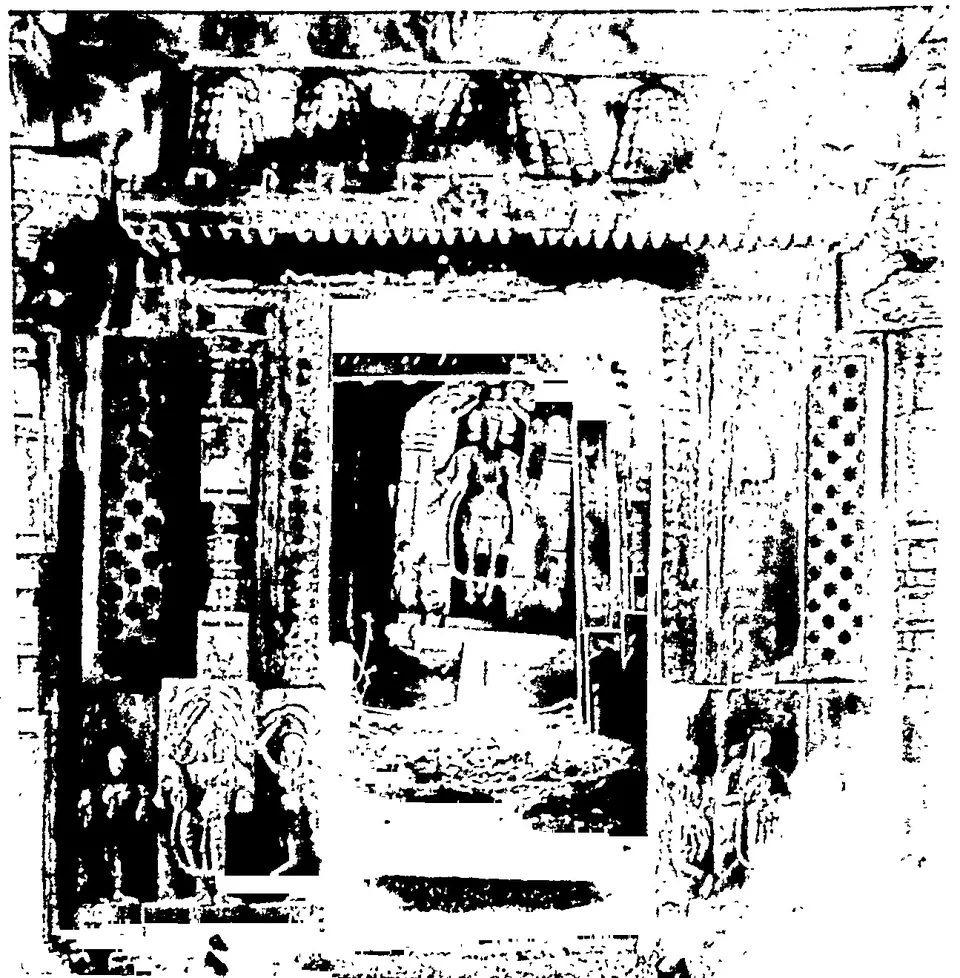
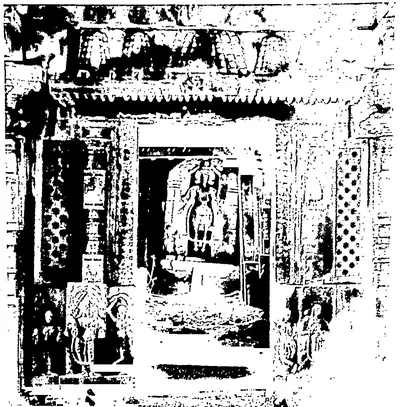
Katakshapur (spelt Katachpur in the older sources) is a village in the forest near Warangal. On the bund of its tank stand two ruined granite temples.1 The Hyderabad Archaeological Department judged that they were of the same age as the temples at Palampet and Ghanpur and the Thousand Pillar Temple at Hanamkonda.1
The village and the tank
Katakshapur lies a furlong west of the Warangal–Mulug road, between its 17th and 18th milestones.1 Syed Yusuf, the assistant director of the Hyderabad Archaeological Department, surveyed it in 1935–36.1 By then it had shrunk to ten or twelve thatched huts.1 North of the village lies a large tank of fresh water, the Katachpur tank.1 The Imperial Gazetteer of 1909 had already listed the Katachpur tank among the chief tanks of Warangal district.2
The temples
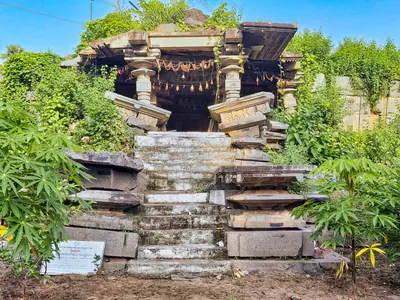
On the southern bund of the tank, hidden in a palmyra grove and overgrown, stand the remains of two temples.1 The report called them Chalukyan.1 It judged from their general plan, architectural features and workmanship that they were contemporary with (of the same age as) the temples at Palampet and Ghanpur and the Thousand Pillar Temple at Hanamkonda.1 It cites no inscription for them.1
Both temples are built of finely dressed grey granite.1 Both are cruciform (cross-shaped) in plan, and both measure 54 feet each way.1 They differ in one thing: the eastern temple has its entrance on the north, while the western one faces east.1 Both stand in a rectangular court with a massive stone wall around it.1 This wall is built in the same manner as the enclosure wall of the Palampet temples.1
Shiva or Vishnu?
The report took them to have been Shaiva (Shiva) temples for three reasons:1
- a damaged Nandi on the platform by the steps of the entrance porch1
- the carving of the door frames1
- the lingas (stone emblems of Shiva) in the shrines1
In the main shrine of the second temple, however, someone had set a figure of Vishnu on a square yoni (the usual base of a linga).1 The report took this to be a later change.1
S. Gopalakrishna Murthy, writing in 1964, read the pair differently.3 He thought that another general, whom he does not name, had built them, one for Shiva and one for Vishnu.3 In his view this happened at a time when the two faiths competed for favour.3 He admired the four-armed image of Vishnu, probably Chennakesava, in the sanctum of what he called the Vishnu temple.3 It is about four and a half feet high, and he counted it as one of the finest Kakatiya sculptures.3
Condition
The temples had long been deserted and were in poor condition.1 The department proposed to repair and protect them.1
Footnotes
-
Annual Report of the Archaeological Department of H.E.H. the Nizam’s Dominions, 1345 F. (1935–36) (1939), p. 8 and Plate XIII (archive.org (opens in a new tab)). Public domain in India; paraphrased. ↩ ↩2 ↩3 ↩4 ↩5 ↩6 ↩7 ↩8 ↩9 ↩10 ↩11 ↩12 ↩13 ↩14 ↩15 ↩16 ↩17 ↩18 ↩19 ↩20 ↩21 ↩22 ↩23
-
Imperial Gazetteer of India, Provincial Series: Hyderabad State (1909), p. 166 (archive.org (opens in a new tab)). ↩
-
S. Gopalakrishna Murthy, The Sculpture of the Kakatiyas (Andhra Pradesh Government Archaeological Series 34, n.d.; preface dated 1964), p. 27 and fig. 28 (archive.org (opens in a new tab)). Public domain in India; paraphrased. ↩ ↩2 ↩3 ↩4 ↩5
Photos
References
Notes (0)
Sources (3)
Spotted an error on this page? Tell us
Last updated: