Gooty fort
Hill fortress on a ring of rocky hills at Gooty in the Anantapur district. An outer rampart runs round the town, and a citadel stands on a steep rock 2,105 feet above the sea, reached by a winding paved path through fourteen gateways. Western Chalukya inscriptions of 1121–23 and a verse praising king Bukka of Vijayanagara are cut on its summit. Local belief credited Krishnadeva Raya with building it, which the Anantapur gazetteer rejected. Morari Rao, Haidar Ali and the Company held it in turn.
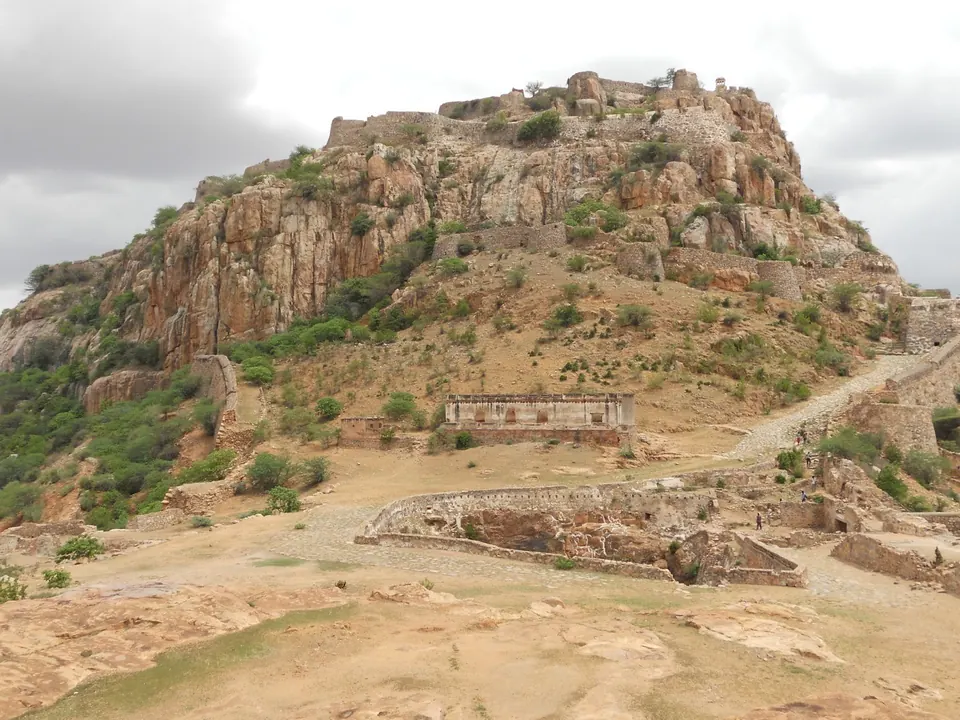
The Anantapur gazetteer of 1905 describes the fortress of Gooty.1 A roughly circular cluster of steep, bare hills surrounds the town.1 Round their outside “runs a strong wall or rampart, built of stone pointed with chunam, which is guarded by frequent round towers or bastions” (chunam is lime plaster).1 It had two openings, once gated, on the north and west.1
The westernmost hill carries the citadel.1 The gazetteer calls it “a huge, precipitous mass of bare rock which towers hundreds of feet above all the others”.1 A paved path leads first to a strongly fortified spur “known in former days as Mar Gooty”.1 It then “winds upwards round the steep sides of the great rock above it”.1 At last it “reaches the summit of the fortress, which is 2,105 feet above the level of the sea”.1
The summit is defended “by a series of walls perched one above the other along its precipitous sides”.1 These walls are “connected with re-entering gateways flanked by bastions”.1 Robert Sewell’s lists counted “fourteen gateways” in the lines of fortification.2
The citadel “contains no buildings or remains of architectural interest”.1 On the top the gazetteer noted what seemed to be a gymnasium and a powder-magazine.1 On the edge of a 300-foot cliff stands a small pavilion of polished chunam, called “Morari Rao’s seat”.1 Reservoirs cut in the clefts of the rock caught the rain.1 Some ruined buildings had served Munro as prisons for unruly poligars (local chiefs).1
The Archaeological Department’s notes of 1912–13 record that the fort and its buildings had been placed on the list of monuments specially conserved by Government.3 Large sums had been spent on repairs.3
Who built it
The gazetteer found that “materials for a continuous history of the fort are not available”.45 There are eight inscriptions near the deserted Narasimha temple on the summit.45 Three belong to the Western Chalukya king Vikramaditya VI, two of them dated in 1121–22 and 1122–23.45 Their existence “shows … that the fort was a place of importance 880 years ago”.45
The eighth, a Sanskrit verse, praises “Gutti-durga, the king of forts” as the hub of the wheel of king Bukka’s rule.6 E. Hultzsch took the king for Bukka I of Vijayanagara.6 See the Gooty inscription.
Sewell’s lists of 1882 reported that the fort was “said to have been constructed by Krishnadeva Raya”.2 They read the Bukka of the verse as “probably Bukka Raja, one of Krishnadeva Raya’s officers, who built the fort”.2 The inspection notes of 1912–13 repeated Sewell’s report.3
The gazetteer disagreed.5 It says that Krishnadeva “is popularly credited with having built” the fortifications, “but it has been stated above that they had been begun many years before his time”.5 In its account of the district’s history, it allowed only that the Vijayanagara kings “built some portions, not now separately distinguishable, of the fortifications at Gooty and Penukonda”.7 See Krishnadeva Raya and Bukka I.
Later sieges
The gazetteer says that the Vijayanagara princes of Penukonda still held the fort at the end of the sixteenth century.8 A Mackenzie manuscript tells of its fall by treachery to Mir Jumla after a siege of twelve years, which the gazetteer doubted.8 The Maratha Morari Rao settled in it about 1746 and repaired its fortifications in 1754.8 Sewell’s lists say that Haidar Ali took it from him in 1776 “after a siege of nine months”.2 It passed to the English in 1799.2
Footnotes
-
Francis, Anantapur Gazetteer (1905), p. 153 (archive.org (opens in a new tab)). ↩ ↩2 ↩3 ↩4 ↩5 ↩6 ↩7 ↩8 ↩9 ↩10 ↩11 ↩12 ↩13 ↩14 ↩15 ↩16
-
Robert Sewell, Lists of the Antiquarian Remains in the Presidency of Madras, Vol. I (1882), p. 115 (archive.org (opens in a new tab)). ↩ ↩2 ↩3 ↩4 ↩5
-
Annual Report of the Archaeological Department, Southern Circle, Madras, for the year 1912–13 (1913), p. 59, Anantapur district, No. 81 (archive.org (opens in a new tab)). ↩ ↩2 ↩3
-
Francis, Anantapur Gazetteer (1905), p. 155 (archive.org (opens in a new tab)). ↩ ↩2 ↩3 ↩4
-
Francis, Anantapur Gazetteer (1905), p. 156 (archive.org (opens in a new tab)). ↩ ↩2 ↩3 ↩4 ↩5 ↩6
-
E. Hultzsch, South-Indian Inscriptions, Vol. I (1890), p. 167, No. 154 (archive.org (opens in a new tab)). ↩ ↩2
-
W. Francis, Madras District Gazetteers: Anantapur (1905), p. 18 (archive.org (opens in a new tab)). ↩
-
Francis, Anantapur Gazetteer (1905), p. 157 (archive.org (opens in a new tab)). ↩ ↩2 ↩3
Photos
Related
Inscriptions
References
Notes (0)
Sources (4)
Spotted an error on this page? Tell us
Last updated: