Kshiraramalingesvara temple, Palakollu
Shiva temple in the middle of Palakollu, in the western Godavari delta, one of the five Pancharama shrines under the name Kshirarama. M. Rama Rao (1964) gave its shrine to the Eastern Chalukya king Chalukya-Bhima I, and the foreword to his monograph counts it among the original Chalukya buildings. Its own inscriptions, more than forty, run from 1136 to 1640. They record gifts of the Velanadu chiefs, the Haihaya chiefs of Konamandala, the Chalukya chiefs of Nidadavolu and the Reddi kings.
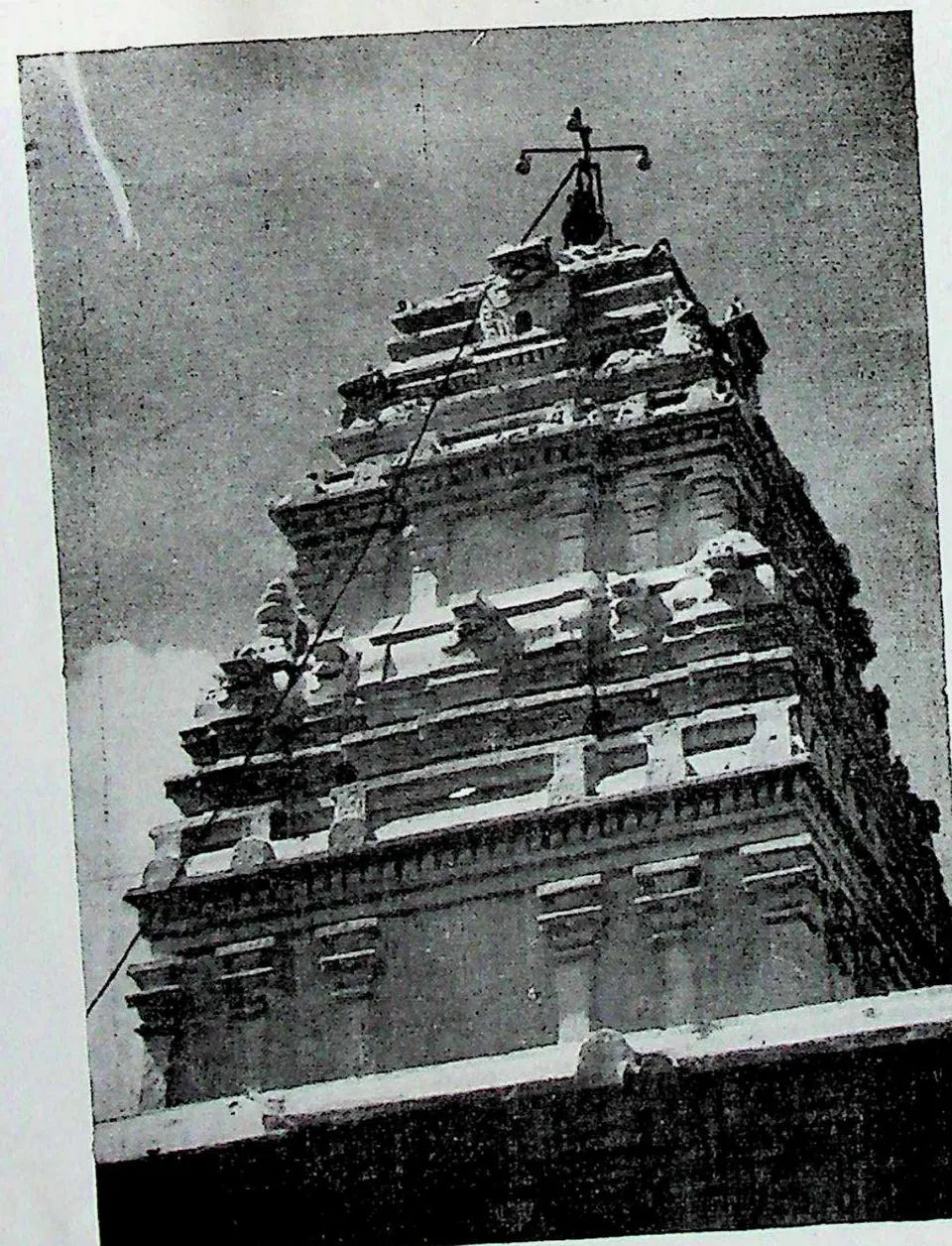
The temple of Shiva as Kshiraramesvara or Ramalingesvara stands almost in the middle of Palakollu, with houses and bazaars on all sides.1 M. Rama Rao described it in 1964 as one of the five famous aramas (Pancharama shrines) of the Telugu country.1 He also called it a popular centre of Saiva (Shiva) pilgrimage.1 The annual report on epigraphy for 1937–38 explained Kshirarama as the Sanskrit name of Palakollu.2
The legend
Rama Rao took the temple’s story from the Bhimesvara Puranamu of the Telugu poet Srinatha.13 Shiva destroyed the demons of Tripura and their city, and only the linga (stone emblem of Shiva) they worshipped survived.13 He broke it into five pieces, which were set up in five places, the Pancharamas.13 Rama installed one piece in the village of Balakota, also called Kshirarama, and so it became Ramalingesvara.13
The Godavari district gazetteer of 1907 gave a different story of the five lingas.4 In it the god Subrahmanya broke a linga worn by the demon Tarakasura.4 It too counted “Palakollu (also called Kshira-rama)” among the five places.4 Robert Sewell’s list of 1882 recorded only “a very old temple” at Palakollu.5 Its sthala-purana (temple legend) was kept by a resident of the village.5
Who built it?
In his preface Rama Rao credited the Eastern Chalukya king Chalukya-Bhima I with raising the Shiva shrines of all five Pancharamas, Palakollu among them.6 He dated that king’s reign 892–922.78 This site follows J. F. Fleet and Robert Sewell, who put it at 888–918.78
M. A. Waheed Khan’s foreword to the monograph goes further for this temple.7 It names the Ramalingesvara temple at Palakollu, with Bikkavolu, Draksharama and Chalukya-Bhimavaram, as temples that seem to be original buildings of the Chalukya kings.7 It says that both inscriptions and architecture show this.7
The inscriptions that Rama Rao himself summarised, however, begin only in 1136.19 His chapter on the temple does not name a builder.19 No earlier source used here gives the temple to the Eastern Chalukyas.54
Inscriptions
Rama Rao counted forty-six inscriptions in the temple, dated from 1136 to 1640.1 Most belong to the Chalukya chiefs of Nidadavolu, the Haihaya chiefs of Konamandala, the Velanadu chiefs of Chandavolu and the Reddi kings of Rajahmundry.1
V. Rangacharya’s list of 1919 draws on the epigraphical collection of 1893.1011 It likewise begins with a lamp given in Saka 1058 (1136; Saka is an Indian way of counting years) in the time of the Velanadu chief Choda, son of Gonka.1011 It also has the building of an Anjaneya shrine by a merchant in Saka 1562 (1640).1011 A record of 1596 in the list still uses the name Vishnuvardhana-Maharaja.1011
Rama Rao noted that several records entrust gifts to the temple’s three hundred sanis, or temple women.1 One gift of the Velanadu queen Gundambika is made to the god “Bhimesvara of Kshirarama”.1
Later gifts
Later gifts recorded in these inscriptions include these:910
- lamps and land from the Kona chiefs in the 13th century910
- a flower garden from the Reddi king Kataya Vema in 1385910
- a golden car in 1415 from Narahari, an officer of the Reddi king Doddaya Allada, who also built a kalyana-mantapa (wedding hall) of twenty-four pillars910
Sewell’s list, made from copies he distrusted, likewise records a mandapam (pillared hall) erected in 1416 in honour of Doddaya Allada.5 The Godavari gazetteer noted that Allada’s inscriptions appear at Palakollu from 1415–17.12
The building
Rama Rao thought the temple must once have had two enclosures, like those at Draksharama and Chalukya-Bhimavaram.9 But he found it much shrunk, with houses and roads built over what had been the outer enclosure.9 A tall gopura (gate tower) facing east marks the main entrance.9
Inside the inner enclosure is a long pillared hall, and a covered passage for circumambulation (walking round the shrine) runs on three sides.913 It holds images of Virabhadra, Brahma, the Seven Mothers, the goddess, Kumara, Mahishamardini, Nataraja and Surya.913
The shrines
In the open court stand five shrines.13 The central one holds the linga of Ramalingesvara or Kshiraramesvara.13 Its base is now cemented over, and its walls carry pilasters, a row of geese and a moulded cornice, under a three-storeyed tower of the Nagara order.13 Rama Rao thought the shrines on either side were later additions.13
He also described carvings of Shiva with Parvati, Ardhanarisvara (Shiva as half man, half woman), Shiva slaying the elephant demon, Brahma, Shiva and Parvati on the bull, and a dancing Shiva.13
See also Bhimesvara temple, Draksharama and Bhimesvara temple, Chalukya-Bhimavaram.
Footnotes
-
Rama Rao, Eastern Calukyan Temples (1964), p. 42 (archive.org (opens in a new tab)). ↩ ↩2 ↩3 ↩4 ↩5 ↩6 ↩7 ↩8 ↩9 ↩10 ↩11 ↩12 ↩13
-
Annual Report on South Indian Epigraphy for 1937–38 (1942), p. 99 (archive.org (opens in a new tab)). ↩
-
Rama Rao, Eastern Calukyan Temples (1964), p. 16 (archive.org (opens in a new tab)). ↩ ↩2 ↩3 ↩4
-
Hemingway, Godavari (1907), p. 207 (archive.org (opens in a new tab)). ↩ ↩2 ↩3 ↩4
-
Robert Sewell, Lists of the Antiquarian Remains in the Presidency of Madras, Vol. I (1882), p. 41, s.v. Palakol (archive.org (opens in a new tab)). ↩ ↩2 ↩3 ↩4
-
M. Rama Rao, Eastern Calukyan Temples of Andhra Desa (1964), preface (unnumbered) (archive.org (opens in a new tab)). ↩
-
Mohd. Abdul Waheed Khan, foreword to M. Rama Rao, Eastern Calukyan Temples of Andhra Desa (1964), p. i (archive.org (opens in a new tab)). ↩ ↩2 ↩3 ↩4 ↩5
-
Robert Sewell and S. Krishnaswami Aiyangar, The Historical Inscriptions of Southern India (1932), p. 337, pedigree and notes (archive.org (opens in a new tab)). ↩ ↩2
-
Rama Rao, Eastern Calukyan Temples (1964), p. 43 (archive.org (opens in a new tab)). ↩ ↩2 ↩3 ↩4 ↩5 ↩6 ↩7 ↩8 ↩9 ↩10 ↩11
-
V. Rangacharya, A Topographical List of the Inscriptions of the Madras Presidency, Vol. II (1919), pp. 902–903, Narasapur taluk, Palakol, Nos. 298–313 (archive.org (opens in a new tab)). ↩ ↩2 ↩3 ↩4 ↩5 ↩6 ↩7 ↩8
-
Rangacharya, Topographical List, Vol. II (1919), p. 904, Nos. 314–316 (archive.org (opens in a new tab)). ↩ ↩2 ↩3 ↩4
-
F. R. Hemingway, Madras District Gazetteers: Godavari (1907), p. 26 (archive.org (opens in a new tab)). ↩
-
Rama Rao, Eastern Calukyan Temples (1964), p. 44 (archive.org (opens in a new tab)). ↩ ↩2 ↩3 ↩4 ↩5 ↩6 ↩7
Photos
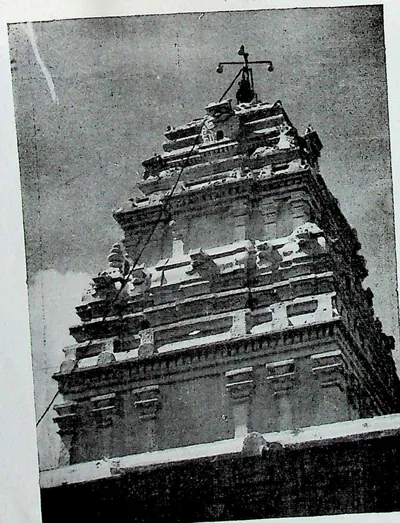 "41. Vimāna - Rāmalingēśwara Temple - Pālakol" (M. Rama Rao, Eastern Calukyan Temples of Andhra Desa, 1964, Fig. 41 (PDF p. 113))Historic photograph · 1964
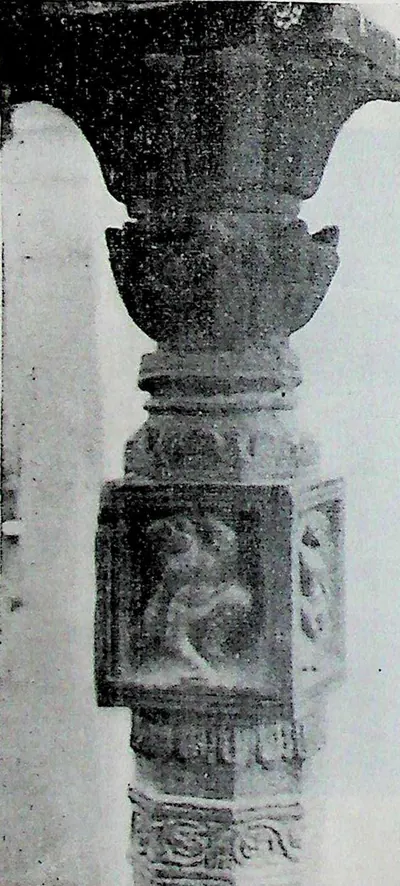 "42. Pillar with Sculpture - Pālakollu" (M. Rama Rao, Eastern Calukyan Temples of Andhra Desa, 1964, Fig. 42 (PDF p. 115))Historic photograph · 1964
References
Notes (0)
Sources (6)
Spotted an error on this page? Tell us
Last updated: