Purani Haveli
The 'old palace' of the Nizams in the north-eastern quarter of the old city of Hyderabad, near the Qutb Shahi Dar-ush-Shifa. The Imperial Gazetteer (1909) says it was built by the first of the Nizams and was still sometimes used by the reigning Nizam. Campbell (1898) calls it the Nizam's old palace. Bilgrami (1927) records Qutb Shahi graves within and beside its walls.
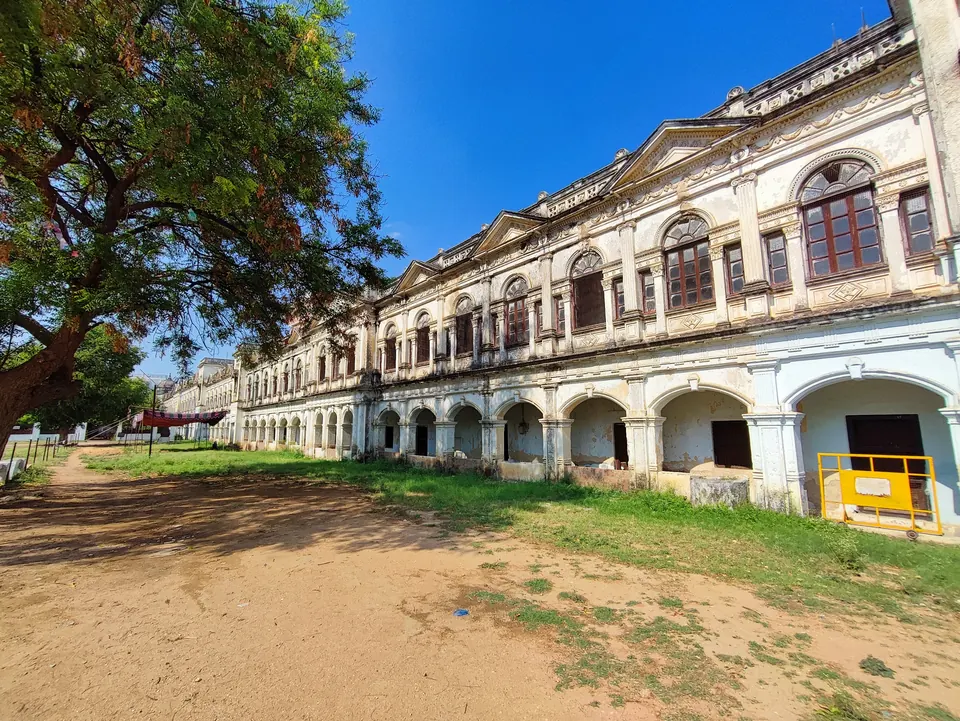
The Purani Haveli, the “old palace”, is a palace of the Asaf Jahi Nizams in the old city of Hyderabad. The Imperial Gazetteer of 1909 lists it first among the city’s “more recent buildings”.1 It calls it “an extensive building in the north-eastern quarter of the city, built by the first of the Nizams, and still occasionally used by the present ruler”.1 The first of the Nizams was Asaf Jah I, who ruled from 1724 to 1748.2 None of the sources consulted gives a closer date.
Setting
The gazetteer uses the palace as a landmark for the older buildings around it. It places the Qutb Shahi hospital, the Dar-ush-Shifa, “about 200 yards to the north-west of the Purani Haveli”.3 It places the palace of the Salar Jang family beyond “the road leading to the Purani Haveli”.4
Campbell’s Glimpses of the Nizam’s Dominions (1898) also uses it as a landmark.56 He places a mosque built by Muhammad Quli about 1600 “opposite the hospital and caravanserai, near the Nizam’s old palace”.56 He puts the Dar-ush-Shifa “near the old palace”.56
Bilgrami’s guide of 1927 records Qutb Shahi graves at the palace. The tomb of Ibn-i-Khatun stands “within the compound wall of Purani Haveli”, near the Zenani Phatak (the women’s gate).7 He was a minister of the Qutb Shahs and a nephew of Shaikh Bahai.7 The grave of Syed Muhammad Akbar lies near the palace, opposite the house of Nawab Qadir Jang.89 He was a scholar of the Qutb Shahi court and a son of Mir Muhammad Baqar Damad.89
Footnotes
-
Imperial Gazetteer: Hyderabad (1909), p. 116 (archive.org (opens in a new tab)). ↩ ↩2
-
Imperial Gazetteer of India: Hyderabad State (1909), p. 15 (archive.org (opens in a new tab)). ↩
-
Imperial Gazetteer: Hyderabad (1909), p. 115 (archive.org (opens in a new tab)). ↩
-
Imperial Gazetteer: Hyderabad (1909), p. 117 (archive.org (opens in a new tab)). ↩
-
A. Claude Campbell, Glimpses of the Nizam’s Dominions (1898), p. 173 (archive.org (opens in a new tab)). ↩ ↩2 ↩3
-
Campbell, Glimpses of the Nizam’s Dominions (1898), p. 233 (archive.org (opens in a new tab)). ↩ ↩2 ↩3
-
Syed Ali Asgar Bilgrami, Landmarks of the Deccan (1927), p. 63 (archive.org (opens in a new tab)). ↩ ↩2
-
Bilgrami, Landmarks of the Deccan (1927), p. 67 (archive.org (opens in a new tab)). ↩ ↩2
-
Bilgrami, Landmarks of the Deccan (1927), p. 68 (archive.org (opens in a new tab)). ↩ ↩2
Photos
References
Notes (0)
Sources (3)
Spotted an error on this page? Tell us
Last updated: