Nizam-ul-Mulk Asaf Jah I (Mir Qamar-ud-din)
Founder of the Asaf Jahi dynasty and first Nizam of Hyderabad. A Mughal noble of Turani descent, born at Delhi in 1671, he was made viceroy of the Deccan in 1713 with the title Nizam-ul-Mulk. He defeated and killed the governor Mubariz Khan at Shakar Kheda in Berar in 1724, received the title Asaf Jah, and ruled the Deccan as an independent sovereign until his death at Burhanpur in 1748. He is buried at Khuldabad near Aurangabad.
Mir Qamar-ud-din, better known by his titles Nizam-ul-Mulk and Asaf Jah, founded the dynasty of the Nizams of Hyderabad. The Imperial Gazetteer of 1909 calls him “a distinguished general of Aurangzeb, of Turkoman descent”.1 It says he was appointed subahdar, or viceroy, of the Deccan in 1713 “with the title of Nizam-ul-mulk, which has since become the hereditary title of the family”.1 See the Asaf Jahis.
Family and early career
Henry Briggs traced the family to Kilich Khan, who came to Aurangzeb’s court from Samarkand.2 K. Krishnaswamy Mudiraj’s Pictorial Hyderabad (1929) calls this ancestor Abid Kuli Khan, a former qazi (judge) of Bukhara who reached India in 1658.34 Mudiraj says that he was mortally wounded by a cannon ball at the siege of Golconda in 1687.34 He was buried at Asafnagar, on the road from Hyderabad to Golconda.34
Bilgrami’s guide of 1927 names him Khwaja Mir Abid Khan, alias Chin Qalich Khan.56 Bilgrami dates the fatal wound to the attack of 28 January 1687.56 He places the grave south of Golconda, near Himayat Sagar and the village of Atapur.56 His son Mir Shahab-ud-din, titled Ghazi-ud-din Khan Firuz Jang, married a daughter of Saadullah Khan, a minister of Shah Jahan. Their son, Mir Qamar-ud-din, was born at Delhi in 1671.47
Mudiraj says that the emperor Farrukhsiyar made him viceroy of the Deccan in 1713, with the title Nizam-ul-Mulk Firuz Jang. He was later moved to Moradabad.8 He was briefly chief minister of Muhammad Shah, but resigned that office and went back to the Deccan.8 Campbell gives the same outline, and dates his arrival at Delhi as vazir (chief minister) to January 1722.9
Shakar Kheda and independence
According to the Imperial Gazetteer, the court at Delhi was jealous of his independence and secretly told Mubariz Khan to oppose him by force. The two met at Shakarkhelda (Fathkhelda) in the Buldana district of Berar in 1724. There Mubariz Khan “was totally defeated and lost his life”. The gazetteer says the battle “established the independence of Asaf Jah, who annexed Berar, and fixed his residence at Hyderabad”.1
William Irvine, working from the Persian chronicles, dates the decisive battle to the afternoon of 23 Muharram AH 1137 (AH is the Islamic way of counting years), that is 11 October 1724.10 Mudiraj puts it in August 1724.8 Campbell puts it in October 1724, and Gribble’s first volume in 1723.1112
Mudiraj adds that the emperor then sent him a rescript (royal order) confirming him in the government of the Deccan.8 With it came gifts and the title Asaf Jah, “equal in dignity to Asoph, the Minister of Solomon”.8 See Mughals in the Telugu country.
Gribble’s second volume (1924) describes the extent of his government. Apart from the strip of the west coast held by the Marathas, it reached from the Tapti to Tiruchirappalli (then Trichinopoly). The Nawab of the Carnatic at Arcot was appointed by him.13 On the east coast, the country from Srikakulam (then Chicacole) southwards paid tribute through a governor of the Nizam stationed at Rajahmundry.13
Mudiraj says that Asaf Jah completed the half-built wall of Hyderabad and made the city his capital.14 Bilgrami credits the first part of the wall to Mubariz Khan, and the rest, with its parapets, to Asaf Jah.15 On where the capital lay, the sources differ. The Imperial Gazetteer says he came first to Aurangabad and “subsequently made Hyderabad his capital”.16 Campbell says that he fixed his seat of government at Hyderabad.11 Gribble, however, shows his successors still holding court at Aurangabad in the 1750s.17
Government
Gribble says Asaf Jah gave the Muslim nobles who came with him from Malwa jagirs, estates held on military tenure, and used them as his generals. He employed the Hindus who came with him chiefly in revenue and finance, and also paid them with jagirs.18 All these grants came to be treated as hereditary.18 The many local Hindu rajas who held grants from earlier kings were confirmed in their estates on payment of tribute. The country was divided between these jagirs, the ruler’s own estates (later called sarf-i-khas) and the government (dewani) lands.19
Many of the government lands were farmed out, that is, leased to revenue contractors.19 Gribble’s first volume gives a similar three-way division.20 Mudiraj records that in 1729 the Nizam granted the Marathas the sardeshmukhi, a tenth of the revenue, and the chauth, a quarter of the collections.21
Last years and death
Mudiraj says that while Asaf Jah was away at Delhi, his son Nasir Jang, left as his deputy, declared himself independent. Father and son fought near Aurangabad in 1741.22 Nasir Jang was wounded, and was held for a time in the fort of Kandhar near Nanded.22
Gribble says Asaf Jah returned to Hyderabad in 1744.23 He died in 1748, a few months after the emperor Muhammad Shah.23 Mudiraj gives the date and place as 19 June 1748 at Burhanpur, at the age of seventy-seven. His body was taken to Aurangabad and buried at Roza, in the shrine of Shaikh Burhan-ud-din.22 The Imperial Gazetteer lists his tomb among those at Khuldabad (Rauza), beside that of Aurangzeb.24
Family
Mudiraj names his wife as Syed-un-Nissa Begum, daughter of a Sayyid nobleman of Gulbarga.22 By her he had two sons, Ghazi-ud-din Khan Firuz Jang and Nasir Jang, and two daughters, Padsha Begum and Moshima Begum.22 Four more sons were born to other wives: Salabat Jang, Nizam Ali Khan, Basalat Jang and Mir Mughal Ali Khan.22
Gribble counts six sons and one daughter, and names the daughter’s son as Muzaffar Jang.25 The treaty collection of 1909 calls Muzaffar Jang the son of Nasir Jang’s sister.26
Mudiraj quotes Briggs’s verdict on him. Briggs called him unscrupulous in an age that admired such skill.2227 He also called him “not only a great soldier but a great diplomatist”.2227 To Briggs he was “an affectionate parent” whose “attachment to his friends was both sincere and steady”.2227
Footnotes
-
Imperial Gazetteer of India: Hyderabad State (1909), p. 15 (archive.org (opens in a new tab)). ↩ ↩2 ↩3
-
Henry George Briggs, The Nizam, Vol. I (1861), pp. 39–41 (archive.org (opens in a new tab)). ↩
-
K. Krishnaswamy Mudiraj, Pictorial Hyderabad, Vol. I (1929), p. 49 (archive.org (opens in a new tab)). ↩ ↩2 ↩3
-
Mudiraj, Pictorial Hyderabad (1929), p. 50 (archive.org (opens in a new tab)). ↩ ↩2 ↩3 ↩4
-
Syed Ali Asgar Bilgrami, Landmarks of the Deccan (1927), p. 88 (archive.org (opens in a new tab)). ↩ ↩2 ↩3
-
Bilgrami, Landmarks of the Deccan (1927), p. 89 (archive.org (opens in a new tab)). ↩ ↩2 ↩3
-
Bilgrami, Landmarks of the Deccan (1927), p. 90 (archive.org (opens in a new tab)). ↩
-
Mudiraj, Pictorial Hyderabad (1929), p. 51 (archive.org (opens in a new tab)). ↩ ↩2 ↩3 ↩4 ↩5
-
A. Claude Campbell, Glimpses of the Nizam’s Dominions (1898), p. 122 (archive.org (opens in a new tab)). ↩
-
William Irvine, Later Mughals, Vol. II (1922), p. 145 (archive.org (opens in a new tab)). ↩
-
Campbell, Glimpses of the Nizam’s Dominions (1898), p. 124 (archive.org (opens in a new tab)). ↩ ↩2
-
J. D. B. Gribble, A History of the Deccan, Vol. I (1896), p. 376 (archive.org (opens in a new tab)). ↩
-
J. D. B. Gribble (ed. M. Pendlebury), A History of the Deccan, Vol. II (1924), p. 2 (archive.org (opens in a new tab)). ↩ ↩2
-
Mudiraj, Pictorial Hyderabad (1929), p. 52 (archive.org (opens in a new tab)). ↩
-
Bilgrami, Landmarks of the Deccan (1927), pp. 94–95 (archive.org (opens in a new tab)). ↩
-
Imperial Gazetteer: Hyderabad (1909), p. 208 (archive.org (opens in a new tab)). ↩
-
Gribble, History of the Deccan, Vol. II (1924), p. 30 (archive.org (opens in a new tab)). ↩
-
Gribble, History of the Deccan, Vol. II (1924), p. 5 (archive.org (opens in a new tab)). ↩ ↩2
-
Gribble, History of the Deccan, Vol. II (1924), p. 6 (archive.org (opens in a new tab)). ↩ ↩2
-
Gribble, History of the Deccan, Vol. I (1896), p. 377 (archive.org (opens in a new tab)). ↩
-
Mudiraj, Pictorial Hyderabad (1929), p. 54 (archive.org (opens in a new tab)). ↩
-
Mudiraj, Pictorial Hyderabad (1929), p. 55 (archive.org (opens in a new tab)). ↩ ↩2 ↩3 ↩4 ↩5 ↩6 ↩7 ↩8 ↩9
-
Gribble, History of the Deccan, Vol. II (1924), p. 14 (archive.org (opens in a new tab)). ↩ ↩2
-
Imperial Gazetteer: Hyderabad (1909), p. 213 (archive.org (opens in a new tab)). ↩
-
Gribble, History of the Deccan, Vol. II (1924), p. 15 (archive.org (opens in a new tab)). ↩
-
C. U. Aitchison, A Collection of Treaties, Engagements and Sanads, Vol. IX (1909), p. 1 (archive.org (opens in a new tab)). ↩
-
Mudiraj, Pictorial Hyderabad (1929), p. 56 (archive.org (opens in a new tab)). ↩ ↩2 ↩3
Photos
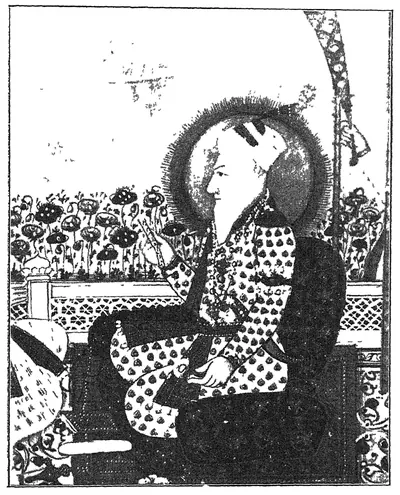 "Another portrait of Nizam-ul-Mulk" (Asaf Jah I; Mudiraj, Pictorial Hyderabad, 1929, p. 53)Book plate · 1929
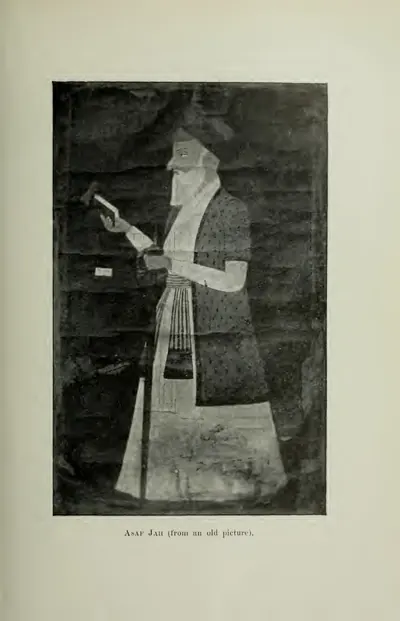 "Asaf Jah (from an old picture)" (Gribble 1896, PDF p. 333)Book plate · 1896
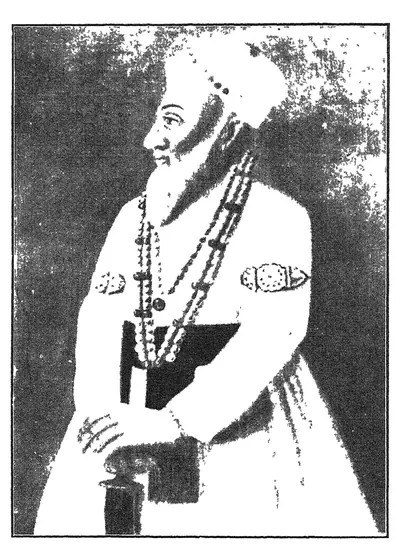 "His Highness Nawab Mir Kamruddin Chin Kulik Khan Amir-ul-Umrah, Nizam-ul-Mulk Asaf Jah, the first Nizam and founder of the Asaf Jahi dynasty" (portrait in Mudiraj, Pictorial Hyderabad, 1929, p. 52)Book plate · 1929
Related
Dynasties
References
Notes (0)
Sources (9)
Spotted an error on this page? Tell us
Last updated: