Rachakonda Fort
Hill fort of the Recherla Velama kings on the twin hills of Rajukonda and Naganayanikonda, east of Hyderabad. Three inscriptions of August 1365 record that Anapota Nayaka built its stone walls and wells and dug the tank between the two hills. Sultan Quli of Golconda took it by storm early in the sixteenth century.
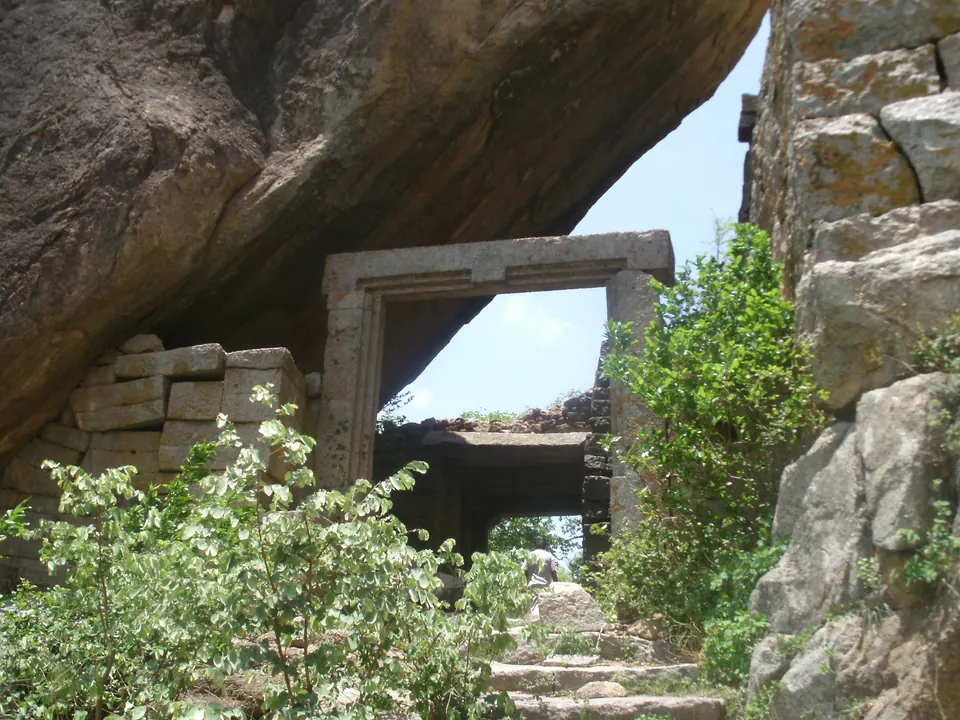
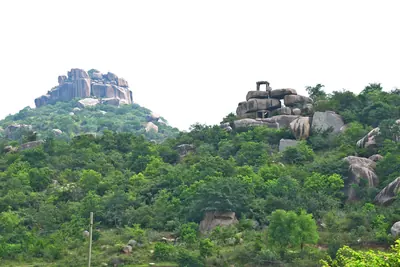
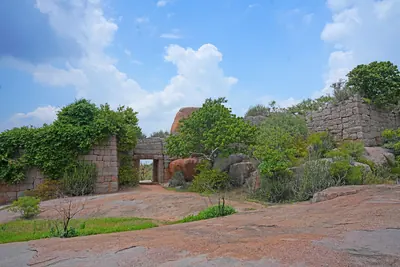
Rachakonda Fort stands on two rocky hills in the forest east of Hyderabad, near the village of Rachakonda. The family chronicle of the Velugoti Rajas, printed in 1910, calls the southern hill Rachakonda and the northern Naganayanikonda.1 It explains that the kings lived on the first.1 Naga Nayadu lived on the second and gave it his name.1 The fort was the capital of the Rachakonda branch of the Recherla Velamas.2
Building
V. Yashoda Devi credits Singama Nayaka with building the first fort at Rajukonda.3 The datable work is his son’s. There are three Telugu inscriptions of Anapota Nayaka at the fort.456 They are dated in the month Sravana of Saka 1287 (Saka is an Indian way of counting years), the year Visvavasu (August 1365).456
The inscriptions give Anapota the titles Andhradesadhisvara (lord of the Andhra country), Kakati-rajya-sthapanacharya (establisher of the Kakatiya kingdom) and Somakula-Parasurama.456 They say that he lived at Rajagiri.456 According to the inscriptions, he did the following works:56
- he built stone fortifications and wells on the hill of Rajukonda, to the south of the tank Anapota-samudram, and on Naganayanikonda, to its north56
- he raised earthen walls to the west56
- he dug the tank itself between the two hills for the good of all beings, naming it after his title Pratigandabhairava56
One of the three records stands near another gate and adds that he built the entrance gate.46 Another records an image of the god Pratigandabhairava set up in the tank.46 All three were written by his karanam (clerk), Chilamaraju Tippana.46 See the Rachakonda inscriptions of 1365.
The chronicle connects the northern hill with Nagaya-nayaka, son of Singama’s younger brother.7 It says that his fort on Naganayanikonda still bore his name.7 Alladi Jagannatha Sastri’s family history of 1922 likewise says that Naga Naidu was remembered by a fort built in his name.8
The ruins
Jagannatha Sastri described the ruins in 1922:9
- a great wall of boulders running round the two peaks9
- four towers with rock-built ramparts twenty yards high on Rachakonda, and other towers on the second hill9
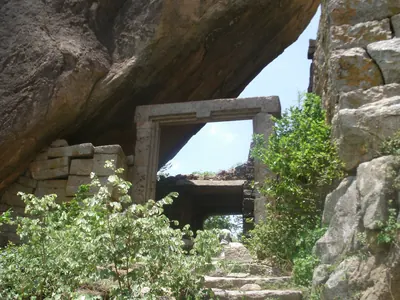
- large gateways leading up the hills9
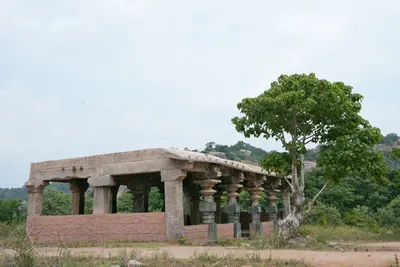
- a central palace hall called Boddu-Chavika that was still standing9
The 1910 chronicle names the gates, among them the Elephant Gate on the west and the Bhuvanagiri pass on the north.1 It describes great rocks near the gates, carved with images of Bhairava, Pratigandabhairava, Virabhadra and Anjaneya and inscribed with the kings’ titles.1 It also mentions a stream running through the town, ruined temples, wells and tanks, and a well called the well of chains.1
The census survey of the Nalgonda district (1964) says the fort had a single main entrance and one side exit. Massive walls stood on top of the two hills, with a moat around them and a flight of steps to the top. The survey records a ruined palace on one hill, with guard rooms in its walls.10 It records a spring between the hills, about a foot and a half wide and thirty feet long, that never dried up.10 It also records temples with inscriptions, and a horse pond, Gurralakoneru, on the northern hill.10
The Archaeological Department of the Nizam’s Dominions photographed the Horse-Pond hill, the ruined town and other parts of Rajkonda in 1915–16.1112
Siege
The Golconda chronicle translated by John Briggs says that Sultan Quli Qutb Shah besieged Rajconda because its raja had attacked his territory. His heavy artillery made breaches in the walls within a few days.1314 The garrison made several desperate sallies (attacks from the fort).1314 But the fort was carried by storm, “though not without considerable loss”.1314 The raja, Venkutty Naig, was taken prisoner to Golconda.1314 See Sultan Quli.
Footnotes
-
Sadasiva Sastri, Velugotivari Vamsacaritramu (1910), pp. 34–35 (archive.org (opens in a new tab)). Telugu; paraphrased. ↩ ↩2 ↩3 ↩4 ↩5 ↩6
-
Yashoda Devi, After the Kakatiyas (1975), p. 64. Cite-only; paraphrased. ↩
-
V. Yashoda Devi, After the Kakatiyas (1975), p. 52. Cite-only; paraphrased. ↩
-
Sadasiva Sastri, Velugotivari Vamsacaritramu (1910), appendix, pp. 26–27, inscriptions Nos. 5 and 6 (archive.org (opens in a new tab)). Telugu; paraphrased. ↩ ↩2 ↩3 ↩4 ↩5 ↩6 ↩7
-
Sadasiva Sastri, Velugotivari Vamsacaritramu (1910), appendix, pp. 28–29, inscriptions Nos. 7 and 8 (archive.org (opens in a new tab)). Telugu; paraphrased. ↩ ↩2 ↩3 ↩4 ↩5 ↩6 ↩7 ↩8
-
Gajjala Vasanta Lakshmi (ed.), Epigraphia Telanganica, vol. 4 (2023), pp. 17–18, Nos. 1–3. Cite-only; paraphrased. ↩ ↩2 ↩3 ↩4 ↩5 ↩6 ↩7 ↩8 ↩9 ↩10 ↩11
-
Vellala Sadasiva Sastri, Velugotivari Vamsacaritramu (1910), pp. 30–31 (archive.org (opens in a new tab)). Telugu; paraphrased. ↩ ↩2
-
Alladi Jagannatha Sastri, A Family History of Venkatagiri Rajas (1922), p. 19 (archive.org (opens in a new tab)). ↩
-
Jagannatha Sastri, Family History of Venkatagiri Rajas (1922), pp. 22–23 (archive.org (opens in a new tab)). ↩ ↩2 ↩3 ↩4 ↩5
-
A. Chandra Sekhar (ed.), Census of India 1961, Vol. II, Part VII-B (20): Fairs and Festivals, Nalgonda District (1964), Section I (Nalgonda taluk), entry “Rajkonda” (PDF p. 23) (censusindia.gov.in (opens in a new tab)). Paraphrased. ↩ ↩2 ↩3
-
Annual Report of the Archaeological Department of His Highness the Nizam’s Dominions, 1915-16 (1917), p. viii (archive.org (opens in a new tab)). ↩
-
Annual Report of the Archaeological Department … 1915-16 (1917), p. 26, Appendix E, photographs Nos. 227–234 (archive.org (opens in a new tab)). ↩
-
Muhammad Qasim Ferishta, tr. John Briggs, History of the Rise of the Mahomedan Power in India, Vol. III (1829), p. 354 (archive.org (opens in a new tab)). ↩ ↩2 ↩3 ↩4
-
Ferishta, tr. Briggs, Vol. III (1829), p. 355 (archive.org (opens in a new tab)). ↩ ↩2 ↩3 ↩4
Photos
Related
Inscriptions
References
Notes (0)
Sources (7)
Spotted an error on this page? Tell us
Last updated: