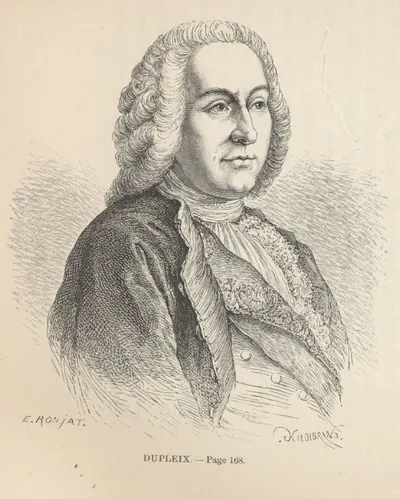
Joseph François Dupleix
Governor of Pondicherry and of the French settlements in India from 1742 to 1754. By backing Muzaffar Jang and then Salabat Jang in the war for the Nizam's throne, he won for the French Company the grant of Masulipatam (1750) and, through his officer Bussy, the Northern Circars (1753). Superseded by Godeheu in 1754, he died in poverty in France.
Joseph François Dupleix was the French governor who turned the trading posts of the Compagnie des Indes into a territorial power.12 He was also the first European to obtain a grant of land in the Telugu country.12
G. B. Malleson, his biographer in the Rulers of India series (1890), says that he “was born at Landrecies in 1697”.3 He was the son of a Farmer-General (a collector of royal taxes) and director of the Company of the Indies.3 The Gazetteer of Southern India (1855) says that he was governor of Chandernagore from 1730.45 From 1742 he was governor of Pondicherry, with the other French establishments.45 See French East India Company.
Masulipatam and the Circars
When the war for the Nizam’s throne broke out after 1748, Dupleix backed Muzaffar Jang. He obtained from him a grant of Machilipatnam (then Masulipatam) and its country. Nasir Jang had the French factories (trading stations) at Machilipatnam and Yanam seized.1678 In 1750, after this, Dupleix secretly embarked troops on two ships lying at Pondicherry, and sent them to take the place.1678 The Kistna manual says he called his secret council only when all was ready.1678
When Muzaffar Jang became Subahdar (governor of the Deccan) in December 1750, he confirmed the grant of Machilipatnam and Divi.9 The Kistna manual says he also “made M. Dupleix Governor of all the country south of the Kistna”.9
Salabat Jang added the lands of Nizampatnam, Kondavidu (then Kondavid) and Narsapur.2 He gave Dupleix himself a territory in the district of Srikakulam (then Chicacole).2 The officer who won the four Circars for the Company in 1753 was Charles de Bussy.9 Bussy had volunteered to command the French troops that Dupleix sent with Muzaffar Jang.9
Called back to France, and death
In France the Company and the King’s ministers had grown weary of a distant war “which brought them neither glory nor profit”. Dupleix learned that he had been replaced.1011 His successor Godeheu anchored off Pondicherry on 1 August 1754 with an order for his recall.1011
The Gazetteer of Southern India says that Godeheu was sent because Dupleix’s character “was too well known to entrust any such pacific operations to him” (that is, peaceful dealings).5 Malleson quotes his memoir, written three days before he died: “I have sacrificed my youth, my fortune, my life, to enrich my nation in Asia.” He dates Dupleix’s death to 10 November 1764.1213
Footnotes
-
Gordon Mackenzie, A Manual of the Kistna District (1883), p. 44 (archive.org (opens in a new tab)). ↩ ↩2 ↩3 ↩4 ↩5
-
G. B. Malleson, History of the French in India (1868), p. 275 (archive.org (opens in a new tab)). ↩ ↩2 ↩3 ↩4
-
G. B. Malleson, Dupleix (Rulers of India, 1890), p. 35 (archive.org (opens in a new tab)). ↩ ↩2
-
A Gazetteer of Southern India, with the Tenasserim Provinces and Singapore (1855), p. 310 (archive.org (opens in a new tab)). ↩ ↩2
-
Gazetteer of Southern India (1855), p. 311 (archive.org (opens in a new tab)). ↩ ↩2 ↩3
-
Mackenzie, Kistna District (1883), p. 45 (archive.org (opens in a new tab)). ↩ ↩2 ↩3
-
Malleson, French in India (1868), p. 252 (archive.org (opens in a new tab)). ↩ ↩2 ↩3
-
Malleson, French in India (1868), p. 253 (archive.org (opens in a new tab)). ↩ ↩2 ↩3
-
Mackenzie, Kistna District (1883), p. 46 (archive.org (opens in a new tab)). ↩ ↩2 ↩3 ↩4
-
Malleson, Dupleix (1890), p. 156 (archive.org (opens in a new tab)). ↩ ↩2
-
Malleson, Dupleix (1890), p. 158 (archive.org (opens in a new tab)). ↩ ↩2
-
Malleson, Dupleix (1890), p. 164 (archive.org (opens in a new tab)). ↩
-
Malleson, Dupleix (1890), p. 165 (archive.org (opens in a new tab)). ↩
Photos
References
Notes (0)
Sources (4)
Spotted an error on this page? Tell us
Last updated: