Yanam
Small town on the Godavari where the Coringa river leaves the Gautami branch. It was a French factory (trading post) from about 1750, and French territory apart from long English occupations in the wars, until the Government of India took over the French Establishments on 1 November 1954. It was famous in the eighteenth century for white long-cloth. Yanam is now a district of the Union Territory of Puducherry, surrounded by the East Godavari country.
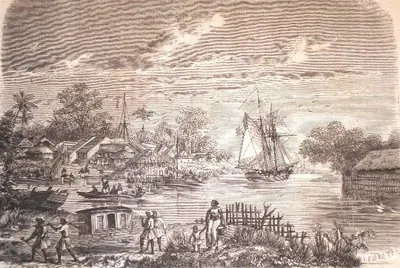
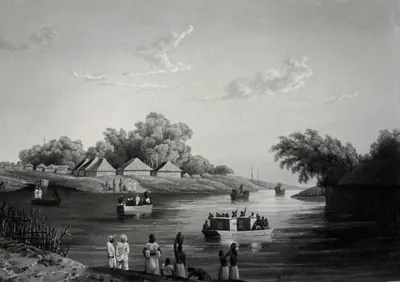
Yanam stands on the left bank of the eastern, or Gautami, branch of the Godavari, about twelve miles from the river’s mouth. It lies “at the point where the Coringa river branches off from the main stream”. The Godavari gazetteer of 1907 says that the settlement stretched along both rivers for seven or eight miles.12 It covered 2,258 acres with four hamlets, and it had 5,005 people in 1901.12
Morris says that Yanam “was not in existence in 1706”, when a great sea flood swept the coast.23 Its site was then forest.23 See French East India Company.
The French factory
Morris says that the French factory was “apparently subordinate to their chief” at Machilipatnam (then Masulipatam), and that it was set up “some time before 1750”.23 The gazetteer says “about 1750”, and adds that the place “was formally ceded to them in 1752”.41
In 1750 the Nizam Nasir Jang had the French lodges at Machilipatnam and Yanam seized.56 Malleson says that in 1751 his brother Salabat Jang “ordered the re-building of all the factories at Yanoon which his brother, Nazir Jung, had destroyed”.56 Yanam was among the towns of the coast that the French held under the grant of the Circars in 1753.7
In 1787 the English Committee of Circuit found that Yanam exported “between two and three thousand bales of white long cloth”.3 The cloth was mostly coarse, and it was largely paid for in coin.3
Taken and restored
Morris says that Yanam “changed masters as often as the fortune of war permitted”.3 It kept “being restored to France with the other French possessions in India at each successive peace”.3
Hemingway’s gazetteer gives the later record.18 Yanam “from 1793 onwards, save for a short period in 1802–03, was in the occupation of the English till the treaties of 1815 restored it to its former owners”.18 “It was then finally handed back in 1817.”18
The Gazetteer of Southern India (1855) names Yanam, with the lodge at Machilipatnam, as the French establishments “on the Orissa Coast”.91011 It gives Yanam’s territory in 1836 as 8,147 acres.91011 By the treaty of 1814 France undertook to keep no fortifications or troops beyond its police in its Indian settlements.9
The English kept customs posts at Nilapalli and Injaram, on Yanam’s eastern and western borders.12 There they taxed goods coming out of Yanam.12
The French town
Morris, writing in 1878, called Yanam “a clean, pretty, carefully-kept little town”.2 Until 1857 its land was farmed to a single “farmer-general”.13 From 1858 the government dealt with the cultivators directly, and an order of 1871 made them owners of their land.13 A hurricane and sea flood in November 1839 laid the town waste and destroyed all the official records.14
In 1907 Yanam was governed by an Administrateur, under the Governor of the French possessions at Pondicherry, with an elected council of six.8 Water from the British canal was given to its fields free.8
1954
A notification of the Government of India is dated 30 October 1954.15 It recites that, by an agreement with France of 21 October 1954, the Indian government had jurisdiction over the French Establishments in India: Pondicherry, Karaikal, Mahe and Yanam.15 It provides for their administration by a Chief Commissioner from 1 November 1954.15
Footnotes
-
F. R. Hemingway, Madras District Gazetteers: Godavari, Vol. I (1907), p. 215, s.v. Yanam (archive.org (opens in a new tab)). ↩ ↩2 ↩3 ↩4 ↩5 ↩6
-
Henry Morris, A Descriptive and Historical Account of the Godavery District (1878), p. 206 (archive.org (opens in a new tab)). ↩ ↩2 ↩3 ↩4 ↩5 ↩6
-
Morris, Godavery District (1878), p. 207 (archive.org (opens in a new tab)). ↩ ↩2 ↩3 ↩4 ↩5 ↩6 ↩7
-
Hemingway, Godavari (1907), p. 29 (archive.org (opens in a new tab)). ↩
-
G. B. Malleson, History of the French in India (1868), p. 252 (archive.org (opens in a new tab)). ↩ ↩2
-
Malleson, French in India (1868), p. 275 (archive.org (opens in a new tab)). ↩ ↩2
-
Malleson, French in India (1868), p. 370 (archive.org (opens in a new tab)). ↩
-
Hemingway, Godavari (1907), p. 216 (archive.org (opens in a new tab)). ↩ ↩2 ↩3 ↩4 ↩5
-
A Gazetteer of Southern India, with the Tenasserim Provinces and Singapore (1855), p. 313 (archive.org (opens in a new tab)). ↩ ↩2 ↩3
-
Gazetteer of Southern India (1855), p. 316 (archive.org (opens in a new tab)). ↩ ↩2
-
Gazetteer of Southern India (1855), p. 317 (archive.org (opens in a new tab)). ↩ ↩2
-
Hemingway, Godavari (1907), p. 187 (archive.org (opens in a new tab)). ↩ ↩2
-
Morris, Godavery District (1878), p. 208 (archive.org (opens in a new tab)). ↩ ↩2
-
Morris, Godavery District (1878), p. 209 (archive.org (opens in a new tab)). ↩
-
The Gazette of India, Extraordinary, Part II, Section 3, No. 254 (1 November 1954), p. 2137, notification S.R.O. 3314 of 30 October 1954 (Public domain in India; paraphrased) (archive.org (opens in a new tab)). ↩ ↩2 ↩3
Photos
References
Notes (0)
Sources (5)
Spotted an error on this page? Tell us
Last updated: