Charles de Bussy
French general, born in 1718, who commanded the French troops at the court of the Nizams Muzaffar Jang and Salabat Jang from 1751 to 1758. He raised Salabat Jang to the throne and obtained from him the four Northern Circars for the French Company in 1753. He governed them through the Raja of Vizianagaram and the zamindars. In 1757 he destroyed the fort of Bobbili and took the English factories on the coast. Lally recalled him to the Carnatic in 1758, and he left the Circars to be lost to Colonel Forde.
Charles de Bussy was the French soldier who, for eight years, made the Nizams of Hyderabad depend on a small French corps.12 For four of those years he governed the Telugu coast from Machilipatnam (then Masulipatam) to Srikakulam (then Chicacole).12
Malleson’s History of the French in India (1868) says that “he was born in 1718, at Bucy, near Soissons”.3 He lost his father early and came to India with La Bourdonnais in 1746.3 His full name was “Charles-Joseph Patissier, Marquis de Bussy-Castelnau”.3 See French East India Company.
The Nizam’s protector
Bussy made his name by storming Gingee in 1750.34 When Muzaffar Jang became Subahdar (governor) of the Deccan, he asked Dupleix for a French bodyguard.4 Bussy “volunteered for the command of this contingent”, which had 300 Europeans with ten field-pieces and 2,000 sepoys (Indian soldiers).4
Muzaffar Jang was killed on the march in 1751.5 Bussy, with the chief officers of the army, at once proclaimed Salabat Jang.5
The Nizam’s minister held back the pay of the French troops.16 So Bussy marched on Aurangabad and obtained four provinces: Mustafanagar, Eluru (then Ellore), Rajahmundry and Srikakulam.16 Malleson dates the grant to 4 December 1753.6 The provinces were given “for the support of their army so long as a certain strength should be maintained in the Dekkan”.16 See Aurangabad.
Governor of the Circars
In July 1754 Bussy came in person to Machilipatnam and Rajahmundry.78 He dismissed some of the zamindars (landholders) and required the rest to keep a militia of 12,000 men.78
James Grant, writing for the English Company in 1784, praised his settlement of the land revenue.910 A complete survey put Bussy “in the knowledge of resources entirely beyond the reach of his Mussulman predecessors”.910 But the assessment was “only doubled in Cicacole and Rajemundry”.910 Vijayarama Raju of Vizianagaram was made chief over the other zamindars.910
In 1756 the Nizam’s court dismissed him, and he held out near Hyderabad until relieved.11 He returned to the Circars at the end of that year.1213 At the urging of the Raja of Vizianagaram, he stormed the fort of Bobbili on 24 January 1757.1213
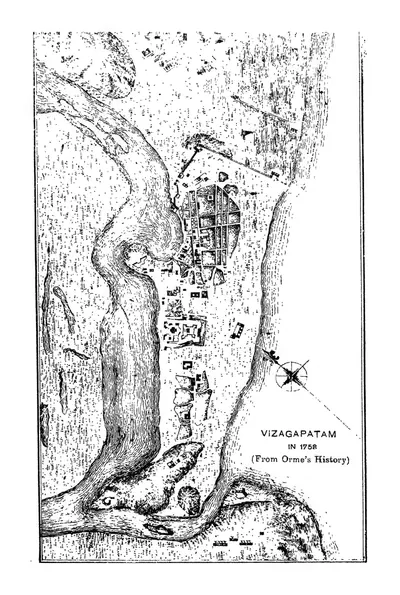
Orme says that when the slaughter was over Bussy “would not go into” the fort.1213 Orme adds that he made the surviving infant son of Ranga Rao lord of other lands.1213 Bussy then took the English factories (trading posts) at Madapollam, Bendamurlanka and Injaram.141516 In June 1757 he took Visakhapatnam (then Vizagapatam).141516
He seized Daulatabad and reconciled the Nizam’s brothers.2 After this, in the spring of 1758, the Kistna manual says that Bussy “was now at the summit of his power”.2 It adds: “The Northern Circars were completely under his sway, and not an Englishman remained in these provinces.”2 See Bobbili, Rajahmundry and Visakhapatnam.
Called south, 1758
In July 1758 Lally, the new French governor, summoned Bussy south with all the troops he could spare. Hemingway’s gazetteer calls his departure “a fatal blow to the fortunes of the French, who within ten months were driven out of the Circars”.11 Bussy came back to India in the war of 1782.17 The Fifth Report’s table records Porto Novo “taken by the French under Bussy”.17
Footnotes
-
Gordon Mackenzie, A Manual of the Kistna District (1883), p. 49 (archive.org (opens in a new tab)). ↩ ↩2 ↩3 ↩4 ↩5
-
Mackenzie, Kistna District (1883), p. 54 (archive.org (opens in a new tab)). ↩ ↩2 ↩3 ↩4 ↩5
-
G. B. Malleson, History of the French in India (1868), p. 258 (archive.org (opens in a new tab)). ↩ ↩2 ↩3 ↩4
-
Mackenzie, Kistna District (1883), p. 46 (archive.org (opens in a new tab)). ↩ ↩2 ↩3
-
Malleson, French in India (1868), p. 274 (archive.org (opens in a new tab)). ↩ ↩2
-
Malleson, French in India (1868), p. 370 (archive.org (opens in a new tab)). ↩ ↩2 ↩3 ↩4
-
F. R. Hemingway, Madras District Gazetteers: Godavari, Vol. I (1907), p. 30 (archive.org (opens in a new tab)). ↩ ↩2
-
Mackenzie, Kistna District (1883), p. 50 (archive.org (opens in a new tab)). ↩ ↩2
-
James Grant, “Political Survey of the Northern Circars” (1784), in W. K. Firminger (ed.), The Fifth Report from the Select Committee … on the Affairs of the East India Company, Vol. III (1918), p. 13 (archive.org (opens in a new tab)). ↩ ↩2 ↩3 ↩4
-
Grant, “Political Survey”, in Firminger, Fifth Report, Vol. III (1918), p. 14 (archive.org (opens in a new tab)). ↩ ↩2 ↩3 ↩4
-
Hemingway, Godavari (1907), p. 31 (archive.org (opens in a new tab)). ↩ ↩2
-
Robert Orme, A History of the Military Transactions of the British Nation in Indostan, Vol. II (Madras reprint, 1861), p. 257 (archive.org (opens in a new tab)). ↩ ↩2 ↩3 ↩4
-
Orme, Military Transactions, Vol. II (1861), p. 259 (archive.org (opens in a new tab)). ↩ ↩2 ↩3 ↩4
-
Orme, Military Transactions, Vol. II (1861), p. 261 (archive.org (opens in a new tab)). ↩ ↩2
-
Orme, Military Transactions, Vol. II (1861), p. 262 (archive.org (opens in a new tab)). ↩ ↩2
-
“Acquisitions of Territory by the British in the Presidency of Fort St. George”, in Firminger, Fifth Report, Vol. III (1918), p. xv, No. XII, Vizagapatam (archive.org (opens in a new tab)). ↩ ↩2
-
“Acquisitions of Territory by the British in the Presidency of Fort St. George”, in Firminger, Fifth Report, Vol. III (1918), p. xiv, Nos. IX–X (archive.org (opens in a new tab)). ↩ ↩2
Photos
References
Notes (0)
Sources (5)
Spotted an error on this page? Tell us
Last updated: