Kam Bakhsh
Youngest son of Aurangzeb (1667–1709). When his father died in 1707 he was on his way to govern Bijapur. He proclaimed himself emperor, struck coins and made Hyderabad his seat, where he had the subahdar Rustam Dil Khan trampled to death. His brother Bahadur Shah marched south and defeated him near Hyderabad on 13 January 1709, and he died of his wounds that night.
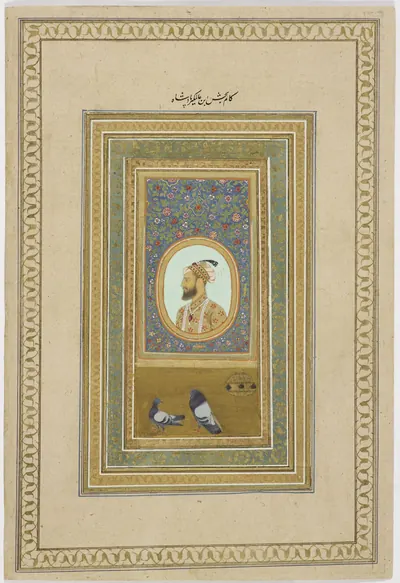
Muhammad Kam Bakhsh was the youngest son of the Mughal emperor Aurangzeb. Khafi Khan records that he was born on 10 Ramazan AH 1077 (25 February 1667; AH is the Islamic way of counting years), and that his mother was Bai Udaipuri.1 He says the prince was well read, “brave and generous”.1
He matters for the Telugu country because for about a year after his father’s death he ruled from Hyderabad as a rival emperor.23 His short reign there was among the most violent episodes of the Mughal period.23 See the Mughals in the Telugu country.
The two provinces
Aurangzeb’s will, as Irvine summarises it, asked his successors to leave Kam Bakhsh “unmolested, should he content himself with the two new provinces, that is, Bijapur and Haidarabad”.4 When the emperor died in 1707, Kam Bakhsh had reached Parenda on his way from Ahmadnagar to his new government at Bijapur. He went on to Bijapur and took the fort.56 He had the Friday prayer read in his own name, with the title Dinpanah, “Protector of the Faith”.56 He issued coins with a couplet (two-line verse) proclaiming him emperor “in the South”.56
Lane-Poole, in his British Museum catalogue, writes that Bahadur Shah had appointed his brother “viceroy of Bijapur and Haidarabad” before the prince rebelled.7
Hyderabad, 1708
His general Ahsan Khan won over Rustam Dil Khan, the subahdar (governor) of Haidarabad, with friendly letters and oaths on the Quran.2 The subahdar came out with four or five thousand horse to pay his respects.2 The commandant of Golconda, pleading an order from Bahadur Shah, refused to surrender.2 The fort was left blockaded while the revenue of the country was collected.2
Bilgrami says that Rustam Dil Khan gave the prince “an ovation” when he came to Golconda from Bijapur.8 Kam Bakhsh’s ministers soon persuaded him that Rustam Dil Khan and Ahsan Khan were plotting to seize him. He summoned Rustam Dil Khan before dawn with his pen-case, on the pretext of drafting a reply to Bahadur Shah.93 He had him arrested and, after three days, trampled to death under an elephant.93 His body was buried in the garden of the Imli Mahal.93
Saif Khan, who had taught the prince archery, had his hand cut off and was killed.31011 Ahsan Khan died in prison after months of torture.31011 Irvine says that for years past Kam Bakhsh “had been noted for a violence of disposition approaching to insanity”.9
The violence reached the townspeople. When Bahadur Shah’s envoy arrived, Kam Bakhsh invited the men of his retinue to a feast.1112 He had some seventy-five of them executed, among them citizens of Hyderabad who had asked to be added to the list.1112 The mufti (expert in religious law) of Hyderabad had refused to approve the executions, and he left the city with many of the learned.1112
News reached Bahadur Shah’s camp that Kam Bakhsh had sent a force against the diwan (revenue officer) of Machilipatnam (then Masulipatam).1314 The diwan held thirty-two lakhs of imperial treasure.1314 Kam Bakhsh had also raised four lakhs of rupees from the money-lenders of Hyderabad.1314 His letters to his brother justified his march on Hyderabad as a rescue of its people from “the oppressor”.13
Defeat and death
Bahadur Shah crossed into the Deccan in May 1708 and marched by Nander towards Hyderabad. As he approached, Kam Bakhsh’s troops deserted.51314 On 1 November local chiefs left his camp with thousands of men.51314 Among them was Pam Naik, brother of the zamindar (landholder) of Wakinkhera.51314
Zulfiqar Khan had an old quarrel with Kam Bakhsh dating from the siege of Jinji.1516 He asked the governor of Madras to stop the prince if he tried to escape by sea.1516 Gribble, following Eradat Khan, says that at Jinji Zulfiqar Khan had put the prince in confinement on Aurangzeb’s orders.17
Kam Bakhsh placed his guns at the Mir Jumla tank near Hyderabad.1518 There he waited, Irvine says, on the promises of astrologers.1518
On the morning of 13 January 1709 the imperial army surrounded the grove, two or three kos from Hyderabad, where he had camped.1619 He charged with a few hundred men and emptied two quivers of arrows.1619 He was captured, badly wounded, by the Afghans of Daud Khan Panni.1619 Bahadur Shah washed his brother’s wounds himself and fed him. Khafi Khan reports Kam Bakhsh’s reply: “Neither did I wish that one of the race of Timur should be made prisoner with the imputation of cowardice”.20 He died that night with one of his sons.202122 The bodies were sent to Delhi for burial near Humayun’s tomb.202122
Lane-Poole dates his death to AH 1120 (1708 in his reckoning), and credits the victory to Zulfiqar Khan.23
Coins
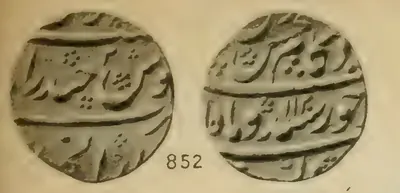
Kam Bakhsh struck coins in gold and silver at Hyderabad. Lane-Poole lists Bijapur and Haidarabad as his mints.2425 He says Kam Bakhsh added Haidarabad “to the list of Moghul mints”.2425 Whitehead, describing the Haidarabad mint, also notes that “Kam Bakhsh struck in both metals” there.26
The British Museum holds a gold coin of his from Haidarabad dated AH 1120.27 Irvine adds that the reading of the couplet given in the British Museum catalogue rests on imperfect coins and is wrong.6
Footnotes
-
Khafi Khan, Muntakhabu-l Lubab, in H. M. Elliot and John Dowson (eds.), The History of India as Told by Its Own Historians, Vol. VII (1877), p. 196 (archive.org (opens in a new tab)). ↩ ↩2
-
Irvine, Later Mughals, Vol. I (1922), p. 52 (archive.org (opens in a new tab)). ↩ ↩2 ↩3 ↩4 ↩5 ↩6
-
Irvine, Later Mughals, Vol. I (1922), p. 54 (archive.org (opens in a new tab)). ↩ ↩2 ↩3 ↩4 ↩5 ↩6 ↩7
-
William Irvine, ed. Jadunath Sarkar, Later Mughals, Vol. I (1922), p. 6 (archive.org (opens in a new tab)). ↩
-
Irvine, Later Mughals, Vol. I (1922), p. 50 (archive.org (opens in a new tab)). ↩ ↩2 ↩3 ↩4 ↩5 ↩6
-
Irvine, Later Mughals, Vol. I (1922), p. 51 and note (archive.org (opens in a new tab)). ↩ ↩2 ↩3 ↩4
-
Stanley Lane-Poole, The Coins of the Moghul Emperors of Hindustan in the British Museum (1892), p. xxxiii (archive.org (opens in a new tab)). ↩
-
Syed Ali Asgar Bilgrami, Landmarks of the Deccan (1927), p. 97 (archive.org (opens in a new tab)). ↩
-
Irvine, Later Mughals, Vol. I (1922), p. 53 (archive.org (opens in a new tab)). ↩ ↩2 ↩3 ↩4
-
Irvine, Later Mughals, Vol. I (1922), p. 55 (archive.org (opens in a new tab)). ↩ ↩2
-
Irvine, Later Mughals, Vol. I (1922), p. 56 (archive.org (opens in a new tab)). ↩ ↩2 ↩3 ↩4 ↩5
-
Irvine, Later Mughals, Vol. I (1922), p. 57 (archive.org (opens in a new tab)). ↩ ↩2 ↩3
-
Irvine, Later Mughals, Vol. I (1922), p. 58 (archive.org (opens in a new tab)). ↩ ↩2 ↩3 ↩4 ↩5 ↩6 ↩7
-
Irvine, Later Mughals, Vol. I (1922), p. 59 (archive.org (opens in a new tab)). ↩ ↩2 ↩3 ↩4 ↩5 ↩6
-
Irvine, Later Mughals, Vol. I (1922), p. 60 (archive.org (opens in a new tab)). ↩ ↩2 ↩3 ↩4
-
Irvine, Later Mughals, Vol. I (1922), p. 62 and note (archive.org (opens in a new tab)). ↩ ↩2 ↩3 ↩4 ↩5
-
J. D. B. Gribble, A History of the Deccan, Vol. I (1896), p. 352 (archive.org (opens in a new tab)). ↩
-
Irvine, Later Mughals, Vol. I (1922), p. 61 (archive.org (opens in a new tab)). ↩ ↩2
-
Irvine, Later Mughals, Vol. I (1922), p. 63 (archive.org (opens in a new tab)). ↩ ↩2 ↩3
-
Khafi Khan, in Elliot and Dowson, History of India, Vol. VII (1877), pp. 407–408 (archive.org (opens in a new tab)). ↩ ↩2 ↩3
-
Irvine, Later Mughals, Vol. I (1922), p. 64 (archive.org (opens in a new tab)). ↩ ↩2
-
Irvine, Later Mughals, Vol. I (1922), p. 65 (archive.org (opens in a new tab)). ↩ ↩2
-
Lane-Poole, Coins of the Moghul Emperors (1892), p. xxxiv (archive.org (opens in a new tab)). ↩
-
Lane-Poole, Coins of the Moghul Emperors (1892), p. xlviii (archive.org (opens in a new tab)). ↩ ↩2
-
Lane-Poole, Coins of the Moghul Emperors (1892), p. lviii (archive.org (opens in a new tab)). ↩ ↩2
-
R. B. Whitehead, Catalogue of Coins in the Panjab Museum, Lahore, Vol. II: Coins of the Mughal Emperors (1914), p. lxxii (archive.org (opens in a new tab)). ↩
-
Lane-Poole, Coins of the Moghul Emperors (1892), p. 164, No. 852, and pl. XXI (archive.org (opens in a new tab)). ↩
Photos
 Gold mohur of the rebel prince Kam Bakhsh struck at Haidarabad (Hyderabad), AH 1120, obverse and reverse (Lane-Poole 1892, No. 852, pl. XXI)Coin · 1892
 Prince Kam Bakhsh: oval bust portrait on an album page, Mughal, c. 1700 (Royal Collection Trust, "Painting of a falcon and portrait of Kam Bakhsh")Other · c. 1700
 Shah Alam (Muhammad Muazzam, later the emperor Bahadur Shah): Deccani portrait, c. 1686, Rijksmuseum (RP-T-00-3186-11); Dutch title: "Portrait of Shah Alam, son of Aurangzeb born after Sultanji; he was first governor (subagar) of the Deccan; after marching against Sambaji, the son of Sivaji, he has now turned against Sultan Abu'l-Hasan and wages war with him"Other · c. 1686
References
Notes (0)
Sources (6)
Spotted an error on this page? Tell us
Last updated: