Mughals in the Telugu country
The Mughal emperors were overlords of Golconda from 1636, when Abdullah Qutb Shah accepted Shah Jahan as his suzerain. They ruled the whole Telugu country from 1687, when Aurangzeb took Golconda and made the kingdom the subah of Haidarabad. The province was governed through a subahdar at Hyderabad, faujdars in the districts and the old Telugu revenue officers, the deshmukhs and deshpandes. The coast formed the Northern Sarkars and the south the Haidarabadi Karnatak. Maratha raids, a prince's rebellion at Hyderabad in 1708–09 and the rising of the toddy-seller Pap Rai marked the years of decline. In 1724 Nizam-ul-Mulk defeated and killed the subahdar Mubariz Khan at Shakar Kheda and founded the Asaf Jahi state.
Swipe sideways to see the whole chart; tap a bar for details.
Each bar is a ruling power in its region; time runs left to right. Dashed = approximate dates. Select a bar for details.
Show as a list
Vijayanagara & the Qutb Shahis 1336–1687 CE
- Telangana
- Adil Shahis of Bijapur (c. 1489–1686 CE) · Qutb Shahis of Golconda (c. 1518–1687 CE) · Vijayanagara Empire (c. 1563–1565 CE)
- Coastal Andhra
- Vijayanagara Empire (c. 1350–1579 CE) · Gajapatis of Orissa (c. 1446–1571 CE) · Qutb Shahis of Golconda (c. 1524–1687 CE)
- Rayalaseema
- Vijayanagara Empire (c. 1336–1646 CE) · Marathas (c. 1677–1687 CE) · Adil Shahis of Bijapur (c. 1568–1686 CE) · Qutb Shahis of Golconda (c. 1579–1687 CE) · Mughal Empire (c. 1686–1724 CE)
Mughals, Asaf Jahis & the British 1687–1948 CE
- Telangana
- Mughal Empire (1687–1724 CE) · Asaf Jahi Nizams of Hyderabad (1724–1948 CE)
- Coastal Andhra
- Mughal Empire (1687–1724 CE) · French East India Company (1750–1759 CE) · Nawabs of the Carnatic (Arcot) (c. 1710–1801 CE) · Asaf Jahi Nizams of Hyderabad (1724–1753 CE) · East India Company (1759–1858 CE)
- Rayalaseema
- Nawabs of Kurnool (c. 1690–1839 CE) · Nawabs of the Carnatic (Arcot) (c. 1710–1801 CE) · Nawabs of Cuddapah (c. 1714–1779 CE) · East India Company (1792–1858 CE) · Mughal Empire (c. 1686–1724 CE) · Morari Rao Ghorpade of Gooty (c. 1741–1776 CE) · Banganapalle State (c. 1724–1948 CE) · Asaf Jahi Nizams of Hyderabad (c. 1724–1800 CE) · Marathas (c. 1743–1774 CE) · Mysore under Haidar Ali and Tipu Sultan (c. 1762–1799 CE)
Sultanates
Adil Shahis of Bijapur
Open page- Telangana: c. 1489–1686 CE (c. 197 years)
After the Bahmani break-up part of Mahbubnagar district went to Bijapur (the rest to Golconda) and stayed with it until Aurangzeb annexed Bijapur in 1686; the Raichur district article likewise passes Raichur (which then included the Alampur taluk and Gadwal) from the Bahmanis to the Adil Shahis.
- Rayalaseema: c. 1568–1686 CE (c. 118 years)
Partial, the western uplands only. Adoni taken by Ali Adil Shah's general Ankus Khan in 1568 after a failed siege in 1535-37; Penukonda besieged in the 1570s (dates disputed) and taken in 1652 (Mackenzie MS); Kurnool taken from Gopala Raja early in the 17th century and governed by Abdul Wahab (d. 1618) and later deputies, Siddi Jauhar holding it as his jagir about 1660; the Bellary and Anantapur uplands held through governors and tributary poligars; Bijapur's rights there passed to Shivaji in 1677-80 (Francis); Bijapur fell to Aurangzeb on 12 September 1686, but Siddi Masud held Adoni until 1688 (Sarkar) or 1687 (Bellary gazetteer)
Rulers (9)
Capitals
Monuments
Sources (11)
Kingdoms and empires
Mughal Empire
Open page- Rayalaseema: c. 1686–1724 CE (c. 38 years)
Kurnool passed to the emperor with the Bijapur provinces in 1686 and was later the jagir of Daud Khan Panni and his brother; Adoni (renamed Imtiyazgarh, a Mughal mint) surrendered by Masaud Khan; the uplands of the Haidarabadi Karnatak (Cuddapah, Gandikota, Gooty, Sidhout) came with Golconda in 1687; Anantapur added to the subah of Bijapur; poligars largely independent (Cuddapah gazetteer); Francis dates the Nizam's independence to 1723
- Telangana: 1687–1724 CE (37 years)
Golconda taken on 21 September 1687 and the kingdom annexed as the subah of Haidarabad, governed from Hyderabad by subahdars (Mahabat Khan, Ruhullah Khan, Jan Sipar Khan, Rustam Dil Khan, Yusuf Khan, Mubariz Khan); Kam Bakhsh held Hyderabad as a rival emperor in 1708 until his defeat on 13 January 1709; Mubariz Khan was killed by Nizam-ul-Mulk at Shakar Kheda in October 1724
- Coastal Andhra: 1687–1724 CE (37 years)
Kondapalli gained by bribery in July 1687; Guntur (Murtazanagar), Kondapalli (Mustafanagar), Ellore, Rajahmundry and Chicacole formed the Northern Circars, with Masulipatam as their chief town and a Mughal mint; the Qutb Shahi assessment of 1635 was kept on Aurangzeb's records (Grant)
Rulers
- Shah Jahan (1628–1658 CE)
- Aurangzeb (Alamgir) (1658–1707 CE)
- Bahadur Shah (Shah Alam I) (1707–1712 CE)
- Jahandar Shah (1712–1713 CE)
- Farrukhsiyar (1713–1719 CE)
- Muhammad Shah (1719–1748 CE)
Inscriptions
Sources (14)
Sultanates
Qutb Shahis of Golconda
Open page- Telangana: c. 1518–1687 CE (c. 169 years)
Sultan Quli governed Telingana for the Bahmanis from 1493-95 and declared independence in 1512 (Ferishta, Haig, IG Hyderabad) or 1518 (Bilgrami, from the Golconda mosque inscription of AH 924); he took the forts of the Telugu chiefs, among them Rachakonda, Devarakonda and, from Shitab Khan, Warangal and Khammam (1519-1525 per Bilgrami). Tributary to the Mughals from 1635-36 (khutba and coins in Shah Jahan's name; two lakhs of huns a year). Hyderabad taken by the Mughals in 1656 and 1685; Golconda surrendered on 21 September 1687 (Old Style) and was annexed
- Coastal Andhra: c. 1524–1687 CE (c. 163 years)
Sultan Quli took Kondapalli and fixed the Godavari as his frontier with Orissa (Ellore ceded) some time before his 1530 campaign, and a 1524 record shows him granting villages near Kondapalli and Bezwada; the Godavari gazetteer and IG Madras date the Krishna-Godavari doab to c. 1540 or 'before 1543', and the IG Madras Kistna article to after 1565.
- Rayalaseema: c. 1579–1687 CE (c. 108 years)
Partial; the sources disagree on when Golconda's hold began. IG Madras says Kurnool and Cuddapah were overrun soon after 1565. The Kurnool Manual dates the campaigns that took Gurramkonda (1579) and Gandikota, Nandyal and Musalimadugu (c. 1590). The Cuddapah gazetteer says Golconda only turned to Cuddapah in the early 17th century and never really conquered it. Chandragiri fell to Golconda in 1646.
Rulers (8)
Capitals
Monuments (13)
Inscriptions (7)
- Epitaph of Sultan Quli, Golconda (1543)
- Makka Darwaza inscription, Golconda (1559)
- Jami Masjid inscription, Hyderabad
- Epitaph of Muhammad Quli Qutb Shah, Golconda (1612)
- Ma Saheba tank inscriptions (1625)
- Musa Burj inscription, Golconda fort (1666–67)
… and 1 more
Sources (23)
Kingdoms and empires
Asaf Jahi Nizams of Hyderabad
Open page- Telangana: 1724–1948 CE (224 years)
Asaf Jah, viceroy of the Deccan from 1713, independent after defeating Mubariz Khan at Shakar Kheda (11 October 1724 in Irvine; 1723 in Gribble); Telangana remained the Telugu heart of the Nizam's Dominions, with the samasthans of Gadwal, Wanaparthy, Jatprole, Amarchinta and Palvancha as tributary estates. Regular districts were formed in 1865-66 and the Telugu divisions surveyed and settled by 1905; the districts were redrawn in 1905 and an Executive Council governed from November 1919. The Standstill Agreement with India was signed on 29 November 1947. Indian troops entered the state on 13 September 1948 (the Police Action); the Nizam ordered a ceasefire on 17 September, and a military governor took charge on 18 September
- Coastal Andhra: 1724–1753 CE (29 years)
The Nizam's governor at Rajahmundry collected the tribute of the coastal zamindars; Masulipatam granted to the French by Muzaffar Jang in 1750 and the lands of Nizampatnam and Kondavid by Salabat Jang in 1751; the four Circars of Mustafanagar, Ellore, Rajahmundry and Chicacole assigned to the French on 4 December 1753 to pay Bussy's army
- Rayalaseema: c. 1724–1800 CE (c. 76 years)
Nominal over much of the region (Kurnool and Cuddapah Nawabs, Maratha tribute, Morari Rao at Gooty, Haidar Ali from 1761); the Nizam gained Tipu Sultan's districts by the treaties of 1792 and 1799 and ceded them to the Company by the treaty of 12 October 1800 to pay the subsidiary force (the Ceded Districts)
- Coastal Andhra: 1759–1788 CE (29 years)
Guntur (Murtazanagar) stayed with the Nizam's brother Basalat Jang after the French were driven out; it was excluded from the cessions of 1766 and 1768, rented by the Company in 1779 and restored, and handed over to the Company only in 1788; the Nizam's claims to the Circars' payments were bought out in 1823
Rulers (10)
Capitals
Monuments (11)
Inscriptions
Sources (16)
Kingdoms and empires
Vijayanagara Empire
Open page- Rayalaseema: c. 1336–1646 CE (c. 310 years)
Founded c. 1335-36; Bukka I held Penukonda and Gooty (records of 1352 and a Gooty rock inscription) and his minister built the Bukkarayasamudram tank near Anantapur in 1364; Cuddapah in the 14th century; Kurnool wholly annexed under Krishnadeva Raya. After Talikota (1565) the kings ruled from Penukonda, which held out against Bijapur in 1577 and Golconda in 1589; the country north of Penukonda was lost after Sriranga I's capture (c. 1579-80); Venkatapati II moved to Chandragiri c. 1592; Golconda held the Cuddapah district and took Chandragiri (Chittoor) in 1646. Bijapur and Golconda took most of the region piecemeal after 1565
- Coastal Andhra: c. 1350–1579 CE (c. 229 years)
Vijayanagara officers kept Guntur (Kondavidu, Vinukonda, Bellamkonda) and the governor of Udayagiri kept Nellore after Talikota; Golconda took Kondavidu in April 1579 (Kistna Manual) or 1580 (a Guntur record of 1592 cited by Sewell), though Sewell thinks Guntur was already under Muslim rule by 1576 and the Nellore Manual says the Muslims held Nellore from 1565.
- Telangana: c. 1563–1565 CE (c. 2 years)
To end the confederate invasion of Golconda, Ibrahim Qutb Shah let Rama Raja keep the forts of Ghanpur and Panagal (Mahbubnagar) until Talikota; Ferishta places this after the Kalyani campaign of the early 1560s, the Kistna Manual dates it to 1557.
Rulers (24)
- Harihara I (Vijayanagara) (c. 1336–1355 CE)
- Bukka I (Vijayanagara) (1355–1377 CE)
- Harihara II (1377–1404 CE)
- Bukka II (1404–1406 CE)
- Deva Raya I (1406–1422 CE)
- Vijaya (Bukka III) (1422 CE)
… and 18 more
- Deva Raya II (Vijayanagara) (1422–1446 CE)
- Mallikarjuna (1446–1465 CE)
- Virupaksha (1465–1485 CE)
- Saluva Narasimha (1485–1492 CE)
- Immadi Narasimha (1492–1505 CE)
- Narasa Nayaka (c. 1505 CE)
- Vira Narasimha (1505–1509 CE)
- Krishnadeva Raya (1509–1529 CE)
- Achyuta Raya (1529–1542 CE)
- Venkata I (1542 CE)
- Sadasiva (c. 1542–1569 CE)
- Tirumala (Aravidu) (c. 1569–1572 CE)
- Sriranga I (1572–1586 CE)
- Venkatapati II (Vijayanagara) (1586–1614 CE)
- Sriranga II (1614 CE)
- Rama Deva (1614–1630 CE)
- Pedda Venkata (1630–1642 CE)
- Sriranga III (c. 1642–1670 CE)
Monuments (7)
- Penukonda fort and Gagan Mahal
- Kalahastisvara temple, Srikalahasti
- Virabhadra temple, Lepakshi
- Chandragiri fort and Raja Mahal
- Gooty fort
- Narasimha temples, Ahobilam
… and 1 more
Inscriptions (14)
- Penukonda fort inscription (1354)
- Gooty rock inscription of Bukka I
- Bitragunta grant of Sangama II (1356)
- Bukkarayasamudram tank inscription (1364)
- Tirumala inscriptions of Krishnadeva Raya and his queens (1513–1514)
- Amaravati inscription of Krishnadeva Raya (1515)
… and 8 more
- Mangalagiri and Kaza pillar inscriptions (1515–1518)
- Simhachalam inscriptions of Krishnadeva Raya (1516–1519)
- Srikalahasti inscription of Krishnadeva Raya (1516)
- Kondavidu pillar inscription of Nadindla Gopa (1520)
- Lepakshi temple inscriptions of Achyuta Raya's reign (1533–1538)
- Kanuma grant of Sadasiva (1548)
- Penukonda inscription of Channappa Nayudu (1577)
- Ahobilam inscription of Sriranga I (1584)
Sources (20)
Colonial powers
French East India Company
Open page- Coastal Andhra: 1750–1759 CE (9 years)
Partial at first (Masulipatam and the island of Divi, seized in July 1750 under Muzaffar Jang's grant; Nizampatnam, Narsapur and Kondavid added by Salabat Jang in 1751-52); from December 1753 the four Northern Circars of Mustafanagar (Kondapalli), Ellore, Rajahmundry and Chicacole, granted for the pay of Bussy's army and settled by Bussy in person from July 1754. Forde routed the French at Condore (Chandurti) on 9 December 1758 and stormed Masulipatam on 7-8 April 1759; by the treaty of May 1759 Salabat Jang ceded the Masulipatam country to the English and excluded the French from the Deccan
- Coastal Andhra: c. 1765–1793 CE (c. 28 years)
Partial (Yanam only): the French factory town on the Godavari, ceded to them in 1752, reoccupied after the peace of 1763 (the restored possessions 'were not occupied before 1765'); the French possessions were also in English hands in 1778-83
- Coastal Andhra: 1817–1954 CE (137 years)
Partial (Yanam only): occupied by the English from 1793 (except 1802-03) and handed back in 1817 under the treaties of 1814-15; about 2,258 acres. The Government of India took over the French Establishments, Yanam among them, from 1 November 1954 after the agreement with France of 21 October 1954
Rulers
- Joseph François Dupleix (1750–1754 CE)
- Charles de Bussy (1754–1758 CE)
- Marquis de Conflans (1758–1759 CE)
Capitals
Sources (10)
Kingdoms and empires
Gajapatis of Orissa
Open page- Coastal Andhra: c. 1446–1571 CE (c. 125 years)
Kapilendra (Kapilesvara, r. 1434-35 to 1469-70) took the Reddi kingdom of Rajahmundry between 1444 and 1448 and held Kondavidu by 1454 through his kinsman Ganadeva; the Bahmanis took Rajahmundry and Kondapalli or Kondavidu in 1470-71 and Purushottama had recovered the Godavari-Krishna country and the Ongole taluk by 1489; the country south of the Krishna passed to Saluva Narasimha after 1470 and, with Udayagiri, Kondavidu and Kondapalli, to Krishnadeva Raya in 1513-16; Golconda took the Godavari-Krishna doab from about 1522 and Rajahmundry in 1571-72. The northern coast (Srikurmam, Simhachalam) stayed Gajapati throughout.
- Telangana: c. 1459–1461 CE (c. 2 years)
Brief: Orissan troops relieved Devarakonda from the Bahmanis in 1459, and Kapilendra's son Hamvira and nephew Raghudeva took Warangal on 2 February 1460 (two gateway inscriptions); in 1461-62 the Orissan army and the zemindars of Telangana marched on Bidar. How long Warangal was held is not recorded
- Telangana: c. 1497–1516 CE (c. 19 years)
Partial: the uplands of Khammam and the Kondapalli-Nelakondapalli country, held by Prataparudra until Krishnadeva Raya's campaigns (Banerji; Nizam's Archaeological Department)
Rulers
- Kapilendra (Kapilesvara) (c. 1434–1470 CE)
- Purushottama (Gajapati) (c. 1470–1497 CE)
- Prataparudra (Gajapati) (c. 1497–1540 CE)
- Kalua Deva (c. 1540–1541 CE)
- Kakharua Deva (c. 1541 CE)
Inscriptions (8)
Sources (10)
Kingdoms and empires
Nawabs of the Carnatic (Arcot)
Open page- Coastal Andhra: c. 1710–1801 CE (c. 91 years)
Partial (Nellore and Ongole, the Palnad, the jagir of Udayagiri and the tributary zamindaris of Venkatagiri and Kalahasti). Saadatullah Khan became Nawab of the Carnatic, the coast from Guntur to the Coleroon, in 1710 (Orme) or 1713 (Wilks), and his fauzdar governed Nellore; he granted the Udayagiri jagir in 1720. Under Muhammad Ali Walajah (1749-95) his brother Najib-ullah held Nellore, rebelled in 1757 and was dislodged by an English force in 1762. The revenues were assigned to the Company in 1781-85 and managed by it in 1790-92; by the treaty of 31 July 1801 Azim-ud-daula handed over the government of the Carnatic, and Nellore, Ongole and the Palnad became British
- Rayalaseema: c. 1710–1801 CE (c. 91 years)
Partial (Chittoor taluks). The Nawabs at Arcot, first as deputies under the Nizam, took tribute from the Chittoor and Chendragiri poligars and the Kalahasti and Karvetnagar zamindars; Muhammad Ali gave Chittoor and Chendragiri to his brother Abdul Wahab as a jagir, and the Carnatic was handed to the Company on 31 July 1801.
Rulers
- Saadatullah Khan (c. 1710–1732 CE)
- Dost Ali Khan (1732–1740 CE)
- Safdar Ali Khan (c. 1740–1742 CE)
- Anwar-ud-din Khan (1744–1749 CE)
- Muhammad Ali Khan Walajah (1749–1795 CE)
- Umdat-ul-Umara (1795–1801 CE)
Capitals
Sources (11)
Colonial powers
East India Company
Open page- Coastal Andhra: 1759–1858 CE (99 years)
Partial at first: the Masulipatam and Nizampatam Circars ceded by Salabat Jang on 14 May 1759 after Forde's defeat of the French. The emperor Shah Alam granted the five Northern Circars on 12 August 1765; by the treaties of 12 November 1766 and 23 February 1768 the Nizam ceded Kondapalli, Ellore, Rajahmundry and Chicacole for a yearly payment (capitalised in 1823), Guntur following in September 1788. Governed through renters until 1769, Chiefs and Councils at Masulipatam and Vizagapatam until 1794, then Collectors; the zamindaris were permanently settled in 1802-03. Nellore, Ongole and the Palnad came with the Carnatic from the Nawab of Arcot on 31 July 1801. Transferred to the Crown in 1858
- Rayalaseema: 1792–1858 CE (66 years)
Partial at first: Kangundi came to the Company with the Baramahal in 1792, when it also began collecting the Kalahasti and Karvetnagar tribute for the Nawab; Punganur and Venkatagirikota (Palmaner) followed from Tipu's lands in 1799. On 12 October 1800 the Nizam ceded the territories he had gained from Mysore in 1792 and 1799, the Ceded Districts of Bellary (with Anantapur) and Cuddapah, with the tribute of the Nawab of Kurnool; Thomas Munro, Principal Collector 1800-1807, reduced the poligars and made the ryotwari settlement. The Nawab of Arcot's Chittoor and Chendragiri country came with the Carnatic in 1801, and the Kurnool Nawab's jagir was annexed in 1839. Transferred to the Crown in 1858
Rulers (23)
- George Pigot (1755–1763 CE)
- Robert Palk (1763–1767 CE)
- Charles Bourchier (1767–1770 CE)
- Josias Du Pré (1770–1773 CE)
- Alexander Wynch (1773–1775 CE)
- Lord Pigot (1775–1776 CE)
… and 17 more
- Sir Thomas Rumbold (1778–1780 CE)
- Lord Macartney (1781–1785 CE)
- Sir Archibald Campbell (1786–1789 CE)
- William Medows (1790–1792 CE)
- Sir Charles Oakeley (1792–1794 CE)
- Lord Hobart (1794–1798 CE)
- Lord Clive (Edward Clive) (1798–1803 CE)
- Lord William Bentinck (1803–1807 CE)
- Sir George Barlow (1807–1813 CE)
- Hugh Elliot (1814–1820 CE)
- Sir Thomas Munro (1820–1827 CE)
- Stephen Rumbold Lushington (1827–1832 CE)
- Sir Frederick Adam (1832–1837 CE)
- Lord Elphinstone (1837–1842 CE)
- Marquis of Tweeddale (1842–1848 CE)
- Sir Henry Pottinger (1848–1854 CE)
- Lord Harris (1854–1859 CE)
Capitals
Monuments
Sources (10)
Kingdoms and empires
Marathas
Open page- Rayalaseema: c. 1677–1687 CE (c. 10 years)
Partial (the Bellary and Anantapur uplands). Shivaji crossed the Krishna near Kurnool in March 1677, went to Srisailam and sent his army south through the Cuddapah country; Gribble says he took and garrisoned poligars' forts in the Cuddapah and Bellary districts. On his return he took Bellary fort after a 27-day siege (1677-78). In 1680 Bijapur formally ceded its rights over the country round Kopal and Bellary and the poligars paid him tribute (chauth), until Aurangzeb overthrew Maratha power in the district in 1687
- Rayalaseema: c. 1743–1774 CE (c. 31 years)
Partial. The Cuddapah gazetteer says the Nizam ceded Penukonda to the Marathas in 1743 (Grant Duff and the Anantapur gazetteer give Gooty and Penukonda to Morari Rao instead). After Balwant Rao killed the Nawab of Cuddapah near Cuddapah on 24 September 1757 the Marathas held Gurramkonda and Punganur (1755 in Gribble). Gurramkonda went to Haidar Ali through Mir Sahib in 1766-67, was retaken by Trimbak Rao after a two-month siege in 1771 and confirmed to the Marathas by the treaty of 1772, and was lost with Punganur, Sira and Madhugiri to Tipu and Haidar in 1773-74
Rulers
- Shivaji (1674–1680 CE)
- Sambhaji (1680–1689 CE)
- Rajaram (1689–1700 CE)
- Shahu (1708–1749 CE)
Sources (11)
Kingdoms and empires
Nawabs of Kurnool
Open page- Rayalaseema: c. 1690–1839 CE (c. 149 years)
Partial (Kurnool proper, the taluks of Ramallakota, Nandikotkur, Nandyal and Sirvel). The Mughals took Kurnool in 1686-88 and gave it as a jagir to the Pathan general Daud Khan Panni in the latter part of the seventeenth century (about 1698 in Burhanuddin); his kinsman Ibrahim Khan seized the fort in 1715, and his son Alif Khan acknowledged Asaf Jah in 1724. The French and Salabat Jang stormed Kurnool in March 1751 and held it for the Nizam until Ranmast (Munawwar) Khan recovered it in 1752. The Nawabs paid tribute to the Nizam and, from 1769, to Haidar Ali and Tipu Sultan; in 1800 the Nizam ceded the tribute to the Company, which fixed it in 1804 at a lakh and a quarter of Gadwal rupees, then a lakh. The last Nawab, Ghulam Rasul Khan, was deposed in 1839 and the jagir annexed
Rulers (8)
- Daud Khan Panni (c. 1690–1715 CE)
- Ibrahim Khan (1715–1724 CE)
- Alif Khan (1724–1733 CE)
- Himmat Bahadur Khan (Nawab of Kurnool) (1733–1751 CE)
- Ranmast Khan (Munawwar Khan, Nawab of Kurnool) (1752–1792 CE)
- Alif Khan II (Nawab of Kurnool) (1792–1815 CE)
… and 2 more
- Munawwar Khan II (1815–1823 CE)
- Ghulam Rasul Khan (Nawab of Kurnool) (1823–1839 CE)
Capitals
Sources (6)
Kingdoms and empires
Nawabs of Cuddapah
Open page- Rayalaseema: c. 1714–1779 CE (c. 65 years)
Partial (the Cuddapah uplands, the circars of Sidhout, Gandikota, Gurramkonda and Cumbum, with the poligar of Punganur as tributary). Pathan (Miana) Nawabs under the Mughals and the Nizams; Abdul Nabi Khan, governor from 1714, was the first to assert real control and raided the Baramahal. After the Maratha general Balwant Rao killed the Nawab Abdul Majid Khan in 1757, Gurramkonda went to the Marathas. The last Nawab, Abdul Halim Khan (from 1761), surrendered to Haidar Ali at Sidhout on 27 May 1779 (Wilks; 1778 in Gribble's local chronology and Brown, 1780 in the Cuddapah gazetteer, 1777 in Kirmani)
Rulers
- Abdul Nabi Khan (Nawab of Cuddapah) (c. 1714–1732 CE)
- Abdul Majid Khan (c. 1732–1757 CE)
- Mohsin Khan (c. 1757–1761 CE)
- Abdul Halim Khan (Nawab of Cuddapah) (1761–1779 CE)
Capitals
Sources (7)
Kingdoms and empires
Morari Rao Ghorpade of Gooty
Open page- Rayalaseema: c. 1741–1776 CE (c. 35 years)
Partial (Gooty, Penukonda, Madakasira, Kodikonda and Tadpatri, with tribute from the Anantapur poligars). The Maratha Morari Rao Ghorpade made the Madakasira poligar pay tribute in 1741, was recognised as chief of Gooty by the first Nizam in 1743-44 and settled there about 1746 (permanent seat 1754). Haidar Ali took Penukonda, Madakasira and Kodikonda in 1762; Morari Rao recovered some forts after the Maratha peace of 1765. Gooty fell to Haidar early in April 1776 (Wilks; 1775 in the Anantapur gazetteer), and Morari Rao died a prisoner at Kabbaldurga
Rulers
Capitals
Sources (5)
Kingdoms and empires
Banganapalle State
Open page- Rayalaseema: c. 1724–1948 CE (c. 224 years)
Partial (a nawabi enclave of about 255 square miles round Banganapalle in the Kurnool district). Muhammad Beg Khan, Mughal killedar of Banganapalle from the late seventeenth century, became a petty Nawab when Asaf Jah made himself independent, and Asaf Jah confirmed the jagir. Tipu Sultan occupied it from 1783 until the family, with the Nizam's troops, won it back at Tammadapalle in 1790. In 1800 the Nizam transferred his control to the East India Company, which took no tribute; the Madras government managed the indebted jagir from 1825 (1832 in the Imperial Gazetteer) to 1848 and restored it by the sanad of 1849. The ruler became a hereditary Nawab in 1876; the Madras government took over the administration on 23 February 1948
Rulers (10)
- Muhammad Beg Khan (c. 1724–1758 CE)
- Muhammad Beg Khan Laug (regent) (c. 1758–1766 CE)
- Fazl Ali Khan (Gulli Nawab) (c. 1766–1782 CE)
- Husain Ali Khan (c. 1782–1783 CE)
- Ghulam Ali Khan (Mansur-ud-daula) of Banganapalle (c. 1790–1821 CE)
- Husain Ali Khan II (c. 1821–1848 CE)
… and 4 more
- Ghulam Muhammad Ali Khan of Banganapalle (1848–1868 CE)
- Fateh Ali Khan, Nawab of Banganapalle (1868–1905 CE)
- Ghulam Ali Khan III (1905–1922 CE)
- Fazl-i-Ali Khan (1922–1948 CE)
Capitals
Sources (5)
Kingdoms and empires
Mysore under Haidar Ali and Tipu Sultan
Open page- Rayalaseema: c. 1762–1799 CE (c. 37 years)
Partial (the Anantapur, Bellary and Cuddapah uplands). Haidar Ali, master of Mysore from 1761, took Penukonda, Madakasira and Kodikonda from Morari Rao of Gooty in 1762 (some went back to Morari Rao in 1764-66). Gurramkonda came to him through Mir Sahib in 1768, was lost to the Marathas in 1771 and recovered by Tipu in 1773-74. He took Bellary in 1775 and Gooty in April 1776 (1775 in the Anantapur gazetteer), and the Nawab of Cuddapah surrendered at Sidhout on 27 May 1779 (1780 in the Cuddapah gazetteer); the Nawab of Kurnool and the poligars of the Bellary and Anantapur country paid him tribute. By the treaty of 18 March 1792 Tipu ceded the Cuddapah taluks, Gurramkonda, Bellary and the Gooty taluks of Tadpatri and Tadimarri to the Nizam; Gooty, Penukonda, Madakasira, Anantapur and the rest of Gurramkonda went to the Nizam after Tipu's death in May 1799, and the Nizam ceded both gains to the Company in 1800
Rulers
Sources (7)
Reigns
Each bar is one ruler’s reign; time runs left to right. c. = approximate date.
- Shah Jahan1628–1658 CE · 30 yrs
- Aurangzeb (Alamgir)1658–1707 CE · 49 yrs
- Bahadur Shah (Shah Alam I)1707–1712 CE · 5 yrs
- Jahandar Shah1712–1713 CE · 1 yr
- Farrukhsiyar1713–1719 CE · 6 yrs
- Muhammad Shah1719–1748 CE · 29 yrs
Only the emperors who were overlords or rulers of the Telugu country. Reign years from the table of mints in Stanley Lane-Poole's British Museum catalogue (1892): Shah Jahan AH 1037–68 (1628–58), Aurangzeb AH 1069–1118 (1659–1707; his first, hurried enthronement was on 21 July 1658, according to Jadunath Sarkar), Bahadur AH 1119–23 (1707–12), Jahandar AH 1124 (1712), Farrukhsiyar AH 1124–31 (1713–19) and Muhammad AH 1131–61 (1719–48). The puppet emperors of 1719 (Rafi-ud-darajat, Rafi-ud-daula and others) are left out. Golconda was a tributary from 1636 to 1687 and the Telugu country a Mughal province from 1687 to 1724; Muhammad Shah reigned on until 1748, but after the battle of Shakar Kheda in 1724 Nizam-ul-Mulk governed the Deccan as an independent ruler.
For close to ninety years the Mughal emperors were the overlords of the Telugu country.1 At first they ruled through a tributary king, and then directly.1 In 1636 a Mughal army was in the Deccan.1 Faced with it, Abdullah Qutb Shah of Golconda accepted Shah Jahan as his suzerain (overlord).1 He promised tribute, struck coins in the emperor’s name and had him proclaimed in the Friday sermon.1
In 1687 Aurangzeb took Golconda and annexed the kingdom.23 It became the Mughal province (subah) of Haidarabad.23 It remained a province until 1724.45 In that year the viceroy of the Deccan, Nizam-ul-Mulk, defeated and killed its governor Mubariz Khan at Shakar Kheda in Berar.45 He then made himself master of the Deccan.45 This page tells the story from the Mughal side. For Golconda’s side, see the Qutb Shahis, Abul Hasan Tana Shah and Golconda Fort. For what followed 1724, see the Asaf Jahis.
The sources
The narrative comes mainly from Persian histories written for the Mughal court, and from the records of the English East India Company.678 The most useful Persian work for this period is Khafi Khan’s Muntakhabu-l Lubab.678 Elliot and Dowson printed long extracts from it in English in 1877.6 Khafi Khan was in the imperial camp during the war of 1708–09, and he counted the dead on the field near Hyderabad.78
Jadunath Sarkar’s History of Aurangzib (1912–30) is built on these chronicles, together with the court newsletters and the Madras records.910 So is William Irvine’s Later Mughals (1922), edited by Sarkar.910
For the province itself there is the Chahar Gulshan, a survey of about 1720.111213 Sarkar translated it in his India of Aurangzib (1901).11 For the coast there is the Political Survey of the Northern Circars by James Grant, printed with the Fifth Report of the House of Commons (1812).12 The Kistna manual calls Grant the Resident at Hyderabad.13 The Madras district manuals and gazetteers add local detail, which does not always agree with the chronicles.1415
Overlordship, 1636–1656
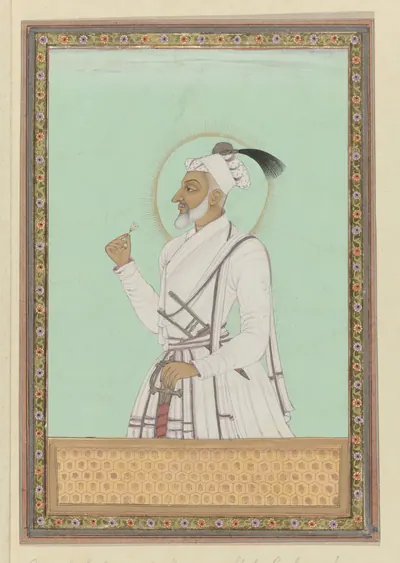
The Mughals entered the Deccan from the north.1 In February 1636 Shah Jahan arrived at Daulatabad with three armies totalling 50,000 men.1 He was ready to invade Bijapur and Golconda if they did not submit.1 Sarkar says that “the news of this immense armament cowed Abdullah, the king of Golkonda”.1 Abdullah “agreed to become a vassal of the Mughals”.1
In April 1636 Abdullah promised a yearly tribute.1 He had gold and silver coins struck at his capital in the name of Shah Jahan.1 He also had the emperor proclaimed “from the pulpit as his suzerain”.1
The treaty with Bijapur that followed declared Golconda “a State under imperial protection”.16 It fixed Golconda’s frontier with Bijapur at the Manjira river.16 It also forbade the Bijapur king to demand presents from Golconda.16 Sarkar later summed up the settlement: the treaties of 1636 “made Golkonda a protected tributary State”.17
James Grant wrote from the Company’s revenue papers.18 He says that the standard assessment (the fixed revenue demand) of the coastal districts was “ascertained by a general statement in 1635”.18 That was the year “when the Princes of that line became tributary to Shah Jehan”.18 So the date of the submission appears as 1636 in Sarkar, but as 1635 in Grant and in other works on this site.118
The tribute was fixed in gold hun, the coin of the south.17 Sarkar gives it as two lakhs of hun a year, paid at the old rate of eight lakhs of rupees.17 The exchange value of the hun rose from four rupees in 1636 to five in 1654.17 The Mughals then demanded the difference for all past years, a new burden of twenty lakhs.17
The tribute “was always in arrears”.17 Prince Aurangzeb, viceroy of the Deccan, also rebuked the king for conquering the Karnatak without his overlord’s leave.17
Meanwhile the Golconda kingdom grew to the east and south.19 Sarkar records that its troops occupied the coast “from the Chilka lake to the Penner river”.19 Srikakulam (then Chicacole) became the seat of a Qutb Shahi faujdar (military governor) some time before 1641.19 In that year the first faujdar, Sher Muhammad Khan, built a mosque there.19 In 1652 a Rajput officer of Golconda seized Visakhapatnam (then Vizagapatam).19
Aurangzeb’s viceroyalty and the war of 1656
Aurangzeb took leave of his father at Daulatabad on 14 July 1636 to govern the Deccan.2021 He returned as viceroy in 1653.2021 Sarkar describes Golconda at this time as “a very fertile and carefully irrigated country”.21 Its capital was the centre of the world’s diamond trade.21 Its port of Machilipatnam (then Masulipatam) was “the best anchorage in the Bay of Bengal”.21 Its excise (tax) on tobacco and toddy yielded a large revenue.21
In 1655–56 the quarrel between Abdullah and his minister Mir Jumla gave Aurangzeb his chance.2223 He sent his son Muhammad Sultan to Hyderabad, then followed him and besieged the king in Golconda.2223 He pressed his father to order annexation.2223 But Shah Jahan ordered peace instead, persuaded by Dara Shukoh and the Golconda envoy at Delhi.2324
The terms were settled in April 1656.24 Muhammad Sultan married Abdullah’s daughter, and the king swore on the Quran to obey the emperor.24 Shah Jahan sent a written agreement “stamped with the impression of his palm dipped in vermilion, promising to protect Qutb Shah”.24
The indemnity (war payment) was fixed at one krore of rupees, and later reduced.252426 Besides the tribute, the king “had to cede the district of Ramgir”.252426 Sarkar identifies Ramgir with Manikdrug and Chinnur, between the Painganga and the Godavari.252426
Aurangzeb wanted Ramgir to bring the Mughal province of Telingana nearer to the Karnatak.2728 Mir Jumla had conquered the Karnatak for Golconda.2728 Aurangzeb persuaded the emperor that this land was Mir Jumla’s personal jagir (assignment of land revenue), and so part of the empire.2728 The king was ordered to recall his officers from it.2728 See Abdullah Qutb Shah and Golconda Fort for the siege itself.
A tributary kingdom, 1656–1685
For nearly thirty years after Aurangzeb became emperor, Golconda was left alone.29 Sarkar explains this by the Mughals’ long wars with the Marathas and Bijapur.29 He notes that Qutb Shah “paid tribute to the imperial Government more regularly than the Sultan of Bijapur”.29
All the same, the grievances piled up:2930
- The indemnity of 1656 and the yearly tribute of two lakhs of hun were “perpetually in arrears”.2930
- During the war of succession, the king had seized Gandikota and Siddhavatam (then Sidhout) from Mir Jumla’s agents, until Aurangzeb recovered them.2930
- His officers took Malkhed and Serum, on the plea that they had belonged to Telingana.2930
- He sent troops to help Bijapur against the Mughals in 1665–66, 1679 and 1685.2930
Above all, Sarkar says, Aurangzeb objected to the king’s welcome of Shivaji at Hyderabad in 1677.30 He also objected to the power of the Brahmin ministers Madanna and Akkanna.30
The conquest, 1685–1687
In 1685 a Mughal army under Prince Shah Alam (Muhammad Muazzam) and Khan Jahan defeated the Golconda forces.3132 The commander-in-chief, Muhammad Ibrahim, went over to the prince.3132 Hyderabad was plundered before the prince could stop it.3132
Peace was bought with these terms:333435
- a payment of one krore and twenty lakhs of rupees333435
- the promise of the yearly tribute333435
- the dismissal of Madanna and Akkanna333435
- the surrender of Malkhed and Serum333435
Madanna and Akkanna were murdered in Golconda in March 1686.333435 After the fall of Bijapur in 1686, Aurangzeb marched on Golconda.36
Khafi Khan quotes Aurangzeb’s letter to Abul Hasan.37 In it he charged the king with “placing the reins of authority and government in the hands of vile tyrannical infidels”.37 He also charged him with having sent “a lac of pagodas” to the Maratha king Sambhaji.37
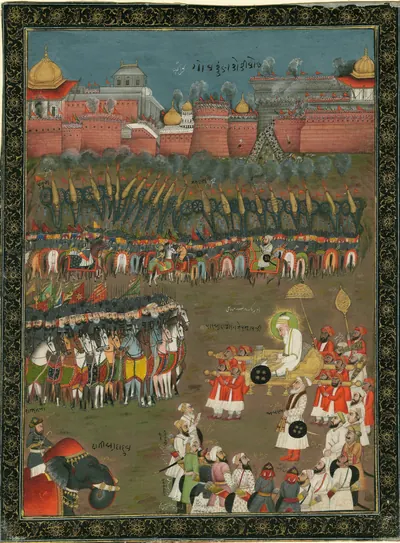
The siege began early in 1687.38394041 In Khafi Khan’s reckoning it lasted “eight months and ten days”.38394041 The besiegers filled the ditch with bags of earth, and the garrison countered their mines.38394041 Famine and disease struck the imperial camp as well as the city.38394041
Bilgrami adds that Chin Qalich Khan, grandfather of the future Nizam-ul-Mulk, was mortally wounded by a cannon ball.42 This happened in an assault on 28 January 1687, and he was buried near Atapur.42
In July Aurangzeb issued a proclamation annexing the kingdom.23 He appointed his own magistrates and revenue collectors to every place in it.23 As Sarkar translates, he said: “How long can Abul Hasan remain hidden in the fort, when his towns villages and cornfields are in our hands?”23
At the same time the khutba (Friday sermon) was read in the emperor’s name.3 A censor of morals (muhtasib) was posted at Hyderabad.3 His orders were to put down Hindu usages, demolish temples and build a mosque.3
Golconda fell on 21 September 1687.34340 An Afghan officer of the garrison, Abdullah Khan Pani, opened a postern gate (a small back gate).34340 A party under Ruhullah Khan entered the fort at about three in the morning.34340 Abul Hasan was sent as a prisoner to Daulatabad, on a pension of Rs 50,000 a year.44
Khafi Khan and Sarkar describe his dignity on the morning of his capture, and his courteous reception by the emperor.4544 The Venetian Niccolao Manucci tells a different story.4647 He says Abul Hasan was left sitting in the sun on an elephant.4647 He was beaten when he refused to say what he had done with his treasure.4647
Sarkar follows Khafi Khan on the spoils taken at Golconda.48 He puts them at nearly seven krores of rupees in cash, besides plate and jewels.48 He puts the revenue of the conquered kingdom at two krores and eighty-seven lakhs.48 Aurangzeb stayed near Golconda until 25 January 1688 “in order to settle the administration of the conquered country”.49
The subah of Haidarabad
The conquered kingdom became the subah of Haidarabad.5051 The Chahar Gulshan says that the city “was at first known as Daru-l-jihad, [the place of religious war], then it became celebrated as Furkhanda-buniad”.50 Bilgrami adds that the name Dar-ul-jihad was given “after the sack of the city by the Emperor Aurangzeb in 1098 A.H.”.51 He says the name Farkhunda Bunyad was restored under Shah Alam.51
The same survey lists twelve sarkars (districts) in about 1720:115253
- Devarakonda
- Warangal
- Rajgopal
- Kam-bhim-mandi
- Ibrahimpatan
- Nizampatan
- Muhammadnagar
- Kulpur
- Rajahmundry
- the mahals (revenue divisions) beyond the Krishna
- the mahals on this side of it
- a twelfth of miscellaneous dues, among them the mint, the tax on toddy and the diamond mines115253
Sarkar’s tables give eighteen sarkars and 129 mahals for about 1700.11 They show the provincial revenue falling from five krores of rupees in 1697 to about 2.73 krores in 1720.11 The Chahar Gulshan also credits Abul Hasan with settling skilled craftsmen in the city.54 It says that “the handicrafts of the place have remained famous in the world up to this day”.54
The first governors were men of the old kingdom.55 Sarkar writes that after the conquest Aurangzeb “wisely retained the former Qutb Shahi officers at their respective posts for some time”.55 Muhammad Ibrahim, now called Mahabat Khan, became subahdar (governor) of Haidarabad.55 A Golconda officer, Ali Askar Khan, became faujdar of the Karnatak, with his headquarters at Kadapa (then Cuddapah).55
In January 1688 these men were replaced.56 Mahabat Khan was sent to Lahore, and Ruhullah Khan received the government of Haidarabad.56 The governors who followed are known only in part:
| Governor | Period | Source |
|---|---|---|
| Muhammad Ibrahim, Mahabat Khan | 1687–88 | Sarkar, Aurangzib V, pp. 56–57 |
| Ruhullah Khan | from January 1688 | Sarkar, Aurangzib V, p. 57; Bilgrami, p. 97 |
| Mir Bahadur Dil, Jan Sipar Khan | until his death in AH 1113 (1701–02) | Bilgrami, p. 97 |
| Rustam Dil Khan, his son | AH 1113 (1701–02) to 1708, with a spell as faujdar of the Bijapur Karnatak | Bilgrami, p. 97; Irvine I, p. 52 |
| Prince Kam Bakhsh (as claimant to the throne) | 1708 | Irvine I, pp. 52–60 |
| Yusuf Khan | under Bahadur Shah (1707–12) and still in 1713 | Khafi Khan, p. 412; Irvine I, pp. 223, 263 |
| Mubariz Khan | about 1713 to 1724 | Irvine II, p. 138 |
The table draws on Sarkar, Bilgrami, Khafi Khan and Irvine, as listed in each row.55565758596010 Sarkar mentions Rustam Dil Khan being sent “from Haidarabad” with troops as early as 1695.61 So he may have acted for his father before 1702.61
Rustam Dil Khan built the Kali Masjid outside the Yaqutpura gate of Hyderabad in AH 1114 (1702; AH is the Islamic way of counting years).62 See the Kali Masjid inscription, Rustam Dil Khan and Mubariz Khan.
Above the subahdars stood the viceroy of the six Deccan provinces.636465 These viceroys were:636465
- Zulfiqar Khan, who left Daud Khan Panni in the Deccan as his deputy when he followed Bahadur Shah north636465
- Nizam-ul-Mulk, from 1713636465
- then Husain Ali Khan636465
How the province was governed
Grant Duff, the historian of the Marathas, describes how the Mughals took possession of a district.66 Two officers were appointed, the faujdar and the khalsa diwan (revenue officer).66 The faujdar commanded the troops and kept the peace.66 He was allowed about a quarter of the collections for his establishment (his staff).66 The diwan collected the revenue, whether for the treasury or for a jagirdar (holder of a jagir).66
The faujdars, “in conjunction with the Dewan, farmed out the districts to the Deshmookhs or Dessayes, and the Dewan realized the amount from them”.66 In other words, the local officers paid a fixed sum for the right to collect the revenue, and the diwan collected that sum from them.66
The Kistna district manual of 1883 describes the same arrangement on the coast.14 There, it says, the subahdar at Hyderabad ruled through faujdars.14 They “assisted Revenue officers called Desmukhs and Despondis to collect the government dues”.14 These dues came from “renters who were responsible for one or more villages”.14
The deshmukh and the deshpande were old Deccan offices, older than the Mughals.6768 Grant calls the deshmukh “at once, the agent of government, the head farmer, and natural representative of the people”.6768 He calls the deshpande the “provincial register”.6768 This office was “for the most part exercised by Bramins”.6768 It was “the only one in its nature hereditary, to be found in the whole system of Mussulman government”.6768 Every grant, rule and rent-roll had to pass through the deshpande’s office (daftar) to be valid.6768
Murshid Quli Khan was Shah Jahan’s diwan in the Deccan.69 In 1654 he brought Todar Mal’s revenue system there.69 Grant says that the southern titles “desmook, chief of a district, or desfandeah, its bramin, recorder, and accomptant” were then used.69 They took the place of the more usual zamindar (landholder) and qanungo.69
The Imperial Gazetteer of Hyderabad, on the other hand, says that under Muslim rule the revenues “seem to have been generally farmed out”.7071 It says that only traces of the Bahmani and Qutb Shahi settlements survived.7071 Regular settlements, it says, were made only in Berar and the Maratha districts.7071
On the coast the Mughals took over the Qutb Shahi assessment rather than making a new one.1872 Grant says the standard assessment (jama kamil) of the Circars was ascertained in 1635.1872 It was “finally enrolled on the Imperial Khalsa Records of Alem-geer, on the entire reduction of the kingdom of Hydrabad”.1872 It remained the standard, “with a small addition”, until the French took over in 1753.1872 Grant thought it “wholly inadequate” by the time of the Mughal conquest.1872
In Rayalaseema, Thomas Munro is quoted in the Anantapur gazetteer.73 He found that Aurangzeb “appears to have adopted the Kamil which he found established”.73 Aurangzeb entered it in his grants with a deduction for waste.73 Munro put the decline down to “the depredations of the Poligars” (raids by local chiefs).73
The coast: the Northern Sarkars
In July 1687, before Golconda fell, the Mughals gained Kondapalli by bribery.5574 Sarkar calls it “the second strongest fort in Telingana and the king’s chief treasury and arsenal”.55 Mughal parties were plundering within three days’ march of Machilipatnam.5574 Grant Duff says that Rajahmundry and the ports of Machilipatnam and Ganjam were then occupied.75
Sarkar notes that the coast north of the Krishna “formed a separate province, under its own viceroy”.76 The Madras records called it “the Gingerlee Country”.76 Its capital was Machilipatnam, and it included Visakhapatnam and Srikakulam.76
The district gazetteers describe the familiar five sarkars: Guntur, Kondapalli, Eluru (then Ellore), Rajahmundry and Srikakulam.7778 The English later called them the Northern Circars.7778 Srikakulam took in the later Ganjam and Visakhapatnam districts.7778 It was still ruled “by a Faujdar residing at the town after which it was named”.7778
Grant gives the assessment of each sarkar as it stood on the Mughal records:1879
- Guntur or Murtazanagar, about 11.7 lakhs of rupees1879
- Kondapalli or Mustafanagar, 11.6 lakhs1879
- Eluru, 5.6 lakhs1879
- Machilipatnam with Nizampatnam (then Nizampatam), 7.9 lakhs, including its customs, mint duties and salt1879
- Rajahmundry, 4.2 lakhs1879
- Srikakulam, the “most distant frontier province to the north, only explored along the sea-coast”, 8.4 lakhs1879
In each sarkar, part of the land was kept as haveli, the crown’s own estate.79 It paid for the garrisons and the civil establishment (the officials).79
Grant judged that Aurangzeb was busy with the larger provinces and the Marathas.12 So he never made the coast “as productive as they ought to have been to the treasury”.12 After his death, Grant wrote, the coast fell into “a total suspension of all regular governments”.12 The Godavari gazetteer agrees.78 It says that “the system (or want of system) of administration remained unchanged, and disorders continued as freely as before”.78
The Company’s Committee of Circuit made an inquiry in 1786.80 It recorded that “during the Mogul Government there were courts of justice established at Rajahmundry and Ellore, where Kazis administered justice according to Muhammadan law”.80 The faujdars kept capital cases (cases punishable by death) for themselves.80 Each place had a kotwal to keep the police.80 By 1786, “of these nothing but the names remain”.80
In the Krishna (then Kistna) district, according to the manual, the faujdar at Kondapalli was “often too weak” to support the deshpandes.14 So the renters began to claim their villages as hereditary, and “to assume the title of Zemindar”.14
The Karnatak and the poligars of Rayalaseema
The Mughals called the southern conquests of Golconda and Bijapur the Karnatak.976 Sarkar divides it at the Palar river into the Haidarabadi Karnatak and the Bijapuri Karnatak.976 Each had an upland (balaghat) and a lowland (painghat).976
The upland of the Haidarabadi Karnatak “began south of Nandiyal”.976 It included Siddhavatam, Gandikota, Gooty, Gurramkonda and Kadapa, the seat of its government.976 Its lowland “embraced the sea-coast from Gantur to Sadras”.976
Grant Duff gives a wider lowland.75 It ran from Guntur “along the Coromandel coast” as far south as the Coleroon.75 He gives the same upland districts of Gooty, Gurramkonda, Gandikota and Siddhavatam.75 See Gandikota and Gooty.
The country was not easily held.8182 In 1688 Aurangzeb made frequent changes in the governorship of the Haidarabadi Karnatak.8182 Late in 1689 some former Golconda officers whom he had taken into his service rebelled.8182 They were Muhammad Sadiq, Yachapa Nayak and Ismail Khan Maka.8182
These officers allied themselves with the Maratha king Rajaram.8182 They began “to usurp the country and collect the revenue”.8182 This went on until Zulfiqar Khan marched down in 1690, by way of Raichur, Kurnool, Nandyal, Kadapa and Gurramkonda.8182
In the west, in Grant Duff’s account, Masaud Khan, the former regent of Bijapur, gave up Adoni to Prince Azam and Ghazi-ud-din.83 The Kurnool manual names the conqueror Ghiyas-ud-din Khan.1584 The Kurnool country was later given as a jagir to the Afghan general Daud Khan Panni.831584 His brother Ibrahim Khan held it in 1724.831584
The Cuddapah gazetteer says that until 1687 the only agents of the central power there were the nawabs of Gandikota and Kadapa.85 They could not subdue the local chiefs.85 By the beginning of the eighteenth century, it says, “the condition of this part of the Deccan fell little short of anarchy”.85
The Anantapur gazetteer gives a local example.86 Aurangzeb reduced the tribute (peshkash) of one family of poligars (local military chiefs) to 11,200 pagodas.86 But he required it to keep 1,200 foot and 150 horse ready for service.86
Kam Bakhsh at Hyderabad, 1708–1709
When Aurangzeb died in 1707, his youngest son Kam Bakhsh was on his way to govern Bijapur.8758 He proclaimed himself emperor, struck coins in his own name and marched on Hyderabad.8758 There the subahdar Rustam Dil Khan submitted to him, but the commandant of Golconda refused to surrender.8758
Within months Kam Bakhsh had Rustam Dil Khan trampled to death by an elephant, and executed other officers.888990 He also sent a force against the diwan of Machilipatnam, who held thirty-two lakhs of imperial treasure.888990
His elder brother, the new emperor Bahadur Shah, marched south.9178 On 13 January 1709 the Afghans of Daud Khan Panni defeated and took Kam Bakhsh near Hyderabad.9178 He died of his wounds the same night.9178 Bahadur Shah visited the palaces of Hyderabad before returning north.92
Disorder and the rebel Papa Rai
The years after Aurangzeb’s death were remembered as a time of disorder.93 Sarkar quotes an account of the time which says that the Marathas “even attacked walled cities like Haidarabad”.93 It says that the population of Hyderabad, as of Bijapur and Burhanpur, had fallen.93
The most famous rebel was a man Khafi Khan calls Pap Rai, “by birth a toddy-seller”.945995 He is remembered in Telangana as Sarvaya Papadu.945995 From a mud fort at Shahpur in the sarkar of Bhongir, he plundered the country and killed a faujdar’s officer, Qasim Khan.945995 In Muharram AH 1120 (1708) he sacked Warangal.945995
After a siege of nine months at his second fort, Pap Rai fled.945995 He was betrayed and executed, and his head was sent to the court.945995 Local tradition places that last siege at Tatikonda.945995 The Kistna manual tells a different story, in which he was killed by an officer of Mubariz Khan.14 His page separates the record from the legend.
The Marathas: chauth and sardeshmukhi
The Maratha claim was to a share of the revenue: chauth, one quarter, and sardeshmukhi, a further tenth.96 Grant Duff describes the Maratha leaders of Aurangzeb’s last years levying tribute wherever they rode.96 They took it “under the various heads of Chouth, Surdeshmookhee, and Ghasdana”.96
In 1718 Husain Ali Khan, viceroy of the Deccan, made a treaty with the Maratha king Shahu.9798 In 1719 the emperor issued grants of the chauth and sardeshmukhi of “the six Soobehs of the Deccan, including the Hyderabad and Beejapoor Carnatic”.9798 The condition was that Shahu kept 15,000 horse to help the imperial governors keep order.9798
Gribble adds that Shahu made himself answerable for the security of the districts on which he levied chauth.99 Grant Duff prints the revenue of the six provinces as the Mughal records registered it.98 For Haidarabad it is more than six krores of rupees.98
Mubariz Khan, governor of Haidarabad, did not accept the agreement.100 Khafi Khan says he “apparently did not pay the chauth according to the agreement made by the Saiyids”.100 He “had shown much activity, in punishing the Mahrattas”.100 But their officials still levied the chauth “whenever and wherever they found the opportunity, … and many of the roads were closed”.100
After 1724 Nizam-ul-Mulk arranged that a sum should be paid from his treasury in place of the chauth of the Haidarabad subah.101 He also arranged that the sardeshmukhi levied from the cultivators should be given up.101
Mints and coins
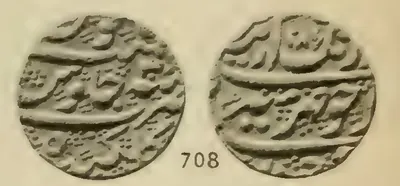
Coins are among the best evidence of Mughal sovereignty in the south. Stanley Lane-Poole wrote a catalogue of the British Museum coins (1892).102 He notes that coins in Aurangzeb’s name were struck “from Sholapur, Golkondah, Bijapur, and Haidarabad”.102 They were struck “even from Masulipatan and Chinapatan (Madras), far down on the Coromandel coast”.102
Lane-Poole lists Golconda among the Deccan mints “now appearing for the first time” under Aurangzeb.103 Others in the list are Ahmadnagar, Bijapur, Chinapatan (“the old name for Madras”) and Masulipatan.103
Whitehead’s catalogue of the Lahore Museum coins (1914) adds that Gulkanda (Golconda) coins of Shah Jahan’s period are known.104105 The Museum’s rupee of Aurangzeb from Haidarabad was “apparently the earliest known issue” of that mint.104105 It bears the epithet (title) Daru-l-jihad, “abode of holy war”.104105 Kam Bakhsh struck coins there in both gold and silver.104105 Under Shah Alam I the epithet was changed to Farkhunda bunyad, “of auspicious foundation”.104105
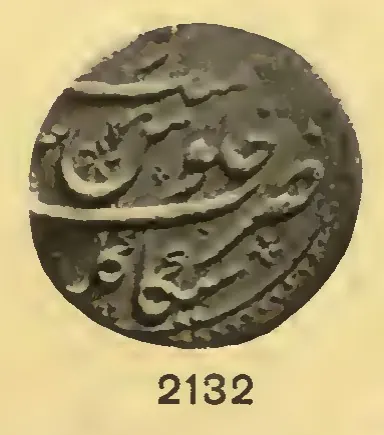
Under Farrukhsiyar new mints appear in the south.106107108 They struck a small gold coin on the pattern of the southern hun.106107108 Lane-Poole names Imtiyazgarh, “Distinction-Fort”, which he explains as “Aurangzib’s new name for Adoni”.106 He also names Gooty (Guti).106 Whitehead knew a half-rupee of Aurangzeb on which the mint is still called Adoni.107108
Whitehead also records gold mohurs of Farrukhsiyar from Sikakul, “identified with Chicacole”.109110 He calls it the capital of the Mughal sarkar of Srikakulam.109110 He also records rupees of Aurangzeb from Machhlipatan (Machilipatnam).109110
Irvine counted the coins of Farrukhsiyar in the British Museum, Lahore and Calcutta collections.111 He assigns eight to mints in the Haidarabad subah: three from Arcot, one from Adoni, three from Chinapatan and one from Gooty.111
Lane-Poole’s table of mints lists Haidarabad only under Kam Bakhsh.112106 His notes credit Kam Bakhsh with adding it to the Mughal mints, although his introduction mentions coins of Aurangzeb from there.112106 The Lahore rupee of Aurangzeb from Haidarabad is dated AH 1099 (1687–88).113
The European factories
The Dutch, English and French traded at Machilipatnam and other coast towns under Qutb Shahi licences.74 The Mughal conquest put these licences in question.74 The Kistna manual quotes the Fort St. George records of October 1687.74 Four hundred horsemen had come to Machilipatnam “from the Mogul with Tasherffs for the Dutch and French”.74 They also brought “strict orders to seize and secure all Englishmen and their concernes”.74
At that time the English Company was at war with Aurangzeb in Bengal.74 The Madras Council voted 50,000 pagodas “in purchasing forbearance from the Emperor”.74
In September 1689, Sarkar records, the emperor’s officer in Telingana seized the English factory (trading post) at Visakhapatnam.114 He killed three of the factors (traders), and the Machilipatnam factory was also seized.114 The Visakhapatnam gazetteer says Aurangzeb “issued orders that the English should be driven from his dominions”.115
The quarrel was made up.116117 In 1690 Elihu Yale, governor of Madras, received a cowle (grant) from Zulfiqar Khan for the English possessions on the coast.116 In 1708 Zulfiqar Khan asked Pitt, then governor, to stop Kam Bakhsh if he tried to escape by sea.117
Mubariz Khan, Nizam-ul-Mulk and Shakar Kheda
By Irvine’s reckoning, Mubariz Khan had governed Haidarabad for nearly twelve years in 1724.11810 In that year the court at Delhi was alarmed by Nizam-ul-Mulk’s return to the Deccan.11810 It appointed Mubariz Khan viceroy of all six provinces.11810
At the time Mubariz Khan was besieging the fort of Phulchari near Machilipatnam, held by Appa Rao.119 At Hyderabad he was joined by:119
- Bahadur Khan Panni, faujdar of Kurnool119
- a son of Abdun-nabi Khan, faujdar of Kadapa119
- an officer of Saadat-ullah Khan, faujdar of the Karnatak119
The armies met at Shakar Kheda in Berar.45 On the afternoon of 23 Muharram AH 1137, Mubariz Khan and his chief officers were killed.45 In Irvine’s conversion this date is 11 October 1724.45
Khafi Khan says that Mubariz Khan’s son had been left in charge at Hyderabad.100 He held out in “the fortress of Muhammad-nagar, near the city”.100 Then Nizam-ul-Mulk gave him grants of jagirs, and so persuaded him “to give up the keys of the fortress”.100
The emperor accepted the result.100 He sent Nizam-ul-Mulk the title of Asaf Jah, “with directions to settle the country, repress the turbulent, punish the rebels, and cherish the people”.100
Grant looked back from the Company’s side.12 He wrote that the battle “transferred in fact, though not in form, the sovereignty of this great limb of the Mogul empire”.12 It passed “from the house of Timeer to that of Assiphean”.12
The Mughal emperor remained the sovereign in name.120 Grant notes that when the Company took the Northern Circars, it obtained sanads (grants) from “the actual rightful acknowledged emperor of Hindostan”.120 The Nizam was then made to confirm these grants by treaty (1766).120 See the Asaf Jahis and Mughals, Asaf Jahis & the British.120
Where the sources disagree
- The date of the submission. Sarkar dates Abdullah’s submission to April 1636.1 Grant dates the general statement of the coastal revenue that went with it to 1635.18
- The capture of Golconda. Khafi Khan and Sarkar describe Abul Hasan’s calm and his courteous treatment.4544 Manucci says he was humiliated and beaten.47 The Old Style (older European calendar) date is 21 September 1687 (Sarkar).3 Manucci’s editor gives 1 October 1687, New Style.121
- The extent of the Haidarabadi Karnatak. Sarkar ends it at the Palar and Sadras.9 Grant Duff carries it to the Coleroon.75
- The governors of Haidarabad. Irvine calls the subahdar killed by Kam Bakhsh “Jan Sipar Khan (Rustam Dil Khan)”.89 Bilgrami makes Jan Sipar Khan the father, who died in 1701–02, and Rustam Dil Khan the son.57 An earlier book, which Grant Duff calls “Scott’s Deccan”, says that Qasim Khan was left as faujdar at Hyderabad after the conquest.122 Grant Duff thought this was a mistake.122 In his view, it arose because Qasim Khan was reinforced from Hyderabad at that time.122
- The end of Papa Rai. Khafi Khan has him executed under the subahdar Yusuf Khan, after the sack of Warangal in 1708.59 The Kistna manual has him killed by Abid Khan, an officer of Mubariz Khan.14
- The date of Shakar Kheda. Irvine converts 23 Muharram AH 1137 to 11 October 1724.4 The Kistna manual gives October 1724.13 The Kurnool manual gives 22 Muharram (24 September 1724).84 Gribble and the Anantapur gazetteer put the battle in 1723.101123
Footnotes
-
Sarkar, History of Aurangzib, Vols. I–II (1912), p. 19 (archive.org (opens in a new tab)). ↩ ↩2 ↩3 ↩4 ↩5 ↩6 ↩7 ↩8 ↩9 ↩10 ↩11 ↩12 ↩13 ↩14 ↩15
-
Sarkar, Aurangzib IV (1930), p. 450 (archive.org (opens in a new tab)). ↩ ↩2 ↩3 ↩4 ↩5
-
Sarkar, Aurangzib IV (1930), p. 451 (archive.org (opens in a new tab)). ↩ ↩2 ↩3 ↩4 ↩5 ↩6 ↩7 ↩8 ↩9 ↩10 ↩11 ↩12
-
Irvine, Later Mughals, Vol. II (1922), p. 145 (archive.org (opens in a new tab)). ↩ ↩2 ↩3 ↩4 ↩5 ↩6 ↩7
-
Irvine, Later Mughals, Vol. II (1922), p. 148 (archive.org (opens in a new tab)). ↩ ↩2 ↩3 ↩4 ↩5 ↩6
-
Khafi Khan, Muntakhabu-l Lubab, in H. M. Elliot and John Dowson (eds.), The History of India as Told by Its Own Historians, Vol. VII (1877), p. 315 (archive.org (opens in a new tab)). ↩ ↩2 ↩3
-
Irvine, Later Mughals, Vol. I (1922), p. 63 (archive.org (opens in a new tab)). ↩ ↩2 ↩3 ↩4 ↩5 ↩6
-
Irvine, Later Mughals, Vol. I (1922), p. 64 (archive.org (opens in a new tab)). ↩ ↩2 ↩3 ↩4 ↩5 ↩6
-
Sarkar, Aurangzib V (1924), p. 50 (archive.org (opens in a new tab)). ↩ ↩2 ↩3 ↩4 ↩5 ↩6 ↩7 ↩8 ↩9
-
Irvine, Later Mughals, Vol. II (1922), p. 138 (archive.org (opens in a new tab)). ↩ ↩2 ↩3 ↩4 ↩5 ↩6
-
Jadunath Sarkar, India of Aurangzib: Topography, Statistics and Roads (1901), p. xciii (archive.org (opens in a new tab)). ↩ ↩2 ↩3 ↩4 ↩5 ↩6
-
James Grant, “Political Survey of the Northern Circars”, in W. K. Firminger (ed.), The Fifth Report from the Select Committee … on the Affairs of the East India Company, Vol. III (1918), p. 11 (archive.org (opens in a new tab)). ↩ ↩2 ↩3 ↩4 ↩5 ↩6 ↩7 ↩8
-
Mackenzie, Kistna District (1883), p. 41 (archive.org (opens in a new tab)). ↩ ↩2 ↩3
-
Mackenzie, Kistna District (1883), p. 40 (archive.org (opens in a new tab)). ↩ ↩2 ↩3 ↩4 ↩5 ↩6 ↩7 ↩8 ↩9
-
Narahari Gopalakristnamah Chetty, A Manual of the Kurnool District (1886), p. 29 (archive.org (opens in a new tab)). ↩ ↩2 ↩3 ↩4
-
Sarkar, Aurangzib I–II (1912), p. 21 (archive.org (opens in a new tab)). ↩ ↩2 ↩3
-
Sarkar, Aurangzib I–II (1912), p. 118 (archive.org (opens in a new tab)). ↩ ↩2 ↩3 ↩4 ↩5 ↩6 ↩7
-
Grant, “Political Survey”, in Firminger, Fifth Report, Vol. III (1918), p. 47 (archive.org (opens in a new tab)). ↩ ↩2 ↩3 ↩4 ↩5 ↩6 ↩7 ↩8 ↩9 ↩10 ↩11 ↩12 ↩13 ↩14 ↩15 ↩16 ↩17
-
Sarkar, Aurangzib I–II (1912), p. 119 (archive.org (opens in a new tab)). ↩ ↩2 ↩3 ↩4 ↩5
-
Jadunath Sarkar, History of Aurangzib, Vols. I–II (1912), p. 16 (archive.org (opens in a new tab)). ↩ ↩2
-
Sarkar, Aurangzib I–II (1912), p. 117 (archive.org (opens in a new tab)). ↩ ↩2 ↩3 ↩4 ↩5 ↩6
-
Sarkar, Aurangzib I–II (1912), pp. 127–128 (archive.org (opens in a new tab)). ↩ ↩2 ↩3
-
Sarkar, Aurangzib I–II (1912), p. 131 (archive.org (opens in a new tab)). ↩ ↩2 ↩3 ↩4
-
Sarkar, Aurangzib I–II (1912), p. 133 (archive.org (opens in a new tab)). ↩ ↩2 ↩3 ↩4 ↩5 ↩6 ↩7
-
Sarkar, Aurangzib I–II (1912), p. 132 and note (archive.org (opens in a new tab)). ↩ ↩2 ↩3
-
Sarkar, Aurangzib I–II (1912), p. 134 (archive.org (opens in a new tab)). ↩ ↩2 ↩3
-
Sarkar, Aurangzib I–II (1912), p. 136 (archive.org (opens in a new tab)). ↩ ↩2 ↩3 ↩4
-
Sarkar, Aurangzib I–II (1912), p. 137 (archive.org (opens in a new tab)). ↩ ↩2 ↩3 ↩4
-
Jadunath Sarkar, History of Aurangzib, Vol. IV (2nd ed., 1930), p. 405 (archive.org (opens in a new tab)). ↩ ↩2 ↩3 ↩4 ↩5 ↩6 ↩7 ↩8
-
Sarkar, Aurangzib IV (1930), p. 406 (archive.org (opens in a new tab)). ↩ ↩2 ↩3 ↩4 ↩5 ↩6 ↩7
-
Khafi Khan, in Elliot and Dowson, History of India, Vol. VII (1877), p. 319 (archive.org (opens in a new tab)). ↩ ↩2 ↩3
-
Khafi Khan, in Elliot and Dowson, History of India, Vol. VII (1877), p. 320 (archive.org (opens in a new tab)). ↩ ↩2 ↩3
-
Sarkar, Aurangzib IV (1930), p. 416 (archive.org (opens in a new tab)). ↩ ↩2 ↩3 ↩4 ↩5 ↩6
-
Sarkar, Aurangzib IV (1930), p. 417 (archive.org (opens in a new tab)). ↩ ↩2 ↩3 ↩4 ↩5 ↩6
-
Khafi Khan, in Elliot and Dowson, History of India, Vol. VII (1877), p. 321 (archive.org (opens in a new tab)). ↩ ↩2 ↩3 ↩4 ↩5 ↩6
-
Khafi Khan, in Elliot and Dowson, History of India, Vol. VII (1877), p. 323 (archive.org (opens in a new tab)). ↩
-
Khafi Khan, in Elliot and Dowson, History of India, Vol. VII (1877), p. 325 (archive.org (opens in a new tab)). ↩ ↩2 ↩3
-
Khafi Khan, in Elliot and Dowson, History of India, Vol. VII (1877), p. 328 (archive.org (opens in a new tab)). ↩ ↩2 ↩3 ↩4
-
Khafi Khan, in Elliot and Dowson, History of India, Vol. VII (1877), p. 330 (archive.org (opens in a new tab)). ↩ ↩2 ↩3 ↩4
-
Khafi Khan, in Elliot and Dowson, History of India, Vol. VII (1877), p. 332 (archive.org (opens in a new tab)). ↩ ↩2 ↩3 ↩4 ↩5 ↩6 ↩7
-
Sarkar, Aurangzib IV (1930), p. 449 (archive.org (opens in a new tab)). ↩ ↩2 ↩3 ↩4
-
Bilgrami, Landmarks (1927), p. 89 (archive.org (opens in a new tab)). ↩ ↩2
-
Sarkar, Aurangzib IV (1930), p. 452 (archive.org (opens in a new tab)). ↩ ↩2 ↩3
-
Sarkar, Aurangzib IV (1930), p. 454 (archive.org (opens in a new tab)). ↩ ↩2 ↩3
-
Khafi Khan, in Elliot and Dowson, History of India, Vol. VII (1877), pp. 333–334 (archive.org (opens in a new tab)). ↩ ↩2
-
Manucci, Storia do Mogor, Vol. II (1907), p. 307 (archive.org (opens in a new tab)). ↩ ↩2 ↩3
-
Manucci, Storia do Mogor, Vol. II (1907), p. 308 (archive.org (opens in a new tab)). ↩ ↩2 ↩3 ↩4
-
Sarkar, Aurangzib IV (1930), p. 456 (archive.org (opens in a new tab)). ↩ ↩2 ↩3
-
Jadunath Sarkar, History of Aurangzib, Vol. V (1924), p. 5 (archive.org (opens in a new tab)). ↩
-
Chahar Gulshan, tr. in Sarkar, India of Aurangzib (1901), p. 157 (archive.org (opens in a new tab)). ↩ ↩2
-
Syed Ali Asgar Bilgrami, Landmarks of the Deccan (1927), p. 17 (archive.org (opens in a new tab)). ↩ ↩2 ↩3
-
Chahar Gulshan, tr. in Sarkar, India of Aurangzib (1901), p. 159 (archive.org (opens in a new tab)). ↩ ↩2
-
Chahar Gulshan, tr. in Sarkar, India of Aurangzib (1901), p. 160 (archive.org (opens in a new tab)). ↩ ↩2
-
Chahar Gulshan, tr. in Sarkar, India of Aurangzib (1901), p. 158 (archive.org (opens in a new tab)). ↩ ↩2
-
Sarkar, Aurangzib V (1924), p. 56 (archive.org (opens in a new tab)). ↩ ↩2 ↩3 ↩4 ↩5 ↩6 ↩7 ↩8
-
Sarkar, Aurangzib V (1924), p. 57 (archive.org (opens in a new tab)). ↩ ↩2 ↩3
-
Bilgrami, Landmarks (1927), p. 97 (archive.org (opens in a new tab)). ↩ ↩2
-
Irvine, Later Mughals, Vol. I (1922), p. 52 and note (archive.org (opens in a new tab)). ↩ ↩2 ↩3 ↩4
-
Khafi Khan, in Elliot and Dowson, History of India, Vol. VII (1877), p. 412 (archive.org (opens in a new tab)). ↩ ↩2 ↩3 ↩4 ↩5 ↩6 ↩7 ↩8 ↩9
-
Irvine, Later Mughals, Vol. I (1922), p. 263, and p. 223, note (archive.org (opens in a new tab)). ↩
-
Sarkar, Aurangzib V (1924), p. 119 (archive.org (opens in a new tab)). ↩ ↩2
-
Bilgrami, Landmarks (1927), p. 96 (archive.org (opens in a new tab)). ↩
-
Grant Duff, History of the Mahrattas, Vol. I (1826), p. 422 (archive.org (opens in a new tab)). ↩ ↩2 ↩3 ↩4 ↩5
-
Irvine, Later Mughals, Vol. I (1922), p. 262 (archive.org (opens in a new tab)). ↩ ↩2 ↩3 ↩4 ↩5
-
J. D. B. Gribble, A History of the Deccan, Vol. I (1896), p. 356 (archive.org (opens in a new tab)). ↩ ↩2 ↩3 ↩4 ↩5
-
Grant Duff, History of the Mahrattas, Vol. I (1826), p. 347 (archive.org (opens in a new tab)). ↩ ↩2 ↩3 ↩4 ↩5 ↩6 ↩7
-
Grant, “Political Survey”, in Firminger, Fifth Report, Vol. III (1918), p. 22 (archive.org (opens in a new tab)). ↩ ↩2 ↩3 ↩4 ↩5 ↩6
-
Grant, “Political Survey”, in Firminger, Fifth Report, Vol. III (1918), pp. 24–25 (archive.org (opens in a new tab)). ↩ ↩2 ↩3 ↩4 ↩5 ↩6
-
Grant, “Political Survey”, in Firminger, Fifth Report, Vol. III (1918), p. 35 (archive.org (opens in a new tab)). ↩ ↩2 ↩3 ↩4
-
Imperial Gazetteer of India: Hyderabad State (1909), p. 59 (archive.org (opens in a new tab)). ↩ ↩2 ↩3
-
Imperial Gazetteer: Hyderabad (1909), p. 60 (archive.org (opens in a new tab)). ↩ ↩2 ↩3
-
Grant, “Political Survey”, in Firminger, Fifth Report, Vol. III (1918), p. 49 (archive.org (opens in a new tab)). ↩ ↩2 ↩3 ↩4 ↩5
-
Thomas Munro, quoted in Francis, Anantapur (1905), p. 103 (archive.org (opens in a new tab)). ↩ ↩2 ↩3 ↩4
-
Gordon Mackenzie, A Manual of the Kistna District (1883), p. 39 (archive.org (opens in a new tab)). ↩ ↩2 ↩3 ↩4 ↩5 ↩6 ↩7 ↩8 ↩9
-
Grant Duff, History of the Mahrattas, Vol. I (1826), p. 346 (archive.org (opens in a new tab)). ↩ ↩2 ↩3 ↩4 ↩5
-
Sarkar, Aurangzib V (1924), p. 51 and note (archive.org (opens in a new tab)). ↩ ↩2 ↩3 ↩4 ↩5 ↩6 ↩7 ↩8 ↩9
-
W. Francis, Madras District Gazetteers: Vizagapatam, Vol. I (1907), p. 30 (archive.org (opens in a new tab)). ↩ ↩2 ↩3 ↩4
-
F. R. Hemingway, Madras District Gazetteers: Godavari, Vol. I (1907), p. 29 (archive.org (opens in a new tab)). ↩ ↩2 ↩3 ↩4 ↩5 ↩6
-
Grant, “Political Survey”, in Firminger, Fifth Report, Vol. III (1918), p. 48 (archive.org (opens in a new tab)). ↩ ↩2 ↩3 ↩4 ↩5 ↩6 ↩7 ↩8 ↩9
-
Hemingway, Godavari (1907), p. 188, quoting the Committee of Circuit’s report of December 1786 (archive.org (opens in a new tab)). ↩ ↩2 ↩3 ↩4 ↩5
-
Sarkar, Aurangzib V (1924), pp. 61–62 (archive.org (opens in a new tab)). ↩ ↩2 ↩3 ↩4 ↩5 ↩6 ↩7
-
Sarkar, Aurangzib V (1924), p. 68 (archive.org (opens in a new tab)). ↩ ↩2 ↩3 ↩4 ↩5 ↩6 ↩7
-
Grant Duff, History of the Mahrattas, Vol. I (1826), p. 345 (archive.org (opens in a new tab)). ↩ ↩2 ↩3
-
Chetty, Kurnool District (1886), p. 30 (archive.org (opens in a new tab)). ↩ ↩2 ↩3 ↩4
-
C. F. Brackenbury, Madras District Gazetteers: Cuddapah, Vol. I (1915), p. 38 (archive.org (opens in a new tab)). ↩ ↩2 ↩3
-
Francis, Anantapur (1905), p. 144 (archive.org (opens in a new tab)). ↩ ↩2 ↩3
-
William Irvine, ed. Jadunath Sarkar, Later Mughals, Vol. I (1922), pp. 50–51 (archive.org (opens in a new tab)). ↩ ↩2 ↩3
-
Irvine, Later Mughals, Vol. I (1922), pp. 53–54 (archive.org (opens in a new tab)). ↩ ↩2
-
Irvine, Later Mughals, Vol. I (1922), p. 58 (archive.org (opens in a new tab)). ↩ ↩2 ↩3
-
Irvine, Later Mughals, Vol. I (1922), p. 59 (archive.org (opens in a new tab)). ↩ ↩2
-
Irvine, Later Mughals, Vol. I (1922), p. 62 (archive.org (opens in a new tab)). ↩ ↩2 ↩3
-
Irvine, Later Mughals, Vol. I (1922), pp. 66–67 (archive.org (opens in a new tab)). ↩
-
Sarkar, Aurangzib V (1924), p. 239 (archive.org (opens in a new tab)). ↩ ↩2 ↩3
-
Khafi Khan, in Elliot and Dowson, History of India, Vol. VII (1877), pp. 410–411 (archive.org (opens in a new tab)). ↩ ↩2 ↩3 ↩4 ↩5 ↩6 ↩7
-
A. Chandra Sekhar (ed.), Census of India 1961, Vol. II, Part VII-B (18): Fairs and Festivals, Warangal District (1964), p. 19, entry “Thatikonda” (PDF p. 42) (censusindia.gov.in (opens in a new tab)). Paraphrased. ↩ ↩2 ↩3 ↩4 ↩5 ↩6 ↩7
-
Grant Duff, History of the Mahrattas, Vol. I (1826), p. 397 (archive.org (opens in a new tab)). ↩ ↩2 ↩3
-
Grant Duff, History of the Mahrattas, Vol. I (1826), pp. 445–446 (archive.org (opens in a new tab)). ↩ ↩2 ↩3
-
Grant Duff, History of the Mahrattas, Vol. I (1826), pp. 450–451 and notes (archive.org (opens in a new tab)). ↩ ↩2 ↩3 ↩4 ↩5
-
Gribble, History of the Deccan (1896), pp. 360–361 (archive.org (opens in a new tab)). ↩
-
Khafi Khan, in Elliot and Dowson, History of India, Vol. VII (1877), pp. 526–527 (archive.org (opens in a new tab)). ↩ ↩2 ↩3 ↩4 ↩5 ↩6 ↩7 ↩8 ↩9
-
Gribble, History of the Deccan (1896), p. 376 (archive.org (opens in a new tab)). ↩ ↩2 ↩3
-
Stanley Lane-Poole, The Coins of the Moghul Emperors of Hindustan in the British Museum (1892), p. xxxi (archive.org (opens in a new tab)). ↩ ↩2 ↩3
-
Lane-Poole, Coins of the Moghul Emperors (1892), p. lvii (archive.org (opens in a new tab)). ↩ ↩2
-
Whitehead, Panjab Museum Catalogue, Vol. II (1914), p. xcviii (archive.org (opens in a new tab)). ↩ ↩2 ↩3 ↩4 ↩5
-
Whitehead, Panjab Museum Catalogue, Vol. II (1914), p. lxxii (archive.org (opens in a new tab)). ↩ ↩2 ↩3 ↩4 ↩5
-
Lane-Poole, Coins of the Moghul Emperors (1892), p. lviii (archive.org (opens in a new tab)). ↩ ↩2 ↩3 ↩4 ↩5 ↩6
-
R. B. Whitehead, Catalogue of Coins in the Panjab Museum, Lahore, Vol. II: Coins of the Mughal Emperors (1914), p. l (archive.org (opens in a new tab)). ↩ ↩2 ↩3
-
Whitehead, Panjab Museum Catalogue, Vol. II (1914), p. li (archive.org (opens in a new tab)). ↩ ↩2 ↩3
-
Whitehead, Panjab Museum Catalogue, Vol. II (1914), p. lxxxvi (archive.org (opens in a new tab)). ↩ ↩2 ↩3
-
Whitehead, Panjab Museum Catalogue, Vol. II (1914), p. cv (archive.org (opens in a new tab)). ↩ ↩2 ↩3
-
Irvine, Later Mughals, Vol. I (1922), p. 400 (archive.org (opens in a new tab)). ↩ ↩2
-
Lane-Poole, Coins of the Moghul Emperors (1892), pp. xlvii–xlix (archive.org (opens in a new tab)). ↩ ↩2
-
Whitehead, Panjab Museum Catalogue, Vol. II (1914), p. 238, No. 1680, and pl. XI (archive.org (opens in a new tab)). ↩
-
Sarkar, Aurangzib V (1924), p. 333 (archive.org (opens in a new tab)). ↩ ↩2
-
Francis, Vizagapatam (1907), p. 37 (archive.org (opens in a new tab)). ↩
-
Henry Morris, A Descriptive and Historical Account of the Godavery District (1878), p. 192 (archive.org (opens in a new tab)). ↩ ↩2
-
Irvine, Later Mughals, Vol. I (1922), p. 60 (archive.org (opens in a new tab)). ↩ ↩2
-
Irvine, Later Mughals, Vol. II (1922), p. 137 (archive.org (opens in a new tab)). ↩ ↩2 ↩3
-
Irvine, Later Mughals, Vol. II (1922), p. 140 (archive.org (opens in a new tab)). ↩ ↩2 ↩3 ↩4 ↩5
-
Grant, “Political Survey”, in Firminger, Fifth Report, Vol. III (1918), p. 16 (archive.org (opens in a new tab)). ↩ ↩2 ↩3 ↩4
-
Niccolao Manucci, tr. William Irvine, Storia do Mogor, Vol. II (1907), p. 306 and note (archive.org (opens in a new tab)). ↩
-
James Grant Duff, A History of the Mahrattas, Vol. I (1826), p. 342, note (archive.org (opens in a new tab)). ↩ ↩2 ↩3
-
W. Francis, Madras District Gazetteers: Anantapur (1905), p. 22 (archive.org (opens in a new tab)). ↩
Photos
 "Emperor Aurangzebe at the siege of Golconda, 1687": Indian gouache painting of the mid- to late 18th century, about a century after the event (Anne S. K. Brown Military Collection, Brown University)Other · c. 1750-1790
 Aurangzeb: Deccani portrait, c. 1686, from an album in the Rijksmuseum (RP-T-00-3186-6); Dutch title: "Portrait of Aurangzeb, youngest son of Shah Jahan, who in his father's time ruled the province of the Deccan, and after his father's death rules all Delhi, having killed all three of his brothers"Other · c. 1686
 Gold mohur of Aurangzeb struck at Golkondah (Golconda), AH 1086, obverse and reverse (Lane-Poole, British Museum catalogue 1892, No. 708, pl. XVIII)Coin · 1892
 Gold mohur of Farrukhsiyar struck at Sikakul (Chicacole, Srikakulam) (Whitehead 1914, No. 2132, pl. XIII)Coin · 1914
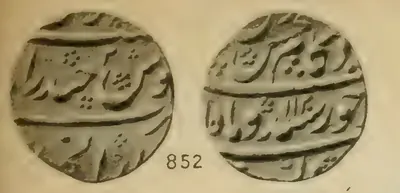 Gold mohur of the rebel prince Kam Bakhsh struck at Haidarabad (Hyderabad), AH 1120, obverse and reverse (Lane-Poole 1892, No. 852, pl. XXI)Coin · 1892
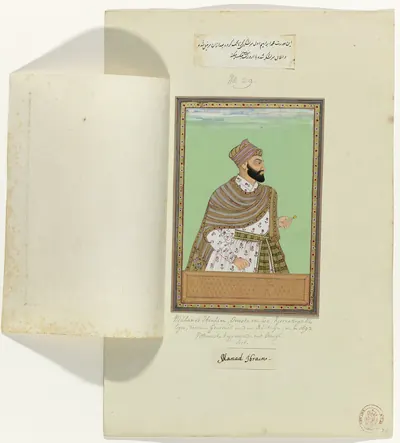 Muhammad Ibrahim (later Mahabat Khan): Deccani portrait, c. 1686, Rijksmuseum (RP-T-00-3186-29); Dutch title: "Portrait of Muhammad Ibrahim; first he served as commander of the Karnatak; then he became commander of the cavalry, and now as commander he wages war against Aurangzeb"Other · c. 1686
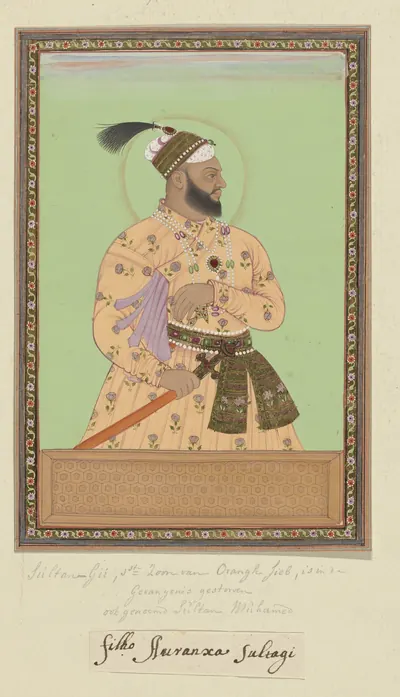 Muhammad Sultan ("Sultanji"): Deccani portrait, c. 1686, Rijksmuseum (RP-T-00-3186-10); Dutch title: "Portrait of Sultanji, the eldest son of Aurangzeb, the son-in-law of Sultan Abdullah; Aurangzeb imprisoned him and he also died in that captivity"Other · c. 1686
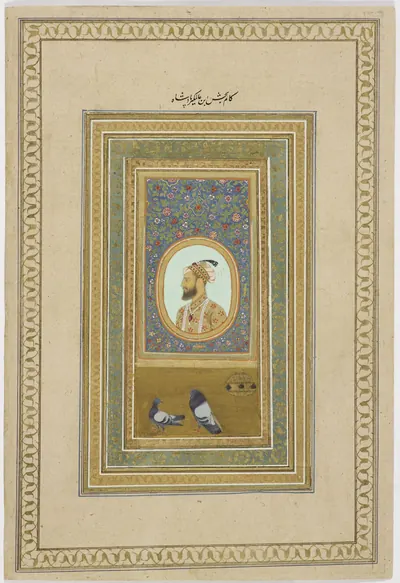 Prince Kam Bakhsh: oval bust portrait on an album page, Mughal, c. 1700 (Royal Collection Trust, "Painting of a falcon and portrait of Kam Bakhsh")Other · c. 1700
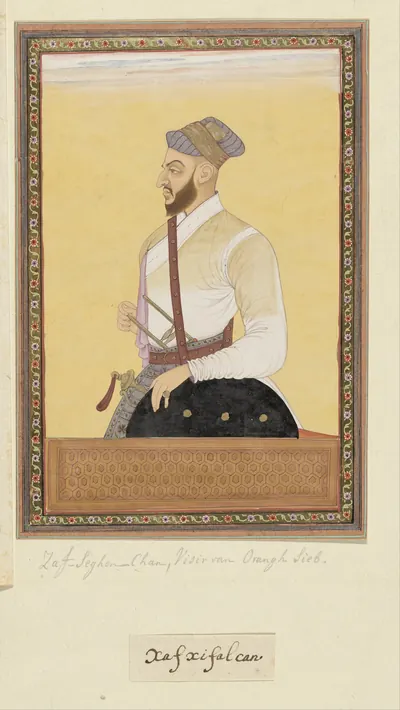 Saf-shikan Khan: Deccani portrait, c. 1686, Rijksmuseum (RP-T-00-3186-18); Dutch title: "Portrait of Saf-shikan Khan, who has been vizier of Aurangzeb"Other · c. 1686
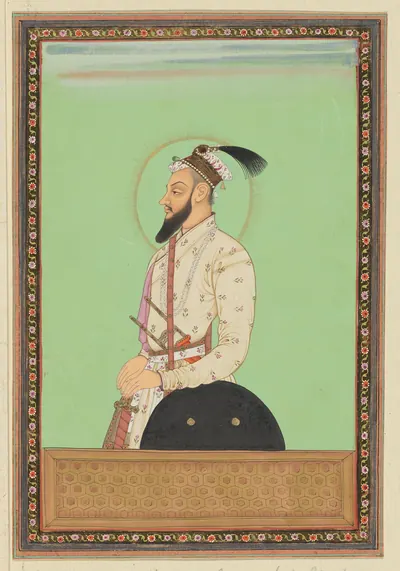 Shah Alam (Muhammad Muazzam, later the emperor Bahadur Shah): Deccani portrait, c. 1686, Rijksmuseum (RP-T-00-3186-11); Dutch title: "Portrait of Shah Alam, son of Aurangzeb born after Sultanji; he was first governor (subagar) of the Deccan; after marching against Sambaji, the son of Sivaji, he has now turned against Sultan Abu'l-Hasan and wages war with him"Other · c. 1686
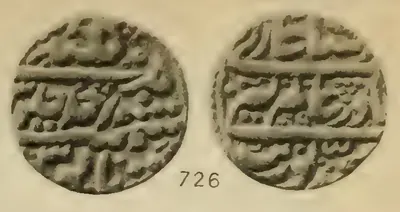 Silver rupee of Aurangzeb struck at Golkondah (Golconda), AH 1069, regnal year 1, obverse and reverse (Lane-Poole 1892, No. 726, pl. XIX)Coin · 1892
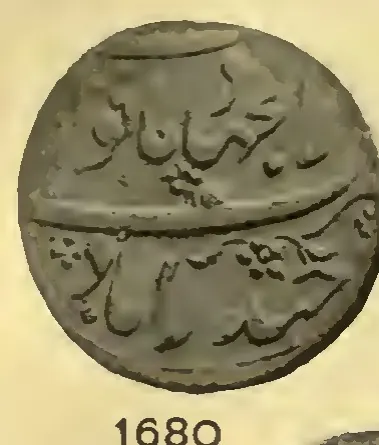 Silver rupee of Aurangzeb struck at Haidarabad "Daru-l-jihad", AH 1099 (Whitehead, Panjab Museum catalogue 1914, No. 1680, pl. XI)Coin · 1914
Show all (16)
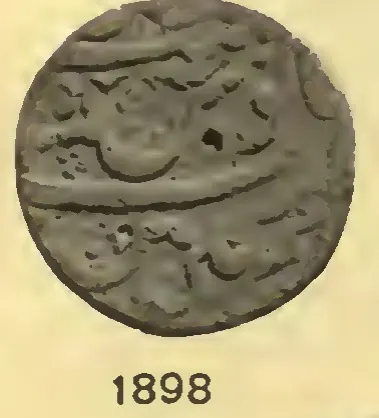 Silver rupee of Aurangzeb struck at Machhlipatan (Machilipatnam), AH 1118, regnal year 51 (Whitehead 1914, No. 1898, pl. XI)Coin · 1914
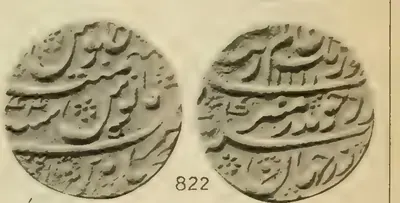 Silver rupee of Aurangzeb struck at Masulipatan (Machilipatnam), regnal year 44, obverse and reverse (Lane-Poole 1892, No. 822, pl. XX)Coin · 1892
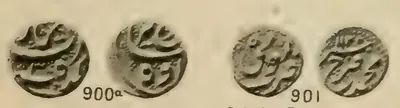 Small gold coins of Farrukhsiyar from the Deccan mints of Imtiyazgarh (Adoni), regnal year 3, and Guti (Gooty), AH 1128 (Lane-Poole 1892, Nos. 900a and 901, pl. XXII)Coin · 1892
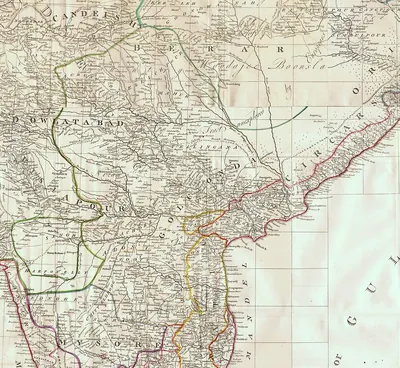 The Deccan in James Rennell's "Map of Hindoostan, or the Mogul Empire" (London, 1788): detail with Golconda, Telingana, Visiapour, Adoni, Dowlatabad, Berar and the CircarsMap · 1788
References
Notes (0)
Sources (23)
Spotted an error on this page? Tell us
Last updated: