Neelam Sanjiva Reddy
Congress leader and member for Kalahasti in the Andhra Legislative Assembly. He was Deputy Chief Minister of the Andhra State at Kurnool from 1953 to 1956 and one of the Andhra leaders who agreed the terms for the union with Telangana in February 1956. On 1 November 1956 he was sworn in as the first Chief Minister of Andhra Pradesh, and he was still Chief Minister in 1958.
Neelam Sanjiva Reddy was a Congress leader and a member of the Andhra Legislative Assembly.12 He was Deputy Chief Minister of the Andhra State, whose government sat at Kurnool.34 On 1 November 1956 he became the first Chief Minister of Andhra Pradesh, the state formed by joining Telangana to Andhra.56
The official records spell his name in several ways, such as N. Sanjeeva Reddi and N. Sanjiva Reddy.47
Deputy Chief Minister of the Andhra State, 1953–1956
The first Andhra Legislative Assembly met at Kurnool in November 1953.1 Its list of members shows N. Sanjeeva Reddi as the member for Kalahasti (today’s Srikalahasti).1
On 30 November 1953 the Assembly debated where the state’s capital should be.8 In a division (a counted vote) on one amendment, his name came second in the list of those voting for it, after Tanguturi Prakasam, the Chief Minister.89 Later that day the Speaker decided to put another amendment to the vote.10 Sanjeeva Reddi then said that, with no disrespect to the Chair, he and his colleagues would take no further part in the proceedings.10 The amended resolution was lost.10
On 24 March 1954, as Deputy Chief Minister, he answered a question about tents put up at Kurnool for government officials.4 He told the Assembly that the tents had cost Rs. 1,40,600 in all.4 The story of the capital is told on the page Kurnool.
On 1 November 1954 Prakasam told the Assembly that Sanjeeva Reddi, his Deputy Chief Minister, would be Leader of the House and would answer for him.11 Two weeks later, after a vote of no confidence against the ministry, the Governor took over the government of the state.12
In November 1955 the Assembly debated the report of the States Reorganisation Commission for two days.13 Sanjeeva Reddi spoke, in Telugu, on the second day.13 In April 1956 he was still Deputy Chief Minister, and he answered questions on irrigation works in the Assembly Hall at Kurnool.14
The Gentlemen’s Agreement, February 1956
On 20 February 1956, leaders of the Andhra State and Hyderabad State met at the Hyderabad Guest House in New Delhi.15 The Andhra side was B. Gopala Reddy, Sanjeeva Reddy, G. Latchanna and A. Satyanarayana Raju.15 The Hyderabad side included Burgula Ramakrishna Rao.15 They agreed on safeguards for Telangana in one state, which became known as the Gentlemen’s Agreement.15
First Chief Minister of Andhra Pradesh, 1956
Andhra Pradesh was formed on 1 November 1956, with Hyderabad city as its capital.6 That day Sanjiva Reddy spoke to the people from the Hyderabad radio station.5 The state government’s Telugu magazine Andhra Pradesh printed his talk in full.5
He said that he and his fellow ministers had taken the oath of office that morning.5 The forming of the Andhra State in 1953 had not fulfilled the wish of all Telugu people, he said, but Andhra Pradesh had done so.5 He compared the union of Andhra and Telangana to the meeting of the Manjira river with the Godavari.16
He said that the two regions still had different systems of administration, rules and laws.16 These would have to become one in time, and he asked officials to work with patience.16 The magazine’s note on the talk says that he promised two things:5
- the minorities and the employees of the Telangana region would suffer no hardship
- the agreement made by the leaders on the terms of the union would be carried out to the letter5
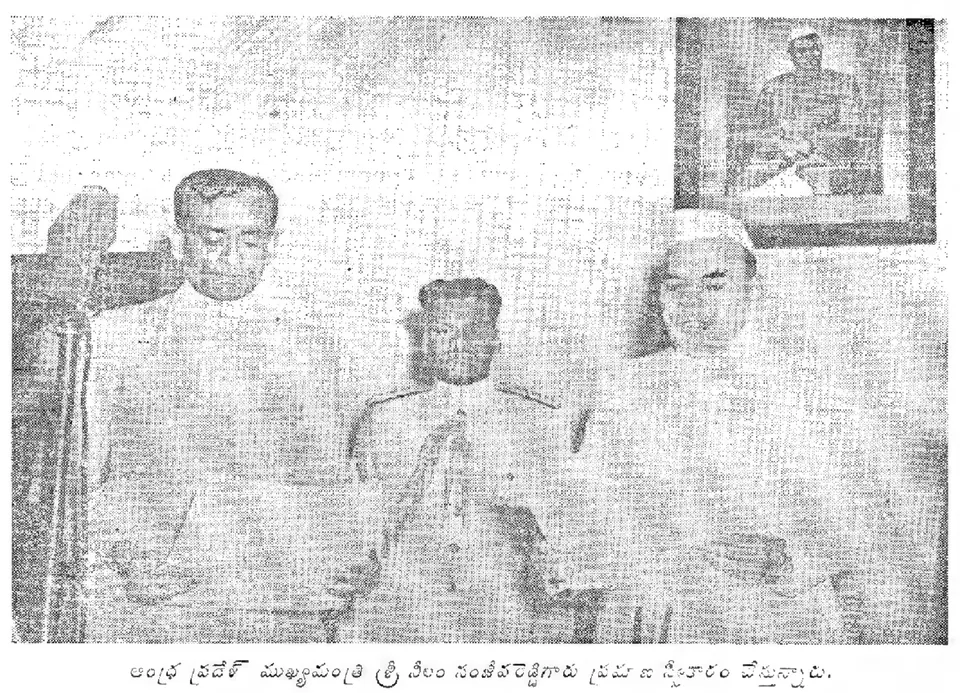
The same issue lists the first Council of Ministers.7 Sanjiva Reddy kept general administration, home, planning, transport and the information department.7 Among the other ministers were K. V. Ranga Reddy (revenue), Kala Venkata Rao (finance) and J. V. Narasinga Rao (power and irrigation).7 The magazine also printed a photograph of him taking the oath.17
In the Andhra Pradesh Assembly, 1956–1958
The Andhra Pradesh Legislative Assembly held its first session in December 1956.18 On 5 December it voted on a resolution to create a Legislative Council (a second chamber).19 One member summed up the two reasons that the Chief Minister had given for it:20
- a council would bring scholars, scientists and other experts into the legislature
- it would act as a check on hasty laws passed by the Assembly20
The resolution was adopted by 189 votes to 65.19 N. Sanjeeva Reddy, as Chief Minister, voted for it.21
The Assembly papers of August 1958 still show N. Sanjiva Reddy as Chief Minister and member for Kalahasti.22 At that time the Governor of Andhra Pradesh was Bhimsen Sachar.22 The Chief Minister then held general administration, law and order, industries and several other subjects.22
Footnotes
-
Andhra Legislative Assembly Debates, 23 November 1953, p. 1 and list of members (archive.org (opens in a new tab)). ↩ ↩2 ↩3
-
Andhra Pradesh Legislative Assembly Debates, 5 December 1956, p. 123 (archive.org (opens in a new tab)). ↩
-
The History of the Andhra Pradesh Police (1861–1961) (1961), p. 250 (archive.org (opens in a new tab)). ↩
-
Andhra Legislative Assembly Debates, 24 March 1954, p. 178 (archive.org (opens in a new tab)). ↩ ↩2 ↩3 ↩4
-
Andhra Pradesh (Telugu monthly of the Andhra Pradesh Information and Public Relations Department), Vol. 1, No. 1 (November–December 1956), p. 16 (archive.org (opens in a new tab)). ↩ ↩2 ↩3 ↩4 ↩5 ↩6 ↩7
-
The History of the Andhra Pradesh Police (1861–1961) (1961), p. 260 (archive.org (opens in a new tab)). ↩ ↩2
-
Andhra Pradesh, Vol. 1, No. 1 (1956), p. 77 (archive.org (opens in a new tab)). ↩ ↩2 ↩3 ↩4
-
Andhra Legislative Assembly Debates, 30 November 1953, p. 412 (archive.org (opens in a new tab)). ↩ ↩2
-
History of the Andhra Pradesh Police (1961), p. 206 (archive.org (opens in a new tab)). ↩
-
Andhra Legislative Assembly Debates, 30 November 1953, p. 429 (archive.org (opens in a new tab)). ↩ ↩2 ↩3
-
Andhra Legislative Assembly Debates, 1 November 1954, p. 1 (archive.org (opens in a new tab)). ↩
-
History of the Andhra Pradesh Police (1961), p. 254 (archive.org (opens in a new tab)). ↩
-
Andhra Legislative Assembly Debates, 26 November 1955, p. 108 (archive.org (opens in a new tab)). ↩ ↩2
-
Andhra Legislative Assembly Debates, 3 April 1956, p. 139 (archive.org (opens in a new tab)). ↩
-
Report of the Committee on Telangana Surpluses (1969), p. 5 (archive.org (opens in a new tab)). ↩ ↩2 ↩3 ↩4
-
Andhra Pradesh, Vol. 1, No. 1 (1956), p. 17 (archive.org (opens in a new tab)). ↩ ↩2 ↩3
-
Andhra Pradesh, Vol. 1, No. 1 (1956), p. 78 (archive.org (opens in a new tab)). ↩
-
Andhra Pradesh Legislative Assembly Debates, 5 December 1956, p. 68 (archive.org (opens in a new tab)). ↩
-
Andhra Pradesh Legislative Assembly Debates, 5 December 1956, pp. 124, 131 (archive.org (opens in a new tab)). ↩ ↩2
-
Andhra Pradesh Legislative Assembly Debates, 5 December 1956, p. 115 (archive.org (opens in a new tab)). ↩ ↩2
-
Andhra Pradesh Legislative Assembly Debates, 5 December 1956, pp. 124–125 (archive.org (opens in a new tab)). ↩
-
Andhra Pradesh Legislative Assembly Debates, Vol. XVII, No. 1 (11 August 1958), “Personnel of the Government of Andhra Pradesh”, pp. i–ii, and list of members (archive.org (opens in a new tab)). ↩ ↩2 ↩3
Photos
References
Notes (0)
Sources (11)
Spotted an error on this page? Tell us
Last updated: