Srikalahasti
Temple town on the right bank of the Swarnamukhi at the end of the Nagari hills, in the old North Arcot (later Chittoor) district. It was the seat of the Kalahasti zamindars. Its Siva temple of the wind linga was extended by the Cholas. By an inscription of 1516, it received a hundred-pillared hall and its great gopura (gateway tower) from Krishnadeva Raya. The North Arcot manual took the zamindars to have begun as officers of the Vijayanagara kings.
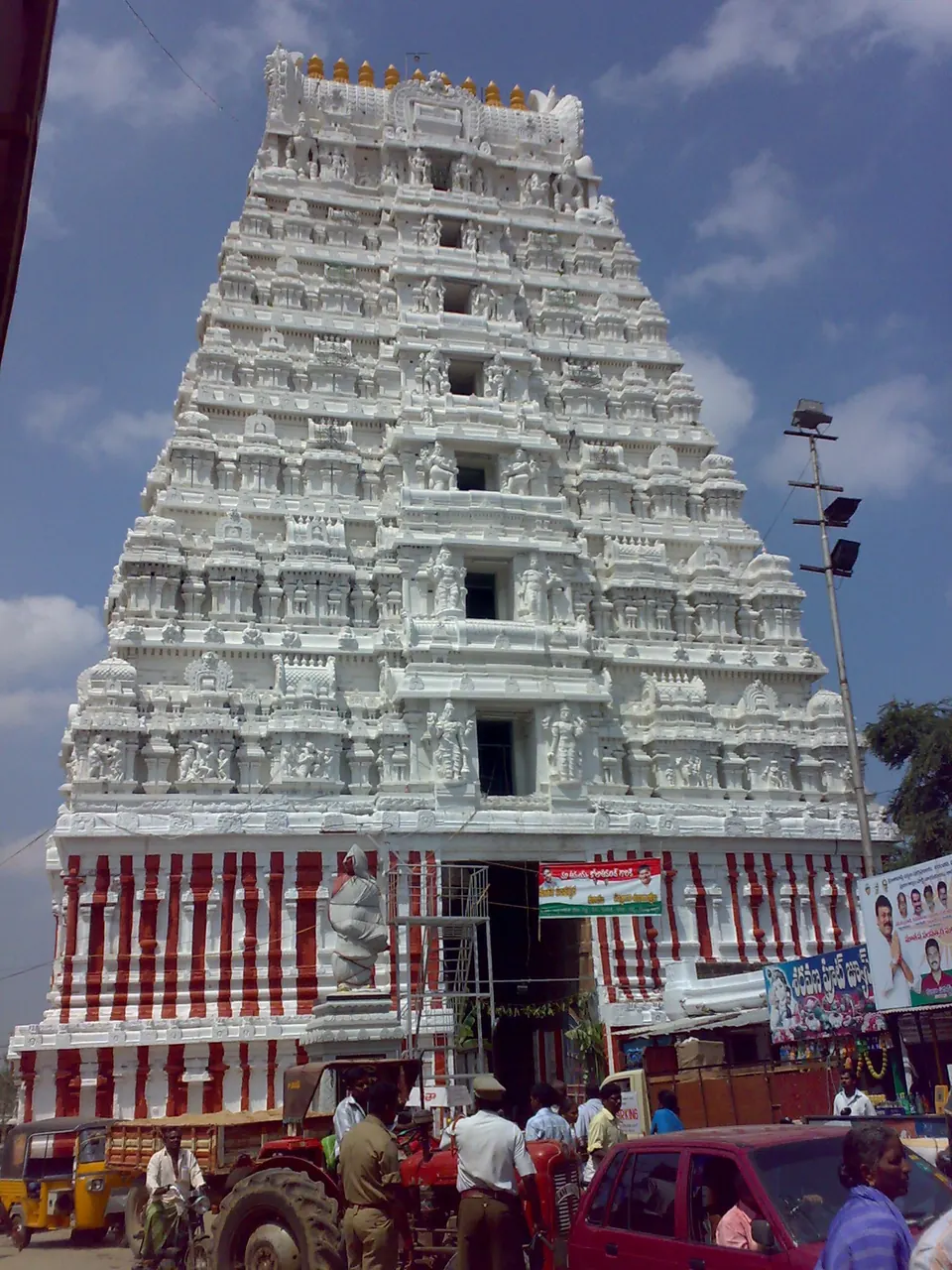
The North Arcot manual of 1894 describes Kalahasti, “Sri Kalahastri or Kalastri”, as a town of 11,754 people and the residence of the Raja of Kalahasti.1 It is “situated upon the right bank of the Swarnamukhi at the extremity of the Nagari hills”.1 Near the town these hills “are considered so holy that it is not permitted to quarry stone or gravel from them”.1
“The temple, from which the chief importance of the town is derived, stands at the base of the southern hill”.2 It is dedicated to Siva in the form of an imperceptible current of air, worshipped as the Vayu or wind linga.2 The manual explains the name by the legend of the spider, the serpent and the elephant that worshipped the linga: sri, kala and hasti.2 See the Srikalahasti temple.
Vijayanagara at Kalahasti
According to the manual the temple “was extended and improved by the Chola kings and by Krishnadeva Rayalu of Vijayanagar”.2 A Telugu inscription of 1516 stands in the second enclosure.3 In V. Rangacharya’s summary it “refers to the king’s conquests, his visit to Kalahasti and his building the 100-pillared mantapa and the big gopura”.3
The Telugu Rayavachakamu says that after Tirupati the king went to Kalahasti.4 There he made large grants to the god and built several choultries (rest houses).4 Rangacharya also noted that the town was called Mummudi-Cholapuram from the time of Rajaraja I until the middle of the sixteenth century.5 See the Srikalahasti inscription and Krishnadeva Raya.
The zamindars
The Kalahasti zamindars were of the Velama caste.6 They told the manual’s compilers that their first poligar (chief) had received the estate from Oraganti Prataparudra, an ancient king of the country.6 The manual thought it “may be safely presumed that they were originally Menkavalgars, appointed by the Vijayanagar kings about the fifteenth century”.6 The manual does not explain the word Menkavalgar.6 Elsewhere it uses kavalgars for the “police” that a poligar had to keep.7 After the fall of that kingdom they “became … a lawless set, constantly warring against their neighbours”.6 See Tirupati.
Footnotes
-
Cox and Stuart, North Arcot Manual, Vol. II (1894), p. 363 (archive.org (opens in a new tab)). ↩ ↩2 ↩3
-
Cox and Stuart, North Arcot Manual, Vol. II (1894), p. 364 (archive.org (opens in a new tab)). ↩ ↩2 ↩3 ↩4
-
Rangacharya, Topographical List, Vol. I (1919), p. 487, Chittoor No. 135 (archive.org (opens in a new tab)). ↩ ↩2
-
S. Krishnaswami Aiyangar (ed.), Sources of Vijayanagar History (1919), p. 117, extract from the Rayavachakamu (archive.org (opens in a new tab)). ↩ ↩2
-
V. Rangacharya, A Topographical List of the Inscriptions of the Madras Presidency, Vol. I (1919), p. 480, Chittoor district, Kalahasti (archive.org (opens in a new tab)). ↩
-
Arthur F. Cox, rev. Harold A. Stuart, Madras District Manuals: North Arcot, Vol. II (1894), p. 360 (archive.org (opens in a new tab)). ↩ ↩2 ↩3 ↩4 ↩5
-
Cox and Stuart, North Arcot, Vol. II (1894), p. 337 (archive.org (opens in a new tab)). ↩
Photos
Related
People
Rajaraja I (Chola)
c. 985–1014 CE
Chola king of Tanjore (Thanjavur) from 985, the founder of the Chola empire, whose inscriptions claim the conquest of Vengai-nadu, the Eastern Chalukya country of Vengi. About 999 he helped the Eastern Chalukya prince Saktivarman I back to the throne of Vengi, and he married his daughter Kundavadevi to Saktivarman's brother Vimaladitya. This began the alliance that made the Eastern Chalukyas Chola vassals and, two generations later, Chola emperors. Inscriptions of his reign are found at Kalahasti, and a Vaidumba chief ruled under him in the Nellore country.
Rajendra I (Chola)
c. 1012–1043 CE
Chola king from 1012, son of Rajaraja I and founder of Gangaikondacholapuram. As a prince he defeated the Eastern Chalukya Vimaladitya, his sister's husband, and set up a pillar of victory on Mahendragiri. As king he fought the Western Chalukya Jayasimha II and claimed Kollippakkai (Kolanupaka). His general marched to the Ganges while he himself waited on the Godavari, in a campaign that Krishna Sastri dated to 1028. His daughter Ammangadevi married the Eastern Chalukya Rajaraja Narendra and was the mother of Kulottunga I.
Rajadhiraja I (Chola)
1018–1052 CE
Chola king, eldest son of Rajendra I and his co-regent from 1018, who fought the Western Chalukya Somesvara I. His Manimangalam inscription claims that he burnt the centre of Kollippakkai (Kolanupaka), a Western Chalukya city on the edge of Telangana, and counts the Andhra king among those who paid him tribute. An inscription of his 28th year is at Kalahasti. He fell in battle against Somesvara at Koppam in 1052.
Kulottunga III (Chola)
1178–1216 CE
Chola king (1178–1216), the last strong ruler of the dynasty. The Telugu Choda chiefs of Pottappi and Nellore, among them Nallasiddha, Tammusiddhi and Tikka, dated their records in his reign, and inscriptions of his years are found at Nellore, in the Gudur country and at Kalahasti, whose temple he renewed. The Cuddapah gazetteer credits him with restoring Chola power in the Paka-nadu in 1196, while the Kakatiyas took over the old Chola lands north of the Krishna.
Shivaji
c. 1627–1680 CE
Founder of the Maratha kingdom (died 1680), crowned at Raigarh in 1674. In the Telugu country he is remembered for his Karnatak expedition of 1677. He made an alliance with Abul Hasan Qutb Shah of Golconda, and the king and his ministers Madanna and Akkanna received him at Hyderabad with great ceremony. He made a pilgrimage to Srisailam, crossed the Krishna near Kurnool and sent his army south through the Cuddapah country to Jinji. On the way home he took the fort of Bellary. In 1680 Bijapur gave him its rights over the Bellary and Anantapur country.
Balwant Rao Mendle
before 1760 CE
Maratha commander of the Peshwa Balaji Baji Rao, left in the Carnatic in 1757 to collect tribute. On 24 September 1757 he defeated the Nawabs of Cuddapah and Kurnool near Cuddapah. The Nawab of Cuddapah was killed, and the Marathas took Gurramkonda and Punganur. He then marched across the Cuddapah country to the coast. He took tribute from the zamindars of Venkatagiri and Kalahasti and was bought off before Nellore. He was killed at Panipat in December 1760.
Dhurjati
Telugu Shaiva poet of Srikalahasti, counted among the eight poets (Ashtadiggajas) of Krishnadeva Raya's court. He wrote the Kalahasti Mahatmyamu, a poem on the holy place of Srikalahasti, and the Kalahastisvara Satakamu, a set of devotional verses to its god. Stories about his loose living go back to a verse about the king's question on the sweetness of his style.
Najib-ullah Khan
Brother of the Nawab Muhammad Ali Walajah and governor of Nellore in the 1750s. In 1753 the adventurer Muhammad Kamal drove him out of Nellore, but he won it back and had Kamal beheaded. In 1757 he refused his brother's demand for an extra payment and rebelled. His garrison beat off the attack of the Nawab's army and an English force under Colonel Forde. He went over to the French, received Bussy at Nellore in 1758 and joined Moracin against Tirupati. When the French siege of Madras failed in 1759, he killed the Frenchmen with him and was confirmed in Nellore for a tribute of 30,000 pagodas. In 1762 an English force under Caillaud took the Nellore fort from him for the Nawab.
Neelam Sanjiva Reddy
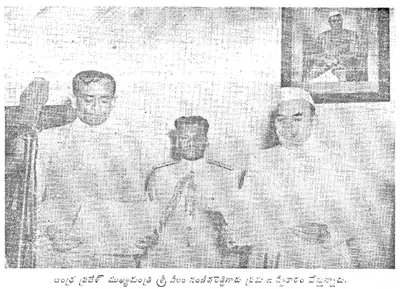
Congress leader and member for Kalahasti in the Andhra Legislative Assembly. He was Deputy Chief Minister of the Andhra State at Kurnool from 1953 to 1956 and one of the Andhra leaders who agreed the terms for the union with Telangana in February 1956. On 1 November 1956 he was sworn in as the first Chief Minister of Andhra Pradesh, and he was still Chief Minister in 1958.
Monuments
Inscriptions
References
Notes (0)
Sources (3)
Spotted an error on this page? Tell us
Last updated: