Saadatullah Khan
Nawab of the Carnatic, with his capital at Arcot, from about 1710–13 until his death in 1732. A Navayat, born Muhammad Saeed, he was the diwan (finance officer) and faujdar (military governor) of the Mughal general Daud Khan Panni. He followed Daud Khan in the government of the Carnatic below the Ghats, which ran along the coast from Guntur to the Coleroon and took in Nellore. A chronology of Sidhout says that he took the place in 1694 and appointed its fort commander, years before he became Nawab. His faujdar governed Nellore. He granted the jagir of Udayagiri in 1720. With the Pathan Nawabs of Cuddapah, Kurnool and Savanur he took a large payment from Mysore. He left the Nawabship to his nephew Dost Ali.
Saadatullah Khan was the first of the Nawabs of the Carnatic whose government reached from Arcot into the southern Telugu country.1 The official record of the treaties says simply that Nizam-ul-Mulk, subahdar (provincial governor) of the Deccan, “had appointed Saadat-ulla to be Nawab of the Carnatic”.1 It says he died in 1732.1
Mark Wilks wrote Historical Sketches of the South of India (1810).23 He used a Persian history of the family, the Saadat Nama, and spoke to its surviving members.23 He calls Saadatullah “of the respectable race of the Nevayets” (the Navayat community).23 He says his first name was Muhammad Saeed.23 See the Nawabs of the Carnatic (Arcot).
Daud Khan’s diwan
Saadatullah rose in the service of Daud Khan Panni, the Mughal commander of the two Carnatics.34 After Aurangzeb’s death Daud Khan was called away to the wars over the throne.34 A faujdar was a military governor, and a diwan a finance officer. Wilks says that he left Saadatullah “as his Foujedar and Dewan to manage those possessions during his absence”.34
Wilks adds in a note that the Saadat Nama dates his appointment as Nawab of the two Carnatics to 1713, right after the accession of Farrukhsiyar.4 The records of Madras give the same year, but Robert Orme places it in 1710.4
The Carnatic below the Ghats
He governed what Wilks calls the Carnatic Hyderabad Payanghat (the lowlands).5 This was “the whole country extending from Guntoor to the Coleroon, along the sea-coast of Coromandel; afterwards better known as the province of Arcot”.5
Wilks says he held “for four years the united governments of the two Carnatics”, above and below the Ghats.6 Then a separate officer was given the Carnatic of Bijapur.6 After that, “it became more usual to designate those several officers as the Nabobs of Sera, Arcot, and Kurpa from the names of their capitals”.6 See Arcot.
The Telugu districts of the province appear in the local records of his time.78 Gribble’s Cuddapah manual prints a chronology of Sidhout.78 It says that in 1694 “Sadoolla Khan of Arcot” defeated Meer Jumla there.7 The chronology’s previous entry calls Meer Jumla “a Sirdar of Alumgheer”, that is, an officer of the emperor Alamgir (Aurangzeb).9 He appointed one Kasari Singh as killadar (fort commander), with a jagir (land grant) of three villages.78 Kasari Singh had to send the revenue of the taluk to Arcot.78
The Cuddapah gazetteer likewise says that “as late as A.D. 1694 a governor of the Siddhavattam-sima was appointed by the Nawab of Arcot”.78 Both these accounts of 1694 come years before 1710 and 1713, the dates given for his appointment as Nawab.74
The Nellore manual says that one Mustafer Sahib was fauzdar of Nellore “in the days of Nawab Sadat-ulla Khan”.1011 It says that in 1720 Saadatullah granted the great jagir of Udayagiri, 68 villages, to Bidr-ud-din Khan.1011 The grant was for putting down a bandit named Jupully Lachman, and for his upkeep as killadar of the hill fort.1011 The emperor confirmed it in 1731.1011 See Siddhavatam, Nellore and Udayagiri.
The Pathan Nawabs and Mysore
Wilks says that Saadatullah was “aware of the riches possessed by the Raja of Mysoor, and jealous of the dismemberment of his own command”.612 So he “entered into a secret combination with the Patan Nabobs of Curpa, Kurnool and Savanore”, and with the Maratha chief of Gooty, to take a payment from Mysore.612
The money was paid.612 Of the sum the Raja actually gave, Saadatullah kept forty lakhs, “the remaining twenty-eight lacs being a simple fraud”.612 The Pathan Nawabs secretly agreed to this fraud, and his five partners received twelve lakhs each.612 Wilks dates the expedition, from the third year of Bahadur Shah, to AH 1123–24 (1711–12; AH is the Islamic way of counting years).6 See the Nawabs of Cuddapah and the Nawabs of Kurnool.
Death and succession
Saadatullah died in 1732.2 Wilks says he “was succeeded by his nephew Doast Ali Khan, according to the previous dispositions of his uncle, but without the sanction of Nizam ul Moolk”.2
Muhammad Burhanuddin’s history of the Carnatic and Kurnool (1905) adds that he had no children.13 He had adopted the two sons of his brother.13 He made the elder, Dost Ali, Nawab of Arcot, and the younger, Bakher Ali, governor of Vellore.13 The Nellore manual’s list of the Nawabs gives him no starting year and ends his rule with his death in 1732.14
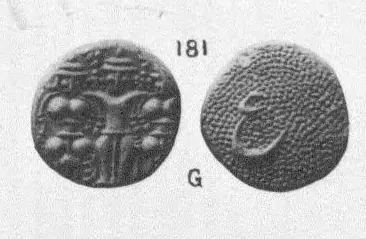
Walter Elliot wrote Coins of Southern India (1886).15 He says that the gold huns of “Sa’adut Ulla Khan” can be known by the Persian letters for illah on the grained back of the coin.15 He dates Saadatullah’s death to 1731.15
Footnotes
-
C. U. Aitchison, A Collection of Treaties, Engagements and Sanads, Vol. VIII (1892), p. 1 (archive.org (opens in a new tab)). ↩ ↩2 ↩3
-
Mark Wilks, Historical Sketches of the South of India, Vol. I (1810), p. 248 (archive.org (opens in a new tab)). ↩ ↩2 ↩3 ↩4 ↩5 ↩6
-
Wilks, Historical Sketches, Vol. I (1810), p. 225 and note (archive.org (opens in a new tab)). ↩ ↩2 ↩3 ↩4 ↩5 ↩6 ↩7
-
Wilks, Historical Sketches, Vol. I (1810), p. 226 and note (archive.org (opens in a new tab)). ↩ ↩2 ↩3 ↩4 ↩5 ↩6
-
Wilks, Historical Sketches, Vol. I (1810), p. 218 (archive.org (opens in a new tab)). ↩ ↩2
-
Wilks, Historical Sketches, Vol. I (1810), p. 227 and notes (archive.org (opens in a new tab)). ↩ ↩2 ↩3 ↩4 ↩5 ↩6 ↩7 ↩8 ↩9
-
J. D. B. Gribble, A Manual of the District of Cuddapah (1875), p. 51 (archive.org (opens in a new tab)). ↩ ↩2 ↩3 ↩4 ↩5 ↩6 ↩7
-
C. F. Brackenbury, Madras District Gazetteers: Cuddapah, Vol. I (1915), p. 41 (archive.org (opens in a new tab)). ↩ ↩2 ↩3 ↩4 ↩5
-
Gribble, Cuddapah (1875), p. 50 (archive.org (opens in a new tab)). ↩
-
John A. C. Boswell, A Manual of the Nellore District (1873), p. 472 (archive.org (opens in a new tab)). ↩ ↩2 ↩3 ↩4
-
Boswell, Nellore District (1873), p. 499 (archive.org (opens in a new tab)). ↩ ↩2 ↩3 ↩4
-
Wilks, Historical Sketches, Vol. I (1810), p. 228 (archive.org (opens in a new tab)). ↩ ↩2 ↩3 ↩4 ↩5
-
Muhammad Burhanuddin Siddiqui, The Carnatic & Kurnool, their Last Muhammedan Rulers (Madras, 1905), p. 23 (archive.org (opens in a new tab)). ↩ ↩2 ↩3
-
Boswell, Nellore District (1873), p. 444 (archive.org (opens in a new tab)). ↩
-
Walter Elliot, Coins of Southern India (1886), p. 144 (archive.org (opens in a new tab)). ↩ ↩2 ↩3
Photos
Related
Dynasties
References
Notes (0)
Sources (7)
Spotted an error on this page? Tell us
Last updated: