Nawabs of the Carnatic (Arcot)
The Mughal and then Asaf Jahi governors of the Carnatic below the Ghats, the coast from Guntur to the Coleroon, who ruled from Arcot from about 1710 until 1801. Their Telugu districts were Nellore, Ongole and the Palnad, with the jagir of Udayagiri and the tributary poligars of Venkatagiri and Kalahasti. The first house, the Navayats of Saadatullah Khan, gave way in 1744 to Anwar-ud-din Khan, who was killed at Ambur in 1749. His son Muhammad Ali Walajah won the Nawabship with English help against Chanda Sahib and the French, while his brother Najib-ullah held Nellore and rebelled. Deep in debt to the East India Company and to private lenders, Muhammad Ali assigned his revenues to the Company in 1781. The Company managed the country in 1790–92, and in 1792 he bound himself to pay for its troops. After a secret correspondence with Tipu Sultan came to light, Azim-ud-daula handed over the government of the Carnatic in 1801, and Nellore and Ongole became a British district.
Swipe sideways to see the whole chart; tap a bar for details.
Each bar is a ruling power in its region; time runs left to right. Dashed = approximate dates. Select a bar for details.
Show as a list
Vijayanagara & the Qutb Shahis 1336–1687 CE
- Telangana
- Adil Shahis of Bijapur (c. 1489–1686 CE) · Qutb Shahis of Golconda (c. 1518–1687 CE)
- Coastal Andhra
- Qutb Shahis of Golconda (c. 1524–1687 CE)
- Rayalaseema
- Vijayanagara Empire (c. 1336–1646 CE) · Marathas (c. 1677–1687 CE) · Adil Shahis of Bijapur (c. 1568–1686 CE) · Qutb Shahis of Golconda (c. 1579–1687 CE) · Mughal Empire (c. 1686–1724 CE)
Mughals, Asaf Jahis & the British 1687–1948 CE
- Telangana
- Mughal Empire (1687–1724 CE) · British Crown (Madras Presidency) (1860–1947 CE) · Asaf Jahi Nizams of Hyderabad (1724–1948 CE)
- Coastal Andhra
- Nawabs of the Carnatic (Arcot) (c. 1710–1801 CE) · French East India Company (1817–1954 CE) · Mughal Empire (1687–1724 CE) · British Crown (Madras Presidency) (1858–1947 CE) · Asaf Jahi Nizams of Hyderabad (1724–1753 CE) · East India Company (1759–1858 CE)
- Rayalaseema
- Nawabs of Kurnool (c. 1690–1839 CE) · British Crown (Madras Presidency) (1858–1947 CE) · Nawabs of the Carnatic (Arcot) (c. 1710–1801 CE) · Nawabs of Cuddapah (c. 1714–1779 CE) · East India Company (1792–1858 CE) · Mughal Empire (c. 1686–1724 CE) · Morari Rao Ghorpade of Gooty (c. 1741–1776 CE) · Banganapalle State (c. 1724–1948 CE) · Asaf Jahi Nizams of Hyderabad (c. 1724–1800 CE) · Marathas (c. 1743–1774 CE) · Mysore under Haidar Ali and Tipu Sultan (c. 1762–1799 CE)
- Movements
- Godavari hill risings (1858–1862 CE)
Reform, freedom & people's movements 1850–1956 CE
- Telangana
- British Crown (Madras Presidency) (1860–1947 CE) · Asaf Jahi Nizams of Hyderabad (1724–1948 CE)
- Coastal Andhra
- French East India Company (1817–1954 CE) · British Crown (Madras Presidency) (1858–1947 CE) · East India Company (1759–1858 CE)
- Rayalaseema
- British Crown (Madras Presidency) (1858–1947 CE) · East India Company (1792–1858 CE) · Banganapalle State (c. 1724–1948 CE)
- Movements
- Godavari hill risings (1858–1862 CE)
Sultanates
Adil Shahis of Bijapur
Open page- Telangana: c. 1489–1686 CE (c. 197 years)
After the Bahmani break-up part of Mahbubnagar district went to Bijapur (the rest to Golconda) and stayed with it until Aurangzeb annexed Bijapur in 1686; the Raichur district article likewise passes Raichur (which then included the Alampur taluk and Gadwal) from the Bahmanis to the Adil Shahis.
- Rayalaseema: c. 1568–1686 CE (c. 118 years)
Partial, the western uplands only. Adoni taken by Ali Adil Shah's general Ankus Khan in 1568 after a failed siege in 1535-37; Penukonda besieged in the 1570s (dates disputed) and taken in 1652 (Mackenzie MS); Kurnool taken from Gopala Raja early in the 17th century and governed by Abdul Wahab (d. 1618) and later deputies, Siddi Jauhar holding it as his jagir about 1660; the Bellary and Anantapur uplands held through governors and tributary poligars; Bijapur's rights there passed to Shivaji in 1677-80 (Francis); Bijapur fell to Aurangzeb on 12 September 1686, but Siddi Masud held Adoni until 1688 (Sarkar) or 1687 (Bellary gazetteer)
Rulers (9)
Capitals
Monuments
Sources (11)
Kingdoms and empires
Mughal Empire
Open page- Rayalaseema: c. 1686–1724 CE (c. 38 years)
Kurnool passed to the emperor with the Bijapur provinces in 1686 and was later the jagir of Daud Khan Panni and his brother; Adoni (renamed Imtiyazgarh, a Mughal mint) surrendered by Masaud Khan; the uplands of the Haidarabadi Karnatak (Cuddapah, Gandikota, Gooty, Sidhout) came with Golconda in 1687; Anantapur added to the subah of Bijapur; poligars largely independent (Cuddapah gazetteer); Francis dates the Nizam's independence to 1723
- Telangana: 1687–1724 CE (37 years)
Golconda taken on 21 September 1687 and the kingdom annexed as the subah of Haidarabad, governed from Hyderabad by subahdars (Mahabat Khan, Ruhullah Khan, Jan Sipar Khan, Rustam Dil Khan, Yusuf Khan, Mubariz Khan); Kam Bakhsh held Hyderabad as a rival emperor in 1708 until his defeat on 13 January 1709; Mubariz Khan was killed by Nizam-ul-Mulk at Shakar Kheda in October 1724
- Coastal Andhra: 1687–1724 CE (37 years)
Kondapalli gained by bribery in July 1687; Guntur (Murtazanagar), Kondapalli (Mustafanagar), Ellore, Rajahmundry and Chicacole formed the Northern Circars, with Masulipatam as their chief town and a Mughal mint; the Qutb Shahi assessment of 1635 was kept on Aurangzeb's records (Grant)
Rulers
- Shah Jahan (1628–1658 CE)
- Aurangzeb (Alamgir) (1658–1707 CE)
- Bahadur Shah (Shah Alam I) (1707–1712 CE)
- Jahandar Shah (1712–1713 CE)
- Farrukhsiyar (1713–1719 CE)
- Muhammad Shah (1719–1748 CE)
Inscriptions
Sources (14)
Colonial powers
British Crown (Madras Presidency)
Open page- Coastal Andhra: 1858–1947 CE (89 years)
The East India Company's government passed to the Crown by Act of Parliament of 2 August 1858 (Maclean); the Queen's proclamation is dated 4 November (Maclean) and the transfer of the Company's territories 1 November 1858 (Sewell). Ruled through the Governor in Council at Madras, the Board of Revenue and district Collectors. Godavari and Kistna were formed in December 1859, Guntur in 1904 and West Godavari, from the old Kistna, in 1925; the hill tracts of Vizagapatam and Godavari were governed as Agencies under special laws (1839, 1879). Ended with independence in 1947
- Rayalaseema: 1858–1947 CE (89 years)
The Ceded Districts and the Carnatic districts passed to the Crown with the rest of the Company's territories in 1858. Kurnool was made a full Collectorate in 1858, Anantapur was separated from Bellary in 1882 and Chittoor was formed on 1 April 1911; the state of Banganapalle stayed under the Madras Government until the 1920s, when it was placed under an Agent to the Governor-General. Ended with independence in 1947
- Telangana: 1860–1947 CE (87 years)
Partial (the Bhadrachalam and Rekapalli taluks only): ceded by the Nizam by the treaty of 26 December 1860; administered until 1874 as part of the Upper Godavari district of the Central Provinces, then transferred to the Godavari district of Madras and made part of the Godavari Agency in 1879
Rulers (22)
- Lord Harris (1854–1859 CE)
- Sir Charles Trevelyan (1859–1860 CE)
- Sir Henry Ward (1860 CE)
- Sir William Denison (1861–1866 CE)
- Lord Napier (1866–1872 CE)
- Lord Hobart (1872–1875 CE)
… and 16 more
- Duke of Buckingham and Chandos (1875–1880 CE)
- W. P. Adam (1880–1881 CE)
- M. E. Grant Duff (1881–1886 CE)
- Robert Bourke (Lord Connemara) (1886–1890 CE)
- Lord Wenlock (1891–1896 CE)
- Sir Arthur Havelock (1896–1900 CE)
- Lord Ampthill (1900–1906 CE)
- Sir Arthur Lawley (1906–1911 CE)
- Sir Thomas Gibson-Carmichael (1911–1912 CE)
- Lord Pentland (1912–1919 CE)
- Lord Willingdon (1919–1924 CE)
- Viscount Goschen (1924–1929 CE)
- Sir George Stanley (1929–1934 CE)
- Lord Erskine (1934–1940 CE)
- Sir Arthur Hope (1940–1946 CE)
- Sir Archibald Nye (1946–1947 CE)
Sources (11)
Sultanates
Qutb Shahis of Golconda
Open page- Telangana: c. 1518–1687 CE (c. 169 years)
Sultan Quli governed Telingana for the Bahmanis from 1493-95 and declared independence in 1512 (Ferishta, Haig, IG Hyderabad) or 1518 (Bilgrami, from the Golconda mosque inscription of AH 924); he took the forts of the Telugu chiefs, among them Rachakonda, Devarakonda and, from Shitab Khan, Warangal and Khammam (1519-1525 per Bilgrami). Tributary to the Mughals from 1635-36 (khutba and coins in Shah Jahan's name; two lakhs of huns a year). Hyderabad taken by the Mughals in 1656 and 1685; Golconda surrendered on 21 September 1687 (Old Style) and was annexed
- Coastal Andhra: c. 1524–1687 CE (c. 163 years)
Sultan Quli took Kondapalli and fixed the Godavari as his frontier with Orissa (Ellore ceded) some time before his 1530 campaign, and a 1524 record shows him granting villages near Kondapalli and Bezwada; the Godavari gazetteer and IG Madras date the Krishna-Godavari doab to c. 1540 or 'before 1543', and the IG Madras Kistna article to after 1565.
- Rayalaseema: c. 1579–1687 CE (c. 108 years)
Partial; the sources disagree on when Golconda's hold began. IG Madras says Kurnool and Cuddapah were overrun soon after 1565. The Kurnool Manual dates the campaigns that took Gurramkonda (1579) and Gandikota, Nandyal and Musalimadugu (c. 1590). The Cuddapah gazetteer says Golconda only turned to Cuddapah in the early 17th century and never really conquered it. Chandragiri fell to Golconda in 1646.
Rulers (8)
Capitals
Monuments (13)
Inscriptions (7)
- Epitaph of Sultan Quli, Golconda (1543)
- Makka Darwaza inscription, Golconda (1559)
- Jami Masjid inscription, Hyderabad
- Epitaph of Muhammad Quli Qutb Shah, Golconda (1612)
- Ma Saheba tank inscriptions (1625)
- Musa Burj inscription, Golconda fort (1666–67)
… and 1 more
Sources (23)
Kingdoms and empires
Asaf Jahi Nizams of Hyderabad
Open page- Telangana: 1724–1948 CE (224 years)
Asaf Jah, viceroy of the Deccan from 1713, independent after defeating Mubariz Khan at Shakar Kheda (11 October 1724 in Irvine; 1723 in Gribble); Telangana remained the Telugu heart of the Nizam's Dominions, with the samasthans of Gadwal, Wanaparthy, Jatprole, Amarchinta and Palvancha as tributary estates. Regular districts were formed in 1865-66 and the Telugu divisions surveyed and settled by 1905; the districts were redrawn in 1905 and an Executive Council governed from November 1919. The Standstill Agreement with India was signed on 29 November 1947. Indian troops entered the state on 13 September 1948 (the Police Action); the Nizam ordered a ceasefire on 17 September, and a military governor took charge on 18 September
- Coastal Andhra: 1724–1753 CE (29 years)
The Nizam's governor at Rajahmundry collected the tribute of the coastal zamindars; Masulipatam granted to the French by Muzaffar Jang in 1750 and the lands of Nizampatnam and Kondavid by Salabat Jang in 1751; the four Circars of Mustafanagar, Ellore, Rajahmundry and Chicacole assigned to the French on 4 December 1753 to pay Bussy's army
- Rayalaseema: c. 1724–1800 CE (c. 76 years)
Nominal over much of the region (Kurnool and Cuddapah Nawabs, Maratha tribute, Morari Rao at Gooty, Haidar Ali from 1761); the Nizam gained Tipu Sultan's districts by the treaties of 1792 and 1799 and ceded them to the Company by the treaty of 12 October 1800 to pay the subsidiary force (the Ceded Districts)
- Coastal Andhra: 1759–1788 CE (29 years)
Guntur (Murtazanagar) stayed with the Nizam's brother Basalat Jang after the French were driven out; it was excluded from the cessions of 1766 and 1768, rented by the Company in 1779 and restored, and handed over to the Company only in 1788; the Nizam's claims to the Circars' payments were bought out in 1823
Rulers (10)
Capitals
Monuments (11)
Inscriptions
Sources (16)
Kingdoms and empires
Nawabs of the Carnatic (Arcot)
Open page- Coastal Andhra: c. 1710–1801 CE (c. 91 years)
Partial (Nellore and Ongole, the Palnad, the jagir of Udayagiri and the tributary zamindaris of Venkatagiri and Kalahasti). Saadatullah Khan became Nawab of the Carnatic, the coast from Guntur to the Coleroon, in 1710 (Orme) or 1713 (Wilks), and his fauzdar governed Nellore; he granted the Udayagiri jagir in 1720. Under Muhammad Ali Walajah (1749-95) his brother Najib-ullah held Nellore, rebelled in 1757 and was dislodged by an English force in 1762. The revenues were assigned to the Company in 1781-85 and managed by it in 1790-92; by the treaty of 31 July 1801 Azim-ud-daula handed over the government of the Carnatic, and Nellore, Ongole and the Palnad became British
- Rayalaseema: c. 1710–1801 CE (c. 91 years)
Partial (Chittoor taluks). The Nawabs at Arcot, first as deputies under the Nizam, took tribute from the Chittoor and Chendragiri poligars and the Kalahasti and Karvetnagar zamindars; Muhammad Ali gave Chittoor and Chendragiri to his brother Abdul Wahab as a jagir, and the Carnatic was handed to the Company on 31 July 1801.
Rulers
- Saadatullah Khan (c. 1710–1732 CE)
- Dost Ali Khan (1732–1740 CE)
- Safdar Ali Khan (c. 1740–1742 CE)
- Anwar-ud-din Khan (1744–1749 CE)
- Muhammad Ali Khan Walajah (1749–1795 CE)
- Umdat-ul-Umara (1795–1801 CE)
Capitals
Sources (11)
Colonial powers
French East India Company
Open page- Coastal Andhra: 1750–1759 CE (9 years)
Partial at first (Masulipatam and the island of Divi, seized in July 1750 under Muzaffar Jang's grant; Nizampatnam, Narsapur and Kondavid added by Salabat Jang in 1751-52); from December 1753 the four Northern Circars of Mustafanagar (Kondapalli), Ellore, Rajahmundry and Chicacole, granted for the pay of Bussy's army and settled by Bussy in person from July 1754. Forde routed the French at Condore (Chandurti) on 9 December 1758 and stormed Masulipatam on 7-8 April 1759; by the treaty of May 1759 Salabat Jang ceded the Masulipatam country to the English and excluded the French from the Deccan
- Coastal Andhra: c. 1765–1793 CE (c. 28 years)
Partial (Yanam only): the French factory town on the Godavari, ceded to them in 1752, reoccupied after the peace of 1763 (the restored possessions 'were not occupied before 1765'); the French possessions were also in English hands in 1778-83
- Coastal Andhra: 1817–1954 CE (137 years)
Partial (Yanam only): occupied by the English from 1793 (except 1802-03) and handed back in 1817 under the treaties of 1814-15; about 2,258 acres. The Government of India took over the French Establishments, Yanam among them, from 1 November 1954 after the agreement with France of 21 October 1954
Rulers
- Joseph François Dupleix (1750–1754 CE)
- Charles de Bussy (1754–1758 CE)
- Marquis de Conflans (1758–1759 CE)
Capitals
Sources (10)
Colonial powers
East India Company
Open page- Coastal Andhra: 1759–1858 CE (99 years)
Partial at first: the Masulipatam and Nizampatam Circars ceded by Salabat Jang on 14 May 1759 after Forde's defeat of the French. The emperor Shah Alam granted the five Northern Circars on 12 August 1765; by the treaties of 12 November 1766 and 23 February 1768 the Nizam ceded Kondapalli, Ellore, Rajahmundry and Chicacole for a yearly payment (capitalised in 1823), Guntur following in September 1788. Governed through renters until 1769, Chiefs and Councils at Masulipatam and Vizagapatam until 1794, then Collectors; the zamindaris were permanently settled in 1802-03. Nellore, Ongole and the Palnad came with the Carnatic from the Nawab of Arcot on 31 July 1801. Transferred to the Crown in 1858
- Rayalaseema: 1792–1858 CE (66 years)
Partial at first: Kangundi came to the Company with the Baramahal in 1792, when it also began collecting the Kalahasti and Karvetnagar tribute for the Nawab; Punganur and Venkatagirikota (Palmaner) followed from Tipu's lands in 1799. On 12 October 1800 the Nizam ceded the territories he had gained from Mysore in 1792 and 1799, the Ceded Districts of Bellary (with Anantapur) and Cuddapah, with the tribute of the Nawab of Kurnool; Thomas Munro, Principal Collector 1800-1807, reduced the poligars and made the ryotwari settlement. The Nawab of Arcot's Chittoor and Chendragiri country came with the Carnatic in 1801, and the Kurnool Nawab's jagir was annexed in 1839. Transferred to the Crown in 1858
Rulers (23)
- George Pigot (1755–1763 CE)
- Robert Palk (1763–1767 CE)
- Charles Bourchier (1767–1770 CE)
- Josias Du Pré (1770–1773 CE)
- Alexander Wynch (1773–1775 CE)
- Lord Pigot (1775–1776 CE)
… and 17 more
- Sir Thomas Rumbold (1778–1780 CE)
- Lord Macartney (1781–1785 CE)
- Sir Archibald Campbell (1786–1789 CE)
- William Medows (1790–1792 CE)
- Sir Charles Oakeley (1792–1794 CE)
- Lord Hobart (1794–1798 CE)
- Lord Clive (Edward Clive) (1798–1803 CE)
- Lord William Bentinck (1803–1807 CE)
- Sir George Barlow (1807–1813 CE)
- Hugh Elliot (1814–1820 CE)
- Sir Thomas Munro (1820–1827 CE)
- Stephen Rumbold Lushington (1827–1832 CE)
- Sir Frederick Adam (1832–1837 CE)
- Lord Elphinstone (1837–1842 CE)
- Marquis of Tweeddale (1842–1848 CE)
- Sir Henry Pottinger (1848–1854 CE)
- Lord Harris (1854–1859 CE)
Capitals
Monuments
Sources (10)
Kingdoms and empires
Vijayanagara Empire
Open page- Rayalaseema: c. 1336–1646 CE (c. 310 years)
Founded c. 1335-36; Bukka I held Penukonda and Gooty (records of 1352 and a Gooty rock inscription) and his minister built the Bukkarayasamudram tank near Anantapur in 1364; Cuddapah in the 14th century; Kurnool wholly annexed under Krishnadeva Raya. After Talikota (1565) the kings ruled from Penukonda, which held out against Bijapur in 1577 and Golconda in 1589; the country north of Penukonda was lost after Sriranga I's capture (c. 1579-80); Venkatapati II moved to Chandragiri c. 1592; Golconda held the Cuddapah district and took Chandragiri (Chittoor) in 1646. Bijapur and Golconda took most of the region piecemeal after 1565
- Coastal Andhra: c. 1350–1579 CE (c. 229 years)
Vijayanagara officers kept Guntur (Kondavidu, Vinukonda, Bellamkonda) and the governor of Udayagiri kept Nellore after Talikota; Golconda took Kondavidu in April 1579 (Kistna Manual) or 1580 (a Guntur record of 1592 cited by Sewell), though Sewell thinks Guntur was already under Muslim rule by 1576 and the Nellore Manual says the Muslims held Nellore from 1565.
- Telangana: c. 1563–1565 CE (c. 2 years)
To end the confederate invasion of Golconda, Ibrahim Qutb Shah let Rama Raja keep the forts of Ghanpur and Panagal (Mahbubnagar) until Talikota; Ferishta places this after the Kalyani campaign of the early 1560s, the Kistna Manual dates it to 1557.
Rulers (24)
- Harihara I (Vijayanagara) (c. 1336–1355 CE)
- Bukka I (Vijayanagara) (1355–1377 CE)
- Harihara II (1377–1404 CE)
- Bukka II (1404–1406 CE)
- Deva Raya I (1406–1422 CE)
- Vijaya (Bukka III) (1422 CE)
… and 18 more
- Deva Raya II (Vijayanagara) (1422–1446 CE)
- Mallikarjuna (1446–1465 CE)
- Virupaksha (1465–1485 CE)
- Saluva Narasimha (1485–1492 CE)
- Immadi Narasimha (1492–1505 CE)
- Narasa Nayaka (c. 1505 CE)
- Vira Narasimha (1505–1509 CE)
- Krishnadeva Raya (1509–1529 CE)
- Achyuta Raya (1529–1542 CE)
- Venkata I (1542 CE)
- Sadasiva (c. 1542–1569 CE)
- Tirumala (Aravidu) (c. 1569–1572 CE)
- Sriranga I (1572–1586 CE)
- Venkatapati II (Vijayanagara) (1586–1614 CE)
- Sriranga II (1614 CE)
- Rama Deva (1614–1630 CE)
- Pedda Venkata (1630–1642 CE)
- Sriranga III (c. 1642–1670 CE)
Monuments (7)
- Penukonda fort and Gagan Mahal
- Kalahastisvara temple, Srikalahasti
- Virabhadra temple, Lepakshi
- Chandragiri fort and Raja Mahal
- Gooty fort
- Narasimha temples, Ahobilam
… and 1 more
Inscriptions (14)
- Penukonda fort inscription (1354)
- Gooty rock inscription of Bukka I
- Bitragunta grant of Sangama II (1356)
- Bukkarayasamudram tank inscription (1364)
- Tirumala inscriptions of Krishnadeva Raya and his queens (1513–1514)
- Amaravati inscription of Krishnadeva Raya (1515)
… and 8 more
- Mangalagiri and Kaza pillar inscriptions (1515–1518)
- Simhachalam inscriptions of Krishnadeva Raya (1516–1519)
- Srikalahasti inscription of Krishnadeva Raya (1516)
- Kondavidu pillar inscription of Nadindla Gopa (1520)
- Lepakshi temple inscriptions of Achyuta Raya's reign (1533–1538)
- Kanuma grant of Sadasiva (1548)
- Penukonda inscription of Channappa Nayudu (1577)
- Ahobilam inscription of Sriranga I (1584)
Sources (20)
Kingdoms and empires
Marathas
Open page- Rayalaseema: c. 1677–1687 CE (c. 10 years)
Partial (the Bellary and Anantapur uplands). Shivaji crossed the Krishna near Kurnool in March 1677, went to Srisailam and sent his army south through the Cuddapah country; Gribble says he took and garrisoned poligars' forts in the Cuddapah and Bellary districts. On his return he took Bellary fort after a 27-day siege (1677-78). In 1680 Bijapur formally ceded its rights over the country round Kopal and Bellary and the poligars paid him tribute (chauth), until Aurangzeb overthrew Maratha power in the district in 1687
- Rayalaseema: c. 1743–1774 CE (c. 31 years)
Partial. The Cuddapah gazetteer says the Nizam ceded Penukonda to the Marathas in 1743 (Grant Duff and the Anantapur gazetteer give Gooty and Penukonda to Morari Rao instead). After Balwant Rao killed the Nawab of Cuddapah near Cuddapah on 24 September 1757 the Marathas held Gurramkonda and Punganur (1755 in Gribble). Gurramkonda went to Haidar Ali through Mir Sahib in 1766-67, was retaken by Trimbak Rao after a two-month siege in 1771 and confirmed to the Marathas by the treaty of 1772, and was lost with Punganur, Sira and Madhugiri to Tipu and Haidar in 1773-74
Rulers
- Shivaji (1674–1680 CE)
- Sambhaji (1680–1689 CE)
- Rajaram (1689–1700 CE)
- Shahu (1708–1749 CE)
Sources (11)
Kingdoms and empires
Nawabs of Kurnool
Open page- Rayalaseema: c. 1690–1839 CE (c. 149 years)
Partial (Kurnool proper, the taluks of Ramallakota, Nandikotkur, Nandyal and Sirvel). The Mughals took Kurnool in 1686-88 and gave it as a jagir to the Pathan general Daud Khan Panni in the latter part of the seventeenth century (about 1698 in Burhanuddin); his kinsman Ibrahim Khan seized the fort in 1715, and his son Alif Khan acknowledged Asaf Jah in 1724. The French and Salabat Jang stormed Kurnool in March 1751 and held it for the Nizam until Ranmast (Munawwar) Khan recovered it in 1752. The Nawabs paid tribute to the Nizam and, from 1769, to Haidar Ali and Tipu Sultan; in 1800 the Nizam ceded the tribute to the Company, which fixed it in 1804 at a lakh and a quarter of Gadwal rupees, then a lakh. The last Nawab, Ghulam Rasul Khan, was deposed in 1839 and the jagir annexed
Rulers (8)
- Daud Khan Panni (c. 1690–1715 CE)
- Ibrahim Khan (1715–1724 CE)
- Alif Khan (1724–1733 CE)
- Himmat Bahadur Khan (Nawab of Kurnool) (1733–1751 CE)
- Ranmast Khan (Munawwar Khan, Nawab of Kurnool) (1752–1792 CE)
- Alif Khan II (Nawab of Kurnool) (1792–1815 CE)
… and 2 more
- Munawwar Khan II (1815–1823 CE)
- Ghulam Rasul Khan (Nawab of Kurnool) (1823–1839 CE)
Capitals
Sources (6)
Kingdoms and empires
Nawabs of Cuddapah
Open page- Rayalaseema: c. 1714–1779 CE (c. 65 years)
Partial (the Cuddapah uplands, the circars of Sidhout, Gandikota, Gurramkonda and Cumbum, with the poligar of Punganur as tributary). Pathan (Miana) Nawabs under the Mughals and the Nizams; Abdul Nabi Khan, governor from 1714, was the first to assert real control and raided the Baramahal. After the Maratha general Balwant Rao killed the Nawab Abdul Majid Khan in 1757, Gurramkonda went to the Marathas. The last Nawab, Abdul Halim Khan (from 1761), surrendered to Haidar Ali at Sidhout on 27 May 1779 (Wilks; 1778 in Gribble's local chronology and Brown, 1780 in the Cuddapah gazetteer, 1777 in Kirmani)
Rulers
- Abdul Nabi Khan (Nawab of Cuddapah) (c. 1714–1732 CE)
- Abdul Majid Khan (c. 1732–1757 CE)
- Mohsin Khan (c. 1757–1761 CE)
- Abdul Halim Khan (Nawab of Cuddapah) (1761–1779 CE)
Capitals
Sources (7)
Kingdoms and empires
Morari Rao Ghorpade of Gooty
Open page- Rayalaseema: c. 1741–1776 CE (c. 35 years)
Partial (Gooty, Penukonda, Madakasira, Kodikonda and Tadpatri, with tribute from the Anantapur poligars). The Maratha Morari Rao Ghorpade made the Madakasira poligar pay tribute in 1741, was recognised as chief of Gooty by the first Nizam in 1743-44 and settled there about 1746 (permanent seat 1754). Haidar Ali took Penukonda, Madakasira and Kodikonda in 1762; Morari Rao recovered some forts after the Maratha peace of 1765. Gooty fell to Haidar early in April 1776 (Wilks; 1775 in the Anantapur gazetteer), and Morari Rao died a prisoner at Kabbaldurga
Rulers
Capitals
Sources (5)
Kingdoms and empires
Banganapalle State
Open page- Rayalaseema: c. 1724–1948 CE (c. 224 years)
Partial (a nawabi enclave of about 255 square miles round Banganapalle in the Kurnool district). Muhammad Beg Khan, Mughal killedar of Banganapalle from the late seventeenth century, became a petty Nawab when Asaf Jah made himself independent, and Asaf Jah confirmed the jagir. Tipu Sultan occupied it from 1783 until the family, with the Nizam's troops, won it back at Tammadapalle in 1790. In 1800 the Nizam transferred his control to the East India Company, which took no tribute; the Madras government managed the indebted jagir from 1825 (1832 in the Imperial Gazetteer) to 1848 and restored it by the sanad of 1849. The ruler became a hereditary Nawab in 1876; the Madras government took over the administration on 23 February 1948
Rulers (10)
- Muhammad Beg Khan (c. 1724–1758 CE)
- Muhammad Beg Khan Laug (regent) (c. 1758–1766 CE)
- Fazl Ali Khan (Gulli Nawab) (c. 1766–1782 CE)
- Husain Ali Khan (c. 1782–1783 CE)
- Ghulam Ali Khan (Mansur-ud-daula) of Banganapalle (c. 1790–1821 CE)
- Husain Ali Khan II (c. 1821–1848 CE)
… and 4 more
- Ghulam Muhammad Ali Khan of Banganapalle (1848–1868 CE)
- Fateh Ali Khan, Nawab of Banganapalle (1868–1905 CE)
- Ghulam Ali Khan III (1905–1922 CE)
- Fazl-i-Ali Khan (1922–1948 CE)
Capitals
Sources (5)
Kingdoms and empires
Mysore under Haidar Ali and Tipu Sultan
Open page- Rayalaseema: c. 1762–1799 CE (c. 37 years)
Partial (the Anantapur, Bellary and Cuddapah uplands). Haidar Ali, master of Mysore from 1761, took Penukonda, Madakasira and Kodikonda from Morari Rao of Gooty in 1762 (some went back to Morari Rao in 1764-66). Gurramkonda came to him through Mir Sahib in 1768, was lost to the Marathas in 1771 and recovered by Tipu in 1773-74. He took Bellary in 1775 and Gooty in April 1776 (1775 in the Anantapur gazetteer), and the Nawab of Cuddapah surrendered at Sidhout on 27 May 1779 (1780 in the Cuddapah gazetteer); the Nawab of Kurnool and the poligars of the Bellary and Anantapur country paid him tribute. By the treaty of 18 March 1792 Tipu ceded the Cuddapah taluks, Gurramkonda, Bellary and the Gooty taluks of Tadpatri and Tadimarri to the Nizam; Gooty, Penukonda, Madakasira, Anantapur and the rest of Gurramkonda went to the Nizam after Tipu's death in May 1799, and the Nizam ceded both gains to the Company in 1800
Rulers
Sources (7)
Movements
Godavari hill risings
Open page- Coastal Andhra: 1858–1862 CE (4 years)
Subba Reddi's revolt near Yernagudem in 1858 and disturbances in the Rampa hills, 1858–1862
- Coastal Andhra: 1879–1881 CE (2 years)
The "Rampa rebellion" of 1879, put down in 1881 when its leader Chendrayya was killed
Sources (2)
Reigns
Each bar is one ruler’s reign; time runs left to right. c. = approximate date.
- Saadatullah Khanc. 1710–1732 CE · c. 22 yrs
- Dost Ali Khan1732–1740 CE · 8 yrs
- Safdar Ali Khanc. 1740–1742 CE · c. 2 yrs
- Anwar-ud-din Khan1744–1749 CE · 5 yrs
- Muhammad Ali Khan Walajah1749–1795 CE · 46 yrs
- Umdat-ul-Umara1795–1801 CE · 6 yrs
Following Wilks and the official narrative in Aitchison's Treaties (Vol. VIII, 1892). Saadatullah Khan's appointment is dated 1713 by Wilks and the Madras records and 1710 by Orme; he died in 1732. Dost Ali was killed by the Marathas in 1740 and his son Safdar Ali was murdered soon after; Nizam-ul-Mulk appointed a temporary deputy, Khwaja Abdullah Khan, in 1743, and Anwar-ud-din Khan reached Arcot in April 1744. Muhammad Ali's claim, made at Trichinopoly after Ambur in July 1749, was disputed by Chanda Sahib, whom the French recognised, until 1752. Umdat-ul-Umara died on 15 July 1801, and his successor Azim-ud-daula resigned the government to the Company on 31 July 1801, remaining titular Nawab until 1819.
Family tree
The rulers and the relatives who explain the succession. Every line rests on a cited statement on a person page; the sources are listed below the tree. Select a card to open that page.
- parent and child
- marriage
- adoption
- the sources disagree (see below)
- brother or sister
- order of succession
Generation 1
- 4Anwar-ud-din Khan1744–1749 CE
Generation 2
- Mahfuz KhanElder son of Anwar-ud-din; taken prisoner at Ambur (1749)Son of Anwar-ud-din Khan
- 5Muhammad Ali Khan Walajah1749–1795 CESon of Anwar-ud-din KhanBrother of Najib-ullah KhanBrother of Abdul Wahab Khan
- Najib-ullah KhanBrother of Muhammad Ali Khan Walajah
- Abdul Wahab KhanBrother of Muhammad Ali; commanded the Nawab's army before Nellore (1757); confirmed in Chandragiri and ChittoorBrother of Muhammad Ali Khan Walajah
Generation 3
- 6Umdat-ul-Umara1795–1801 CESon and successor of Muhammad Ali (1795); died 15 July 1801Son of Muhammad Ali Khan Walajah
Sources for every line of the tree
- Anwar-ud-din Khan → Mahfuz Khan and Muhammad Ali Khan Walajah (parent and child)
- Wilks says that two of Anwar-ud-din's sons fought at Ambur. →
- Wilks, Historical Sketches, Vol. I (1810), p. 259 (archive.org (opens in a new tab)).
- Wilks writes that two sons of Anwar-ud-din fought in the battle of Ambur, where their father was killed on 23 July 1749. →
- Mark Wilks, Historical Sketches of the South of India, Vol. I (1810), p. 259 (archive.org (opens in a new tab)).
- Wilks says that two of Anwar-ud-din's sons fought at Ambur. →
- Muhammad Ali Khan Walajah · Najib-ullah Khan (brother or sister)
- Najib-ullah Khan was a brother of the Nawab Muhammad Ali and his governor of Nellore. →
- Robert Orme, A History of the Military Transactions of the British Nation in Indostan, Vol. II (Madras reprint, 1861), p. 202 (archive.org (opens in a new tab)).
- John A. C. Boswell, A Manual of the Nellore District (1873), p. 451 (archive.org (opens in a new tab)).
- Najib-ullah Khan was a brother of the Nawab Muhammad Ali and his governor of Nellore. →
- Muhammad Ali Khan Walajah · Abdul Wahab Khan (brother or sister)
- The Nellore manual, following Orme, says that the Nawab's army before Nellore in 1757 was led by his brother Abdul Wahab. →
- Boswell, Nellore District (1873), p. 452 (archive.org (opens in a new tab)).
- The Nellore manual, following Orme, says that the Nawab's army before Nellore in 1757 was led by his brother Abdul Wahab. →
- Muhammad Ali Khan Walajah → Umdat-ul-Umara (parent and child)
- The official record says that Muhammad Ali was succeeded by his son Umdat-ul-Umara on 16 October 1795. →
- Aitchison, Treaties, Vol. VIII (1892), p. 4 (archive.org (opens in a new tab)).
- The official record says that Muhammad Ali was succeeded by his son Umdat-ul-Umara on 16 October 1795. →
A line from one parent only means that the cited sources name no other parent.
The Nawabs of the Carnatic, called from their capital the Nawabs of Arcot, governed the country below the Eastern Ghats from the Krishna to the Coleroon.12 They governed it first for the Mughal emperors and then for the Nizams.12 Wilks calls their province the Carnatic Hyderabad Payanghat.1 He describes it as “the whole country extending from Guntoor to the Coleroon, along the sea-coast of Coromandel; afterwards better known as the province of Arcot”.1 The Nellore manual says that it “included the district of Nellore”.2
Most of their history was made in the Tamil country, at Arcot, Tiruchirappalli (then Trichinopoly) and Madras.12 This page follows them where they touched the Telugu districts: Nellore, Ongole, the Palnad and Udayagiri.12 It also follows the treaties by which those districts passed to the East India Company in 1801.12 See Arcot, the Nawabs of Cuddapah and the Nawabs of Kurnool.
The sources
For the Telugu districts the main source is John Boswell’s Manual of the Nellore District (1873).34 Its chapters on the Nawabs follow Robert Orme for the wars of the 1750s.34 They print the reports of the Company’s first Collectors of Nellore, and of Ongole and the Palnad, in 1790–91.34
C. U. Aitchison edited the Collection of Treaties, Engagements and Sanads.5 The official narrative in its eighth volume (1892) sets out the treaties with the Nawabs from 1754 to 1801.5 Mark Wilks’s Historical Sketches of the South of India (1810) draws on a Persian history of Saadatullah Khan’s family, the Saadat Nama, and on members of the family.6 Walter Elliot’s Coins of Southern India (1886) describes the Nawabs’ coinage from their mint accounts.7
Origins and the first Nawabs
The government of the Carnatic came to Saadatullah Khan, a Navayat and the diwan (revenue minister) of the Mughal general Daud Khan Panni.869 It came to him in 1713 according to Wilks and the records of Madras, or in 1710 according to Orme.869 In Wilks’s words, “thenceforward it became more usual to designate those several officers as the Nabobs of Sera, Arcot, and Kurpa from the names of their capitals”.869
The Nawab’s officers reached into the Telugu uplands as well.1011 Gribble’s chronology of Siddhavatam (then Sidhout) says that in 1694 “Sadoolla Khan of Arcot” appointed a killadar (fort commander) there.1011 The killadar sent the revenue to Arcot, until the Nawab of Cuddapah superseded his son in 1714.1011
Saadatullah died in 1732, and his nephew Dost Ali succeeded him.125 In 1740 a Maratha army came south by way of Kurnool and Kadapa (then Cuddapah).111314 It killed Dost Ali at the pass of Damalcheruvu.111314 His son Safdar Ali was murdered by a kinsman soon afterwards.111314
Nizam-ul-Mulk came to Arcot in 1743.3155 His first nominee died, and then he “appointed one of his own officers, Anwar-ud-din Khan, to the vacant Nawabship”.3155
Anwar-ud-din Khan had governed the Telugu north for the Nizam.16 Burhanuddin says that he was “Nabob of the Ellore and Rajamundry countries, which he governed from the year 1725 to 1741”.16 He reached Arcot in April 1744.1718 On 23 July 1749 he was killed at Ambur, fighting Muzaffar Jang and Chanda Sahib, who had brought down a French corps.1718 The official narrative calls him “the founder of the family of the Carnatic”.19
The Telugu districts
The Nawabs’ northern country was Nellore and its dependencies, Ongole and the Palnad.4 In 1790 the Company took over the management of the Nawab’s revenues.4 It appointed one Collector to “Nellore and dependencies”, and another to “Ongole and the Palnaud”.4
The Nellore district then had 23 perghanas (revenue divisions), from Nellore, Duvvur and Sarvepalli to Kandukur, Kavali and Gudur.20 Each was under an amildar (revenue officer) with his clerks and peons.20 Erskine was told that Ongole “was rated in the Nawab’s books at a lakh of pagodas, but … he never received more than 85,000 pagodas for it”.2122 A raja of Ongole drew an allowance of 3,000 pagodas.2122
The Palnad had been a zamindari (estate) under Virabhadra Rao, until the Nawab dispossessed him.2322 His son raided it from across the Krishna.2322 The Imperial Gazetteer says that “with the cession of the Palnad in 1801 by the Nawab of Arcot, the entire District” of Guntur “finally became British territory”.24 See Nellore, Ongole, Kandukur, Kavali and Macherla.
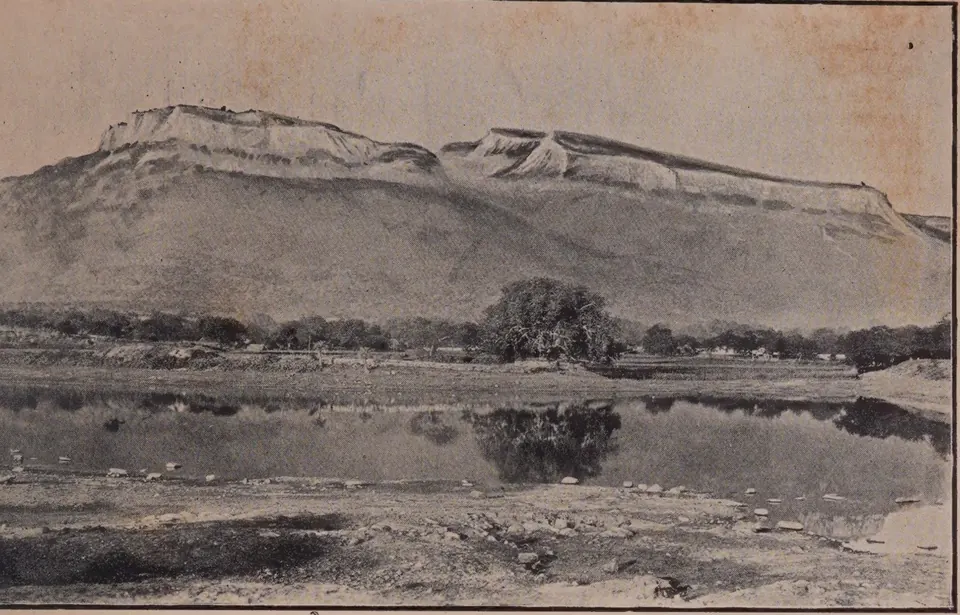
The great hill fort of Udayagiri was held by jagirdars (holders of land grants).25 The Nellore manual says that the jagir of Udayagiri, 68 villages, “was the most important of all”.25 Saadatullah Khan granted it in 1720, for the suppression of a freebooter (robber) and the support of the killadar of the hill fort.25 In 1801 the grantee’s grandson held it.25 He “had a considerable force, and was in possession of the Udayagiri droog, one of the strongest hill forts in the presidency”.25 The Imperial Gazetteer says that the last of the line was deported in 1839, and the jagir taken back.26 See Udayagiri.
The great poligars (local chiefs) of the north paid tribute but kept their own forces.27 In 1756 the Nawab went north with an English detachment to collect the tribute of “the Northern Polygars”.27 The poligar of Venkatagiri agreed to pay 1,40,000 rupees.27 The poligar of Kalahasti agreed to pay 1,00,000 rupees “and to acknowledge the Nawab”.27
In 1791 Venkatagiri paid a fixed peshkash (tribute) of 21,673 star pagodas at Madras, and Kalahasti paid 10,775.28 The zamindar (landholder) of Saidapuram, smaller poligars and the jagirdar of Udayagiri paid theirs at Nellore.28 See Srikalahasti.
Nellore under Najib-ullah, 1753–1762
In the 1750s Nellore was held by the Nawab Muhammad Ali’s brother, Najib-ullah.2927 The adventurer Muhammad Kamal surprised the town and drove him out.2927 But a year later, in 1753, Muhammad Kamal was defeated near Tirupati, and beheaded on Najib-ullah’s order.2927
In 1757 Najib-ullah refused the Nawab’s demand for an extra subsidy, and rebelled.3031 An army of about 10,000 men under the Nawab’s brother Abdul Wahab besieged Nellore.323334 With it were an English detachment under Forde, and the troops of the poligars of Venkatagiri and Kalahasti.323334 Nellore was a town of mud walls with a dry ditch.323334 The garrison, helped by twenty Frenchmen, threw back the assault on the breach, and the army withdrew.323334
Najib-ullah then joined the French.3536 In 1758 he bought off the Maratha Balwant Rao.3536 He received Bussy at Nellore and marched with the French against Tirupati.3536
In 1759 the French siege of Madras failed.363738 Najib-ullah then killed the Frenchmen with him, and was confirmed in Nellore for a tribute of 30,000 pagodas.363738 In 1762 an English force under Caillaud took the Nellore fort, and made over the district to the Nawab.363738 See Tirupati and Balwant Rao Mendle.
Government and revenue
The Imperial Gazetteer judged the financial system of the Subahdar of the Deccan “and his subordinate the Nawab of Arcot”.39 It thought it “probably in practice the worst that the country had ever known”.39 It says that in Nellore, “under the Nawabs of Arcot the country was parcelled out into large divisions”.40 It adds that the right of collecting “all the demands of the state on each of these was farmed out to the highest bidder”.40 The effects, it says, “were notoriously bad”.40
The district was governed by fauzdars (military governors).4142 The Nellore manual lists them “from the days of the Nawab Anwar-u-din and his successors”.4142 Among them were Abdul Wahab Khan, Muhammad Kamal and Najib-ullah.4142 They were often named together with a colleague, such as “Ramana Puntulu”.4142 Later came Nagulapati Venkata Rao and Bolla Venkata Rao.4142
Dighton, the first Collector, believed that from 1781 to 1789 the collections “never exceeded three lakhs of pagodas”.21224344 He reckoned that the district could yield 3,60,000 pagodas “without oppressing the inhabitants”.21224344 He noted that the Nawab allowed 5,000 pagodas a year for tanks and channels.21224344 This was honestly spent for some years, but neglected since.21224344
Erskine described how the Palnad was farmed.2123 Before, it had been governed by a resident fauzdar with a force of sepoys, horse and peons.2123 But for twelve years it had been governed through amildars, whose posts “were generally put up to sale”.2123 The post went to the man “who could advance the largest sum”.2123
Each new amildar broke the leases of his predecessor, and the people fled.2123 Erskine wrote that “twenty-seven villages, out of 150 … are reduced to this state”.2123 The population had fallen “within these twelve or fourteen years nearly one-third”.2123 The Board of Revenue noted in 1791 that Nellore and Ongole, by contrast, had “entirely escaped the effects of the two last wars”.28
Forts and troops
The Nawabs relied on English troops for their wars after 1750.3245 Orme described Nellore itself in 1757.32 Its walls were “of mud, and only the gateway and a few of the towers of stone”.32 The Imperial Gazetteer thought its fort “probably built about this time”.45
In the Palnad the fauzdar at Timmarikota had once commanded “about 800 sepoys, 50 horse, and from 100 to 500 peons”.2123 In 1790 the Nawab had two companies of sepoys there, and none in Ongole.2123 During the assignment of the revenues, a revenue battalion and a regular battalion of the Company’s sepoys were stationed at Nellore.2123 By the treaty of 1792 the Carnatic was to be “garrisoned by British troops”.46 See Udayagiri.
Coins
Elliot says that the gold pagodas of “Sa’adut Ulla Khán” can be recognised by the Persian letters for illah on the granulated reverse.7 Those of his relative Safdar Ali can be recognised by the letter ain.7 Muhammad Ali, with the title Walajah, struck coins at Arcot, Porto Novo, Tiruchirappalli and Tiruvamur.7 Among them were the Walajahi, the Kuruki, the Star and the Feringhipet pagodas.7 His mint accounts list “Arcot rupees” among the silver coins.7
Elliot adds that the rupees of the Nawabs’ mints were “inferior in standard, but of the same nominal value” as the Company’s.47 Charles Philip Brown’s Carnatic Chronology says that from 1758 the English coined money at Madras for the Nawab.48 These coins were “called Arcot rupees, and dated A.H. 1172”.48 Elliot’s plates show a Kuruki pagoda “struck by the Nawabs of Arcot” and a pagoda of Safdar Ali.49 See the gallery on this page.
The Company and the Nawab, 1763–1792
The treaty of Paris of 1763 recognised Muhammad Ali as Nawab.5051 After that he granted the Company the jagir round Madras, and the emperor gave him the title of Walajah.5051
His debts grew with the wars against Haidar Ali.52 The official narrative says that on 2 December 1781 an agreement was made.52 It was agreed “that the revenues of the Carnatic should be transferred to the British Government for five years, the Nawab receiving one-sixth for his private expenses”.52 The Imperial Gazetteer says that with this assignment of 1781, “Nellore passed for the first time under direct British management”.38
The revenues were restored in 1785.52 By the treaty of 1787 the Nawab agreed to pay nine lakhs of pagodas a year for the Carnatic’s defence.52 See Muhammad Ali Khan Walajah.
When war with Tipu Sultan broke out in 1790, the Company took over the country again.534 The Court of Directors complained that the Nawab’s fauzdar and amildar at Nellore “absolutely refused to submit to the Company’s authority”.534 Dighton was appointed Collector of Nellore, and Erskine of Ongole and the Palnad.534
The treaty of 12 July 1792 ended the arrangement.46 Its terms were these:4641
- The Nawab was to pay nine lakhs of pagodas a year for the Company’s troops.46
- The Company was to collect the poligars’ tribute in his name, and to take over the whole country in war.46
- Certain districts, among them Nellore and Ongole, were named in its schedule as security.46
By the end of August 1792 Nellore “had been transferred to the Nawab’s officers”.41
The end, 1795–1801
Muhammad Ali was succeeded by his son Umdat-ul-Umara on 16 October 1795.46 To meet the subsidy, the Nawab “contracted heavy loans, and to liquidate them assigned to his creditors the revenues of his country”.46 This was “a system which resulted in cruel oppression”.46
Srirangapatna (then Seringapatam) fell in 1799, and papers were found there.46 They showed “a treasonable correspondence … which had been begun by Muhammad Ali and his son with Tipu Sultan shortly after the conclusion of the treaty of 1792”.46 The Company declared itself released from the treaty.46
Umdat-ul-Umara died on 15 July 1801.4619 His reputed son refused the Company’s terms.4619 On 31 July 1801 his nephew Azim-ud-daula, “great-grandson by both parents of Anwar-ud-din”, accepted them.4619
The treaty vested in the Company “the sole and exclusive administration of the civil and military governments of all the territories and dependencies of the Carnatic Payen Ghat”.5455 It also gave the Company “the full and exclusive right to the revenues thereof”.5455 A fifth of the net revenues was allotted to the Nawab and his family.5455
The Nellore manual has a map of “the District of Nellore and Ongole at the date of the assumption in 1801”, showing the new district.56 The manual goes on from “its final cession in 1801” to the British administration.56
The Nawabs kept their title for half a century more.1957 Azim-ud-daula died in 1819, and his son in 1825.1957 The son’s infant successor, Muhammad Ghaus, died without issue (children) in 1855.1957 The government then declared “the title, privileges, and immunities of the Carnatic family” at an end.1957 In 1867 Muhammad Ghaus’s uncle, Azim Jah, was made Prince of Arcot.1957 In 1873 the Nellore district still paid Carnatic stipends among its political pensions.56
Where the sources disagree
- Saadatullah Khan’s dates. Wilks and the Madras records date his appointment to 1713, and Orme to 1710.6 Brown’s chronology has “Saadat Ali Khan, of Arcot” governor of the Carnatic in 1710.58 Gribble’s Sidhout chronology names “Sadoolla Khan of Arcot” acting there in 1694.10 Wilks and the official narrative date his death to 1732, and Elliot to 1731.1257
- Ambur. Wilks dates the battle to 23 July 1749.18 Brown, writing in 1863, cites a Persian record dating it to the equivalent of 3 December 1750.59
- Muhammad Ali’s place among his brothers. Wilks calls him the youngest son of Anwar-ud-din, and Mahfuz Khan “the only legitimate son”.1860 The Nellore manual calls him the second son.61
- Muhammad Ali’s reign. The Nellore manual’s list gives him 1750 to 1794, and Umdat-ul-Umara 1794 to 1801.242 Its narrative, and the official narrative, put his death in October 1795.4246
- The title Walajah. Elliot dates the emperor’s grant to 1766.7 The Nellore manual places it with the grant of the Northern Circars to the Company (1765).51
- Najib-ullah’s garrison in 1757. The Nellore manual, following Orme, says 4,000 peons with twenty Frenchmen.32 The Imperial Gazetteer says 3,000 men.62
- The cession of Nellore. The treaty with Azim-ud-daula is dated 31 July 1801.54 Brown’s chronology says that “the English took possession of Nelloor” in 1800.63
Footnotes
-
Mark Wilks, Historical Sketches of the South of India, Vol. I (1810), p. 218 (archive.org (opens in a new tab)). ↩ ↩2 ↩3 ↩4 ↩5 ↩6 ↩7
-
John A. C. Boswell, A Manual of the Nellore District (1873), p. 444 (archive.org (opens in a new tab)). ↩ ↩2 ↩3 ↩4 ↩5 ↩6 ↩7
-
Boswell, Nellore District (1873), p. 445 (archive.org (opens in a new tab)). ↩ ↩2 ↩3 ↩4 ↩5
-
Boswell, Nellore District (1873), p. 464 (archive.org (opens in a new tab)). ↩ ↩2 ↩3 ↩4 ↩5 ↩6 ↩7 ↩8 ↩9
-
C. U. Aitchison, A Collection of Treaties, Engagements and Sanads, Vol. VIII (1892), p. 1 (archive.org (opens in a new tab)). ↩ ↩2 ↩3 ↩4 ↩5 ↩6
-
Wilks, Historical Sketches, Vol. I (1810), p. 226 and note (archive.org (opens in a new tab)). ↩ ↩2 ↩3 ↩4 ↩5
-
Walter Elliot, Coins of Southern India (1886), p. 144 and note 2 (archive.org (opens in a new tab)). ↩ ↩2 ↩3 ↩4 ↩5 ↩6 ↩7 ↩8
-
Wilks, Historical Sketches, Vol. I (1810), p. 225 (archive.org (opens in a new tab)). ↩ ↩2 ↩3
-
Wilks, Historical Sketches, Vol. I (1810), p. 227 (archive.org (opens in a new tab)). ↩ ↩2 ↩3
-
J. D. B. Gribble, A Manual of the District of Cuddapah (1875), p. 51 (archive.org (opens in a new tab)). ↩ ↩2 ↩3 ↩4
-
C. F. Brackenbury, Madras District Gazetteers: Cuddapah, Vol. I (1915), p. 41 (archive.org (opens in a new tab)). ↩ ↩2 ↩3 ↩4 ↩5 ↩6
-
Wilks, Historical Sketches, Vol. I (1810), p. 248 (archive.org (opens in a new tab)). ↩ ↩2
-
Wilks, Historical Sketches, Vol. I (1810), p. 252 (archive.org (opens in a new tab)). ↩ ↩2 ↩3
-
Wilks, Historical Sketches, Vol. I (1810), p. 253 (archive.org (opens in a new tab)). ↩ ↩2 ↩3
-
Wilks, Historical Sketches, Vol. I (1810), p. 254 (archive.org (opens in a new tab)). ↩ ↩2
-
Muhammad Burhanuddin Siddiqui, The Carnatic & Kurnool, their Last Muhammedan Rulers (Madras, 1905), p. 30 (archive.org (opens in a new tab)). ↩ ↩2
-
Wilks, Historical Sketches, Vol. I (1810), p. 255 (archive.org (opens in a new tab)). ↩ ↩2
-
Wilks, Historical Sketches, Vol. I (1810), p. 259 (archive.org (opens in a new tab)). ↩ ↩2 ↩3 ↩4
-
Aitchison, Treaties, Vol. VIII (1892), p. 5 (archive.org (opens in a new tab)). ↩ ↩2 ↩3 ↩4 ↩5 ↩6 ↩7 ↩8 ↩9
-
Boswell, Nellore District (1873), p. 465 (archive.org (opens in a new tab)). ↩ ↩2
-
Boswell, Nellore District (1873), p. 466, quoting the reports of Dighton and Erskine for fasli 1200 (archive.org (opens in a new tab)). ↩ ↩2 ↩3 ↩4 ↩5 ↩6 ↩7 ↩8 ↩9 ↩10 ↩11 ↩12 ↩13 ↩14 ↩15 ↩16
-
Boswell, Nellore District (1873), p. 468 (archive.org (opens in a new tab)). ↩ ↩2 ↩3 ↩4 ↩5 ↩6 ↩7 ↩8
-
Boswell, Nellore District (1873), p. 467, quoting Erskine (archive.org (opens in a new tab)). ↩ ↩2 ↩3 ↩4 ↩5 ↩6 ↩7 ↩8 ↩9 ↩10 ↩11 ↩12
-
Imperial Gazetteer of India, Provincial Series: Madras, Vol. I (1908), p. 302 (archive.org (opens in a new tab)). ↩
-
Boswell, Nellore District (1873), p. 499 (archive.org (opens in a new tab)). ↩ ↩2 ↩3 ↩4 ↩5
-
Imperial Gazetteer: Madras, Vol. I (1908), p. 368 (archive.org (opens in a new tab)). ↩
-
Boswell, Nellore District (1873), p. 450 (archive.org (opens in a new tab)). ↩ ↩2 ↩3 ↩4 ↩5 ↩6 ↩7
-
Boswell, Nellore District (1873), p. 471, quoting the Board of Revenue’s report of 1791 (archive.org (opens in a new tab)). ↩ ↩2 ↩3
-
Boswell, Nellore District (1873), p. 449 (archive.org (opens in a new tab)). ↩ ↩2 ↩3
-
Robert Orme, A History of the Military Transactions of the British Nation in Indostan, Vol. II (Madras reprint, 1861), p. 202 (archive.org (opens in a new tab)). ↩
-
Boswell, Nellore District (1873), p. 451 (archive.org (opens in a new tab)). ↩
-
Boswell, Nellore District (1873), p. 452 (archive.org (opens in a new tab)). ↩ ↩2 ↩3 ↩4 ↩5 ↩6 ↩7 ↩8
-
Boswell, Nellore District (1873), p. 453 (archive.org (opens in a new tab)). ↩ ↩2 ↩3 ↩4
-
Boswell, Nellore District (1873), p. 454 (archive.org (opens in a new tab)). ↩ ↩2 ↩3 ↩4
-
Boswell, Nellore District (1873), p. 455 (archive.org (opens in a new tab)). ↩ ↩2 ↩3
-
Boswell, Nellore District (1873), p. 456 (archive.org (opens in a new tab)). ↩ ↩2 ↩3 ↩4 ↩5 ↩6
-
Imperial Gazetteer: Madras, Vol. I (1908), p. 344 (archive.org (opens in a new tab)). ↩ ↩2 ↩3
-
Imperial Gazetteer: Madras, Vol. I (1908), p. 345 (archive.org (opens in a new tab)). ↩ ↩2 ↩3 ↩4
-
Imperial Gazetteer: Madras, Vol. I (1908), p. 90 (archive.org (opens in a new tab)). ↩ ↩2
-
Imperial Gazetteer: Madras, Vol. I (1908), p. 355 (archive.org (opens in a new tab)). ↩ ↩2 ↩3
-
Boswell, Nellore District (1873), p. 472 (archive.org (opens in a new tab)). ↩ ↩2 ↩3 ↩4 ↩5 ↩6 ↩7
-
Boswell, Nellore District (1873), p. 473 (archive.org (opens in a new tab)). ↩ ↩2 ↩3 ↩4 ↩5 ↩6 ↩7
-
Boswell, Nellore District (1873), p. 469 (archive.org (opens in a new tab)). ↩ ↩2 ↩3 ↩4
-
Boswell, Nellore District (1873), p. 470 (archive.org (opens in a new tab)). ↩ ↩2 ↩3 ↩4
-
Imperial Gazetteer: Madras, Vol. I (1908), p. 366 (archive.org (opens in a new tab)). ↩ ↩2
-
Aitchison, Treaties, Vol. VIII (1892), p. 4 (archive.org (opens in a new tab)). ↩ ↩2 ↩3 ↩4 ↩5 ↩6 ↩7 ↩8 ↩9 ↩10 ↩11 ↩12 ↩13 ↩14 ↩15 ↩16
-
Elliot, Coins of Southern India (1886), p. 145 (archive.org (opens in a new tab)). ↩
-
C. P. Brown, Carnatic Chronology (1863), p. 74 (archive.org (opens in a new tab)). ↩ ↩2
-
Elliot, Coins of Southern India (1886), p. 152h, description of Plate IV, Nos. 180–181 (archive.org (opens in a new tab)). ↩
-
Boswell, Nellore District (1873), p. 459 (archive.org (opens in a new tab)). ↩ ↩2
-
Boswell, Nellore District (1873), p. 460 (archive.org (opens in a new tab)). ↩ ↩2 ↩3
-
Aitchison, Treaties, Vol. VIII (1892), p. 3 (archive.org (opens in a new tab)). ↩ ↩2 ↩3 ↩4 ↩5
-
Boswell, Nellore District (1873), p. 463 (archive.org (opens in a new tab)). ↩ ↩2 ↩3
-
Aitchison, Treaties, Vol. VIII (1892), p. 57, treaty with Azim-ud-daula, 31 July 1801, Articles 1 and 4 (archive.org (opens in a new tab)). ↩ ↩2 ↩3 ↩4
-
Aitchison, Treaties, Vol. VIII (1892), p. 58, Articles 4–5 (archive.org (opens in a new tab)). ↩ ↩2 ↩3
-
Boswell, Nellore District (1873), p. 474, and the map facing it (archive.org (opens in a new tab)). ↩ ↩2 ↩3
-
Aitchison, Treaties, Vol. VIII (1892), p. 6 (archive.org (opens in a new tab)). ↩ ↩2 ↩3 ↩4 ↩5
-
Brown, Carnatic Chronology (1863), p. 71 (archive.org (opens in a new tab)). ↩
-
Brown, Carnatic Chronology (1863), p. 73 (archive.org (opens in a new tab)). ↩
-
Wilks, Historical Sketches, Vol. I (1810), p. 261 (archive.org (opens in a new tab)). ↩
-
Boswell, Nellore District (1873), p. 447 (archive.org (opens in a new tab)). ↩
-
Imperial Gazetteer: Madras, Vol. I (1908), p. 367 (archive.org (opens in a new tab)). ↩
-
Brown, Carnatic Chronology (1863), p. 77 (archive.org (opens in a new tab)). ↩
Photos
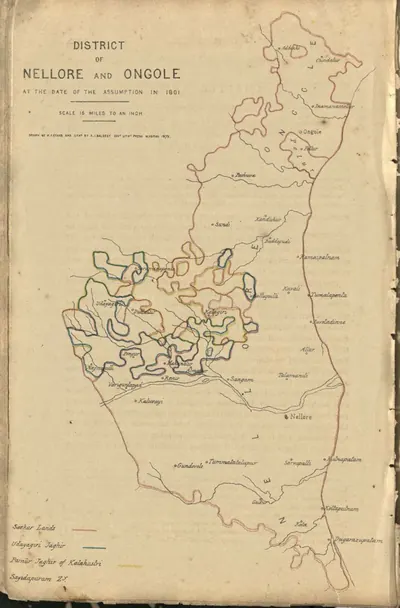 "District of Nellore and Ongole at the date of the assumption in 1801" (coloured lithograph) (Boswell 1873, PDF p. 496)Map · 1873
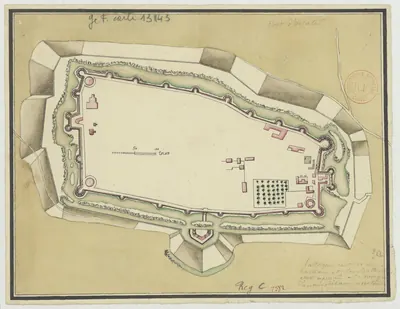 "Fort d'Arcate": French manuscript plan of the fort of Arcot, 1758 (Bibliotheque nationale de France)Plan · 1758
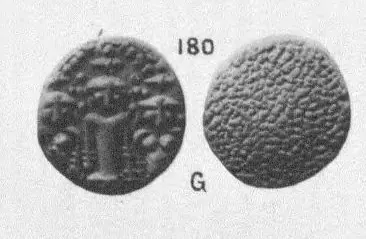 "Known as the Kuruki pagoda, struck by the Nawabs of Arcot": gold pagoda with three standing figures (Elliot 1886, Pl. IV, No. 180)Coin · 1886
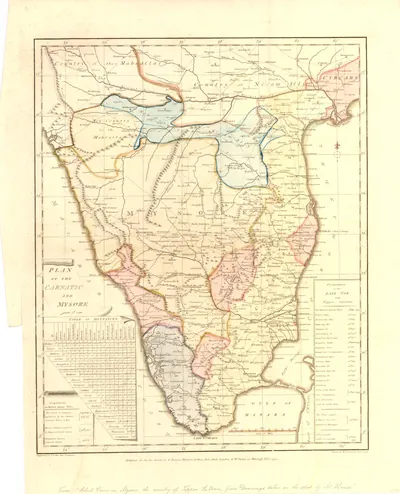 "Plan of the Carnatic and Mysore": hand-coloured map engraved after Robert Home, published 1794 (British Museum)Map · 1794
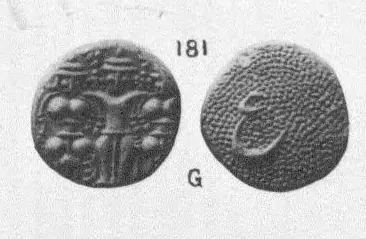 "Struck by Safdar 'Ali, of the family of the Arcot Nawab": gold pagoda with the letter ain on the reverse (Elliot 1886, Pl. IV, No. 181)Coin · 1886
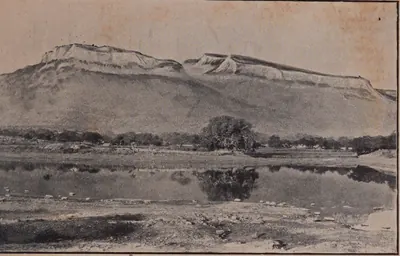 "Udayagiri in the Nellore District" (Madras Archaeological Report 1916-17, plate I-a (PDF p. 231 of 31761123499139))Historic photograph · 1917
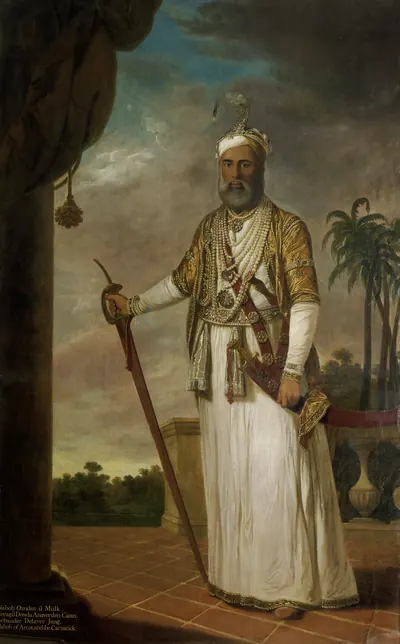 Muhammad Ali Khan Walajah, Nawab of Arcot: full-length portrait by Tilly Kettle, 1770s (Norfolk Museums)Other · c. 1772–76
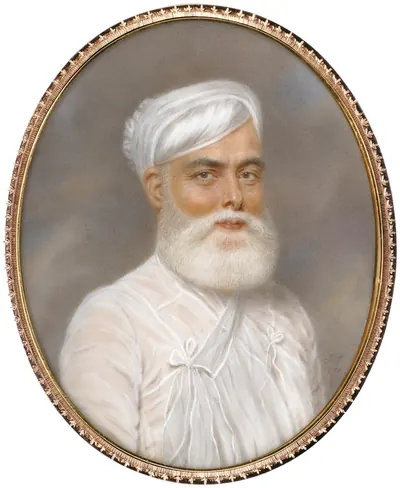 Muhammad Ali Khan Walajah, Nawab of Arcot: portrait miniature by John Smart, 1791Other · 1791
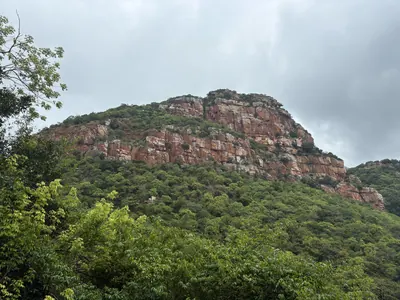 The Udayagiri hill (Udayagiri Droog), Nellore districtPhotograph · 2025
References
Notes (0)
Sources (10)
Spotted an error on this page? Tell us
Last updated: