Nellore
Town on the Penner near the east coast, called Vikramasimhapura in its medieval inscriptions. From about 1205 it was the capital of the Telugu Chodas, the Madhurantaka Pottapi-Cholas. Tammusiddhi was anointed there, and Tikka I and Manumasiddhi II ruled the Pakanadu from it. Kakatiya armies restored Manumasiddhi there, and the Pandya Sundara Pandya claimed to have been crowned there. In the eighteenth century it belonged to the Nawabs of the Carnatic (Arcot). Their brother Najib-ullah held it and rebelled in 1757, and he beat off an assault by the Nawab's army and an English detachment. In 1801 it became the headquarters of a British district.
Nellore is a town just south of the Penner river.1 It was a seat of the Telugu Choda kings, and in the eighteenth century it belonged to the Nawabs of the Carnatic.23
Vikramasimhapura
Tamil inscriptions of the Telugu Choda period at Nellore call the town Nellur alias Vikramasingapura. One of them is in the Ranganayaka temple.4 It records that Madurantakapottapichola alias Tammusiddharasa gave a tax-free village to the god Pallikondaperumal at Tiruppalkadal in Nellore.4 The gift was made in the 26th year of a Chola Kulottunga.4
Other inscriptions record these gifts:567
- a gift by a follower of Madurantaka Pottapi-Chola Nallasiddharasa to the same god567
- a grant by Manumasiddharasa to the god Nagaresvara567
- a gift by Nallasiddharasa to a temple of Manumasiddhisvara567
The Nellore gazetteer of 1942 also gives Vikramasimhapura as the town’s name at this time.8
Capital of the Telugu Chodas
Tammusiddhi, of the Telugu Choda family of Pottapi, was anointed “in the town of Nellûr” in 1205–06.9 This is known from his inscription at Kanchipuram.9
Until then Pottapi had been the seat of the Madhurantaka Pottapi-Cholas.2 Brackenbury’s Cuddapah gazetteer (1915) records that “both Tikka and his son and successor Manumasiddhi ruled the Pâka-nâdu from Nellore”.2 See the Telugu Chodas of Pottapi and Nellore.
Kakatiya and Pandya armies
When Manumasiddhi II was driven out of Nellore, the Kakatiya king Ganapatideva restored him. The Nayanapalle inscription says that Ganapati killed the men who had burnt Nellore.10 A Telugu literary account adds that he crowned Manumasiddhi there, built a large tank at Nellore and stayed some months.10
The Pandya Jatavarman Sundara Pandya I claimed to have marched as far as Nellore about 1258–60.111213 He also claimed to have performed a victory anointment there.111213 Sewell doubted the march, while the Nellore gazetteer accepted it.111213
The gazetteer also records a later Sundara Pandya who was crowned at Nellore and endowed a hall in the Ranganayaka temple.14 It notes that inscriptions of the Kakatiyas reappear at Nellore after 1305, when Telugu Choda records end.14
The Nawabs of Arcot
In the eighteenth century Nellore belonged to the Nawabs of the Carnatic.3 The Nellore manual says that their province “from its capital … also received the name of Arcot, and included the district of Nellore”.3 The manual lists the chief fauzdars (military governors) of Nellore “from the days of the Nawab Anwar-u-din and his successors”.1516 It names one Mustafer Sahib as fauzdar under Saadatullah Khan.1516 See the Nawabs of the Carnatic (Arcot).
The Imperial Gazetteer says that the town “first attained historical importance in the eighteenth century, when the English and the French were contesting the supremacy of Southern India”.17 It commanded “the northern high road and the passage of the Penner”.17 According to the gazetteer its fort, “portions of the wall and ditch of which are still visible, was probably built about this time”.17
Najib-ullah
In the 1750s the town was held by the Nawab Muhammad Ali’s brother Najib-ullah. The adventurer Muhammad Kamal surprised the town and drove him out to Arcot.1819 Kamal was beheaded on Najib-ullah’s order in 1753.1819
In 1757 Najib-ullah rebelled.12021 The Nawab’s army and an English detachment under Forde camped before the town.12021 Orme’s account says that the town “stood about 500 yards to the south of the river Pennair”.1 It “extended at that time about 1,200 yards from east to west, and 600 on the other sides”.1 “The walls were of mud, and only the gateway and a few of the towers of stone.”1 The garrison beat off the assault on the breach, and the besiegers withdrew.20
- In 1758 Najib-ullah bought off the Maratha general Balwant Rao before Nellore.2223
- On 4 September he received the French general Bussy there “as a friend and ally”.23
- In 1759 he made his peace with the English.222324
- In February 1762 an English force under Caillaud took the Nellore fort and made over the district to the Nawab.24
See Muhammad Ali Khan Walajah and Balwant Rao Mendle.
The Company
In 1781 the Nawab assigned the revenues of the Carnatic to the Company.24 The Imperial Gazetteer says that then “Nellore passed for the first time under direct British management”.24 In 1790 war with Tipu Sultan broke out, and the Company took over the Nawab’s revenues “and Mr. Dighton was appointed the first Collector of Nellore”.2526 The administration was restored to the Nawab in 1792, “but it was permanently assumed by the British in 1801”.2526
The Nellore manual’s map shows “the District of Nellore and Ongole at the date of the assumption in 1801”.27 Charles Philip Brown’s Carnatic Chronology says that “the English took possession of Nelloor” in 1800.28
Where the sources disagree
- When the British took over. The Imperial Gazetteer says that the British “permanently assumed” the government of Nellore in 1801.25 The Nellore manual’s map also dates the assumption to 1801.27 Brown’s Carnatic Chronology puts the English taking of Nellore in 1800.28
Footnotes
-
Boswell, Nellore District (1873), p. 452, following Orme (archive.org (opens in a new tab)). ↩ ↩2 ↩3 ↩4 ↩5 ↩6
-
C. F. Brackenbury, Madras District Gazetteers: Cuddapah (1915), p. 32 (archive.org (opens in a new tab)). ↩ ↩2 ↩3
-
John A. C. Boswell, A Manual of the Nellore District (1873), p. 444 (archive.org (opens in a new tab)). ↩ ↩2 ↩3
-
Butterworth and Venugopaul Chetty, Nellore Inscriptions II (1905), Nellore No. 72, p. 843 (archive.org (opens in a new tab)). ↩ ↩2 ↩3
-
Alan Butterworth and V. Venugopaul Chetty, A Collection of the Inscriptions on Copper-Plates and Stones in the Nellore District, Part II (1905), Nellore No. 67, pp. 836–837 (archive.org (opens in a new tab)). ↩ ↩2 ↩3 ↩4
-
Butterworth and Venugopaul Chetty, Nellore Inscriptions II (1905), Nellore No. 82, p. 852 (archive.org (opens in a new tab)). ↩ ↩2 ↩3 ↩4
-
Butterworth and Venugopaul Chetty, Nellore Inscriptions II (1905), Nellore No. 86, p. 853 (archive.org (opens in a new tab)). ↩ ↩2 ↩3 ↩4
-
W. E. Johns, Gazetteer of the Nellore District, brought up to 1938 (1942), p. 40 (archive.org (opens in a new tab)). Paraphrased. ↩
-
H. Lüders, “Two Further Inscriptions of Tammusiddhi”, Epigraphia Indica VII (1903), p. 152 (archive.org (opens in a new tab)). ↩ ↩2
-
V. Venkatasubba Ayyar, “Nayanapalle Inscription of Ganapatideva”, Epigraphia Indica XXVII (1956), p. 194 (archive.org (opens in a new tab)). Paraphrased. ↩ ↩2
-
Robert Sewell, The Historical Inscriptions of Southern India (1932), p. 154 (archive.org (opens in a new tab)). Paraphrased. ↩ ↩2 ↩3
-
Sewell, Historical Inscriptions (1932), p. 155 (archive.org (opens in a new tab)). Paraphrased. ↩ ↩2 ↩3
-
Johns, Nellore District Gazetteer (1942), p. 45 (archive.org (opens in a new tab)). Paraphrased. ↩ ↩2 ↩3
-
Johns, Nellore District Gazetteer (1942), p. 47 (archive.org (opens in a new tab)). Paraphrased. ↩ ↩2
-
Boswell, Nellore District (1873), p. 472 (archive.org (opens in a new tab)). ↩ ↩2
-
Boswell, Nellore District (1873), p. 473 (archive.org (opens in a new tab)). ↩ ↩2
-
Imperial Gazetteer of India, Provincial Series: Madras, Vol. I (1908), p. 366 (archive.org (opens in a new tab)). ↩ ↩2 ↩3
-
Boswell, Nellore District (1873), p. 449 (archive.org (opens in a new tab)). ↩ ↩2
-
Boswell, Nellore District (1873), p. 450 (archive.org (opens in a new tab)). ↩ ↩2
-
Boswell, Nellore District (1873), p. 453 (archive.org (opens in a new tab)). ↩ ↩2 ↩3
-
Boswell, Nellore District (1873), p. 454 (archive.org (opens in a new tab)). ↩ ↩2
-
Boswell, Nellore District (1873), p. 455 (archive.org (opens in a new tab)). ↩ ↩2 ↩3
-
Boswell, Nellore District (1873), p. 456 (archive.org (opens in a new tab)). ↩ ↩2 ↩3 ↩4
-
Imperial Gazetteer: Madras, Vol. I (1908), p. 345 (archive.org (opens in a new tab)). ↩ ↩2 ↩3 ↩4 ↩5
-
Imperial Gazetteer: Madras, Vol. I (1908), p. 367 (archive.org (opens in a new tab)). ↩ ↩2 ↩3
-
Boswell, Nellore District (1873), p. 464 (archive.org (opens in a new tab)). ↩ ↩2
-
Boswell, Nellore District (1873), p. 474, and the map facing it (archive.org (opens in a new tab)). ↩ ↩2
-
C. P. Brown, Carnatic Chronology (1863), p. 77 (archive.org (opens in a new tab)). ↩ ↩2
Photos
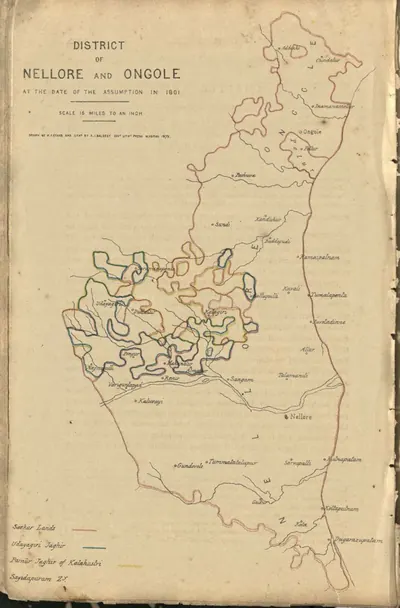 "District of Nellore and Ongole at the date of the assumption in 1801" (coloured lithograph) (Boswell 1873, PDF p. 496)Map · 1873
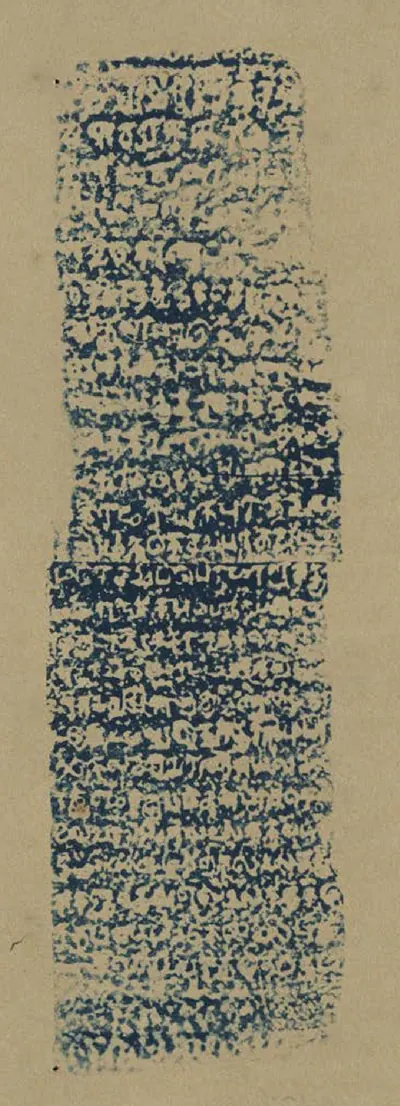 "Nellore No. 101": Tamil inscription of Madhurantaka Pottapi-Chola alias Tirukkalattideva over the shrine of the temple at Ramatirtham (Butterworth & Chetty 1905, Part II, to face p. 864 (PDF p. 403))Inscription rubbing · 1905
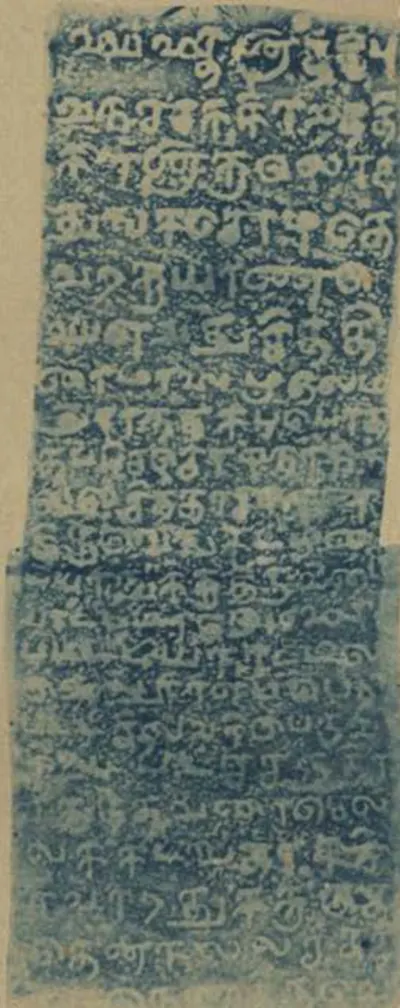 "Part of Gudur No. 34": the Gunupadu inscription of Nallasiddha, dated in the 27th year of a Chola Kulottunga (Butterworth and Venugopaul Chetty 1905, plate facing p. 406)Inscription rubbing · 1905
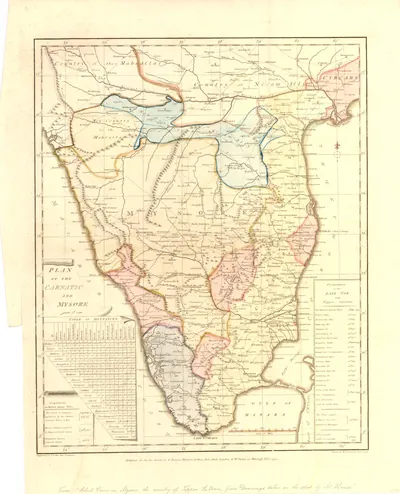 "Plan of the Carnatic and Mysore": hand-coloured map engraved after Robert Home, published 1794 (British Museum)Map · 1794
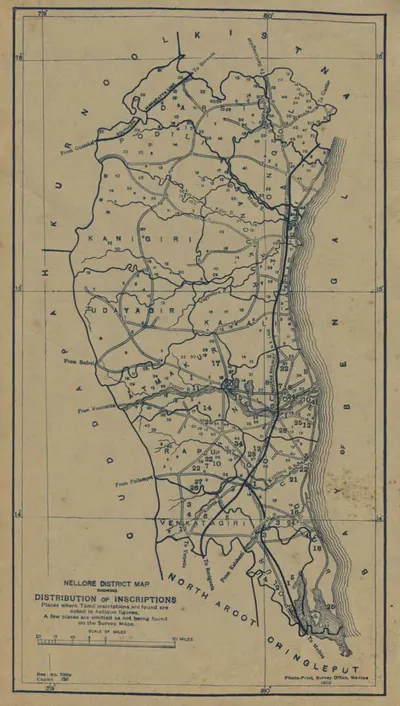 Nellore District map showing the distribution of inscriptions (Butterworth & Chetty 1905, PDF p. 7)Map · 1905
Related
Dynasties
People
Kulottunga III (Chola)
1178–1216 CE
Chola king (1178–1216), the last strong ruler of the dynasty. The Telugu Choda chiefs of Pottappi and Nellore, among them Nallasiddha, Tammusiddhi and Tikka, dated their records in his reign, and inscriptions of his years are found at Nellore, in the Gudur country and at Kalahasti, whose temple he renewed. The Cuddapah gazetteer credits him with restoring Chola power in the Paka-nadu in 1196, while the Kakatiyas took over the old Chola lands north of the Krishna.
Tammusiddhi
c. 1205–1208 CE
Telugu Choda king of the Pottapi and Nellore family, and a vassal of the Chola king Kulottunga III. He was anointed at Nellore in 1205–06 and made grants at Kanchipuram, Tiruvalangadu, Tiruppasur, Tiruvorriyur, Nellore and Kavali. His inscriptions give the fullest early family tree of the family, but they disagree about who his brother or uncle Nallasiddhi was.
Tikka I (Telugu Choda of Nellore)
c. 1209–1248 CE
Telugu Choda king of Nellore, also called Tirukalatti and Ganda-Gopala, who ruled from about 1209 to 1248 or 1250. He was a loyal vassal of the Chola Rajaraja III, fought the Hoysalas and held Kanchi. In one modern account he owed his throne at Nellore to the Kakatiya Ganapatideva. He was the father of Manumasiddhi II.
Rajendra III (Chola)
c. 1246–1267 CE
The last Chola king (1246 to about 1267). His regnal years were still used by the Telugu Choda rulers of Nellore, among them Manumasiddhi, the patron of the poet Tikkana, and a Tamil record dated in his reign survives in the Gudur country of Nellore as late as 1263–64. An inscription of 1260–61 at Tripurantakam claims victories for him over two Pandya kings, which V. Rangacharya took for a real campaign and Robert Sewell did not. The Cuddapah gazetteer dates his death, and the end of the Cholas, to 1268.
Manumasiddhi II
c. 1248 CE
Telugu Choda king of Nellore from about 1248 or 1250, son of Tikka I and patron of the poet Tikkana Somayaji. He was driven out of Nellore early in his reign. The Kakatiya king Ganapatideva restored him after Tikkana went to the Kakatiya court as his envoy, and he later fought for Ganapati against Kalinga on the Godavari. Whether he was the same king as Vijaya-Gandagopala of Kanchi is disputed.
Jatavarman Sundara Pandya I
c. 1251–1268 CE
Pandya king of Madurai who came to the throne in 1251 and led the second Pandya empire to its height. His records claim the defeat of the Hoysala Somesvara, the capture of Kopperunjinga's fortress, the occupation of Kanchi after killing Gandagopala, and a victory over the Telugus and their allies at Mudugur, from which he drove them to the Krishna. He was anointed as conqueror at Nellore. P. V. Parabrahma Sastry dates the battle at Muttukuru to 1263 and adds that he struck coins with the Kakatiya boar. Robert Sewell doubted the northern march.
Harihara I (Vijayanagara)
c. 1336–1355 CE
First ruler of Vijayanagara and eldest of the five sons of Sangama. With his brother Bukka he founded the kingdom on the Tungabhadra about 1336. His first dated inscription, of 1340, calls him only a mahamandalesvara, 'great lord'. It is disputed whether he and his brothers came from the service of the Kakatiyas of Warangal, of the Rai of Kampili or of the Hoysalas. His brother Kampa held Udayagiri and Nellore, the first Vijayanagara base in the Telugu country.
Deva Raya II (Vijayanagara)
1422–1446 CE
King of Vijayanagara from 1422 or 1423 to 1446, the greatest ruler of the first dynasty. He enlisted Muslim archers in his army, survived an attempt on his life in 1443 and received the Persian envoy Abdur Razzaq. His inscriptions reach the Godavari delta and the Guntur and Nellore country. The Telugu poet Vallabharaya governed Vinukonda for him, and Srinatha was bathed in gold in his Pearl Hall. After his death the Bahmani sultan and the Gajapati of Orissa besieged his capital together.
Muhammad Ali Khan Walajah
1749–1795 CE
Nawab of the Carnatic (Arcot) from 1749 to 1795, the son of Anwar-ud-din Khan. His father was killed at Ambur in 1749. He held out at Trichinopoly and, with English help, won the Nawabship from Chanda Sahib and the French. The treaty of Paris of 1763 recognised him, and the Mughal emperor gave him the title Walajah. His Telugu districts were Nellore, held under his brother Najib-ullah, who rebelled in 1757, Ongole and the Palnad. He owed large debts to the Company and to private lenders. He handed the revenues of the Carnatic to the Company in 1781, saw it take over their management in 1790–92, and agreed by the treaty of 1792 to pay nine lakhs of pagodas a year for its troops. He died in October 1795.
Rajagopala Krishna Yachendra of Venkatagiri
1857–1916 CE
Raja and later Maharaja of Venkatagiri in the Nellore district (1857–1916), head of the Velugoti family, installed in 1879. He built the Indra Mahal and the Town Hall at Venkatagiri and sat twice in the Madras Legislative Council. He was president of the Madras Landholders' Association from its founding in 1890. He was made K.C.I.E. in 1888, Maharaja in 1910 and G.C.I.E. in 1915. His brothers were adopted into the Bobbili, Pithapuram and Jetprole families.
Puchalapalli Sundarayya
1913 CE
Communist leader from Alaganipadu in Nellore district (born 1913). He left his studies for the national movement in 1930, was a member of the Communist Party's Central Committee from 1934, led the left wing of the Andhra Socialist Party, and kept in touch with the Telangana communists during the struggle of 1946–1948. He sat in the Rajya Sabha from 1952.
Balwant Rao Mendle
before 1760 CE
Maratha commander of the Peshwa Balaji Baji Rao, left in the Carnatic in 1757 to collect tribute. On 24 September 1757 he defeated the Nawabs of Cuddapah and Kurnool near Cuddapah. The Nawab of Cuddapah was killed, and the Marathas took Gurramkonda and Punganur. He then marched across the Cuddapah country to the coast. He took tribute from the zamindars of Venkatagiri and Kalahasti and was bought off before Nellore. He was killed at Panipat in December 1760.
Francis Forde
before 1770 CE
Irish officer of the 39th Foot, sent by Clive from Bengal in 1758. He routed the French under Conflans at Condore (Chandurti) near Pithapuram on 9 December 1758 and stormed Masulipatam in April 1759, so winning the Northern Circars from the French for the East India Company. He had earlier led the English detachment in the failed attack on Nellore (1757). Appointed one of the Company's Supervisors in 1769, he was lost at sea when the frigate Aurora disappeared after leaving the Cape at the end of that year.
Najib-ullah Khan
Brother of the Nawab Muhammad Ali Walajah and governor of Nellore in the 1750s. In 1753 the adventurer Muhammad Kamal drove him out of Nellore, but he won it back and had Kamal beheaded. In 1757 he refused his brother's demand for an extra payment and rebelled. His garrison beat off the attack of the Nawab's army and an English force under Colonel Forde. He went over to the French, received Bussy at Nellore in 1758 and joined Moracin against Tirupati. When the French siege of Madras failed in 1759, he killed the Frenchmen with him and was confirmed in Nellore for a tribute of 30,000 pagodas. In 1762 an English force under Caillaud took the Nellore fort from him for the Nawab.
Saadatullah Khan
before 1732 CE
Nawab of the Carnatic, with his capital at Arcot, from about 1710–13 until his death in 1732. A Navayat, born Muhammad Saeed, he was the diwan (finance officer) and faujdar (military governor) of the Mughal general Daud Khan Panni. He followed Daud Khan in the government of the Carnatic below the Ghats, which ran along the coast from Guntur to the Coleroon and took in Nellore. A chronology of Sidhout says that he took the place in 1694 and appointed its fort commander, years before he became Nawab. His faujdar governed Nellore. He granted the jagir of Udayagiri in 1720. With the Pathan Nawabs of Cuddapah, Kurnool and Savanur he took a large payment from Mysore. He left the Nawabship to his nephew Dost Ali.
Tikkana Somayaji
Telugu poet of the 13th century at the court of the Telugu Choda king Manumasiddhi II of Nellore. He translated fifteen books of the Mahabharata into Telugu, completing the work Nannaya had begun two centuries earlier, and wrote the Nirvachanottara Ramayana. He went as his patron's envoy to the Kakatiya Ganapatideva, whose help restored Manumasiddhi to Nellore.
Inscriptions
References
Notes (0)
Sources (9)
Spotted an error on this page? Tell us
Last updated: