Siddhavatam (Sidhout)
Fortified town on the Penner below Cuddapah, called Dakshina Kasi, 'the southern Benares'. The Matla chiefs of Chitvel built the first fort. Under the Nawabs of Cuddapah it was the jagir (land grant) of a branch of their family, and a state prison. The last Nawab, Abd-ul-Halim Khan, surrendered to Haidar Ali there on 27 May 1779 (local and later accounts give 1778 and 1780). Tipu's diwan of Cuddapah stored lead there. The taluk went to the Nizam in 1792 and to the Company in 1800, and Sidhout was for a time the Collector's residence after 1807.
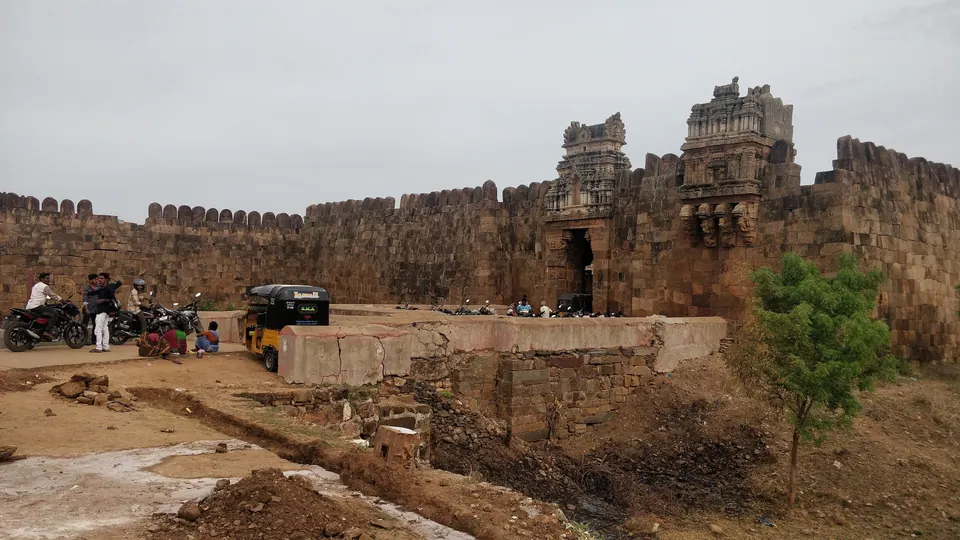
Siddhavatam is a fortified town on the Penner river, a few miles east of Kadapa (then Cuddapah).1 Older records call it Sidhout.1 A branch of the Nawabs of Kadapa held it as a jagir (land grant), and a later Nawab used its fort as a prison.23 In 1779 the last Nawab surrendered to Haidar Ali there.45
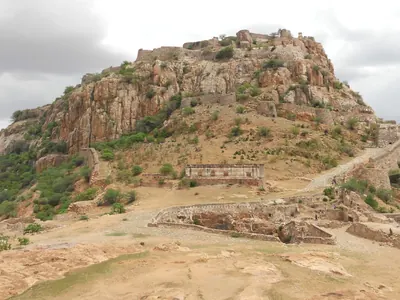
Siddhavatam lies in a valley between the Palkonda hills and the Velikonda range.1 The Imperial Gazetteer of Madras says it was “a place of some importance and of considerable sanctity” (holiness).1 It was sometimes called Dakshina Kasi, “the Southern Benares”.1 This name came from “a fancied resemblance” (an imagined likeness) between its position on the Penner and that of Benares on the Ganges.1 The town was known for the melons grown from January to March in the dry bed of the river.1
The Kadapa gazetteer names the Siddhavattam-sima as one of the two main divisions (simas) of the old Kadapa country.6 See Mysore under Haidar Ali and Tipu Sultan.
The fort
Gribble’s manual of 1875 says that Sidhout “was originally a dependency of the Chitwail Rajah, a member of the important Matli family”.7 He says the fort was founded by a relative of the reigning raja, named Anantaraz.7
In 1604, the Kadapa gazetteer of 1915 says, the Matla chief Anantaraju “repaired the walls of the temples at Sidhout and created the nucleus of the fort”.8 The nucleus was the first core of the fort, which “was afterwards completed by a Nawab of Cuddapah”.8
Gribble describes it as “by no means a strong fort”.9 It lies in a narrow valley, where the Penner “adds but little to its protection”.9 It shows “traces, not only of Hindu and Mahomedan architecture, but also of European fortification”.9 The clearest European work is an outlying semicircular redoubt (a small outer fort).9
Gribble printed a chronology collected by the taluk sheristadar (head clerk) Tiruvengada Charry.23 It runs through these events:23
- the conquest of Sidhout by the Matla chief Ellamaraju in 1604
- the defeat of Ellamaraju’s successor Anantaraju by Mir Jumla, “a Sirdar of Alumgheer” (a noble of Alamgir), in 1684
- the defeat of Mir Jumla by Saadat Ullah Khan of Arcot, who appointed a killadar (fort commander), in 1694
- the grant of the jagir to his second son by Abdul Nabi Khan of Kadapa in 171423
A later Nawab “imprisoned the three sons of the former Nabob in the Sidhout fort”.3 One of them, Abd-ul-Halim Khan, became Nawab under his will.3 See Kadapa.
Haidar Ali, 1779
The cavalry of the Nawab Abd-ul-Halim Khan were beaten at Duvvur.4 After this, in 1779, he left Kadapa and went “to Sidhout, a place of inconsiderable strength to the north-east of Kurpa”, that is, a weak place.4 There Haidar’s army besieged him.4
During this siege, some eighty Afghan prisoners who had been allowed to keep their swords broke into Haidar Ali’s tent at night.1011 Haidar escaped by cutting through the tent wall.1011 Wilks says that the attack “contributed to shorten the defence of Sidhout”.1011
According to Wilks, Abd-ul-Halim Khan (“Abd-ul-Helleem Khan”) surrendered on the 27th of May, on a simple promise of his personal safety.5 He was sent as a prisoner, with his family and relatives, to Srirangapatna (then Seringapatam).5 This page follows Wilks’s date. The sheristadar’s chronology in Gribble puts the fall of Sidhout in 1778.3 The Kadapa gazetteer of 1915 puts it in 1780.12
Gribble says that this dynasty “was put an end to by Hyder Ali … and the fort was pulled down”.1314 Haidar added Sidhout and Kadapa to the jagir of his brother-in-law Mir Sahib.1314 See Mir Ali Raza Khan (Mir Sahib).
Tipu Sultan and the cession
Tipu Sultan used the fort as a store.1516 In a letter to his diwan (chief revenue officer) of Kadapa, he ordered the lead of a newly found mine to be collected “in the fort of Sidhoot”.1516 He added that “It is an ancient custom for a silver mine … to be [always] found under a lead-mine”.1516
In 1800 the Nizam handed over to the Company the lands he had gained by the treaty of 1792.17 The list of these lands begins with “Sidbout, 6 Talooks”.17 Gribble’s chronology records a brief seizure of Sidhout by Hasan Ali Khan of Banganapalle in 1793.3
After Munro left in 1807, Gribble says, “Sidhout was for some time the residence of the Collector”.13 But its position was remote and awkward, so “the head-quarters were subsequently moved to Cuddapah”.13
Footnotes
-
Imperial Gazetteer of India, Provincial Series: Madras, Vol. I (1908), p. 388 (archive.org (opens in a new tab)). ↩ ↩2 ↩3 ↩4 ↩5 ↩6 ↩7
-
Gribble, Cuddapah (1875), p. 50 (archive.org (opens in a new tab)). ↩ ↩2 ↩3 ↩4
-
Gribble, Cuddapah (1875), p. 51 (archive.org (opens in a new tab)). ↩ ↩2 ↩3 ↩4 ↩5 ↩6 ↩7 ↩8
-
Mark Wilks, Historical Sketches of the South of India, Vol. II (1817), p. 192 (archive.org (opens in a new tab)). ↩ ↩2 ↩3 ↩4
-
Wilks, Historical Sketches, Vol. II (1817), p. 195 (archive.org (opens in a new tab)). ↩ ↩2 ↩3
-
C. F. Brackenbury, Madras District Gazetteers: Cuddapah, Vol. I (1915), p. 35 (archive.org (opens in a new tab)). ↩
-
J. D. B. Gribble, A Manual of the District of Cuddapah (1875), p. 48 (archive.org (opens in a new tab)). ↩ ↩2
-
Brackenbury, Cuddapah (1915), p. 39 (archive.org (opens in a new tab)). ↩ ↩2
-
Gribble, Cuddapah (1875), p. 97 (archive.org (opens in a new tab)). ↩ ↩2 ↩3 ↩4
-
Wilks, Historical Sketches, Vol. II (1817), p. 193 (archive.org (opens in a new tab)). ↩ ↩2 ↩3
-
Wilks, Historical Sketches, Vol. II (1817), p. 194 (archive.org (opens in a new tab)). ↩ ↩2 ↩3
-
Brackenbury, Cuddapah (1915), p. 44 (archive.org (opens in a new tab)). ↩
-
Gribble, Cuddapah (1875), p. 49 (archive.org (opens in a new tab)). ↩ ↩2 ↩3 ↩4
-
Gribble, Cuddapah (1875), p. 98 (archive.org (opens in a new tab)). ↩ ↩2
-
William Kirkpatrick (tr.), Select Letters of Tippoo Sultan (1811), p. 227, Letter CXCV (archive.org (opens in a new tab)). ↩ ↩2 ↩3
-
Kirkpatrick, Select Letters of Tippoo Sultan (1811), p. 228 (archive.org (opens in a new tab)). ↩ ↩2 ↩3
-
C. U. Aitchison, A Collection of Treaties, Engagements and Sanads, Vol. IX (4th ed., 1909), p. 76, schedule to the treaty of 1800 (archive.org (opens in a new tab)). ↩ ↩2
Photos
Related
Dynasties
People
Abdul Nabi Khan (Nawab of Cuddapah)
c. 1714 CE
Pathan (Miana) Nawab of Cuddapah in the early eighteenth century. Gribble's chronology calls him 'the greatest of the Cuddapah Nabobs'. Kirmani says that the emperor Bahadur Shah gave him Cuddapah as a land grant, and the Cuddapah gazetteer dates his governorship from 1714. He took Sidhout from its fort commander in 1714 and held Gandikota, Cumbum and Gurramkonda. He made the poligar of Punganur pay him tribute, raided the Baramahal and joined the Nawab of Arcot in taking money from Mysore. Local tradition says he founded the town of Cuddapah. He had stopped ruling by 1732, when an inscription names his son as Nawab.
Abdul Halim Khan (Nawab of Cuddapah)
1761–1779 CE
The last Pathan Nawab of Cuddapah. He ruled Cuddapah and Sidhout from 1761 until Haidar Ali conquered him in 1779. A Telugu account translated by C. P. Brown says he was freed from prison in the fort of Sidhout in 1761 and became ruler when the Nawab Mohsin Khan left. Gribble says he followed his uncle, whom he calls Mahasim Khan. He paid Haidar money in 1769 and sent him horsemen in 1776, but he sided with the Nizam's general against him. In 1779 Haidar and Mir Sahib defeated his Pathan horsemen near Duvvur, took Cuddapah and forced him to surrender at Sidhout. He died a prisoner at Seringapatam, and his sister became Haidar's wife as Bakhshi Begum.
Haidar Ali
1761–1782 CE
A soldier who made himself master of Mysore in 1761 and ruled it until he died in December 1782. In the Telugu country he took Penukonda and Madakasira from the Maratha Morari Rao in 1762. He won back Gurramkonda through his brother-in-law Mir Sahib in 1768, took Bellary in 1775 and took Gooty from Morari Rao in 1776. In 1779 he conquered the Nawab of Cuddapah, and the Nawab of Kurnool and the poligars of the Bellary and Anantapur country paid him tribute. His invasion of the Carnatic in 1780 began the Second Mysore War.
Tipu Sultan
1782–1799 CE
Son of Haidar Ali and ruler of Mysore from December 1782 until he was killed at the fall of Seringapatam on 4 May 1799. As a young commander he took Gurramkonda back from the Marathas in 1773–74. As Sultan he held Gooty, Gurramkonda, Cuddapah, Bellary and the Anantapur country. He gave Gooty and Gurramkonda the new names Faiz Hisar and Zafarabad and struck copper coins at both. He besieged Adoni in 1786 and seized the poligars of Rayadurg and Harpanahalli. By the treaty of 1792 he gave up Cuddapah, Gurramkonda, Bellary and Tadpatri to the Nizam. The rest of his Telugu districts went to the Nizam after his death and were ceded to the East India Company in 1800.
Mir Ali Raza Khan (Mir Sahib)
before 1781 CE
Brother-in-law of Haidar Ali and governor of Gurramkonda, who died in 1781. His family had held Gurramkonda as a jagir (land grant) under Golconda until the Nawabs of Cuddapah took it from them. As Haidar's commander at Sira, he surrendered the fort to the Marathas in 1767 and received Gurramkonda from them. He came back to Haidar's side in 1768 and held Gurramkonda for him. In 1779 he led the first attack on the Nawab of Cuddapah. Haidar gave him the conquered country, with Gurramkonda, as a military grant, for which he had to keep 3,000 horse. He was buried in a mosque at the foot of Gurramkonda fort.
Saadatullah Khan
before 1732 CE
Nawab of the Carnatic, with his capital at Arcot, from about 1710–13 until his death in 1732. A Navayat, born Muhammad Saeed, he was the diwan (finance officer) and faujdar (military governor) of the Mughal general Daud Khan Panni. He followed Daud Khan in the government of the Carnatic below the Ghats, which ran along the coast from Guntur to the Coleroon and took in Nellore. A chronology of Sidhout says that he took the place in 1694 and appointed its fort commander, years before he became Nawab. His faujdar governed Nellore. He granted the jagir of Udayagiri in 1720. With the Pathan Nawabs of Cuddapah, Kurnool and Savanur he took a large payment from Mysore. He left the Nawabship to his nephew Dost Ali.
References
Notes (0)
Sources (6)
Spotted an error on this page? Tell us
Last updated: