Saktivarman I
Eastern Chalukya king of Vengi (about 999–1011), the eldest son of Danarnava. He took the throne after the 27 years in which, as the later grants put it, Vengi had no ruler. The Chola king Rajaraja I is said to have restored order in Vengi at this time, and historians have read Saktivarman's accession as a Chola restoration. Gold coins with his title Chalukya-Chandra have been found in Arakan.
Saktivarman I ruled Vengi, the Eastern Chalukya kingdom between the Krishna and the Godavari, for twelve years around the year 1000.12 He was the first king of the family to reign after the gap of 27 years that the later grants place after the death of Danarnava.12
Family
Saktivarman I was the eldest son of Danarnava.31 The Pithapuram pillar inscription of 1202 names his mother as Ariyadevi.4 V. Venkayya gave her name, from the Ranastipundi grant, as Aryamahadevi.5 His younger brother and successor was Vimaladitya.16
The grants call him by his proper name, Saktivarman, or by his title Chalukya-Chandra, “the moon of the Chalukyas”.17 The Korumelli plates say that Chalukya-Chandra, the son of Danarnava, came to the throne and reigned for twelve years.17 J. F. Fleet noted that Sir Walter Elliot’s copy of the Pithapuram inscription seemed to call him Kirtivarman.6 Fleet thought this was probably the copyist’s mistake.6
The years without a ruler
The grants of his descendants say that after Danarnava’s three years the country was without a lord for 27 years.21 One of them describes the earth as burning with a fever for a suitable lord.21 It says “her fever was assuaged by Chalukya-Chandra”, that is, Saktivarman.21 The Chellur plates of Kulottunga-Chodadeva II leave the gap out and give Danarnava 30 years instead.8
Historians have disagreed about what happened in this interval and how it ended.
- Fleet (1891) suspected that the Cholas conquered and held the country for a time, under the king before Rajaraja Chola I.2 He thought Rajaraja’s own claim to have conquered Vengi was merely honorary.2 By his dating of Rajaraja (from 1003 or 1004), Vengi already had a ruler of its own again in Saktivarman.2
- E. Hultzsch (1897) showed that Rajaraja Chola came to the throne in 984–85.4 So his conquest of Vengi, recorded in his 13th or 14th year, fell in 997–98, within the gap.4
- V. Venkayya (1901) argued from the date of Vimaladitya’s coronation that the gap lasted from about 972 to 999.5 Rajaraja’s conquest of Vengi is first mentioned in his 14th year, 998–99.5 So, Venkayya argued, the Chola invasion could not have caused the interregnum (the time without a king), and it probably ended it.5 In his view Rajaraja restored order in Vengi by placing Saktivarman on the throne.5
- Robert Sewell’s chronology (1932) noted a Chola record of 998, which says that Rajaraja restored order in Vengi after it had been 27 years without a ruler.9 It took this to mean that Rajaraja helped Saktivarman to win back the throne, about 999.9
- The Godavari district gazetteer (1907) wrote that Rajaraja conquered the Eastern Chalukya country.10 It said he seems to have set up Saktivarman as king, or perhaps as a feudatory.10
- B. V. Krishna Rao (1930) suggested that the “interregnum” was in fact the reign of Badapa, eldest son of Yuddhamalla II, who seized the throne with Rashtrakuta help.1112 In his view the senior branch, restored by Saktivarman I in 999, simply did not recognise the rule of the junior branch.1112
Dates
Fleet’s list of 1891 places Saktivarman’s reign of twelve years in 1003–1015, after an unexplained interval of about thirty years.3 Then the Ranastipundi grant fixed the coronation of his successor in May 1011.5 From this Venkayya counted back twelve years to about 999 for Saktivarman’s accession.5 Sewell’s chronology gives 999–1011.13 The grants that state the length of his reign agree on twelve years.6
Coins
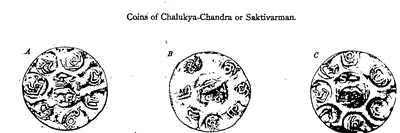
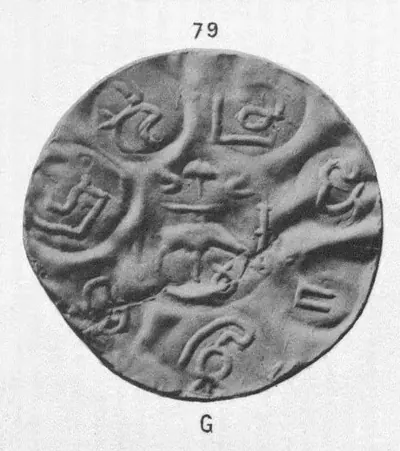
In 1890 Fleet published three gold coins bearing Saktivarman’s title.7 They are thin plates of about 65 to 66 grains, struck with separate punches.7 In the centre is a boar, the Chalukya crest, with an umbrella and two fly-whisks above it and a lamp-stand before and behind.7 Round these runs the legend sri-Chalukya-Chandrasya, “of the glorious Chalukya-Chandra”.7 Coins of the same kind with the name of his nephew Rajaraja were found with them.7
The coins had been picked up on the shore of Ramree island and on Cheduba island, off the coast of Arakan.14157 Others were said to have come from Siam.14157 Walter Elliot had taken them for very early punch-marked coins of the 5th or 6th century, and connected them with the Chalukya king Mangalesa.14157
Fleet showed from the letters of the legend that they were some four centuries later.14157 He remarked that “it is useless to build up history on numismatic bases, until the latter have been very carefully tested by and arranged in accordance with epigraphical evidence”.14157 He recorded a local tradition that the coins had been brought from India as religious offerings for an image of the Buddha.16
Footnotes
-
J. F. Fleet, “Korumelli Plates of Rajaraja II [I]”, Indian Antiquary XIV (1885), p. 50 (archive.org (opens in a new tab)). ↩ ↩2 ↩3 ↩4 ↩5 ↩6 ↩7 ↩8 ↩9
-
Fleet, “Chronology of the Eastern Chalukya Kings” (1891), p. 272 (archive.org (opens in a new tab)). ↩ ↩2 ↩3 ↩4 ↩5 ↩6 ↩7 ↩8
-
J. F. Fleet, “The Chronology of the Eastern Chalukya Kings”, Indian Antiquary XX (1891), p. 12, list of kings (archive.org (opens in a new tab)). ↩ ↩2
-
E. Hultzsch, “Pithapuram Pillar Inscription of Mallapadeva”, Epigraphia Indica IV (1897), p. 227 (archive.org (opens in a new tab)). ↩ ↩2 ↩3
-
V. Venkayya, “Ranastipundi Grant of Vimaladitya”, Epigraphia Indica VI (1900–01), p. 349 (archive.org (opens in a new tab)). ↩ ↩2 ↩3 ↩4 ↩5 ↩6 ↩7
-
Fleet, “Chronology of the Eastern Chalukya Kings” (1891), p. 273 (archive.org (opens in a new tab)). ↩ ↩2 ↩3 ↩4
-
Fleet, “Some Gold Coins of the Eastern Chalukya Kings” (1890), p. 81 (archive.org (opens in a new tab)). ↩ ↩2 ↩3 ↩4 ↩5 ↩6 ↩7 ↩8 ↩9 ↩10 ↩11 ↩12
-
J. F. Fleet, “Chellur Plates of Kulottunga-Chodadeva II”, Indian Antiquary XIV (1885), p. 55 and note (archive.org (opens in a new tab)). ↩
-
Robert Sewell and S. Krishnaswami Aiyangar, The Historical Inscriptions of Southern India (1932), p. 56 (archive.org (opens in a new tab)). ↩ ↩2
-
F. R. Hemingway, Madras District Gazetteers: Godavari (1907), p. 20 (archive.org (opens in a new tab)). ↩ ↩2
-
B. V. Krishna Rao, “Telugu Academy Plates of Saktivarman II”, Journal of the Andhra Historical Research Society V, pt. 1 (1930), p. 35 (archive.org (opens in a new tab)). ↩ ↩2
-
Krishna Rao, “Telugu Academy Plates of Saktivarman II” (1930), p. 36 (archive.org (opens in a new tab)). ↩ ↩2
-
Sewell and Aiyangar, Historical Inscriptions of Southern India (1932), p. 337 (archive.org (opens in a new tab)). ↩
-
J. F. Fleet, “Some Gold Coins of the Eastern Chalukya Kings Saktivarman and Rajaraja II”, Indian Antiquary XIX (1890), p. 79 (archive.org (opens in a new tab)). ↩ ↩2 ↩3 ↩4 ↩5
-
Fleet, “Some Gold Coins of the Eastern Chalukya Kings” (1890), p. 80 (archive.org (opens in a new tab)). ↩ ↩2 ↩3 ↩4 ↩5
-
Fleet, “Some Gold Coins of the Eastern Chalukya Kings” (1890), p. 82 (archive.org (opens in a new tab)). ↩
Photos
Related
Dynasties

References
Notes (0)
Sources (8)
Spotted an error on this page? Tell us
Last updated: