Danarnava
Eastern Chalukya king of Vengi (970–973), elder half-brother of Amma II and son of Chalukya-Bhima II. While Amma II was away in Kalinga about 956, he held the kingdom with the support of the Rashtrakuta Krishna III. His Mangallu grant, made at the request of the Kakatiya chief Gundyana, is the earliest record to name the Kakatiya family. The later records say that after his three-year reign Vengi was without a ruler for twenty-seven years, until his sons Saktivarman and Vimaladitya were restored with Chola help.
Danarnava was the last king of the Eastern Chalukya line to rule Vengi before a long break. The later grants give him a reign of three years. J. F. Fleet counted forward from the coronation of Amma II and placed it in 970–973, and Robert Sewell gives the same dates.12 He had already held the kingdom once before, while his half-brother was away about 956.34
Family
Danarnava was the elder half-brother of Amma II.1 Two grants call him Amma’s dvaimatura (half-brother) without saying which was older, and a third says clearly that he was the elder.1 Danarnava and Amma II were both sons of Chalukya-Bhima II.56 Danarnava’s mother, according to the editor of the Mangallu grant, was named Ankidevi, and Amma II’s mother was Lokambika (Lokamahadevi).6
Robert Sewell noted that it was uncertain which of the two brothers was the elder.7 He followed the family tables that make Danarnava the elder, though he thought people would naturally suppose that Amma II was.7
The Pithapuram inscription of 1202 appears to give the name of Danarnava’s queen as Aryadevi.1 The same inscription, in its editor’s reading, names Ariyadevi as the mother of Saktivarman.8 Saktivarman was the eldest son of Danarnava.9 Vimaladitya, who reigned after Saktivarman, was a younger son of Danarnava.910
Passed over in 945
When Chalukya-Bhima II died in 945 the throne went to the younger son, Amma II, who was then a boy in his twelfth year.11 V. Rangacharya explained the choice by the lower rank of Danarnava’s mother.6 He thought that Danarnava accepted the arrangement and even ran the government in his brother’s name.6
Ruler of Vengi about 956
The Mangallu grant was first noticed in 1917.1213 It says that Amma II ruled for eleven years and then went to the Kalinga country on account of the Rashtrakuta king Krishna III.1213 His half-brother Danarnava obtained the land from the Vallabha (the Rashtrakuta king) and ruled it.1213 The grant itself gives the village of Mangallu, in the Natavadi district, to a Brahman named Dommana. It was made at the request of a feudatory chief named Kakatya Gundyana.13
The grant is addressed to the householders of the district, and to the minister, chaplain, commander and the other members of the eighteen offices (tirthas) of state.13 Rangacharya placed Mangallu in the Nandigama taluk of the Krishna district.3
Who issued the grant, and in what role, is disputed:
- The 1921 epigraphy report concluded that Danarnava reigned while Amma was away in the north, and issued his grant in Amma’s name.144 In this view he held the Natavadi district in the west.144 The pretender Badapa, a son of Yuddhamalla II, held the east with Krishna III’s help.144
- Rangacharya (1960) published it as a grant of Amma II.3 He held that Danarnava was not a rival but Amma’s regent (ruler on his behalf).3 Krishna III, who may have held Amma prisoner for a time, allowed Danarnava to rule in Amma’s name.3
- P. V. Parabrahma Sastry (1978) argued that Amma II had nothing to do with the charter.1516 In his reading Krishna III had made Danarnava king of Vengi.1516 Danarnava ruled with the Rashtrakuta king’s help and not with Amma’s consent.1516 He issued the grant in his own right, under Amma’s royal name Vijayaditya, before Amma came back from Kalinga and won back the throne.1516
The Kakatiya connection
The grant says that Kakatya Gundyana, the chief at whose request it was made, belonged to the family of Samanta Voddi.13 His ancestor Gundiya-rashtrakuta had served a Chalukya king.13 Gundiya’s son was Erija-rashtrakuta, a skilled horseman, and Gundyana was Erija’s son by Vandyanamba.13
Parabrahma Sastry took this to be the earliest reference to the Kakatiya chiefs, the family that later ruled from Hanamkonda and Warangal.17 He dated it to about 956.17 (See Kakatiyas.)
King, 970–973
All the records of the dynasty agree that Amma II reigned for twenty-five years and died in 970. Danarnava then succeeded him as sole king and reigned for three years, 970–973.31 One grant gives him thirty years instead of three.1 Fleet explained this as the result of adding to his reign the twenty-seven years that followed.1
The interval after his death
How Danarnava died, and what happened after his death, is not recorded in his family’s grants. P. V. Parabrahma Sastry wrote in 1978 that Danarnava was killed by Jata-Choda Bhima, who seized the Vengi kingdom.18 Vengi, he wrote, was then thrown into disorder.18
One grant says that “for twenty-seven years a feverish desire to obtain a suitable lord consumed the earth, which was without a leader”.1 It says this lasted until Saktivarman (Chalukya-Chandra) ended it.1 Another grant says that through the spite of fate the land of Vengi was without a leader for twenty-seven years.1 A third says that the Andhra country, with Kalinga, was without a master.1
Fleet and Hultzsch both pointed out that, if the lengths of the neighbouring reigns are right, the break must have lasted about thirty years.1 Fleet suspected that the Cholas had conquered and held the country in this period.1
Hultzsch wrote in 1897, when the accession of the Chola king Rajaraja I had been fixed at 984–85.8 He concluded that Rajaraja’s conquest of Vengi, in the thirteenth or fourteenth year of his reign, fell in 997–98, within the break.8
Sewell cited a Chola record of about 998.19 It says that Rajaraja restored order in Vengi after it had been twenty-seven years without a ruler.19 Sewell took it to mean that Rajaraja helped Danarnava’s son Saktivarman to win back the throne, about 999.19 See Saktivarman I and Vimaladitya.
Footnotes
-
Fleet, “Chronology of the Eastern Chalukya Kings” (1891), p. 272 (archive.org (opens in a new tab)). ↩ ↩2 ↩3 ↩4 ↩5 ↩6 ↩7 ↩8 ↩9 ↩10 ↩11 ↩12 ↩13
-
Robert Sewell and S. Krishnaswami Aiyangar, The Historical Inscriptions of Southern India (1932), p. 51 (archive.org (opens in a new tab)). ↩
-
Rangacharya, “Mangallu Grant of Amma II” (1960), p. 40 (archive.org (opens in a new tab)). ↩ ↩2 ↩3 ↩4 ↩5 ↩6
-
Annual Report on Epigraphy, Madras, for 1920–21 (1921), Part II, para. 14, p. 91 (archive.org (opens in a new tab)). ↩ ↩2 ↩3 ↩4
-
Fleet, “Chronology of the Eastern Chalukya Kings” (1891), p. 270 and note 12 (archive.org (opens in a new tab)). ↩
-
Rangacharya, “Mangallu Grant of Amma II” (1960), p. 39 (archive.org (opens in a new tab)). ↩ ↩2 ↩3 ↩4
-
Sewell and Aiyangar, Historical Inscriptions of Southern India (1932), p. 337, note on Nos. 23 and 24 (archive.org (opens in a new tab)). ↩ ↩2
-
E. Hultzsch, “Pithapuram Pillar Inscription of Mallapadeva”, Epigraphia Indica IV (1897), p. 227 (archive.org (opens in a new tab)). ↩ ↩2 ↩3
-
Fleet, “Chronology of the Eastern Chalukya Kings” (1891), p. 273 (archive.org (opens in a new tab)). ↩ ↩2
-
E. Hultzsch, South-Indian Inscriptions, Vol. I (1890), No. 39, p. 51 (archive.org (opens in a new tab)). ↩
-
Fleet, “Chronology of the Eastern Chalukya Kings” (1891), p. 271 (archive.org (opens in a new tab)). ↩
-
V. Rangacharya, “Mangallu Grant of Amma II”, Epigraphia Indica XXXI (1955–56, publ. 1960), p. 37 (archive.org (opens in a new tab)). ↩ ↩2 ↩3
-
Rangacharya, “Mangallu Grant of Amma II” (1960), p. 38 (archive.org (opens in a new tab)). ↩ ↩2 ↩3 ↩4 ↩5 ↩6 ↩7 ↩8
-
Annual Report on Epigraphy, Madras, for 1920–21 (1921), Part II, paras. 13–14, p. 90 (archive.org (opens in a new tab)). ↩ ↩2 ↩3
-
Parabrahma Sastry, The Kakatiyas of Warangal (1978), p. 15. ↩ ↩2 ↩3 ↩4
-
Parabrahma Sastry, The Kakatiyas of Warangal (1978), p. 16. ↩ ↩2 ↩3 ↩4
-
P. V. Parabrahma Sastry, The Kakatiyas of Warangal (1978), p. 14. ↩ ↩2
-
Parabrahma Sastry, The Kakatiyas of Warangal (1978), p. 41. ↩ ↩2
-
Sewell and Aiyangar, Historical Inscriptions of Southern India (1932), p. 56 (archive.org (opens in a new tab)). ↩ ↩2 ↩3
Photos
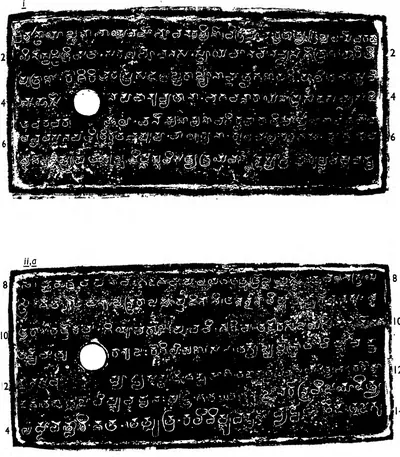 "Mangallu Grant of Amma II", plates i and ii a (Epigraphia Indica XXXI, Plate I (PDF p. 76))Inscription rubbing · 1960
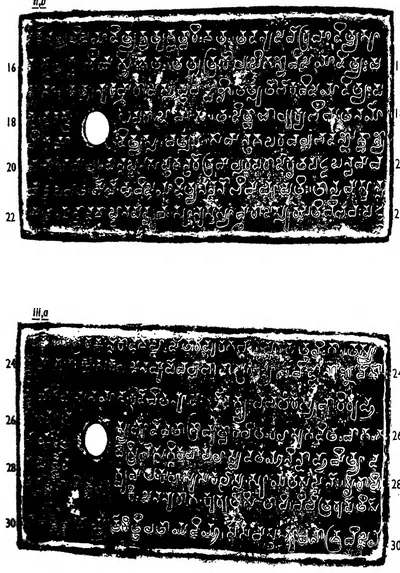 "Mangallu Grant of Amma II", plates ii b and iii a (Epigraphia Indica XXXI, Plate I (PDF p. 77))Inscription rubbing · 1960
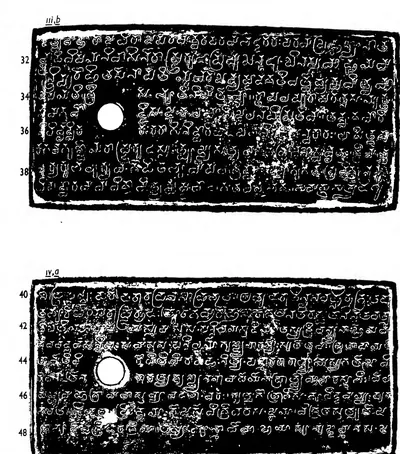 "Mangallu Grant of Amma II", plates iii b and iv a (Epigraphia Indica XXXI, Plate II (PDF p. 80))Inscription rubbing · 1960
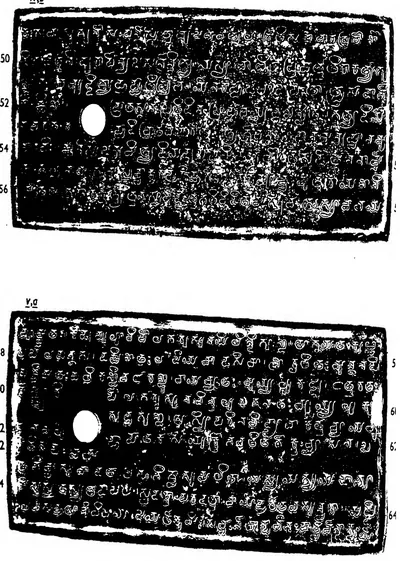 "Mangallu Grant of Amma II", plates iv b and v a (Epigraphia Indica XXXI, Plate II (PDF p. 81))Inscription rubbing · 1960
Related
Dynasties

References
Notes (0)
Sources (7)
Spotted an error on this page? Tell us
Last updated: