Vengi (Pedavegi)
Village a few miles north of Eluru (Ellore). It stands on the site generally taken to be Vengipura, the capital of the Salankayana kings and then of the early Eastern Chalukyas. Nineteenth-century surveys found ruined temples and mounds spread over Pedavegi, Chinavegi and Denduluru. The city gave its name to the whole country between the Krishna and the Godavari.
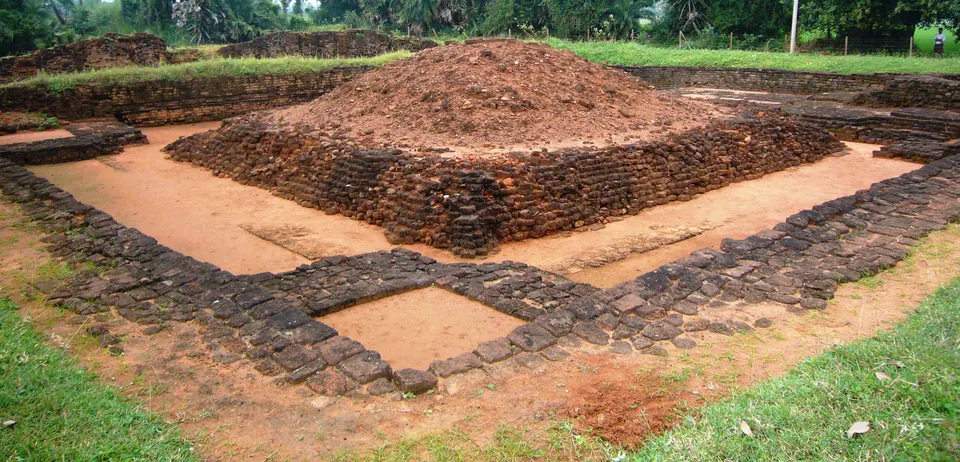
Pedavegi is a village north of Eluru (Ellore). It is generally taken to be the site of Vengipura, the “victorious Vengipura” from which the Salankayana kings issued their grants.12
The sources put it six to eight miles from the town:314
- six miles in Robert Sewell’s list of 18823
- seven in E. Hultzsch’s account of 19081
- eight in the Imperial Gazetteer of 19084
Finding Vengipura
Vengipura first came to notice through the Kolleru plates, which were issued there. Walter Elliot recalled that those plates were found in the Kolleru lake.5 This led to an inquiry in that part of the country, which found a group of villages near Eluru.5 These villages were then identified as Vengipura.5
A. C. Burnell was less certain, and Fleet quoted his account in 1876.67 Burnell wrote that the capital “appears to have entirely vanished”.67 He added that it was said to be “the place now called Pedda Vengi or Vegi”, but that “there are several places of the same name in the neighbourhood”.67
Sewell noted in 1882 that it was “not yet certain that Pedda Vegi is the site of the oldest city”.3 His reason was that “there is another village close by called Chinna Vegi”.3
K. V. Lakshmana Rao accepted “this traditional identity”.8 But he warned that there were four places of the name in the Northern Circars:8
- Chinna Vegi and Pedda Vegi near Eluru8
- another at Chintapalli in Guntur district8
- a deserted site called Vegipadu north-west of Rajahmundry8
Later evidence supported the identification. Hultzsch visited Pedda-Vegi in 1902.1 There the villagers showed him a small mound as the site of the ancient temple of Chitrarathasvamin, the family god of the Salankayanas.1 He took this as confirmation.1
Hultzsch also pointed out that the Kolleru lake was close by.1 He noted too that Devavarman’s grant was addressed to the villagers of Elura, seven miles away.1 G. Jouveau-Dubreuil accepted the identity of Vengipura with Pedda-Vegi for the same reasons.9
R. Subba Rao wrote in 1926 that the ruined shrine pointed out as Chitrarathasvamin’s temple stood in Chinavegi.2 He took Chinavegi to be part of the ancient city.2 The Peddavegi plates of Nandivarman II were themselves found near Pedavegi.10
The ruins
Sewell’s list describes “evidences of extensive ancient buildings here”.3 It also notes “many curious mounds which Sir Walter Elliot thinks probably cover the remains of the old city”.3 Elliot traced them as far as Chinna Vegi and Dendaluru, five miles to the south-east.311 Sewell recorded that the Muslims were said to have built the fort at Eluru with stones from the ruined temples of Vegi and Dendaluru.3
The Imperial Gazetteer describes the country as “strewn with the remains of ancient temples and buildings and with mounds which probably cover other ruins”.4
Subba Rao listed mounds, large tanks, ruined temples, ramparts, great stones and images of bulls and gods.12 He thought that Pedavegi, Chinavegi and Denduluru, with its hamlets, might all have formed part of the ancient city.12 K. R. Subramanian mentioned the ruins of a temple to the sun at Pedavegi.13
The capital of Vengi
The Salankayana grants were issued from Vengipura, Vijaya-Vengipura or Vijaya-Vengi.14 D. C. Sircar thought the Salankayanas had held the district even in Ptolemy’s time. Ptolemy gives Benagouron as the chief city of a people called the Salakenoi.1516 Sircar read Benagouron as a mistake for Bengaouron, that is, Vengipura.1516
K. R. Subramanian thought that neither the location of the Salakenoi nor their link with the Salankayanas could yet be determined.17 Sircar also noted that the Eastern Chalukya inscriptions call the country Vengi-mandala, Vengi-rashtra and Vengi-mahi.18 He thought it was probably already called the Vengi kingdom in Salankayana times.18
The Vishnukundins followed the Salankayanas and ruled from Lendulura.19 Subba Rao identified Lendulura with Denduluru near Vengipura.19 Sewell’s chronology also places their founder at Dendaluru, close to Vengi.20
Vishnuvardhana, brother of the Chalukya king Pulakesin II, made himself an independent king in the early 7th century.21 According to the Godavari gazetteer, the capital of his kingdom of Vengi was at Pedda Vegi near Eluru.21
Burnell suggested that “Ping-ki-lo”, the capital named by the Chinese pilgrim Xuanzang, was Vengi.67 In his view, the Telugu locative ending -lo (an ending that means in) had been mistaken for part of the name.67 The Telugu Mahabharata, which Burnell dated to the twelfth century, calls Rajahmundry the chief city of Vengidesa.67 From this Burnell concluded that the old capital “must have been deserted long before that time”.67 See Eastern Chalukyas and The Vengi period.
Where the sources disagree
- The date of the Telugu Mahabharata. Burnell placed the Telugu Mahabharata in the twelfth century.67 The Andhra Historical Research Society said that its author, Nannaya Bhatta, lived at the court of the Eastern Chalukya king Rajaraja Narendra.22 The Kistna district manual says that Nannaya “flourished at Rajahmundry in the eleventh century”.23
Footnotes
-
E. Hultzsch, “Plates of Vijaya-Devavarman”, Epigraphia Indica IX (1907–08), p. 58 (archive.org (opens in a new tab)). ↩ ↩2 ↩3 ↩4 ↩5 ↩6 ↩7 ↩8
-
Subba Rao, “Pedavegi Copper-plates” (1926), p. 97 (archive.org (opens in a new tab)). ↩ ↩2 ↩3
-
Sewell, Lists of the Antiquarian Remains, Vol. I (1882), p. 36, s.v. Vegi or Pedda Vegi (archive.org (opens in a new tab)). ↩ ↩2 ↩3 ↩4 ↩5 ↩6 ↩7 ↩8
-
Imperial Gazetteer of India: Madras, Vol. I (1908), p. 193 (archive.org (opens in a new tab)). ↩ ↩2 ↩3
-
Walter Elliot, Coins of Southern India (1886), p. 39 (archive.org (opens in a new tab)). ↩ ↩2 ↩3
-
A. C. Burnell, Elements of South-Indian Palaeography (2nd ed., 1878), p. 16, note 1 (archive.org (opens in a new tab)). ↩ ↩2 ↩3 ↩4 ↩5 ↩6 ↩7 ↩8
-
J. F. Fleet, “Sanskrit and Old-Canarese Inscriptions, No. XVIII”, Indian Antiquary V (1876), p. 176, quoting Burnell (archive.org (opens in a new tab)). ↩ ↩2 ↩3 ↩4 ↩5 ↩6 ↩7 ↩8
-
K. V. Lakshmana Rao, “Two Copper-plate Grants of the Salankayanas of Vengi”, Journal of the Andhra Historical Research Society V, pt. 1 (1930), p. 25 (archive.org (opens in a new tab)). ↩ ↩2 ↩3 ↩4 ↩5
-
G. Jouveau-Dubreuil, Ancient History of the Deccan (1920), p. 89 (archive.org (opens in a new tab)). ↩
-
R. Subba Rao, “Pedavegi Copper-plates of Nandivarman II”, Journal of the Andhra Historical Research Society I, pt. 2 (1926), p. 92 (archive.org (opens in a new tab)). ↩
-
Robert Sewell, Lists of the Antiquarian Remains in the Presidency of Madras, Vol. I (1882), p. 35, s.v. Dendaluru (archive.org (opens in a new tab)). ↩
-
Subba Rao, “Pedavegi Copper-plates” (1926), p. 100 (archive.org (opens in a new tab)). ↩ ↩2
-
Subramanian, Buddhist Remains in Andhra (1932), p. 92 (archive.org (opens in a new tab)). ↩
-
D. C. Sircar, The Successors of the Satavahanas in Lower Deccan (1939), p. 64 (archive.org (opens in a new tab)). ↩
-
Sircar, Successors of the Satavahanas (1939), p. 71 (archive.org (opens in a new tab)). ↩ ↩2
-
Sircar, Successors of the Satavahanas (1939), p. 72 (archive.org (opens in a new tab)). ↩ ↩2
-
K. R. Subramanian, Buddhist Remains in Andhra and the History of Andhra between 225 and 610 A.D. (1932), p. 89 (archive.org (opens in a new tab)). ↩
-
Sircar, Successors of the Satavahanas (1939), p. 77 (archive.org (opens in a new tab)). ↩ ↩2
-
Subba Rao, “Pedavegi Copper-plates” (1926), p. 99 (archive.org (opens in a new tab)). ↩ ↩2
-
Robert Sewell and S. Krishnaswami Aiyangar, The Historical Inscriptions of Southern India (1932), p. 20 (archive.org (opens in a new tab)). ↩
-
F. R. Hemingway, Madras District Gazetteers: Godavari (1907), p. 19 (archive.org (opens in a new tab)). ↩ ↩2
-
Journal of the Andhra Historical Research Society, Vol. I, pt. 2 (1926), “Brief history of the Society”, p. 4 (archive.org (opens in a new tab)). ↩
-
Gordon Mackenzie, A Manual of the Kistna District (1883), p. 12 (archive.org (opens in a new tab)). ↩
Photos
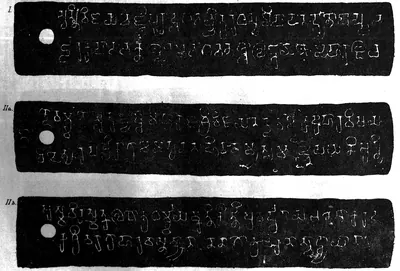 "Copper-plate grant of the kings of the Vengi country": Kollair (Kolleru) grant of the Salankayana Maharaja Vijaya-Nandivarman, plates I, IIa and IIb (Indian Antiquary V, 1876, plate at p. 176 (PDF p. 214))Inscription rubbing · 1876
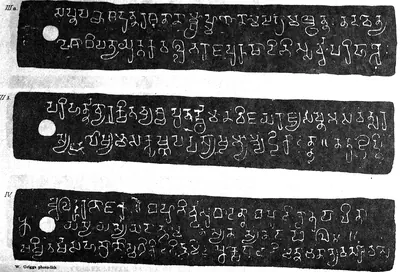 "Copper-plate grant of the kings of the Vengi country": Kollair (Kolleru) grant of the Salankayana Maharaja Vijaya-Nandivarman, plates IIIa, IIIb and IV (Indian Antiquary V, 1876, plate at p. 177 (PDF p. 215))Inscription rubbing · 1876
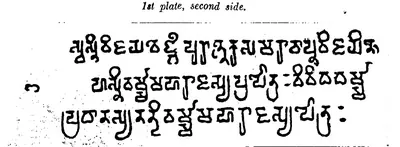 "Pedavegi Copper-plates of Nandivarman II": "1st plate, second side" (eye-copy) (Journal of the Andhra Historical Research Society I, pt. 2, Oct. 1926, p. 101 (PDF p. 122))Drawing · 1926
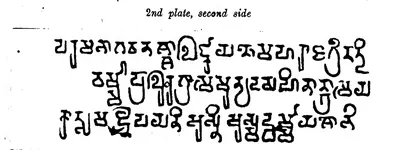 "Pedavegi Copper-plates of Nandivarman II": "2nd plate, second side" (eye-copy) (Journal of the Andhra Historical Research Society I, pt. 2, Oct. 1926, p. 102 (PDF p. 123))Drawing · 1926
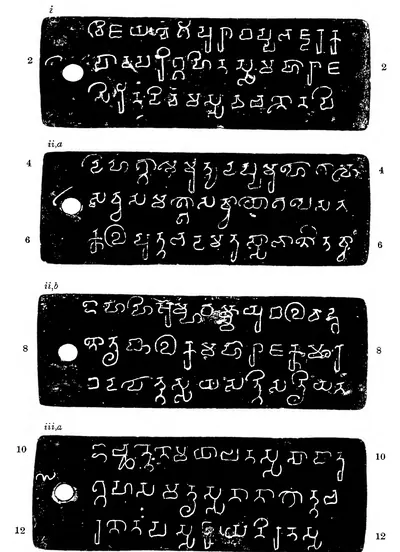 "Two Salankayana Charters from Kanukollu-Plate I. A.-Plates of Nandivarman (I), Year 14": plates i to iii a (Epigraphia Indica XXXI, Plate I, left half, between pp. 4 and 5 (PDF p. 24))Inscription rubbing · 1960
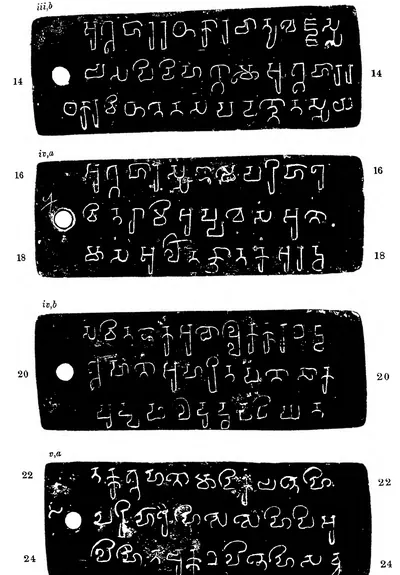 "Two Salankayana Charters from Kanukollu-Plate I. A.-Plates of Nandivarman (I), Year 14": plates iii b to v a (Epigraphia Indica XXXI, Plate I, right half, between pp. 4 and 5 (PDF p. 25))Inscription rubbing · 1960
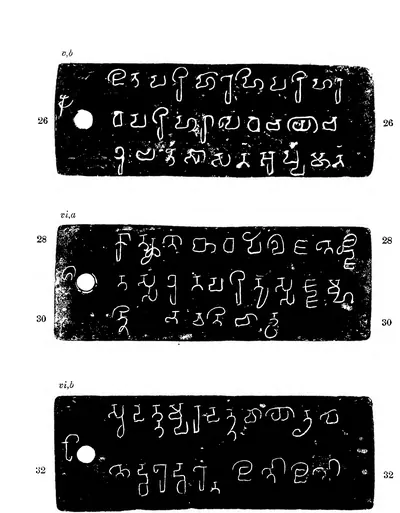 "Two Salankayana Charters from Kanukollu-Plate II. A.-Plates of Nandivarman (I), Year 14": plates v b to vi b (Epigraphia Indica XXXI, Plate II, left half, between pp. 6 and 7 (PDF p. 28))Inscription rubbing · 1960
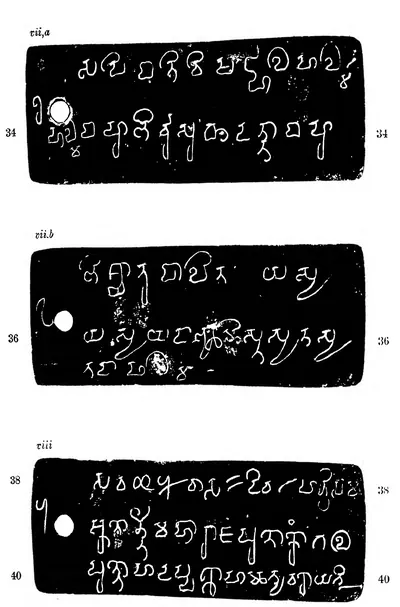 "Two Salankayana Charters from Kanukollu-Plate II. A.-Plates of Nandivarman (I), Year 14": plates vii a to viii (Epigraphia Indica XXXI, Plate II, right half, between pp. 6 and 7 (PDF p. 29))Inscription rubbing · 1960
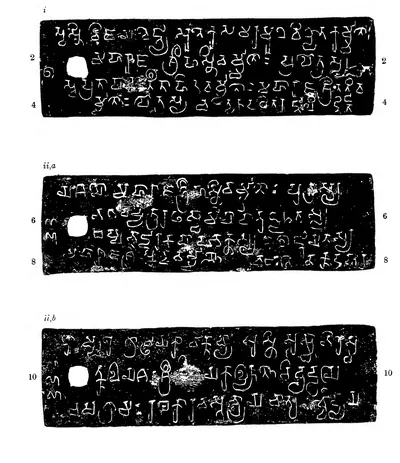 "Two Salankayana Charters from Kanukollu-Plate III. B.-Plates of Skandavarman, Year 1": plates i to ii b (Epigraphia Indica XXXI, Plate III, left half, between pp. 8 and 9 (PDF p. 32))Inscription rubbing · 1960
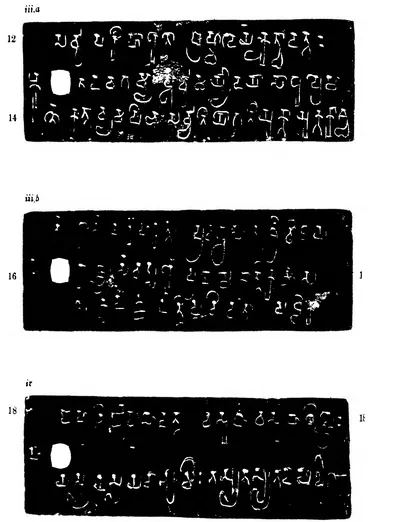 "Two Salankayana Charters from Kanukollu-Plate III. B.-Plates of Skandavarman, Year 1": plates iii a to iv (Epigraphia Indica XXXI, Plate III, right half, between pp. 8 and 9 (PDF p. 33))Inscription rubbing · 1960
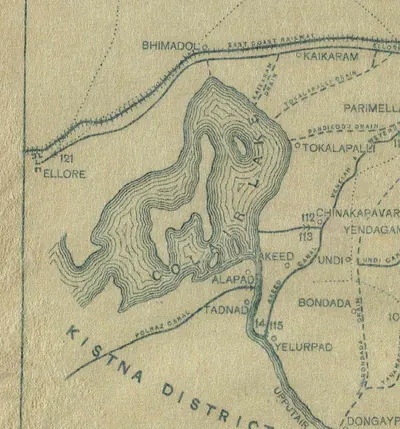 Ellore and Colair (Kolleru) Lake, detail of the "Sketch Map of the Godavari Delta showing positions of the principal irrigation & navigation works" (Walch 1896, folding map, PDF p. 17)Map · 1896
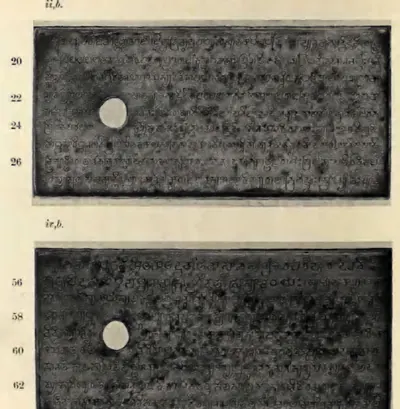
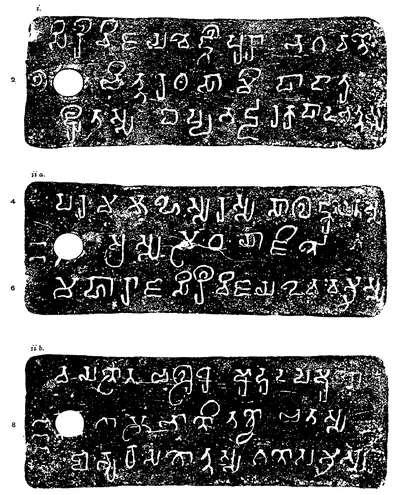 Ellore Prakrit grant: "Plates of Vijaya-Devavarman", plates i, ii a and ii b (Epigraphia Indica IX, plate between pp. 58 and 59 (PDF p. 83))Inscription rubbing · 1908
Show all (15)
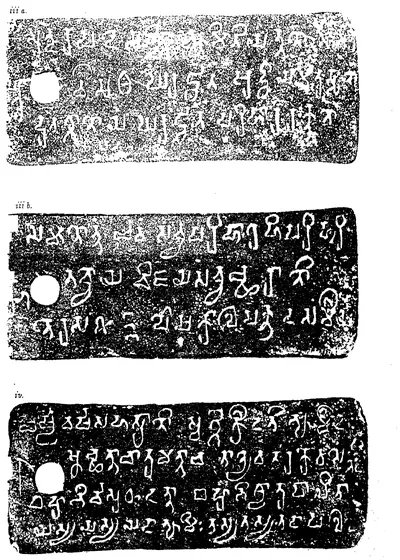 Ellore Prakrit grant: "Plates of Vijaya-Devavarman", plates iii a, iii b and iv (Epigraphia Indica IX, plate between pp. 58 and 59 (PDF p. 84))Inscription rubbing · 1908
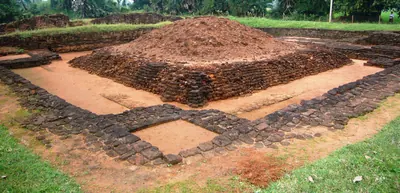 Excavated brick remains at Pedavegi (ancient Vengi), West Godavari district (photograph, 2007)Photograph · 2007
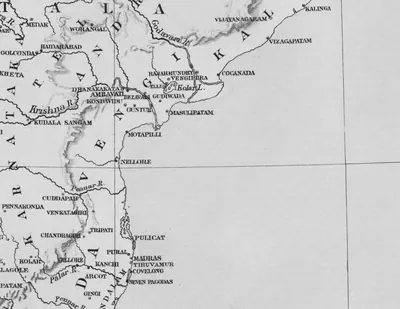 Vengi, the Krishna and the coast south to Kanchi and Tondamandalam: detail of "A Map of Southern India shewing the territories of the ancient dynasties according to the best authorities" (Elliot 1886, folding map, PDF p. 185)Map · 1886
Related
Dynasties
Salankayanas of Vengi
c. 300–470 CE
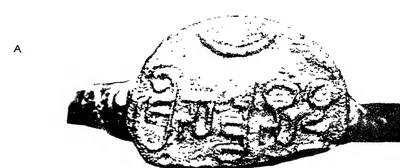
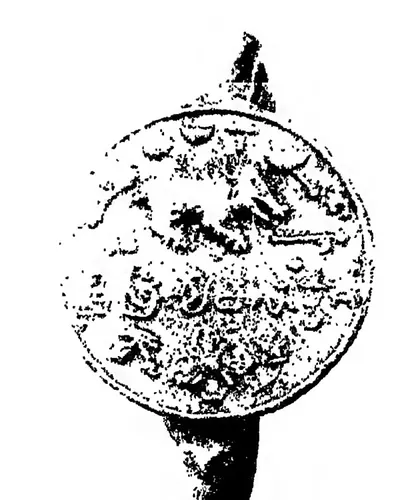
Dynasty of the country between the Krishna and the Godavari in the 4th and 5th centuries CE, ruling from Vengipura, the modern Pedavegi near Eluru. Seven copper-plate grants name seven kings in two lines descended from Hastivarman. Most scholars identify him with the 'Hastivarman of Vengi' of Samudragupta's Allahabad inscription. Their earlier grants are in Prakrit and their later ones in Sanskrit. Their seals bear a bull, and their family god was Chitrarathasvamin.
Vishnukundins
c. 500–630 CE
Dynasty of the Krishna–Godavari country that ruled after the Salankayanas and before the Eastern Chalukyas. It is known from a handful of Sanskrit copper-plate grants and one stone inscription. Its kings worshipped the lord of Sriparvata, claimed eleven horse sacrifices for their greatest ruler, Madhavavarman, and married into the Vakataka royal family. Their capital in the later grants was Lendulura (Denduluru near Vengi). Scholars have dated them anywhere from the 4th to the 8th century. Most later reconstructions put the main line in the 6th century and end it with the Chalukya conquest of the early 7th, though D. C. Sircar continued it to about 670.

Eastern Chalukyas of Vengi
c. 615–1077 CE
A branch of the Chalukyas of Badami that ruled Vengi, the coastal country between the lower Godavari and Krishna, from the early 7th century. Its founder, Kubja Vishnuvardhana, was a younger brother of Pulakesin II. The kings fought the Rashtrakutas for two centuries. After about 1000 they were bound to the Cholas by marriage, and in 1070 their heir became the Chola emperor Kulottunga I. Their copper-plate grants record the length of every reign. The first Telugu literary work, Nannaya's Mahabharata, was written at their court in Rajahmundry.
People
Devavarman (Salankayana)
c. 320–345 CE
Salankayana king of Vengi. He is known from a Prakrit grant of his 13th year addressed to the villagers of Ellore, in which he calls himself a performer of the horse sacrifice and a devotee of Shiva. His place in the family is unknown. Scholars have made him a son of Hastivarman, an earlier king (perhaps Hastivarman's father), and a successor of Nandivarman I.
Hastivarman (Salankayana)
c. 345–370 CE
Salankayana king of Vengi, the earliest king in the family list of his family's copper-plate grants, which praise him for victories in many battles. Since 1926 most scholars have identified him with the Hastivarman of Vengi whom the Gupta emperor Samudragupta claims to have captured and released in the mid-4th century. Older works took that king for a Pallava viceroy.
Nandivarman I (Salankayana)
c. 370–395 CE
Salankayana king of Vengi, son of Hastivarman and father of Chandavarman and Hastivarman II. A Prakrit grant of his 14th year, found at Kanukollu and published in 1960, is the only record of his own. Its editor dated it to the close of the 3rd century, but D. C. Sircar placed it about the middle of the 4th.
Chandavarman (Salankayana)
c. 395–420 CE
Salankayana king of Vengi, son of Nandivarman I and father of Nandivarman II. He is known only from his son's grants, which say that subordinate rulers bowed to his power. He has often been confused with Chandavarman, a 5th-century king of Kalinga who issued the Komarti plates.
Nandivarman II (Salankayana)
c. 420–445 CE
Salankayana king of Vengi, eldest son of Chandavarman, and the best-documented king of the dynasty. The Kolleru plates of his 7th year, the Peddavegi plates of his 10th and probably one of the Kanteru grants are his. He called himself a parama-bhagavata (devout worshipper of the Lord) and gave land to a temple of Vishnu. Most scholars date him to the first half or middle of the 5th century.
Kubja Vishnuvardhana
c. 615–633 CE
Younger brother of the Chalukya king Pulakesin II of Badami and founder of the Eastern Chalukya dynasty of Vengi. He served his brother as heir-apparent and governed the newly conquered east coast. He became an independent king there by 632 at the latest. His reign is usually dated 615–633, but scholars have put the start of his rule in Vengi anywhere from about 605 to after 631.
Jayasimha I
c. 633–663 CE
Second Eastern Chalukya king of Vengi (about 633–663), the eldest son of Kubja Vishnuvardhana. Four copper-plate grants of his are known, issued from Udayapura and Asanapura and granting villages in the Krishna–Godavari country to Brahmins. Most later records give him a reign of 33 years, one gives 30, and the scholars who fixed the chronology disagreed over which to follow.
Vikramendravarman II (Vishnukundin)
c. 655–670 CE
Vishnukundin king, eldest son of Indravarman, who issued the Chikkulla plates from Lendulura (Denduluru near Vengi) in his 10th year, giving a village on the Krishna to a Shiva temple. The plates say he took up the government as a child. Some scholars identify him with the Vikramahendra of the Polamuru plates, the grandfather of the last known Vishnukundin king; D. C. Sircar did not. Sircar dated him about 655–670, and the scheme printed by Sewell in 1932 about 496–521.
Govinda III (Rashtrakuta)
c. 793–814 CE
Rashtrakuta king (about 793–814), son of Dhruva, under whom the dynasty's power reached from the Vindhyas to the Tungabhadra. His Radhanpur plates of 808 say that the lord of Vengi, the Eastern Chalukya Vijayaditya II, came at his command and built an enclosure for him like a servant. An undated inscription at Kuruvagattu in the Mahbubnagar district names him as the friend of a Chalukya prince. A shrine of the Sun at Alampur was built for the prosperity of a king Prabhutavarsha who may be Govinda III.
Vijayaditya II Narendra-mrigaraja
c. 799–843 CE
Eastern Chalukya king of Vengi (799–843 in Fleet's chronology), the first of the dynasty to use the full imperial titles. His family's records say he fought 108 battles against the Gangas and the Rashtrakutas over twelve years and founded 108 temples of Shiva. Rashtrakuta records say that Govinda III made the king of Vengi build the walls of his city. The later grants give his reign as 40, 41, 44 or 48 years.
Amoghavarsha I
c. 814–878 CE
Rashtrakuta king (814–about 878), son of Govinda III, who reigned for more than sixty years and made Manyakheta (Malkhed) the capital of the dynasty. His records claim the homage of the king of Vengi and a victory over the Eastern Chalukyas at Vingavalli. Kannada inscriptions of his reign have been found in the Medak and Warangal districts of Telangana.
Gunaga Vijayaditya III
c. 844–888 CE
Eastern Chalukya king of Vengi (c. 844–888). His records claim victories over the Gangas, the Nolamba king Mangi, a chief Sankila of Dahala and the Rashtrakuta Krishna, and the burning of Kiranapura and Chakrakuta. Historians have seen him both as the man who sacked the Rashtrakuta capital and as a Rashtrakuta vassal. His general Pandaranga is praised in one of the earliest Telugu verse inscriptions.
Krishna II (Rashtrakuta)
c. 878–914 CE
Rashtrakuta king (about 878–914), son of Amoghavarsha I. The Eastern Chalukya Gunaga Vijayaditya III claimed to have frightened him and burnt his city, and a Rashtrakuta grant admits that his enemies once abandoned his capital. Later Eastern Chalukya records in turn admit that his army overran Vengi until Chalukya-Bhima I won it back. A Kannada record of 907 in his reign has been found at Velmajala in Telangana.
Chalukya-Bhima I
c. 888–918 CE
Eastern Chalukya king of Vengi (888–918 in Fleet's and Sewell's reckoning), nephew and successor of Gunaga Vijayaditya III. His records say he won back the Vengi country after the Rashtrakuta king Krishna II had overrun it. A young son of his fell in battle against the Rashtrakuta army. He built the Siva temple of Chalukya-Bhimesvara, which gave its name to Bhimavaram near Kakinada (then Cocanada).
Amma I
c. 918–925 CE
Eastern Chalukya king of Vengi (918–925), grandson of Chalukya-Bhima I. He came to the throne against a conspiracy of his own relatives allied with the Rashtrakutas. His surname Raja-Mahendra led J. F. Fleet to suggest that Rajahmundry (Rajamahendrapuram) was named after him. His death in 925 opened nine years of civil war among the branches of the dynasty. His son Beta-Vijayaditya V, deposed as a child, founded the line of the Chalukya princes of Pithapuram.
Yuddhamalla II
c. 927–934 CE
Eastern Chalukya king of Vengi (about 927–934) of the junior line descended from Yuddhamalla I. He seized the throne during the civil war that followed the death of Amma I in 925, and held it for seven years until Chalukya-Bhima II drove him out. A Telugu verse inscription on a pillar at Vijayawada (then Bezwada), recording a temple of Kumarasvamin and a monastery for Saiva ascetics, is attributed to him or to his grandfather. His sons Badapa and Tala II later tried to win back the throne with Rashtrakuta help.
Chalukya-Bhima II
c. 934–945 CE
Eastern Chalukya king of Vengi (about 934–945), called Rajabhima, a son of Vijayaditya IV. He ended the civil war that followed the death of his half-brother Amma I by driving out Yuddhamalla II. His grants list a long series of enemies he overcame, among them an army of the Rashtrakuta Govinda IV and Nolamba and Ganga princes of the Mysore country. He was the father of the kings Amma II and Danarnava.
Krishna III (Rashtrakuta)
c. 939–966 CE
Rashtrakuta king (about 939–966), the most powerful of the line, who took Kanchi and Tanjore from the Cholas. In the Telugu country he held most of the Cuddapah country through the Vaidumba chiefs, and the Nolamba chiefs of Anantapur served under him. The Eastern Chalukya pretender Badapa sought his help to drive Amma II out of Vengi. Inscriptions of his reign or of his feudatories have been found at Chennur, Mallikarjunapalli, Minambaram and Inavolu in Telangana.
Amma II
945–970 CE
Eastern Chalukya king of Vengi (945–970), son of Chalukya-Bhima II and Lokamahadevi. He was crowned as a boy on 5 December 945, the first firmly dated event in the dynasty's history. About 956 the Rashtrakuta Krishna III, backing the claims of Yuddhamalla II's son Badapa, invaded Vengi and Amma went to Kalinga. Whether he fled or fought, and whether his half-brother Danarnava then ruled in his name or in his own, is disputed. His many grants include gifts to Jain temples and to a Kalamukha Saiva community at Bezwada.
Danarnava
970–973 CE
Eastern Chalukya king of Vengi (970–973), elder half-brother of Amma II and son of Chalukya-Bhima II. While Amma II was away in Kalinga about 956, he held the kingdom with the support of the Rashtrakuta Krishna III. His Mangallu grant, made at the request of the Kakatiya chief Gundyana, is the earliest record to name the Kakatiya family. The later records say that after his three-year reign Vengi was without a ruler for twenty-seven years, until his sons Saktivarman and Vimaladitya were restored with Chola help.
Rajaraja I (Chola)
c. 985–1014 CE
Chola king of Tanjore (Thanjavur) from 985, the founder of the Chola empire, whose inscriptions claim the conquest of Vengai-nadu, the Eastern Chalukya country of Vengi. About 999 he helped the Eastern Chalukya prince Saktivarman I back to the throne of Vengi, and he married his daughter Kundavadevi to Saktivarman's brother Vimaladitya. This began the alliance that made the Eastern Chalukyas Chola vassals and, two generations later, Chola emperors. Inscriptions of his reign are found at Kalahasti, and a Vaidumba chief ruled under him in the Nellore country.
Saktivarman I
c. 999–1011 CE
Eastern Chalukya king of Vengi (about 999–1011), the eldest son of Danarnava. He took the throne after the 27 years in which, as the later grants put it, Vengi had no ruler. The Chola king Rajaraja I is said to have restored order in Vengi at this time, and historians have read Saktivarman's accession as a Chola restoration. Gold coins with his title Chalukya-Chandra have been found in Arakan.
Vimaladitya
1011–1022 CE
Eastern Chalukya king of Vengi (1011–1022), the younger brother of Saktivarman I. He was crowned on 10 May 1011. The Chola prince Rajendra defeated him, and he appears to have spent some years at the Chola court. There he married Kundavadevi, daughter of the Chola king Rajaraja I. Their son Rajaraja Narendra succeeded him.
Rajaraja Narendra
1022–1063 CE
Eastern Chalukya king of Vengi (crowned 1022, died about 1061–63), the son of a Chola princess and husband of another, who ruled from Rajahmundry. His reign was disturbed by Chola and Western Chalukya intervention and by a rising of his half-brother Vijayaditya VII. Telugu tradition remembers him as the patron of Nannaya, whose Mahabharata is the oldest surviving Telugu literary work.
Kulottunga I
c. 1063–1118 CE
Eastern Chalukya prince of Vengi, son of Rajaraja Narendra and the Chola princess Ammangadevi. As Rajendra (Rajendra-Choda, Rajendra II) he was heir to Vengi in 1063. In 1070 he seized the Chola throne, and he reigned as Kulottunga Chola I until about 1118. He united the Eastern Chalukya and Chola crowns, and governed Vengi first through his uncle Vijayaditya VII and then through his own sons as viceroys.
Vijayaditya VII
c. 1063–1076 CE
Eastern Chalukya prince, a son of Vimaladitya and half-brother of Rajaraja Narendra. He governed Vengi from about 1063 until his death about 1076–77, at first in rivalry with his nephew Rajendra (Kulottunga I) and later as his viceroy. Grants found in the 20th century show that he had also seized Vengi from Rajaraja about 1030–35, and set up his own son Saktivarman II there in 1061.
Virarajendra (Chola)
c. 1063–1070 CE
Chola king from 1062–63 to 1070, probably a younger son of Rajendra I, whose inscriptions give the fullest Chola account of the struggle with the Western Chalukyas of Kalyani for Vengi. He defeated armies sent into Vengi, and in his fifth year his army beat the enemy at Bezwada on the Krishna, marched to the Godavari and through Kalinga, and gave Vengi to a Vijayaditya, whom Hultzsch identified with the Eastern Chalukya Vijayaditya VII. A record of his seventh year, Saka 991, is in the Chittoor district.
Vikramaditya VI
c. 1076–1126 CE
Western Chalukya king of Kalyani, called Tribhuvanamalla. He deposed his brother Somesvara II in 1076 and reigned for fifty years, to 1126. He replaced the Saka era with his own Chalukya-Vikrama era, in which most Telangana records of the time are dated. As a prince he fought the Cholas and their Eastern Chalukya allies for Vengi. Late in his reign, after the Chola viceroy left in 1118, he was recognised as king in Vengi and the coastal Telugu country. His feudatories in Telangana included the Kakatiyas Beta II and Prola II and the Choda chiefs of Kandur.
Vira-Choda
c. 1078–1093 CE
Son of Kulottunga I and viceroy of Vengi, installed on 23 August 1078. He was recalled in 1084 in favour of his eldest brother Chodaganga, and sent back about 1088–89. His Chellur and Pithapuram copper plates carry the full Eastern Chalukya family line, and the account of how Kulottunga handed Vengi to his uncle and his sons.
Vikrama-Chola
c. 1118–1135 CE
Son of the Chola emperor Kulottunga I who governed Vengi for his father from about 1092–93 and left it in 1118 to be crowned Chola king. In his absence the Western Chalukya Vikramaditya VI took the Vengi province, holding Draksharama from 1120–21 to 1123–24; Vikrama-Chola won it back, and his records are found at Chebrolu and Nidubrolu in 1127 and 1135. An inscription of his ninth year records the building of the temple at Gudimallam, and his records are at Nandalur and Tripurantakam.
Skandavarman (Salankayana)
Salankayana king of Vengi, known from two Sanskrit grants of his first regnal year, from Kanteru and Kanukollu. The Kanukollu plates, published in 1960, make him a son of Hastivarman II and a great-grandson of Hastivarman I, a cousin of Nandivarman II; before they were found he was usually placed after Nandivarman II as the last known king of the line.
Inscriptions
Peddavegi plates of Nandivarman II
c. 430 CE
A Sanskrit copper-plate grant of the 10th year of the Salankayana king Nandivarman II, found near Pedavegi north of Ellore and first published in 1924. It gives land in four villages to a temple of Vishnu. Its four-generation family line, beginning with Hastivarman of Vengi, is the backbone of the dynasty's history.
Pedda-Vegi plates of Jayasimha I
c. 632–663 CE
An undated Sanskrit copper-plate grant of the second Eastern Chalukya king, Jayasimha I Sarvasiddhi. It was found two or three feet underground near Pedda-Vegi, the old capital of Vengi. It gives the village of Kombaru, identified with Komali in Repalle taluk, to a Brahmin from Kukkanur. It is the only grant of the dynasty that opens with a prayer to the sun, and it calls the founder Vishnuvarman. It was registered in 1917–18 and edited by V. Rangacharya in 1928.
References
Notes (0)
Sources (15)
Spotted an error on this page? Tell us
Last updated: