Sri Satakarni
Third Satavahana king and husband of Queen Nayanika of the Nanaghat inscriptions. He was probably the Satakarni whom Kharavela of Kalinga defied in the Hathigumpha inscription. Nothing of his is known from the Telugu country, but Kharavela's campaign is said to have reached the Krishna.
Sri Satakarni was the third king of the Satavahana dynasty in the order of the Puranic lists.12 E. J. Rapson and Vincent Smith both identified him with the King Siri Satakani of the Nanaghat inscriptions in the western Ghats.12 The long Nanaghat inscription and the Hathigumpha inscription of Kharavela in Orissa are the main evidence for his reign. Neither gives a date in years.
Family
G. Bühler’s study of the Nanaghat records, as summarised by Rapson, made Sri Satakarni the son of King Simuka Satavahana.3 His queen was Nayanika (Naganika), daughter of a Maharathi, a great noble.3 The Puranas instead make him the son of the second king, Krishna, which Rapson could not reconcile with the inscriptions.1
Rapson read the Nanaghat inscription as a record of sacrifices and of gifts to Brahmans, set up by Nayanika after her husband’s death while she acted as regent for her son Vedisri.345 She had a second son, Saktisri.345
In the inscription the queen’s father bears the title “the cherisher of the race of Anga”.6 Rapson noted that Anga lay in eastern India, near Bihar, and thought the family might have come from there.6 Labels over the ruined carved figures in the cave name “Devi Nayanika” and “King Siri Satakani” together.7
The Puranic name is corrupt. Smith gives Satakarni or Mallakarni, with a reign of ten years.8 Robert Sewell’s list calls him “Yajna-Sri Satakarni, or Srimallakarni, or Santakarna”.9 It dates his accession to about 179 BCE.9
In another entry Sewell placed the accession of a “Yajnasri Satakarani” in 179 BCE and reported a war with the Sunga prince Agnimitra.10 The editor of Sewell’s book noted that this rested on L. D. Barnett.10 The editor added that the king in that war was a ruler of Vidarbha, not an Andhra.10
Kharavela and the Krishna
The Hathigumpha inscription of Kharavela, king of Kalinga, mentions a Satakarni in the second year of Kharavela’s reign.11 James Burgess followed Bhagvanlal Indraji’s reading.11 He understood it to describe Satakarni “protecting the west” with a large army.11
K. P. Jayaswal and R. D. Banerji read the rock again. In their translation Kharavela, “disregarding Satakamni”, sent an army to the western regions.12 They argued that only Sri Satakarni, the husband of Nayanika, was early enough to have lived at the same time as Kharavela.1314
Their notes identify the river the army reached, the Kanha-bemna, with the Krishna.14 They also discuss the “city of the Musikas” that the army threatened.14 A further note in the article argues that the army struck the Krishna near its source in Maharashtra.15
D. C. Sircar read the same passage as a siege of Asikanagara on the bank of the Kanhavena (Krishna).1617 In his view the town probably lay within Satakarni’s lands.1617 He linked it with the later rule of the Aira family, Kharavela’s own family name, in the Krishna–Guntur region.1617
Dates
The Hathigumpha synchronism is the only fixed point for the early kings, and it has been dated very differently:
- Burgess (1887): the inscription was dated in a Mauryan era and fell in 157 or 92 BCE, according to when that era began.11
- Rapson (1908): about 168 BCE, the only fixed point in early Andhra chronology.183
- Smith (1924): about 171 BCE.19
- Sewell (1932), after Smith: accession about 179 BCE.9
- Jayaswal and Banerji (1933): no Mauryan-era date exists on the rock; they placed Kharavela in the first half of the 2nd century BCE.13
- Sircar (1959): Kharavela about the end of the 1st century BCE.16
Coins
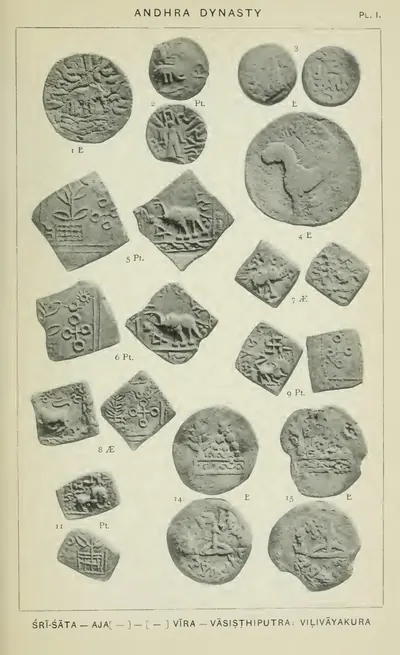
Rapson attributed to Sri Satakarni some rare round coins inscribed “Rano Siri-Satasa”.20721 They are of lead and of potin (a mixed metal), with an elephant and a river with fish. They are of a type linked with Malwa. Rapson compared their letters with the Nanaghat label of Nayanika and Siri Satakani, and dated them about 150 BCE.20721
Large lead coins from Chitaldrug in northern Mysore name a “Sadakana Kalalaya Maharathi”.2223 Rapson thought this might be the Maharathi of the Nanaghat inscription, Nayanika’s father.2223 But the coins could also belong to a later member of the family.2223
Sri Satakarni and the Telugu country
No inscription or coin of Sri Satakarni from the Telugu country is recorded in these sources. Sircar held that the early Satavahanas ruled lands north of the Krishna.17 In his view their kingdom reached the Krishna–Guntur region only under Vasishthiputra Pulumavi in the 2nd century CE.17 So the Hathigumpha passage is the only record that connects his reign with the Krishna, and its reading is disputed.
Footnotes
-
Rapson, Catalogue of the Coins of the Andhra Dynasty (1908), p. xix and n. 4 (archive.org (opens in a new tab)). ↩ ↩2 ↩3
-
Smith, Early History of India (1924), p. 230 (archive.org (opens in a new tab)). ↩ ↩2
-
Rapson, Catalogue of the Coins of the Andhra Dynasty (1908), p. xviii (archive.org (opens in a new tab)). ↩ ↩2 ↩3 ↩4 ↩5
-
Rapson, Catalogue of the Coins of the Andhra Dynasty (1908), p. xx (archive.org (opens in a new tab)). ↩ ↩2
-
Rapson, Catalogue of the Coins of the Andhra Dynasty (1908), p. xlv (archive.org (opens in a new tab)). ↩ ↩2
-
Rapson, Catalogue of the Coins of the Andhra Dynasty (1908), p. xxi and n. 2 (archive.org (opens in a new tab)). ↩ ↩2
-
Rapson, Catalogue of the Coins of the Andhra Dynasty (1908), p. xciii (archive.org (opens in a new tab)). ↩ ↩2 ↩3
-
Smith, Early History of India (1924), p. 231 (archive.org (opens in a new tab)). ↩
-
Sewell, Historical Inscriptions (1932), p. 324 (archive.org (opens in a new tab)). ↩ ↩2 ↩3
-
Robert Sewell, The Historical Inscriptions of Southern India (1932), p. 12 and n. 1 (archive.org (opens in a new tab)). ↩ ↩2 ↩3
-
James Burgess, The Buddhist Stupas of Amaravati and Jaggayyapeta (1887), p. 3, n. 5 (archive.org (opens in a new tab)). ↩ ↩2 ↩3 ↩4
-
Jayaswal and Banerji, “The Hathigumpha Inscription” (1933), p. 86, translation of line 4 (archive.org (opens in a new tab)). ↩
-
K. P. Jayaswal and R. D. Banerji, “The Hathigumpha Inscription of Kharavela”, Epigraphia Indica XX (1933), p. 74 (archive.org (opens in a new tab)). ↩ ↩2
-
Jayaswal and Banerji, “The Hathigumpha Inscription” (1933), p. 83 and nn. 22–24 (archive.org (opens in a new tab)). ↩ ↩2 ↩3
-
Jayaswal and Banerji, “The Hathigumpha Inscription” (1933), p. 84, note (archive.org (opens in a new tab)). ↩
-
D. C. Sircar, “Two Inscriptions from Guntur District”, Epigraphia Indica XXXII (1959), pp. 84–85 (archive.org (opens in a new tab)). ↩ ↩2 ↩3 ↩4
-
Sircar, “Two Inscriptions from Guntur District” (1959), p. 86 (archive.org (opens in a new tab)). ↩ ↩2 ↩3 ↩4 ↩5
-
E. J. Rapson, Catalogue of the Coins of the Andhra Dynasty, the Western Ksatrapas, the Traikutaka Dynasty, and the “Bodhi” Dynasty (1908), p. xvii (archive.org (opens in a new tab)). ↩
-
Vincent A. Smith, The Early History of India, 4th ed. (1924), p. 219 and n. 1 (archive.org (opens in a new tab)). ↩
-
Rapson, Catalogue of the Coins of the Andhra Dynasty (1908), p. xcii (archive.org (opens in a new tab)). ↩ ↩2
-
Rapson, Catalogue of the Coins of the Andhra Dynasty (1908), p. xciv (archive.org (opens in a new tab)). ↩ ↩2
-
Rapson, Catalogue of the Coins of the Andhra Dynasty (1908), p. lxxxii (archive.org (opens in a new tab)). ↩ ↩2 ↩3
-
Rapson, Catalogue of the Coins of the Andhra Dynasty (1908), p. lxxxiii (archive.org (opens in a new tab)). ↩ ↩2 ↩3
Photos
Related
Dynasties
References
Notes (0)
Sources (6)
Spotted an error on this page? Tell us
Last updated: