Gautamiputra Satakarni
Satavahana king of the early 2nd century CE. He overthrew the Kshaharata satrap Nahapana and won back the western Deccan. His deeds are known mainly from the Nasik cave inscription set up by his mother, Gautami Balasri. Whether he also ruled the Krishna valley is disputed.
Gautamiputra Satakarni was a king of the Satavahana dynasty who reigned in the first half of the 2nd century CE. He defeated the Kshaharata satrap Nahapana, a ruler of Saka (Scythian) descent who had taken the western Deccan from the Satavahanas. E. J. Rapson judged that the dynasty’s power was at its height in his reign.1 Almost all that is known of him comes from cave inscriptions in the western Deccan and from coins. His place in the history of the Telugu country is uncertain, as set out below.
Name and family
His inscriptions call him Gotamiputa Siri-Satakani, “Sri Satakarni, son of Gotami”.234 Like other Satavahana kings he was known by a metronymic, a name taken from his mother’s family.234 His mother was Gautami Balasri, and his son and successor was Vasishthiputra Pulumavi.234
Walter Elliot noted that he was the first of the dynasty known by such a name, and reviewed several explanations of the custom without accepting any.5 Rapson thought it probable, though not proven, that he was the “Gautamiputra Vilivayakura” named on coins found at Kolhapur.67 Robert Sewell’s list therefore calls him Vilivayakura II.8
Dates
His inscriptions give only regnal years, so his dates depend on Nahapana’s.69 Nahapana’s last recorded date is year 46 of the Saka era, or 124 CE.69 Rapson argued that Gautamiputra defeated him in his own 18th regnal year, which put his accession at about 106 CE.69
His latest known date is his 24th year, about 130 CE.69 The Puranas, Sanskrit texts that keep king-lists, give him only 21 years.69 Other writers have suggested different dates:
- James Burgess (1887): about 114–135 CE.10
- Vincent Smith (1924): accession about the beginning of the 2nd century, the Kshaharatas extirpated about 119 CE, succeeded by his son about 128 CE.1112
- Sewell (1932), following Vincent Smith: accession about 113 CE and a reign of 25 years. Sewell also gives L. D. Barnett’s accession date of 106 CE.8
- D. C. Sircar (1959): about 106–130 CE.13
- The Godavari district gazetteer (1907): 172–202 CE.14
- James Fergusson (1868): 309 CE, following an 1852 study of the Nasik inscriptions that Burgess regarded as superseded by 1887.1516
War with Nahapana
In his 18th year Gautamiputra sent an order to his officer at Govardhana, the Nasik district, “from the camp of victory of the Vejayanti army”.1718 In it he granted the Buddhist ascetics of the Trirasmi hill a field “previously enjoyed by Usabhadata”.1718 Usabhadata (Rishabhadatta) was Nahapana’s son-in-law.1718
The order gave the field the usual immunities:17
- royal officers were not to enter it
- it was not to be dug for salt
- the district police were not to interfere with it17
A similar edict of the same year at Karle confirmed a village that Rishabhadatta had earlier given to the monks there.189 Rapson read both edicts as Gautamiputra confirming, under the new dynasty, gifts made under the old one.189 He took Vejayanti (Vaijayanti) to be Banavasi, where the victorious army was in camp for the rainy season.189
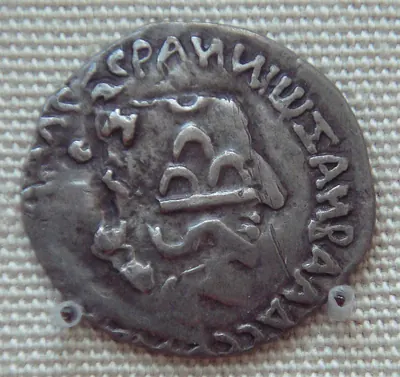
The coins tell the same story. In 1906 a hoard of about 13,250 silver coins found at Jogalthembi in the Nasik district held only coins of Nahapana.19 More than two-thirds of them had been restruck with Satavahana designs, a stupa (chaitya) and the “Ujjain symbol”.19 Rapson attributed the restriking to Gautamiputra.19
His mother’s inscription
The fullest account of his reign is a Prakrit inscription in Cave 3 at Nasik. Gautami Balasri set it up in the 19th year of his son Pulumavi, when she gave the cave to monks of the Bhadavaniya school.2203 Pulumavi granted a village for its upkeep.2203
In Rapson’s rendering, it praises Gautamiputra as the king:4
- “who crushed down the pride and conceit of the Ksatriyas”
- “who destroyed the Sakas, Yavanas and Pahlavas”
- “who rooted out the Khakharata family”
- “who restored the glory of the Satavahana race”4
Rapson took the Sakas, Yavanas and Pahlavas to be Scythian, Greek and Parthian invaders, and the Khakharatas to be Nahapana’s Kshaharata family.4
Two writers on the Telugu country read “Pahlavas” differently.514 Elliot thought they were the Pallavas of the Deccan.514 The Godavari gazetteer says that Gautamiputra boasted of defeating the Pallavas.514
Senart’s translation also credits him with never levying taxes except in accordance with justice.2 It credits him too with stopping “the contamination of the four varnas”, the classes of Hindu society.2 Senart took the first phrase to mean that the taxes were both raised and spent justly.20
The inscription names him king of Asika, Asaka, Mulaka, Suratha, Kukura, Aparanta, Anupa, Vidabha and Akaravanti. It also calls him lord of a list of mountains running from the Vindhyas to Malaya and Mahendra.2
Rapson argued that the countries were kingdoms conquered from Nahapana in western India, not a map of the whole empire.211 In his view they were roughly Gujarat, Malwa, Berar and the northern Konkan.211 He added that Rudradaman later retook most of them for the Western Kshatrapas.211
Gautamiputra and the Telugu country
Writers disagree about whether he ruled the lower Krishna. Sewell believed that he lived at Dhanyakataka (Amaravati) while his heir governed the west from Paithan.22 In his king-list, however, Sewell named Kolhapur as the capital.8
D. R. Bhandarkar, as reported by Smith, held that father and son reigned jointly for a time.12 During that time, in his view, Gautamiputra held Andhradesa, the home country of the Satavahanas, and Pulumavi held Maharashtra.12
Two of the mountains in the inscription have been placed in or near Andhra. R. G. Bhandarkar identified Siritana with Srisailam on the Krishna, but Rapson thought this doubtful.23 Rapson also argued that “Mahendra” here meant a southern range near Malaya, not the Eastern Ghats of Kalinga.23
Sircar went further and pointed out that no Satavahana inscription earlier than Pulumavi’s had been found in the Krishna–Guntur region. He also noted that the inscription lists no land south of the Krishna. He concluded that Gautamiputra’s son, not Gautamiputra, brought the region under Satavahana rule.24
The coins of the region do not settle the question. Rapson attributed the lead coins of Andhradesa to Pulumavi and later kings, and none of them to Gautamiputra.2526 The stupa and “Ujjain symbol” restruck on Nahapana’s silver are the types of one of the Andhradesa lead fabrics.19 Rapson noted that they had not been found on coins of Gautamiputra before.19
Elliot pointed to another kind of trace.2728 The two branches of the Godavari delta are called the Gautami and the Vasishthi.2728 He connected these names with the queen-mothers remembered in the kings’ metronymics.2728
Last years
A postscript to the Nasik edict, dated in his 24th year, was issued in the name of the king and of his mother, the “king’s queen-mother”.29 It replaced the Kakhadi field, which had gone out of cultivation, with another.29 Rapson suggested that failing health may have led the king to share power with her.29
Senart read a word in the inscription of Pulumavi’s 19th year as meaning that Pulumavi transferred the merit of his gift to his father.30 He inferred that Gautamiputra was dead by then.30
Sewell wrote that soon after the victory over Nahapana, the Saka king Chashtana defeated the Satavahanas.8 In his account they lost their lands north of the Narmada.8 Rapson instead linked the losses to Rudradaman’s wars with Pulumavi.131
Footnotes
-
Rapson, Catalogue of the Coins of the Andhra Dynasty (1908), p. xxxvi (archive.org (opens in a new tab)). ↩ ↩2 ↩3 ↩4 ↩5
-
É. Senart, “The Inscriptions in the Caves at Nasik”, Epigraphia Indica VIII (1906), p. 61 (archive.org (opens in a new tab)). ↩ ↩2 ↩3 ↩4 ↩5 ↩6 ↩7 ↩8
-
Rapson, Catalogue of the Coins of the Andhra Dynasty (1908), p. l (archive.org (opens in a new tab)). ↩ ↩2 ↩3 ↩4 ↩5
-
Rapson, Catalogue of the Coins of the Andhra Dynasty (1908), p. xxxvii (archive.org (opens in a new tab)). ↩ ↩2 ↩3 ↩4 ↩5 ↩6
-
Walter Elliot, Coins of Southern India (1886), p. 17 (archive.org (opens in a new tab)). ↩ ↩2 ↩3 ↩4
-
E. J. Rapson, Catalogue of the Coins of the Andhra Dynasty, the Western Ksatrapas, the Traikutaka Dynasty, and the “Bodhi” Dynasty (1908), p. xxvii (archive.org (opens in a new tab)). ↩ ↩2 ↩3 ↩4 ↩5 ↩6
-
Rapson, Catalogue of the Coins of the Andhra Dynasty (1908), p. xxviii (archive.org (opens in a new tab)). ↩
-
Robert Sewell, The Historical Inscriptions of Southern India (1932), p. 325 (archive.org (opens in a new tab)). ↩ ↩2 ↩3 ↩4 ↩5
-
Rapson, Catalogue of the Coins of the Andhra Dynasty (1908), p. xxx (archive.org (opens in a new tab)). ↩ ↩2 ↩3 ↩4 ↩5 ↩6 ↩7 ↩8
-
James Burgess, The Buddhist Stupas of Amaravati and Jaggayyapeta (1887), p. 5 (archive.org (opens in a new tab)). ↩
-
Vincent A. Smith, The Early History of India, 4th ed. (1924), p. 221 (archive.org (opens in a new tab)). ↩
-
Smith, Early History of India (1924), p. 222 and n. 1 (archive.org (opens in a new tab)). ↩ ↩2 ↩3
-
D. C. Sircar, “Two Inscriptions from Guntur District”, Epigraphia Indica XXXII (1959), p. 83 (archive.org (opens in a new tab)). ↩
-
F. R. Hemingway, Madras District Gazetteers: Godavari (1907), p. 18 (archive.org (opens in a new tab)). ↩ ↩2 ↩3 ↩4
-
James Fergusson, Tree and Serpent Worship (1868), Appendix F, PDF p. 460 (archive.org (opens in a new tab)). ↩
-
James Burgess, The Buddhist Stupas of Amaravati and Jaggayyapeta (1887), p. 11 (archive.org (opens in a new tab)). ↩
-
Senart, “The Inscriptions in the Caves at Nasik” (1906), p. 72 (archive.org (opens in a new tab)). ↩ ↩2 ↩3 ↩4 ↩5
-
Rapson, Catalogue of the Coins of the Andhra Dynasty (1908), p. xxix (archive.org (opens in a new tab)). ↩ ↩2 ↩3 ↩4 ↩5 ↩6
-
Rapson, Catalogue of the Coins of the Andhra Dynasty (1908), pp. lxxxviii–lxxxix (archive.org (opens in a new tab)). ↩ ↩2 ↩3 ↩4 ↩5
-
Senart, “The Inscriptions in the Caves at Nasik” (1906), p. 62 (archive.org (opens in a new tab)). ↩ ↩2 ↩3
-
Rapson, Catalogue of the Coins of the Andhra Dynasty (1908), p. xxxv (archive.org (opens in a new tab)). ↩ ↩2 ↩3
-
Robert Sewell, The Historical Inscriptions of Southern India (1932), p. 14 (archive.org (opens in a new tab)). ↩
-
Rapson, Catalogue of the Coins of the Andhra Dynasty (1908), p. xxxiv (archive.org (opens in a new tab)). ↩ ↩2
-
D. C. Sircar, “Two Inscriptions from Guntur District”, Epigraphia Indica XXXII (1959), p. 86 (archive.org (opens in a new tab)). ↩
-
Rapson, Catalogue of the Coins of the Andhra Dynasty (1908), p. lxxii (archive.org (opens in a new tab)). ↩
-
Rapson, Catalogue of the Coins of the Andhra Dynasty (1908), p. lxxiv (archive.org (opens in a new tab)). ↩
-
Elliot, Coins of Southern India (1886), p. 21 (archive.org (opens in a new tab)). ↩ ↩2 ↩3
-
Elliot, Coins of Southern India (1886), p. 22 (archive.org (opens in a new tab)). ↩ ↩2 ↩3
-
Rapson, Catalogue of the Coins of the Andhra Dynasty (1908), p. xlviii (archive.org (opens in a new tab)). ↩ ↩2 ↩3
-
Senart, “The Inscriptions in the Caves at Nasik” (1906), p. 64 (archive.org (opens in a new tab)). ↩ ↩2
-
Rapson, Catalogue of the Coins of the Andhra Dynasty (1908), p. xxxviii (archive.org (opens in a new tab)). ↩
Photos
Related
Dynasties
References
Notes (0)
Sources (9)
Spotted an error on this page? Tell us
Last updated: