Satavahanas
Deccan dynasty, called the Andhras in the Puranas, whose later kings ruled the Krishna valley, the Godavari delta and parts of Rayalaseema in the 2nd and early 3rd centuries CE. Its beginnings, its dates and when it reached the Telugu country are all debated.
Swipe sideways to see the whole chart; tap a bar for details.
Each bar is a ruling power in its region; time runs left to right. Dashed = approximate dates. Select a bar for details.
Show as a list
Mauryas & Satavahanas 300 BCE – 225 CE
- Telangana
- Mauryas (c. 272 BCE – 185 BCE) · Satavahanas (c. 220 BCE – 225 CE) · Kotilingala coin kings (c. 200 BCE – 52 BCE)
- Coastal Andhra
- Mauryas (c. 260 BCE – 185 BCE) · Satavahanas (c. 220 BCE – 225 CE)
- Rayalaseema
- Mauryas (c. 268 BCE – 185 BCE) · Satavahanas (c. 1–225 CE)
Ikshvakus, Vishnukundins & early kingdoms 225–624 CE
- Telangana
- Ikshvakus (c. 225–352 CE) · Vishnukundins (c. 375–612 CE) · Vakatakas (c. 300–500 CE)
- Coastal Andhra
- Ikshvakus (c. 225–350 CE) · Pallavas (c. 250–630 CE) · Salankayanas of Vengi (c. 300–470 CE)
- Rayalaseema
- Pallavas (c. 300–900 CE)
Kingdoms and empires
Mauryas
Open page- Telangana: c. 272 BCE – 185 BCE (c. 87 years)
IG Hyderabad says Asoka's dominions covered a considerable part of the eastern tracts of the Nizam's State; no Telangana edict cited. Asoka 272-231 BCE in IG Hyderabad, 268-226 BCE in Sewell
- Rayalaseema: c. 268 BCE – 185 BCE (c. 83 years)
Asokan edicts at Erragudi and Rajula-Mandagiri, Pattikonda taluk, Kurnool; Bindusara (296-268 BCE) is believed to have extended rule south
- Coastal Andhra: c. 260 BCE – 185 BCE (c. 75 years)
Asoka's Kalinga war (260 BCE in the Godavari gazetteer, 256 BCE in Sewell) and a Mauryan-script record at Amaravati; empire ended 185/184 BCE
Rulers
Inscriptions
Sources (5)
Kingdoms and empires
Ikshvakus
Open page- Coastal Andhra: c. 225–350 CE (c. 125 years)
Lower Krishna valley (Vijayapuri at Nagarjunakonda, Jaggayyapeta, Uppugundur); four kings known; dated inscriptions of 273–74 and 333–34 (Sircar), with an Abhira interlude about 278–79
- Telangana: c. 225–352 CE (c. 127 years)
Partial: the lower Krishna valley on the Nalgonda side. Inscriptions of the Ikshvaku kings Chamtamula and Rudrapurushadatta at Phanigiri (Nalgonda); the editors of Epigraphia Telanganica date Rudrapurushadatta's pillar to 352 and take it as the end of Ikshvaku rule.
Rulers
Capitals
Monuments
Inscriptions
Sources (5)
Kingdoms and empires
Vishnukundins
Open page- Telangana: c. 375–612 CE (c. 237 years)
Partial: the early kingdom north of Srisailam (Nalgonda and Mahabubnagar), with its capital at Keesaragutta near Hyderabad or at Indrapura (Indrapala Gutta near Tummalagudem, Nalgonda); the capital later moved to Trivaranagara (Tiruvuru). The Tummalagudem plates of Govindavarman (37th year) and Vikramendravarman II (Saka 488, 566-67) were found in Nalgonda. The early dates (Indravarman c. 375-400) and the end in 612 follow Goel et al.
- Coastal Andhra: c. 500–630 CE (c. 130 years)
Krishna-Godavari country; later capital Lendulura (Denduluru near Vengi); grants from the Godavari delta, Tenali taluk and the Vizianagaram region, and a pillar at Velpuru south of the Krishna. Dates disputed: K. V. Lakshman Rao (in Sewell 1932) about 357-610; Panchamukhi (1936) about 500 to the Chalukya conquest of 621-631; Mirashi puts Madhavavarman I about 510-568; Sircar (1939) about 500-670 and an end later still
Rulers (7)
- Vikramahendra (c. 500–520 CE)
- Govindavarman (c. 520–535 CE)
- Madhavavarman (Vishnukundin) (c. 535–585 CE)
- Madhavavarman II (Vishnukundin) (c. 585–615 CE)
- Vikramendravarman I (c. 615–625 CE)
- Indravarman (Vishnukundin) (c. 625–655 CE)
Capitals
Inscriptions (7)
- Chikkulla plates of Vikramendravarman II
- Ipur plates (set I) of Govindavarman's son Madhavavarman
- Ipur plates (set II) of Madhavavarman II
- Khanapur plates of Madhavavarman
- Polamuru plates of Madhavavarman Janashraya
- Ramatirtham plates of Indravarman
… and 1 more
Sources (8)
Kingdoms and empires
Satavahanas
Open page- Telangana: c. 220 BCE – 225 CE (c. 445 years)
IG Hyderabad: rise c. 220 BCE, end about a century after Pulumayi II (acc. c. 138 CE); Sewell: by c. 170 BCE the Andhra king ruled Hyderabad as well as the Telugu tracts
- Coastal Andhra: c. 220 BCE – 225 CE (c. 445 years)
Sources disagree: IG Madras 220 BCE-236 CE; Sewell 'from at least 250 BCE' to c. 225 CE when the Pallava Bappa ended the line; Godavari gazetteer dates the known kings c. 110-220 CE, last inscriptions c. 218
- Rayalaseema: c. 1–225 CE (c. 224 years)
Sewell: about 1 CE the Andhra king ruled parts of Cuddapah and Kurnool; an inscription of Pulumayi II (c. 145 CE) in Adoni taluk proves Andhra rule there; Bellary gazetteer: the Andhras ruled that district in the 2nd century CE. When their rule here began is not recorded
Rulers (12)
- Simuka (c. 220 BCE – 197 BCE)
- Krishna (Kanha) (c. 197 BCE – 179 BCE)
- Sri Satakarni (c. 179 BCE – 169 BCE)
- Sivasvati (c. 85–113 CE)
- Gautamiputra Satakarni (c. 113–138 CE)
- Vasishthiputra Pulumavi (c. 138–170 CE)
… and 6 more
- Siva Sri Satakarni (c. 170–177 CE)
- Sivaskanda Satakarni (c. 177–184 CE)
- Yajna Sri Satakarni (c. 184–213 CE)
- Vijaya Satakarni (c. 213–219 CE)
- Chandra Sri Satakarni (c. 219–229 CE)
- Pulumavi III (c. 229–236 CE)
Capitals
Inscriptions
Sources (5)
Kingdoms and empires
Vakatakas
Open page- Telangana: c. 300–500 CE (c. 200 years)
Partial: the Adilabad, Nizamabad and Karimnagar country north of the Godavari, as part of the Vakataka lands of central India and the northern Deccan. Goel et al. (2022) place the Vakataka lands from the findspots of their 37 inscriptions and name only these three Telangana districts. Jouveau-Dubreuil (1920) claimed much more: almost the whole of the Hyderabad State, and up to Kurnool. A Vakataka princess married the Vishnukundin Madhavavarman (Chikkulla plates). No Vakataka inscription from Telangana is listed in Epigraphia Telanganica I; this span rests on modern histories. Dates follow the Sewell table (Vindhyasakti c. 275-300 to Harishena c. 465-500).
Rulers (8)
- Vindhyasakti (c. 275–300 CE)
- Pravarasena I (c. 300–330 CE)
- Rudrasena I (c. 330–340 CE)
- Prithvisena I (c. 340–390 CE)
- Rudrasena II (c. 390–395 CE)
- Pravarasena II (c. 395–420 CE)
… and 2 more
- Devasena (c. 445–465 CE)
- Harishena (c. 465–500 CE)
Sources (5)
Kingdoms and empires
Kotilingala coin kings
Open page- Telangana: c. 200 BCE – 52 BCE (c. 148 years)
Partial: the Godavari country of the old Karimnagar district (Kotilingala, Peddabankur, Dhulikatta), known only from coins of four kings: Gobhada, Kamvaya, Narana and Samagopa, in that order (Lodaya). Dating disputed: the excavators date Gobhada to the first half of the 2nd century BCE, K. D. Bajpai to c. 125-100 BCE; Samagopa to the 1st century BCE. Lodaya has Simuka oust Samagopa about 52 BCE and Shastri puts the Satavahana rise in the mid-1st century BCE; Parabrahma Sastry instead took Gobhada and Samagopa for Sunga kings with the early Satavahanas as their subordinates, and Krishna Sastry left open whether such local rulers served the Satavahanas or another power
Sources (3)
Kingdoms and empires
Pallavas
Open page- Coastal Andhra: c. 250–630 CE (c. 380 years)
Krishna-Guntur, Ongole and Nellore. Prakrit grant of the crown prince Sivaskandavarman to his officer at Dhanyakataka (Amaravati), dated from about 234 (Sewell) or 250-275 (Jouveau-Dubreuil) to the first half of the 4th century (Sircar); Sanskrit grants of a Nellore-Guntur line (Omgodu, Uruvupalli, Pikira, Mangalur, Vilavatti, Chura) in the 5th and 6th centuries. Karmarashtra (Ongole-Bapatla) was Chalukya by about 630 (Kopparam plates of Pulakesin II). The Godavari gazetteer calls 200-615 a Pallava age, and IG Madras calls Vengi originally a Pallava province; Sircar found no evidence that the Pallavas held Vengi itself.
- Rayalaseema: c. 300–900 CE (c. 600 years)
Partial. Pallava frontier guards at Sriparvata (Kurnool) in the 4th century (Talagunda inscription; Sircar); Ganga kings of the Penukonda plates installed by Pallava kings (5th century); inscription of Paramesvaravarman II at Ulchala near Kurnool (728-29); Bana vassals in the Chittoor country under Nripatunga (9th century). The Cuddapah gazetteer has the Pallavas hold the eastern Cuddapah taluks for four centuries until the Chola Aditya I crippled them at the end of the 9th century. The Cuddapah gazetteer says the Pallavas of Kanchi pushed up the Penner from Nellore into north Cuddapah for a time and then ruled the eastern Cuddapah taluks for four centuries, until the Chola Aditya I crippled them at the end of the 9th century; Sewell gives a Pallava regnal-year record in Chittoor (864-65), with the Banas as Pallava vassals.
- Coastal Andhra: c. 670–750 CE (c. 80 years)
Southern Nellore only: grants of Paramesvaravarman I (Podili-Kandukur country, 687) and Narasimhavarman II (Revuru, Atmakur taluk, about 700-711), and a Tamil record of the 15th year of Nandipottarasar at Mallam (Gudur taluk), read as Pallava supremacy (Nellore gazetteer, 1942) or as Pallava rule under the Western Chalukyas (Butterworth and Venugopaul Chetty, 1905).
Rulers (18)
- Bappa (c. 225–250 CE)
- Sivaskandavarman (Pallava) (c. 250–275 CE)
- Vishnugopa of Kanchi (c. 325–350 CE)
- Kumaravishnu II (Pallava) (c. 425–450 CE)
- Skandavarman II (Pallava) (c. 450–475 CE)
- Simhavarman II (Pallava) (c. 500–525 CE)
… and 12 more
- Vishnugopavarman (c. 525–550 CE)
- Simhavishnu (c. 575–600 CE)
- Mahendravarman I (c. 600–630 CE)
- Narasimhavarman I (c. 630–668 CE)
- Mahendravarman II (c. 668–670 CE)
- Paramesvaravarman I (c. 670–690 CE)
- Narasimhavarman II (c. 690–715 CE)
- Nandivarman II Pallavamalla (c. 717–779 CE)
- Dantivarman (c. 779–830 CE)
- Nandivarman III (c. 830–854 CE)
- Nripatunga (c. 854–880 CE)
- Aparajita (c. 880–900 CE)
Capitals
Inscriptions (14)
Sources (19)
Kingdoms and empires
Salankayanas of Vengi
Open page- Coastal Andhra: c. 300–470 CE (c. 170 years)
Vengi (Pedavegi near Eluru), between the Krishna and the Godavari. Dates debated: D. C. Sircar (1939) about 320-470, from Devavarman to Skandavarman; B. V. Krishna Rao puts Nandivarman I at the close of the 3rd century, Sircar (1960) the Ellore and Kanukollu grants in the mid-4th; Subramanian about 275-450; Subba Rao has the Vishnukundins take Vengi about 450. Older works call these rulers Pallavas
Rulers
Capitals
Inscriptions
Sources (5)
Reigns
Each bar is one ruler’s reign; time runs left to right. c. = approximate date.
- Simukac. 220 BCE – 197 BCE · c. 23 yrs
- Krishna (Kanha)c. 197 BCE – 179 BCE · c. 18 yrs
- Sri Satakarnic. 179 BCE – 169 BCE · c. 10 yrs
- Sivasvatic. 85–113 CE · c. 28 yrs
- Gautamiputra Satakarnic. 113–138 CE · c. 25 yrs
- Vasishthiputra Pulumavic. 138–170 CE · c. 32 yrs
- Siva Sri Satakarnic. 170–177 CE · c. 7 yrs
- Sivaskanda Satakarnic. 177–184 CE · c. 7 yrs
- Yajna Sri Satakarnic. 184–213 CE · c. 29 yrs
- Vijaya Satakarnic. 213–219 CE · c. 6 yrs
- Chandra Sri Satakarnic. 219–229 CE · c. 10 yrs
- Pulumavi IIIc. 229–236 CE · c. 7 yrs
Approximate reign years after Sewell (1932), who follows Vincent Smith. Simuka, Krishna, Sri Satakarni, Gautamiputra, Pulumavi, Siva Sri, Yajna Sri and Chandra Sri are named in inscriptions or on coins; Sivasvati, Sivaskanda, Vijaya and Pulumavi III are known from the Puranic lists, or from identifications that are disputed. The Puranas name eighteen more kings between Sri Satakarni and Sivasvati.
Family tree
The rulers and the relatives who explain the succession. Every line rests on a cited statement on a person page; the sources are listed below the tree. Select a card to open that page.
- parent and child
- marriage
- adoption
- the sources disagree (see below)
- brother or sister
- order of succession
Generation 1
- 1Simukac. 220 BCE – 197 BCEBrother of Krishna (Kanha)
- 2Krishna (Kanha)c. 197 BCE – 179 BCEBrother of Simuka
- Gautami BalasriQueen-mother; donor of the Nasik cave
- GautamiMother of Yajna Sri (from his metronymic)
Generation 2
- Nayanika (Naganika)Queen; daughter of a MaharathiWife of Sri Satakarni
- 3Sri Satakarnic. 179 BCE – 169 BCEHusband of Nayanika (Naganika)
- 5Gautamiputra Satakarnic. 113–138 CESon of Gautami Balasri
- 9Yajna Sri Satakarnic. 184–213 CESon of Gautami
Generation 3
- VedisriSon; his mother acted as regentSon of Sri Satakarni and Nayanika (Naganika)
- SaktisriSecond sonSon of Sri Satakarni and Nayanika (Naganika)
- Daughter of RudradamanQueen (Sewell: Dakshamitra)sources disagree
- 6Vasishthiputra Pulumavic. 138–170 CESon of Gautamiputra Satakarni
- 7Siva Sri Satakarnic. 170–177 CE
- 11Chandra Sri Satakarnic. 219–229 CE
Where the sources disagree
Whose son was Sri Satakarni?
Son of Simuka (Bühler, from the Nanaghat inscriptions)
- Bühler's study of the Nanaghat records, as summarised by Rapson, made Sri Satakarni the son of King Simuka Satavahana. →
- Rapson, Catalogue of the Coins of the Andhra Dynasty (1908), p. xviii (archive.org (opens in a new tab)).
Son of Krishna (the Puranas)
- The Puranas instead make him the son of the second king, Krishna, which Rapson could not reconcile with the inscriptions. →
- Rapson, Catalogue of the Coins of the Andhra Dynasty (1908), p. xix and n. 4 (archive.org (opens in a new tab)).
Krishna (Kanha) → Sri Satakarni (parent and child)
Did Pulumavi marry Rudradaman's daughter?
A queen of a Vasishthiputra Sri Satakarni was Rudradaman's daughter (the Kanheri inscription)
- He explained the "connection" by an inscription at Kanheri of a queen of "Vasishthiputra Sri Satakarni", of the Kardamaka family. →
- Rapson, Catalogue of the Coins of the Andhra Dynasty (1908), p. xxxviii (archive.org (opens in a new tab)).
- Rapson, Catalogue of the Coins of the Andhra Dynasty (1908), p. li (archive.org (opens in a new tab)).
- She was almost certainly described in it as the daughter of the Mahakshatrapa Rudra, that is, Rudradaman. →
- Rapson, Catalogue of the Coins of the Andhra Dynasty (1908), p. xxxviii (archive.org (opens in a new tab)).
- Rapson, Catalogue of the Coins of the Andhra Dynasty (1908), p. li (archive.org (opens in a new tab)).
Sewell accepted the marriage and named her Dakshamitra
- Sewell accepted the marriage and gave the queen's name as Dakshamitra. →
- Robert Sewell, The Historical Inscriptions of Southern India (1932), p. 325 (archive.org (opens in a new tab)).
Were Siva Sri and Chandra Sri brothers of Pulumavi?
Brothers who succeeded him in turn (Bhandarkar)
- Bhandarkar's view that Pulumavi was succeeded in turn by his brothers Siva Sri Satakarni and Sri Chandra Sati. →
- Vincent A. Smith, The Early History of India, 4th ed. (1924), p. 224, n. 1 (archive.org (opens in a new tab)).
Chandra Sri perhaps a brother (Rapson, from the coins); a successor of Yajna Sri (Sircar)
- His coins share their design with those of Pulumavi and Siva Sri, and Rapson thought he might be a brother of Pulumavi. →
- E. J. Rapson, Catalogue of the Coins of the Andhra Dynasty, the Western Ksatrapas, the Traikutaka Dynasty, and the "Bodhi" Dynasty (1908), p. xl (archive.org (opens in a new tab)).
- Rapson, Catalogue of the Coins of the Andhra Dynasty (1908), p. lxxiii (archive.org (opens in a new tab)).
- Sircar (1939) treated Chandra Sati as a successor of Yajna Sri. →
- D. C. Sircar, The Successors of the Satavahanas in Lower Deccan (1939), p. 3 (archive.org (opens in a new tab)).
Vasishthiputra Pulumavi · Chandra Sri Satakarni (brother or sister)
Sources for every line of the tree
- Simuka · Krishna (Kanha) (brother or sister)
- The Puranas give him a reign of 23 years, and several of them make the second king, Krishna, his brother. →
- Robert Sewell, The Historical Inscriptions of Southern India (1932), p. 324 (archive.org (opens in a new tab)).
- Rapson, Catalogue of the Coins of the Andhra Dynasty (1908), p. xix and nn. 3–4 (archive.org (opens in a new tab)).
- The Puranas give him a reign of 23 years, and several of them make the second king, Krishna, his brother. →
- Simuka → Sri Satakarni (parent and child) · sources disagree
- Bühler's study of the Nanaghat records, as summarised by Rapson, made Sri Satakarni the son of King Simuka Satavahana. →
- Rapson, Catalogue of the Coins of the Andhra Dynasty (1908), p. xviii (archive.org (opens in a new tab)).
- Bühler's study of the Nanaghat records, as summarised by Rapson, made Sri Satakarni the son of King Simuka Satavahana. →
- Krishna (Kanha) → Sri Satakarni (parent and child) · sources disagree
- The Puranas instead make him the son of the second king, Krishna, which Rapson could not reconcile with the inscriptions. →
- Rapson, Catalogue of the Coins of the Andhra Dynasty (1908), p. xix and n. 4 (archive.org (opens in a new tab)).
- The Puranas instead make him the son of the second king, Krishna, which Rapson could not reconcile with the inscriptions. →
- Sri Satakarni · Nayanika (Naganika) (marriage)
- His queen was Nayanika (Naganika), daughter of a Maharathi, a great noble. →
- Rapson, Catalogue of the Coins of the Andhra Dynasty (1908), p. xviii (archive.org (opens in a new tab)).
- His queen was Nayanika (Naganika), daughter of a Maharathi, a great noble. →
- Sri Satakarni and Nayanika (Naganika) → Vedisri and Saktisri (parent and child)
- Rapson read the Nanaghat inscription as a record of sacrifices and of gifts to Brahmans, set up by Nayanika after her husband's death while she acted as regent for her son Vedisri. →
- Rapson, Catalogue of the Coins of the Andhra Dynasty (1908), p. xviii (archive.org (opens in a new tab)).
- Rapson, Catalogue of the Coins of the Andhra Dynasty (1908), p. xx (archive.org (opens in a new tab)).
- Rapson, Catalogue of the Coins of the Andhra Dynasty (1908), p. xlv (archive.org (opens in a new tab)).
- She had a second son, Saktisri. →
- Rapson, Catalogue of the Coins of the Andhra Dynasty (1908), p. xviii (archive.org (opens in a new tab)).
- Rapson, Catalogue of the Coins of the Andhra Dynasty (1908), p. xx (archive.org (opens in a new tab)).
- Rapson, Catalogue of the Coins of the Andhra Dynasty (1908), p. xlv (archive.org (opens in a new tab)).
- Rapson read the Nanaghat inscription as a record of sacrifices and of gifts to Brahmans, set up by Nayanika after her husband's death while she acted as regent for her son Vedisri. →
- Gautami Balasri → Gautamiputra Satakarni (parent and child)
- His mother was Gautami Balasri, and his son and successor was Vasishthiputra Pulumavi. →
- É. Senart, "The Inscriptions in the Caves at Nasik", Epigraphia Indica VIII (1906), p. 61 (archive.org (opens in a new tab)).
- Rapson, Catalogue of the Coins of the Andhra Dynasty (1908), p. l (archive.org (opens in a new tab)).
- Rapson, Catalogue of the Coins of the Andhra Dynasty (1908), p. xxxvii (archive.org (opens in a new tab)).
- His mother was Gautami Balasri, and his son and successor was Vasishthiputra Pulumavi. →
- Gautamiputra Satakarni → Vasishthiputra Pulumavi (parent and child)
- He was the son of Gautamiputra Satakarni. →
- Rapson, Catalogue of the Coins of the Andhra Dynasty (1908), p. xxxvii (archive.org (opens in a new tab)).
- Rapson, Catalogue of the Coins of the Andhra Dynasty (1908), p. l (archive.org (opens in a new tab)).
- His mother was Gautami Balasri, and his son and successor was Vasishthiputra Pulumavi. →
- É. Senart, "The Inscriptions in the Caves at Nasik", Epigraphia Indica VIII (1906), p. 61 (archive.org (opens in a new tab)).
- Rapson, Catalogue of the Coins of the Andhra Dynasty (1908), p. l (archive.org (opens in a new tab)).
- Rapson, Catalogue of the Coins of the Andhra Dynasty (1908), p. xxxvii (archive.org (opens in a new tab)).
- He was the son of Gautamiputra Satakarni. →
- Vasishthiputra Pulumavi · Daughter of Rudradaman (marriage) · sources disagree
- On this reading Pulumavi was Rudradaman's son-in-law. →
- Rapson, Catalogue of the Coins of the Andhra Dynasty (1908), p. xxxviii (archive.org (opens in a new tab)).
- Rapson, Catalogue of the Coins of the Andhra Dynasty (1908), p. li (archive.org (opens in a new tab)).
- On this reading Pulumavi was Rudradaman's son-in-law. →
- Vasishthiputra Pulumavi · Siva Sri Satakarni (brother or sister) · sources disagree
- Bhandarkar's view that Pulumavi was succeeded in turn by his brothers Siva Sri Satakarni and Sri Chandra Sati. →
- Vincent A. Smith, The Early History of India, 4th ed. (1924), p. 224, n. 1 (archive.org (opens in a new tab)).
- Bhandarkar's view that Pulumavi was succeeded in turn by his brothers Siva Sri Satakarni and Sri Chandra Sati. →
- Vasishthiputra Pulumavi · Chandra Sri Satakarni (brother or sister) · sources disagree
- Bhandarkar's view that Pulumavi was succeeded by his brothers Siva Sri and Sri Chandra Sati. →
- Vincent A. Smith, The Early History of India, 4th ed. (1924), pp. 223–224 and p. 224, n. 1 (archive.org (opens in a new tab)).
- Bhandarkar's view that Pulumavi was succeeded by his brothers Siva Sri and Sri Chandra Sati. →
- Gautami → Yajna Sri Satakarni (parent and child)
- It is dated in the 27th year of "the king, the lord Siriyana Satakani, the son of the (Queen of the) Gautama (race)". →
- Bühler, "A New Inscription of the Andhra King Yajnasri Gautamiputra" (1892), p. 96 (archive.org (opens in a new tab)).
- It is dated in the 27th year of "the king, the lord Siriyana Satakani, the son of the (Queen of the) Gautama (race)". →
A line from one parent only means that the cited sources name no other parent.
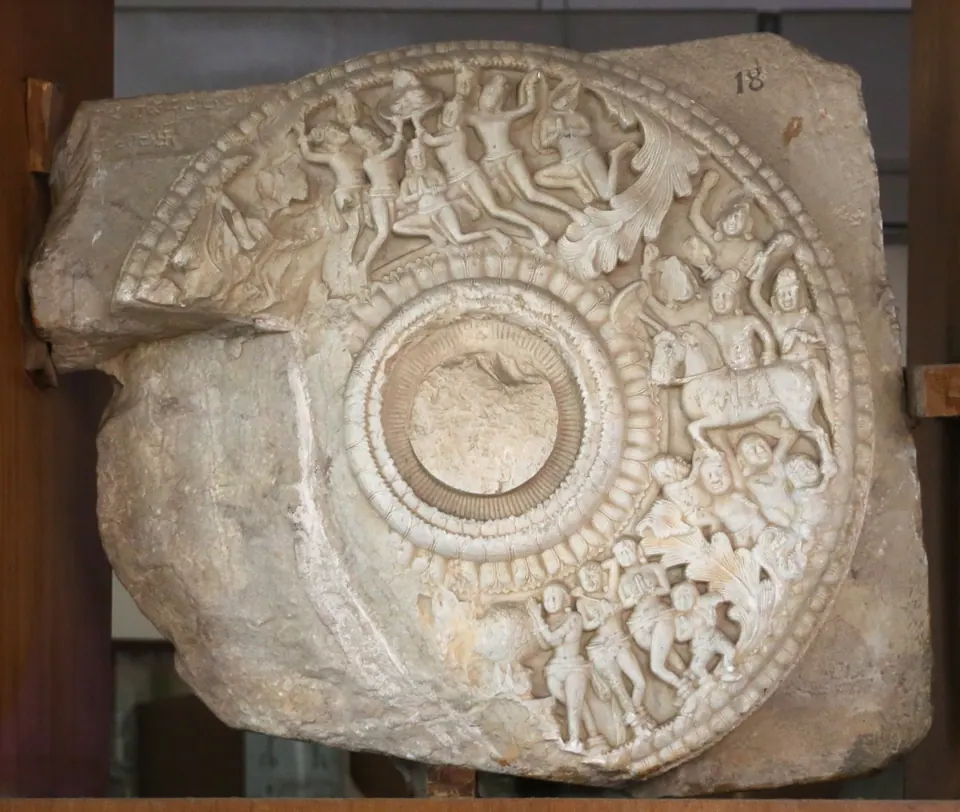
The Satavahanas were the first large kingdom of the Deccan whose rulers are known by name from their own inscriptions and coins. At their height their records reached from the western Deccan to the mouth of the Krishna. For the Telugu country they matter mainly through their later kings.12345 Their inscriptions and lead coins are found in the Krishna valley and the Godavari delta.12345 In their reigns the Buddhist stupa (relic mound) of Amaravati was enlarged.12345
About the sources. Almost everything about the dynasty except its name has been disputed. Scholars disagree on where it came from, when it began and how long it lasted. They also disagree on where its capitals were and when it first ruled the lower Krishna. This page sets out what the sources in the site’s library say, from James Fergusson in 1868 to D. C. Sircar in 1959. Later research is summarised in The Age of the Satavahanas (1999), which has not been consulted page by page here.
Name and origins
The Puranas, Sanskrit compilations of legend and genealogy, list these kings as the Andhras. Nineteenth-century writers often called them Andhrabhrityas.26 The family name Satavahana is fixed by a label at Nanaghat, near Pune, carved for a statue of the founder: “Raya Simuka Satavahano”.7 E. J. Rapson explained Satavahana as the name of the clan to which the ruling family belonged.8
Several kings took the throne-name Satakarni and told themselves apart by metronymics, names taken from their mothers’ families, such as Gautamiputra and Vasishthiputra.7 The later Ikshvaku kings of the Krishna valley copied this habit.9 The family name itself is rare in inscriptions.10 One of the few to use it is the record of a “king of the Satavahanas” at Myakadoni in Ballari (then Bellary) district.10
The term Andhrabhritya (“servants of the Andhras”) has been read in different ways. Burgess noted that the Matsya Purana speaks of “seven other Andhra kings of the race of their servants”.1 He noted too that the Vayu Purana does not support a separate dynasty.1 Rapson thought the term originally belonged to that later family alone, probably the Chutus of the western Deccan.11 Walter Elliot instead imagined a revolution under Gautamiputra Satakarni, which would have put a “servant” line on the throne of the “true” Andhras.12
Writers also disagree about where the Andhras began. Rapson pointed to a mention of the Andhras in the Aitareya Brahmana, among tribes on the fringe of Aryan civilisation.813 He placed their home then, as later, in the Telugu country between the Krishna and the Godavari.813 Vincent Smith likewise described them in about 300 BCE as a Dravidian people in the Godavari and Krishna deltas.14 Smith also cited P. T. Srinivas Iyengar’s contrary argument (1913) that the Andhras spoke Prakrit and that their rule spread from west to east.15
Sewell made them chiefs of a tribe near the Vindhya hills.16 Sircar argued that the Andhra people first lived in the northern Deccan and that the early Satavahanas ruled lands north of the Krishna.2 Elliot imagined a migration down the east coast, by way of the Chilka lake, to a capital on the Krishna above Amaravati.17
Asoka’s Rock Edict XIII names the Andhras in the 3rd century BCE. Sewell read it as placing them beyond Asoka’s borders. Rapson took them to be semi-independent. Sircar’s translation of the Erragudi copy lists them among the peoples within the Mauryan dominions.161318 See Mauryas.
The evidence
Four kinds of evidence survive:
- Inscriptions in Prakrit, mostly in caves of the western Deccan (Nanaghat, Nasik, Karle, Kanheri) and, for the later kings, in the Krishna and Godavari country and at Myakadoni. They are dated only in regnal years.12
- Coins, mostly of lead, with some of copper and of potin (a copper alloy), and a few of silver.192021
- Classical writers. Pliny credited a people he called the Andarae, whom James Burgess took to be the Andhras, with thirty fortified towns and a large army. Ptolemy, in the 2nd century, named Paithana on the upper Godavari as the capital of “Siri Polemaios”, generally taken to be a King Pulumavi.122
- The Puranic king-lists. The Matsya Purana gives 29 kings and 460 years, and the Vishnu, Vayu and Bhagavata give 30 kings and 456 years.23
Territory in the Telugu country
The Krishna valley
Most of the Andhra evidence comes from the lower Krishna. An inscription dated in the reign of Vasishthiputra Pulumavi was found at the Amaravati stupa.5 Another, of Gautamiputra Yajna Satakarni, was found on the sea-shore south of the Krishna near the village of Chinna in Kistna district.24 Lead coins of several kings came from Gudivada and from Amaravati, including the stupa mound itself, locally called Dipaldinne.2526272829
Sewell described the political picture about the beginning of the Christian era.30 He gave the Andhra king the Godavari and Krishna tracts, with parts of Nellore, Kadapa (then Cuddapah) and Kurnool.30
Sircar disagreed about the date. He edited an inscription from Velpuru in Sattenapalle taluk of a Maharaja of the Aira family, in letters of about Pulumavi’s time. From it he argued that the Airas held the Krishna–Guntur region until Pulumavi conquered it.31322
The Godavari delta
Kodavali is a village about nine miles north-west of Pithapuram.433 On a hill beyond it, a short inscription of Vasishthiputra Chandasati is cut into the wall of a rock-cut well.433 The well stands beside the brick remains of what looked like a Buddhist stupa.433 Sewell took the inscription to show Andhra rule there by about 208 CE.16
Lead coins attributed to the dynasty were found at Chittala in the Yernagudem taluk of Godavari district.34 Rapson grouped the coins of Andhradesa, the Krishna and Godavari districts, as a distinct regional currency.35 Elliot noted that the two branches of the Godavari delta are called the Gautami and the Vasishthi.3621 These are the same names as the queens remembered in the kings’ metronymics.3621
Rayalaseema and the south
In Rayalaseema the only Satavahana inscription in these sources is a rock inscription at Myakadoni in Adoni taluk. It is dated in the eighth year of a King Pulumavi. It names a district (janapada) called Satavahani-hara. Its editor, V. S. Sukthankar, thought that district covered much of Ballari.3738 He thought the rock fixed a point south of the Krishna where Satavahana rule reached.3738
The Bellary gazetteer of 1904 cited an inscription of a Haritiputra Satakarni and a lead coin naming Pulumayi, both from neighbouring parts of Mysore.39 It took them as proof that the Andhras ruled the district in the 2nd century CE.39 Rapson described lead coins of a horse type from Bathapalli in Anantapur and from Kadapa. He tentatively assigned them to a Haritiputra of the Chutu family.4041 Lead coins with a ship were picked up on the Coromandel coast between Madras and Cuddalore.4042
Telangana
The Imperial Gazetteer of Hyderabad (1909) described the Andhras extending their rule from the Krishna delta to Nasik, and named Paithan, outside the Telugu country, as Pulumayi’s capital.43 The older sources used for this page record no Satavahana inscription or coin find from the Telangana districts. Elliot remarked in 1886 that most of the old Andhra dominion lay in the Nizam’s territory, where opportunities for coin research were few.21
Later finds changed this picture. At Kotilingala on the Godavari, in Karimnagar district, a fair number of coins of Simuka were found, with coins of Satakarni I and of a king Satavahana.44 They are of cheap metal, so Ajay Mitra Shastri argued that they were used where they were found.44 He took them as proof that part of present Andhra Pradesh belonged to the dynasty from the start.44 A silver portrait coin of Vasishthiputra Sivasri Pulumavi came from the excavation at Dhulikatta.45 Coins of local kings such as Samagopa were found at the same sites.46 Shastri and Rachna Lodaya date them before the Satavahanas.4746
Capitals
The sources disagree about where the kings lived. Burgess reported a tradition that the first capital was Srikakulam on the Krishna, founded by a legendary emperor Sumati (perhaps Simuka). In this tradition the seat later moved to Dhanyakataka (Dharanikota), next to Amaravati. He added that either the royal seat moved often or princes governed separate viceroyalties.122
The Godavari gazetteer repeated this sequence.48 Smith noted that the river had cut away the old site at Srikakulam.15 The 1910 revision of Fergusson’s History of Indian Architecture put the capital at Dhanyakataka, with a second capital later at Paithan.49
Sewell made Kolhapur the capital of Gautamiputra and Paithan that of Pulumavi in his king-list.5051 In another passage he wrote that Gautamiputra lived at Dhanyakataka while the heir ruled the west from Paithan.5051 No Satavahana inscription from Dharanikota itself is known in these sources, but an Amaravati donor of the period calls himself a man “of Dhamnakataka”.52
Rulers
The reign chart follows Sewell. Rapson found that the Puranas gave the first three kings, Simuka, Krishna and Sri Satakarni, correctly when checked against the inscriptions. Between the early and the later inscriptions he saw a long “dark period” known only from the Puranic lists.535455
The kings attested in the Telugu country are all late:
- Vasishthiputra Pulumavi: the Amaravati inscription and lead coins of Andhradesa.556
- Siva Sri Satakarni and Chandra Sri (Chandra Sati): lead coins of Andhradesa, and for Chandra Sati the Kodavali inscription.5733
- Yajna Sri Satakarni: the Chinna inscription and coins of both Andhra fabrics.5859
- A King Pulumavi at Myakadoni, whose identity is disputed.1060
- Sri Sivamaka Sada, named in a fragment at Amaravati, who may not have been a Satavahana.6132
- Sri Rudra Satakarni and Sri Krishna II, known only from coins and absent from the Puranas.59622040
Rapson thought the empire divided after Yajna Sri. The Satavahana line kept the eastern provinces, while another family of Satakarnis, the Chutus, held the west and south.5962 Earlier kings are covered on the pages for Simuka, Sri Satakarni and Gautamiputra Satakarni.
How the kingdom was governed
The Andhra records say little about government, and most of what is known comes from the western caves. The Myakadoni inscription is the fullest Andhra example. It names the district of Satavahani-hara as belonging to a great general (mahasenapati) called Skandanaga. The village of Vepuraka belonged to a captain (gumika) called Kumaradatta.38
Sukthankar took hara here to mean a district or kingdom, the rattha of a later Pallava grant.38 He guessed that these officers held their lands somewhat like jagirs (land grants).38
At Kodavali the donor was an amacha (Sanskrit amatya), a minister or officer.6360 Krishna Sastri named him Sasa of Khaddavali, the old name of Kodavali, while Sircar read the name as Satyamitra.6360 An Amaravati fragment names a superintendent of the water establishment (paniyagharika) of King Sri Sivamaka Sada.61 Hultzsch offered this reading only with diffidence (with doubt).61
The western records show the same offices at work. Gautamiputra sent his orders on land grants to the amacha in charge of Govardhana, the Nasik district.64 Other officials registered and kept the order.64 Rapson called these districts aharas.656667 He identified the Maharathis and Mahabhojas as high officers of state, probably viceroys, often related to the royal family.656667 Smith, summarising D. R. Bhandarkar, ranked the Maharathis, Mahabhojas and Mahasenapatis as feudatories in charge of districts, above the amatyas, mahamatras and treasury officers.68
Taxes and revenue
None of the Satavahana inscriptions from the Telugu country in these sources is a royal grant. They record private gifts: the Chinna and Kodavali gifts, the Amaravati donations, and the Myakadoni reservoir dug by a householder.693710 The terms of royal grants are known from Nasik. There Gautamiputra gave a field to Buddhist monks with immunities (freedom from dues and interference).64 It was not to be entered or touched by royal officers, not to be dug for salt, and not to be interfered with by the district police.64
His mother’s inscription praises him as a king who levied taxes only “in conformity to justice”.7071 Senart understood the phrase to mean that the taxes were also spent on just purposes.7071
Religious endowments were also invested with guilds at interest.72 One, made under the satrap Nahapana before Gautamiputra’s conquest, earned one per cent a month to clothe the monks.72 Yajna Sri endowed monks at Kanheri with money at interest and the revenue of a field.69
Law and order
The sources say almost nothing about courts or punishment. The Nasik immunities show that district police existed, since they were barred from the granted field.64 Gautamiputra was praised as one who “stopped the contamination of the four varnas”, that is, as an upholder of caste rules.7073 Smith noted that permanent endowments were publicly proclaimed and recorded with a town assembly (nigama-sabha).74
Army
Pliny credited the Andhras with 100,000 infantry, 2,000 cavalry and 1,000 elephants.1 Sewell applied the figures to the Andhra king of the 1st century CE. Smith thought they came from Megasthenes and described the Andhra nation of about 300 BCE.511415
Burgess read the Hathigumpha inscription of Kharavela as describing Satakarni “protecting the west” with a numerous army.1 Jayaswal and Banerji later read it as Kharavela sending his army west “disregarding Satakarni”.75 Gautamiputra issued his Nasik order “from the camp of victory of the Vejayanti army”.64 Rapson took this to be the army in rainy-season quarters at Banavasi.76
In the Telugu country a great general held the Myakadoni district.38 At Amaravati one of the earliest inscriptions, in letters of Mauryan type, records a pillar given by a general named Mudakutala.77 Dharanikota was walled by a massive embankment about 650 yards a side.28 Gudivada too had a fort.25
Economy and trade
The Andhra coast lay on the sea route to the West. The Periplus, a 1st-century merchant’s guide, describes Masalia, a coast “stretching a great way” where “a great quantity of muslins is made”.78 Its translator W. H. Schoff identified Masalia with Machilipatnam (then Masulipatam) and called it “the greatest market of the Andhra kingdom”.79
Ptolemy lists on this coast the mouth of the river Maisolos and the marts of Kontakossyla, Koddoura and Allosygne.80 He also lists a point of departure for ships sailing to the land he called Khryse.80 His translator J. W. McCrindle placed Koddoura at Gudur near Machilipatnam, and noted that Yule had put Kontakossyla near Kondapalle.81 Scholars disagreed whether the Maisolos was the Krishna or the Godavari.8079 Vogel identified an emporium called Kantakasela, named in a Nagarjunakonda inscription, with Ptolemy’s Kontakossyla.8283
Roman coins were plentiful on the Coromandel coast, and Rapson saw in them evidence of the sea trade.84 A pot of Roman gold coins, mostly of Trajan and Hadrian, was found near Nellore in the 1780s.85
Lead coins showing a two-masted ship were found at Gudivada.25 Rapson assigned the Coromandel ship coins to Pulumavi, and Smith referred them to Yajna Sri.8486 At Gudivada Robert Sewell also found beads of crystal, glass, amber and garnet, and pots three or four feet across at the mouth.25 He concluded that the people were skilled lapidaries (gem-cutters).25
Guilds appear early. At Bhattiprolu one relic casket lists the members of a negama, and another the members of a committee (goṭhi).8788 In the western caves guilds of weavers, potters, oil-pressers and others took deposits at interest, as Smith summarised.6874 Water works also appear: the Myakadoni reservoir, and the rock-cut wells beside the Kodavali mound.3833
Coins
Elliot described the Andhra coinage as mainly of lead, with some copper and alloy pieces and, in his day, none of gold or silver. He took about thirty-five grains as the unit.2189
Rapson divided the lead coins of Andhradesa into two fabrics.35561990 Fabric A has a stupa (chaitya) on one side and the “Ujjain symbol” on the other.35561990 On Fabric B a lion was followed by a horse and, from Yajna Sri’s reign, an elephant.35561990 Coins of the two fabrics are often found together, as at Gudivada, so Rapson took them to be currencies of neighbouring districts.35
Rapson’s catalogue records Andhra coins from Gudivada, from Amaravati and the Dipaldinne mound, from elsewhere in Krishna district and from Chittala in Godavari district.349192932627 He also quotes Elliot on a hoard found in 1826 at Magalli, three or four miles from Nandigama. Floods of the Muneru river had exposed pots holding about 105 pounds of lead coins, mostly of the elephant type.94
Alexander Rea described seventy-two lead coins from Gudivada, with stupa, horse, lion, ship and elephant designs.9596 At Nagarjunakonda A. H. Longhurst found lead ore and an earthenware coin die in a monastery cell. He concluded that the monks minted coins.9798
Outside the Telugu country, Rapson attributed coins of Malwa type inscribed “Rano Siri-Satasa” to Sri Satakarni, about 150 BCE.99100 He described silver coins with Yajna Sri’s head as the only known coin-portrait of an Andhra king.101 See Yajna Sri Satakarni.
Social life
The Amaravati inscriptions name the donors and their families. They include householders (gahapati), merchants, a goldsmith, a perfume-dealer and a man Burgess called “the Tamil Kanha”.102103104105 One donor, Vidhika, is described by a word that Burgess translated as leather-worker, with a query.106 Childers thought it meant a smith or carpenter.106
Gifts were usually made “with” a wide family.103 The wife of the householder Sidhatha, for example, gave a lamp pillar with her daughters, sons, mother, brothers and the daughter-in-law of her house.103
Women gave in their own names.10210752106 The wife of the merchant Nagatisa gave with her sons.10210752106 The merchant’s wife Sidhi came from Vijayapura, and the female ascetic Sagharakhita gave with her daughters.10210752106 Burgess remarked that women appear in the sculptures “among his most ardent votaries” (the Buddha’s keenest followers).102
The donors came from several named places, among them Dhamnakataka, Kevurura, Mandara and Rajasaila.52108107105
The inscriptions are in Prakrit in the Brahmi script. Rapson thought two dialects were used in the Krishna district. One was a widely understood Prakrit. The other was a local one, perhaps with Dravidian elements, written in the variant script of the Bhattiprolu caskets. He saw traces of it in names such as Haku for Sakti.109110111 Smith noted traditions linking the kings with Prakrit literature, above all Hala’s anthology of verses.112
Religion
Nineteenth-century writers described the Andhras as Buddhists. The Imperial Gazetteer added that they also patronised Brahmins.3113114 It credited them with the Amaravati stupa and the other Buddhist buildings of the Krishna and Guntur districts.3113114 Sewell attributed to them the Amaravati stupa, the Guntupalli caves and many stupas of the Godavari and Krishna tracts.11516
The inscriptions give a more mixed picture, and the long Nanaghat record describes great Brahmanical sacrifices.1 Smith called the kings officially Brahmanical, though most of their recorded donations went to Buddhist institutions.116 At Amaravati the gift dated in Pulumavi’s reign was made by householders, not by the king.5
Several Amaravati inscriptions place the stupa in the keeping of the Chaitika school, a branch of the Mahasanghikas.77 Bühler thought the Chinna inscription might record a Buddhist gift, made by a man described as a sacrificer.117
Other cults are glimpsed too. The Velpuru inscription records a hall built for a god called Bhutagrahaka by a woman torch-bearer in the service of the Aira king.32 Burgess suggested that the serpent (naga) of the Amaravati carvings stood for an older cult with which Buddhism allied itself in the Andhra country.118 Chinese and Tibetan tradition gave the Buddhist teacher Nagarjuna a patron of the “Sadvahana” family.119 Burgess thought this patron one of the last kings, possibly Yajna Sri.119
Art and architecture
The great work of the period in the Telugu country is the carved railing of the Amaravati stupa. Burgess dated it to the later 2nd century, refining Fergusson’s earlier argument from style. He held the stupa itself to be much older.120121
The 1910 revision of Fergusson’s History dated the rail from the 1st century to before the end of the 2nd.49122 It judged that the decoration of stupas then reached its “highest point of elaboration”.49122 It counted about three hundred ancient mounds in the Krishna district alone, many of them stupas, among them Bhattiprolu, Jaggayyapeta, Ghantasala and Gudivada.123124
Burgess suggested that some heads found at Amaravati portrayed chiefs or kings and their wives, as the Nanaghat statues did.125 Longhurst saw Roman influence in some of the Nagarjunakonda sculptures.126 See Amaravati stupa and Temples and architecture.
Decline and successors
Sewell has Rudradaman defeat Pulumavi and take most of the dynasty’s western lands. Sewell says that Pulumavi had married Rudradaman’s daughter. In his account a branch, the Chutu-Satakarnis, then held the west.5150 Yajna Sri’s realm was largely confined to the Telugu districts and the eastern Deccan.5150
Sewell ended the dynasty around 225–236 CE, at the hands of the Pallava king Bappa.12750 The Godavari gazetteer put the Pallava conquest about the end of the 2nd century, since no Andhra inscriptions were known after about 218.48 Smith wrote that Yajna Sri was the last king to hold both the eastern and the western provinces. He called the 3rd century “one of the dark spaces” of Indian history.74
Excavation and epigraphy changed the picture. Burgess suspected another dynasty between the Andhras and the Pallavas, represented by King Purushadatta of his Jaggayyapeta inscriptions.120 Rapson took the same inscriptions to show that a new dynasty succeeded the Satavahanas in the Krishna district.128 The Nagarjunakonda inscriptions identified this dynasty as the Ikshvakus.9129
In 1939 Sircar argued that Yajna Sri ended his rule not long after 200 CE.130131 In his view the Ikshvakus were the first local family to throw off Satavahana overlordship, about the third decade of the 3rd century.130131 In 1959 he dated the end of Satavahana rule in the Krishna–Guntur region to about the close of the first quarter of the 3rd century.60
Evidence and disagreements
Chronology
The inscriptions carry only regnal years, so every chronology rests on links with datable outsiders, above all the Saka satraps of western India. Gautamiputra rooted out the family of the satrap Nahapana, whose last known date is 124 CE. The satrap Rudradaman recorded about 150 CE that he twice defeated “Satakarni, the lord of Dakshinapatha”.2313213322
| Source | Span of the dynasty | Gautamiputra Satakarni | Vasishthiputra Pulumavi |
|---|---|---|---|
| Fergusson (1868)134 | 31 BCE to the 5th century CE | 309 CE | 330 CE |
| Burgess (1887)1135 | 2nd century BCE to c. 200–220 CE | c. 114–135 CE | c. 135–163 CE |
| Rapson (1908)2376133 | from soon after 232 BCE into the 3rd century CE | accession c. 106 CE | accession c. 131 CE |
| Imperial Gazetteer (1908)3 | 220 BCE to 236 CE | not given | not given |
| Smith (1924)147311686 | c. 240/230 BCE to c. 225 CE | early 2nd century to c. 128 CE | c. 128–156 CE |
| Sewell, after Vincent Smith (1932)1650 | c. 220 BCE to c. 236 CE | accession 113 CE (Barnett: 106) | accession 138 CE (Barnett: 131) |
| Sircar (1959)60 | to c. 225 CE in the Krishna–Guntur region | c. 106–130 CE | c. 130–159 CE |
| Shastri (1987)4744 | from about the middle of the 1st century BCE | not given | not given |
Fergusson’s late dates followed an 1852 study of the Nasik inscriptions, which Burgess regarded as superseded.120 For the start of the dynasty, Burgess dated the Hathigumpha inscription to 157 or 92 BCE, according to when a supposed Mauryan era began.1 Jayaswal and Banerji found no such date on the rock, and identified Kharavela’s Satakarni with Sri Satakarni.7136 Sircar placed Kharavela about the end of the 1st century BCE.32
Puranas and inscriptions
Rapson judged the Puranas originally accurate but so corrupted in copying that they could not be used without the check of inscriptions.55 The checks cut both ways. The Puranas give Gautamiputra 21 years, but his inscriptions run to his 24th.76 For Yajna Sri the Chinna inscription of his 27th year fits the 29 years of the Vayu and Matsya Puranas. Bühler called the agreement “very remarkable”.117 Elliot showed that the older Puranic reckoning, which ran the dynasty from 23 BCE to 437 CE, could not be squared with Asoka’s edicts.137
Other open questions
- The order of the later kings. Rapson’s coins put Siva Sri and Chandra Sati soon after Pulumavi and before Yajna Sri. Sewell and Smith follow the Puranas in placing Chandra Sri after him.5750138 Sircar found the letters of the Chinna inscription of Yajna Sri no earlier than those of the Kodavali and Myakadoni records, even though those kings are usually placed later.60
- When the dynasty reached the Krishna. Burgess and Rapson treated the Krishna country as the original home of the Andhras. Sircar dated its conquest to Pulumavi.1352
- The Myakadoni Pulumavi. Sukthankar and Sewell identified him with Vasishthiputra Pulumavi. Sircar noted that he is generally placed after Yajna Sri.105160
- Sri Sivamaka Sada. Burgess suggested Simuka and Rapson Siva Sri Satakarni. Sircar doubted that the king was a Satavahana at all.615732
- The Kodavali date. Sten Konow read the regnal year, with some doubt, as 13; H. Krishna Sastri read 2, and Sircar 11.1396360
- The local kings of Kotilingala. Shastri (1987) and Lodaya counted Samagopa and Kamvaya among kings who ruled before the Satavahanas, and so dated the dynasty’s rise to the middle of the 1st century BCE. P. V. Parabrahma Sastry instead took Gobhada and Samagopa for Sunga kings, which would make the early Satavahanas their subordinates. See Kotilingala.4746140
Footnotes
-
James Burgess, The Buddhist Stupas of Amaravati and Jaggayyapeta (1887), p. 3 and notes (archive.org (opens in a new tab)). ↩ ↩2 ↩3 ↩4 ↩5 ↩6 ↩7 ↩8 ↩9 ↩10 ↩11 ↩12 ↩13 ↩14
-
Sircar, “Two Inscriptions from Guntur District” (1959), p. 86 (archive.org (opens in a new tab)). ↩ ↩2 ↩3 ↩4 ↩5 ↩6 ↩7 ↩8
-
Imperial Gazetteer of India, Provincial Series: Madras, Vol. I (1908), pp. 15–16 (archive.org (opens in a new tab)). ↩ ↩2 ↩3 ↩4 ↩5 ↩6
-
H. Krishna Sastri, “The Kodavali Rock-Inscription of Chandasati”, Epigraphia Indica XVIII (1926), p. 316 (archive.org (opens in a new tab)). ↩ ↩2 ↩3 ↩4 ↩5 ↩6
-
Burgess, Amaravati and Jaggayyapeta (1887), p. 100 (archive.org (opens in a new tab)). ↩ ↩2 ↩3 ↩4 ↩5 ↩6
-
James Fergusson, rev. James Burgess, History of Indian and Eastern Architecture, Vol. I (1910), p. 21 (archive.org (opens in a new tab)). ↩
-
K. P. Jayaswal and R. D. Banerji, “The Hathigumpha Inscription of Kharavela”, Epigraphia Indica XX (1933), p. 74 (archive.org (opens in a new tab)). ↩ ↩2 ↩3
-
E. J. Rapson, Catalogue of the Coins of the Andhra Dynasty, the Western Ksatrapas, the Traikutaka Dynasty, and the “Bodhi” Dynasty (1908), p. xv and n. 1 (archive.org (opens in a new tab)). ↩ ↩2 ↩3
-
J. Ph. Vogel, “Prakrit Inscriptions from a Buddhist Site at Nagarjunikonda”, Epigraphia Indica XX (1933), p. 6 (archive.org (opens in a new tab)). ↩ ↩2
-
Sukthankar, “A New Andhra Inscription of Siri-Pulumavi” (1918), p. 154 (archive.org (opens in a new tab)). ↩ ↩2 ↩3 ↩4 ↩5
-
Rapson, Catalogue of the Coins of the Andhra Dynasty (1908), p. lxix (archive.org (opens in a new tab)). ↩
-
Elliot, Coins of Southern India (1886), p. 18 (archive.org (opens in a new tab)). ↩
-
Rapson, Catalogue of the Coins of the Andhra Dynasty (1908), p. xvi and n. 2 (archive.org (opens in a new tab)). ↩ ↩2 ↩3
-
Vincent A. Smith, The Early History of India, 4th ed. (1924), p. 217 (archive.org (opens in a new tab)). ↩ ↩2 ↩3
-
Smith, Early History of India (1924), p. 218 and nn. 1–2 (archive.org (opens in a new tab)). ↩ ↩2 ↩3
-
Sewell, Historical Inscriptions (1932), p. 324 (archive.org (opens in a new tab)). ↩ ↩2 ↩3 ↩4 ↩5
-
Walter Elliot, Coins of Southern India (1886), p. 15 (archive.org (opens in a new tab)). ↩
-
D. C. Sircar, “Erragudi Edicts of Asoka”, Epigraphia Indica XXXII (1959), p. 24 (archive.org (opens in a new tab)). ↩
-
Rapson, Catalogue of the Coins of the Andhra Dynasty (1908), p. lxxiv (archive.org (opens in a new tab)). ↩ ↩2 ↩3 ↩4
-
Rapson, Catalogue of the Coins of the Andhra Dynasty (1908), p. lxxx (archive.org (opens in a new tab)). ↩ ↩2
-
Elliot, Coins of Southern India (1886), p. 22 (archive.org (opens in a new tab)). ↩ ↩2 ↩3 ↩4 ↩5
-
Burgess, Amaravati and Jaggayyapeta (1887), p. 4 (archive.org (opens in a new tab)). ↩ ↩2 ↩3
-
Rapson, Catalogue of the Coins of the Andhra Dynasty (1908), p. xxvi (archive.org (opens in a new tab)). ↩ ↩2 ↩3
-
G. Bühler, “A New Inscription of the Andhra King Yajnasri Gautamiputra”, Epigraphia Indica I (1892), p. 95 (archive.org (opens in a new tab)). ↩
-
Rea, South Indian Buddhist Antiquities (1894), p. 20, quoting Robert Sewell (archive.org (opens in a new tab)). ↩ ↩2 ↩3 ↩4 ↩5
-
Rapson, Catalogue of the Coins of the Andhra Dynasty (1908), catalogue p. 34 (archive.org (opens in a new tab)). ↩ ↩2
-
Rapson, Catalogue of the Coins of the Andhra Dynasty (1908), catalogue p. 46 (archive.org (opens in a new tab)). ↩ ↩2
-
Burgess, Amaravati and Jaggayyapeta (1887), p. 13 (archive.org (opens in a new tab)). ↩ ↩2
-
Alexander Rea, South Indian Buddhist Antiquities (1894), p. 19, quoting Walter Elliot (archive.org (opens in a new tab)). ↩
-
Sewell, Historical Inscriptions (1932), p. 13, entry for A.D. 1 (archive.org (opens in a new tab)). ↩ ↩2
-
D. C. Sircar, “Two Inscriptions from Guntur District”, Epigraphia Indica XXXII (1959), p. 82 (archive.org (opens in a new tab)). ↩
-
Sircar, “Two Inscriptions from Guntur District” (1959), pp. 84–85 (archive.org (opens in a new tab)). ↩ ↩2 ↩3 ↩4 ↩5
-
Krishna Sastri, “The Kodavali Rock-Inscription of Chandasati” (1926), p. 317 (archive.org (opens in a new tab)). ↩ ↩2 ↩3 ↩4 ↩5
-
Rapson, Catalogue of the Coins of the Andhra Dynasty (1908), catalogue p. 2 and n. 2 (archive.org (opens in a new tab)). ↩ ↩2
-
Rapson, Catalogue of the Coins of the Andhra Dynasty (1908), p. lxxi (archive.org (opens in a new tab)). ↩ ↩2 ↩3 ↩4 ↩5 ↩6
-
Elliot, Coins of Southern India (1886), p. 21 (archive.org (opens in a new tab)). ↩ ↩2
-
V. S. Sukthankar, “A New Andhra Inscription of Siri-Pulumavi”, Epigraphia Indica XIV (1918), p. 153 (archive.org (opens in a new tab)). ↩ ↩2 ↩3
-
Sukthankar, “A New Andhra Inscription of Siri-Pulumavi” (1918), p. 155, text, translation and notes (archive.org (opens in a new tab)). ↩ ↩2 ↩3 ↩4 ↩5 ↩6 ↩7
-
W. Francis, Madras District Gazetteers: Bellary (1904), p. 27 (archive.org (opens in a new tab)). ↩ ↩2
-
Rapson, Catalogue of the Coins of the Andhra Dynasty (1908), p. lxxxi (archive.org (opens in a new tab)). ↩ ↩2 ↩3
-
Rapson, Catalogue of the Coins of the Andhra Dynasty (1908), catalogue p. 25 (archive.org (opens in a new tab)). ↩
-
Rapson, Catalogue of the Coins of the Andhra Dynasty (1908), catalogue p. 23 and n. 1 (archive.org (opens in a new tab)). ↩
-
Imperial Gazetteer of India, Provincial Series: Hyderabad State (1909), p. 10 (archive.org (opens in a new tab)). ↩
-
Shastri, Early History of the Deccan: Problems and Perspectives (1987), p. 11 (archive.org (opens in a new tab)). Cite-only; paraphrased. ↩ ↩2 ↩3 ↩4
-
Shastri, Early History of the Deccan: Problems and Perspectives (1987), p. 31 (archive.org (opens in a new tab)). Cite-only; paraphrased. ↩
-
Rachna Shamji Lodaya, An Integrated Approach to the Pre-Satavahana Coinage of the Deccan (PhD thesis, Deccan College, Pune, not before 2011), pp. 130–131 (archive.org (opens in a new tab)). Cite-only; paraphrased. ↩ ↩2 ↩3
-
Ajay Mitra Shastri, Early History of the Deccan: Problems and Perspectives (1987), p. 9 (archive.org (opens in a new tab)). Cite-only; paraphrased. ↩ ↩2 ↩3
-
F. R. Hemingway, Madras District Gazetteers: Godavari (1907), p. 18 (archive.org (opens in a new tab)). ↩ ↩2
-
Fergusson, History of Indian and Eastern Architecture, Vol. I (1910), p. 22 (archive.org (opens in a new tab)). ↩ ↩2 ↩3
-
Sewell, Historical Inscriptions (1932), p. 325 (archive.org (opens in a new tab)). ↩ ↩2 ↩3 ↩4 ↩5 ↩6 ↩7
-
Sewell, Historical Inscriptions (1932), p. 14 (archive.org (opens in a new tab)). ↩ ↩2 ↩3 ↩4 ↩5 ↩6
-
Burgess, Amaravati and Jaggayyapeta (1887), p. 90, inscriptions Nos. 53 and 50 (archive.org (opens in a new tab)). ↩ ↩2 ↩3 ↩4 ↩5
-
Rapson, Catalogue of the Coins of the Andhra Dynasty (1908), p. xix (archive.org (opens in a new tab)). ↩
-
Rapson, Catalogue of the Coins of the Andhra Dynasty (1908), p. xxiv (archive.org (opens in a new tab)). ↩
-
Rapson, Catalogue of the Coins of the Andhra Dynasty (1908), p. xxv (archive.org (opens in a new tab)). ↩ ↩2
-
Rapson, Catalogue of the Coins of the Andhra Dynasty (1908), p. lxxii (archive.org (opens in a new tab)). ↩ ↩2 ↩3 ↩4
-
Rapson, Catalogue of the Coins of the Andhra Dynasty (1908), p. xl and n. 2 (archive.org (opens in a new tab)). ↩ ↩2 ↩3
-
Rapson, Catalogue of the Coins of the Andhra Dynasty (1908), p. xli (archive.org (opens in a new tab)). ↩
-
Rapson, Catalogue of the Coins of the Andhra Dynasty (1908), p. xlii (archive.org (opens in a new tab)). ↩ ↩2 ↩3
-
Sircar, “Two Inscriptions from Guntur District” (1959), p. 83 and nn. 7–9 (archive.org (opens in a new tab)). ↩ ↩2 ↩3 ↩4 ↩5 ↩6 ↩7 ↩8
-
Burgess, Amaravati and Jaggayyapeta (1887), p. 61 and n. 2 (archive.org (opens in a new tab)). ↩ ↩2 ↩3 ↩4
-
Rapson, Catalogue of the Coins of the Andhra Dynasty (1908), p. xliii (archive.org (opens in a new tab)). ↩ ↩2
-
Krishna Sastri, “The Kodavali Rock-Inscription of Chandasati” (1926), p. 319, translation and Sten Konow’s postscript (archive.org (opens in a new tab)). ↩ ↩2 ↩3
-
Senart, “The Inscriptions in the Caves at Nasik” (1906), p. 72, No. 4 (archive.org (opens in a new tab)). ↩ ↩2 ↩3 ↩4 ↩5 ↩6
-
Rapson, Catalogue of the Coins of the Andhra Dynasty (1908), p. xxi (archive.org (opens in a new tab)). ↩ ↩2
-
Rapson, Catalogue of the Coins of the Andhra Dynasty (1908), p. xxii (archive.org (opens in a new tab)). ↩ ↩2
-
Rapson, Catalogue of the Coins of the Andhra Dynasty (1908), p. xlix (archive.org (opens in a new tab)). ↩ ↩2
-
Smith, Early History of India (1924), p. 225 (archive.org (opens in a new tab)). ↩ ↩2
-
Rapson, Catalogue of the Coins of the Andhra Dynasty (1908), p. lii (archive.org (opens in a new tab)). ↩ ↩2
-
É. Senart, “The Inscriptions in the Caves at Nasik”, Epigraphia Indica VIII (1906), p. 61 (archive.org (opens in a new tab)). ↩ ↩2 ↩3
-
Senart, “The Inscriptions in the Caves at Nasik” (1906), p. 62 (archive.org (opens in a new tab)). ↩ ↩2
-
Rapson, Catalogue of the Coins of the Andhra Dynasty (1908), p. lviii (archive.org (opens in a new tab)). ↩ ↩2
-
Smith, Early History of India (1924), p. 221 (archive.org (opens in a new tab)). ↩ ↩2
-
Smith, Early History of India (1924), p. 226 (archive.org (opens in a new tab)). ↩ ↩2 ↩3
-
Jayaswal and Banerji, “The Hathigumpha Inscription” (1933), p. 86, translation of line 4 (archive.org (opens in a new tab)). ↩
-
Rapson, Catalogue of the Coins of the Andhra Dynasty (1908), p. xxx (archive.org (opens in a new tab)). ↩ ↩2 ↩3
-
Burgess, Amaravati and Jaggayyapeta (1887), p. 101 and n. 3 (archive.org (opens in a new tab)). ↩ ↩2
-
Wilfred H. Schoff (tr.), The Periplus of the Erythraean Sea (1912), § 62, p. 47 (archive.org (opens in a new tab)). ↩
-
Schoff, Periplus (1912), p. 252 (archive.org (opens in a new tab)). ↩ ↩2
-
J. W. McCrindle (tr.), Ancient India as Described by Ptolemy (1885), p. 66 (archive.org (opens in a new tab)). ↩ ↩2 ↩3
-
McCrindle, Ancient India as Described by Ptolemy (1885), pp. 67–68 (archive.org (opens in a new tab)). ↩
-
Vogel, “Prakrit Inscriptions from Nagarjunikonda” (1933), p. 9 (archive.org (opens in a new tab)). ↩
-
Vogel, “Prakrit Inscriptions from Nagarjunikonda” (1933), p. 23 (archive.org (opens in a new tab)). ↩
-
Rapson, Catalogue of the Coins of the Andhra Dynasty (1908), p. lxxxii (archive.org (opens in a new tab)). ↩ ↩2
-
Imperial Gazetteer: Madras, Vol. I (1908), p. 345 (archive.org (opens in a new tab)). ↩
-
Smith, Early History of India (1924), p. 223 (archive.org (opens in a new tab)). ↩ ↩2
-
G. Bühler, “The Bhattiprolu Inscriptions”, Epigraphia Indica II (1894), p. 327 (archive.org (opens in a new tab)). ↩
-
Bühler, “The Bhattiprolu Inscriptions” (1894), p. 328 (archive.org (opens in a new tab)). ↩
-
Elliot, Coins of Southern India (1886), p. 23 (archive.org (opens in a new tab)). ↩
-
Rapson, Catalogue of the Coins of the Andhra Dynasty (1908), p. lxxvi (archive.org (opens in a new tab)). ↩ ↩2 ↩3
-
Rapson, Catalogue of the Coins of the Andhra Dynasty (1908), catalogue p. 10 (archive.org (opens in a new tab)). ↩
-
Rapson, Catalogue of the Coins of the Andhra Dynasty (1908), catalogue p. 20 (archive.org (opens in a new tab)). ↩
-
Rapson, Catalogue of the Coins of the Andhra Dynasty (1908), catalogue p. 29 (archive.org (opens in a new tab)). ↩
-
Rapson, Catalogue of the Coins of the Andhra Dynasty (1908), catalogue p. 50, n. 3, quoting Walter Elliot (archive.org (opens in a new tab)). ↩
-
Rea, South Indian Buddhist Antiquities (1894), p. 21 (archive.org (opens in a new tab)). ↩
-
Rea, South Indian Buddhist Antiquities (1894), p. 23 (archive.org (opens in a new tab)). ↩
-
Longhurst, Nagarjunakonda (1938), p. 10 (archive.org (opens in a new tab)). ↩
-
H. Hargreaves (ed.), Annual Report of the Archaeological Survey of India, 1927–28 (1931), p. 121 (archive.org (opens in a new tab)). ↩
-
Rapson, Catalogue of the Coins of the Andhra Dynasty (1908), p. xcii (archive.org (opens in a new tab)). ↩
-
Rapson, Catalogue of the Coins of the Andhra Dynasty (1908), p. xciii (archive.org (opens in a new tab)). ↩
-
Rapson, Catalogue of the Coins of the Andhra Dynasty (1908), p. lxxxix (archive.org (opens in a new tab)). ↩
-
Burgess, Amaravati and Jaggayyapeta (1887), p. 82, inscription No. 28 (archive.org (opens in a new tab)). ↩ ↩2 ↩3 ↩4 ↩5
-
Burgess, Amaravati and Jaggayyapeta (1887), p. 103, inscriptions Nos. 27 and 38 (archive.org (opens in a new tab)). ↩ ↩2 ↩3
-
Burgess, Amaravati and Jaggayyapeta (1887), p. 105, inscription No. 49 (archive.org (opens in a new tab)). ↩
-
Burgess, Amaravati and Jaggayyapeta (1887), p. 104, inscriptions Nos. 39 and 41 (archive.org (opens in a new tab)). ↩ ↩2
-
Burgess, Amaravati and Jaggayyapeta (1887), p. 91, inscription No. 36 and n. 5 (archive.org (opens in a new tab)). ↩ ↩2 ↩3 ↩4 ↩5
-
Burgess, Amaravati and Jaggayyapeta (1887), p. 85, inscriptions Nos. 22 and 30 (archive.org (opens in a new tab)). ↩ ↩2 ↩3 ↩4
-
Burgess, Amaravati and Jaggayyapeta (1887), p. 78, inscription No. 19 (archive.org (opens in a new tab)). ↩
-
Rapson, Catalogue of the Coins of the Andhra Dynasty (1908), p. xc (archive.org (opens in a new tab)). ↩
-
Rapson, Catalogue of the Coins of the Andhra Dynasty (1908), p. xci (archive.org (opens in a new tab)). ↩
-
Rapson, Catalogue of the Coins of the Andhra Dynasty (1908), p. xx, n. 3 (archive.org (opens in a new tab)). ↩
-
Smith, Early History of India (1924), p. 220 (archive.org (opens in a new tab)). ↩
-
Imperial Gazetteer: Madras, Vol. I (1908), pp. 192–193 (archive.org (opens in a new tab)). ↩ ↩2
-
Imperial Gazetteer: Madras, Vol. I (1908), p. 301 (archive.org (opens in a new tab)). ↩ ↩2
-
Robert Sewell, The Historical Inscriptions of Southern India (1932), pp. 8–9 (archive.org (opens in a new tab)). ↩
-
Smith, Early History of India (1924), p. 222 (archive.org (opens in a new tab)). ↩ ↩2
-
Bühler, “A New Inscription of the Andhra King Yajnasri Gautamiputra” (1892), p. 96 (archive.org (opens in a new tab)). ↩ ↩2
-
Burgess, Amaravati and Jaggayyapeta (1887), p. 93 (archive.org (opens in a new tab)). ↩
-
Burgess, Amaravati and Jaggayyapeta (1887), p. 8 (archive.org (opens in a new tab)). ↩ ↩2
-
Burgess, Amaravati and Jaggayyapeta (1887), p. 11 (archive.org (opens in a new tab)). ↩ ↩2 ↩3
-
Burgess, Amaravati and Jaggayyapeta (1887), p. 12 (archive.org (opens in a new tab)). ↩
-
Fergusson, History of Indian and Eastern Architecture, Vol. I (1910), p. 81 (archive.org (opens in a new tab)). ↩ ↩2
-
Fergusson, History of Indian and Eastern Architecture, Vol. I (1910), p. 82 (archive.org (opens in a new tab)). ↩
-
Fergusson, History of Indian and Eastern Architecture, Vol. I (1910), p. 83 (archive.org (opens in a new tab)). ↩
-
Burgess, Amaravati and Jaggayyapeta (1887), p. 97 (archive.org (opens in a new tab)). ↩
-
Longhurst, Nagarjunakonda (1938), p. 15 (archive.org (opens in a new tab)). ↩
-
Sewell, Historical Inscriptions (1932), p. 16 (archive.org (opens in a new tab)). ↩
-
Rapson, Catalogue of the Coins of the Andhra Dynasty (1908), p. xliv (archive.org (opens in a new tab)). ↩
-
A. H. Longhurst, The Buddhist Antiquities of Nagarjunakonda (1938), p. 4 (archive.org (opens in a new tab)). ↩
-
D. C. Sircar, The Successors of the Satavahanas in Lower Deccan (1939), p. 3 (archive.org (opens in a new tab)). ↩ ↩2
-
Sircar, Successors of the Satavahanas (1939), p. 4 (archive.org (opens in a new tab)). ↩ ↩2
-
Rapson, Catalogue of the Coins of the Andhra Dynasty (1908), p. xxvii (archive.org (opens in a new tab)). ↩
-
Rapson, Catalogue of the Coins of the Andhra Dynasty (1908), p. xxxviii (archive.org (opens in a new tab)). ↩ ↩2
-
James Fergusson, Tree and Serpent Worship (1868), Appendix F, PDF p. 460 (archive.org (opens in a new tab)). ↩
-
Burgess, Amaravati and Jaggayyapeta (1887), p. 5 (archive.org (opens in a new tab)). ↩
-
Jayaswal and Banerji, “The Hathigumpha Inscription” (1933), p. 83 (archive.org (opens in a new tab)). ↩
-
Elliot, Coins of Southern India (1886), p. 16 (archive.org (opens in a new tab)). ↩
-
Smith, Early History of India (1924), table “The Later Andhra Kings and Connected Dynasties”, PDF p. 271 (archive.org (opens in a new tab)). ↩
-
Krishna Sastri, “The Kodavali Rock-Inscription of Chandasati” (1926), p. 318 (archive.org (opens in a new tab)). ↩
-
V. V. Krishna Sastry, Proto and Early History of the Karimnagar Region (PhD thesis, Karnatak University, 1978), p. 205 (archive.org (opens in a new tab)). Cite-only; paraphrased. ↩
Photos
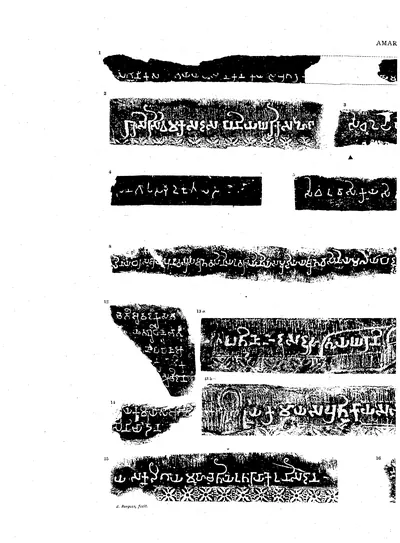 "Amaravati Inscriptions", Nos. 1-16 (left half of the folding plate), including No. 1, dated in the reign of Vasishthiputra Sri Pulumavi, and No. 2, naming "king Sri Sivamaka Sada" (Burgess 1887, Pl. LVI)Inscription rubbing · 1887
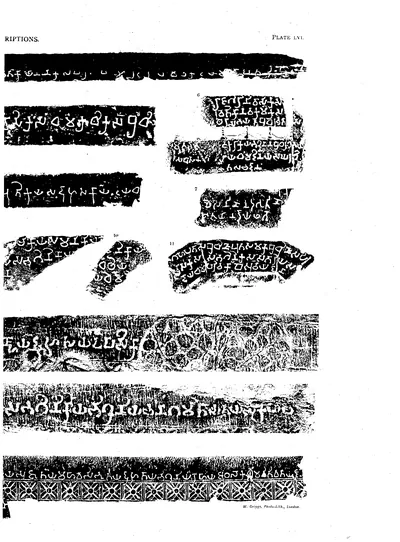 "Amaravati Inscriptions", Nos. 1-16 (right half of the folding plate) (Burgess 1887, Pl. LVI)Inscription rubbing · 1887
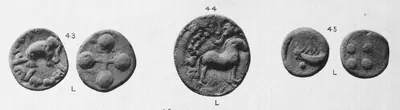 "Andhra Coins": lead coins from the Krishna district with an elephant, a horse and a two-masted ship (Elliot 1886, Pl. II, Nos. 43-45)Coin · 1886
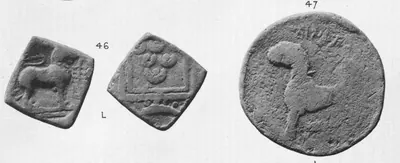 "Andhra Coins": square and round lead coins with a maneless lion, from the Krishna district (Elliot 1886, Pl. II, Nos. 46-47)Coin · 1886
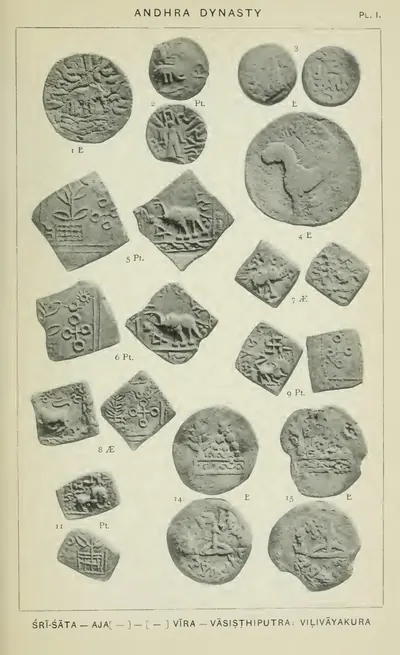 "Andhra Dynasty, Pl. I": coins captioned "Sri-Sata — Aja[ ] — [ ] Vira — Vasisthiputra Vilivayakura" (Rapson 1908)Coin · 1908
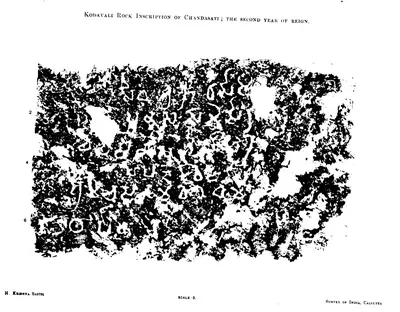 "Kodavali Rock Inscription of Chandasati; the second year of reign" (Epigraphia Indica XVIII, plate)Inscription rubbing · 1926
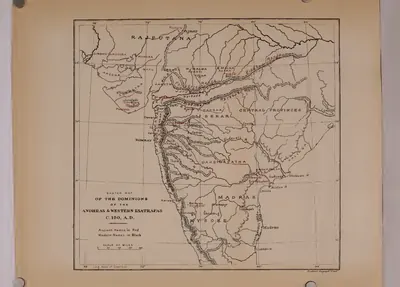 "Sketch map of the dominions of the Andhras & Western Ksatrapas, c. 150 A.D." (Rapson 1908, map)Map · 1908
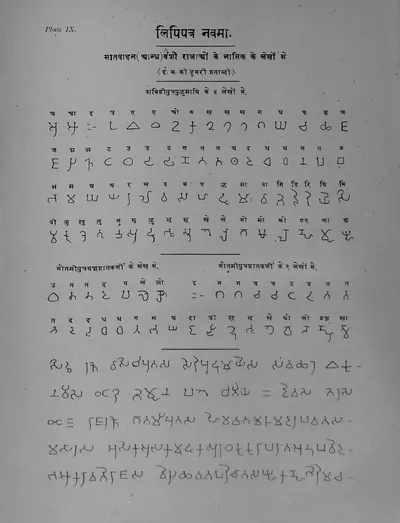 Alphabet table from the Nasik inscriptions of the Satavahana (Andhra) kings, 2nd century CE (Ojha, Bharatiya Prachin Lipimala, 1918, Plate 9)Book plate · 1918
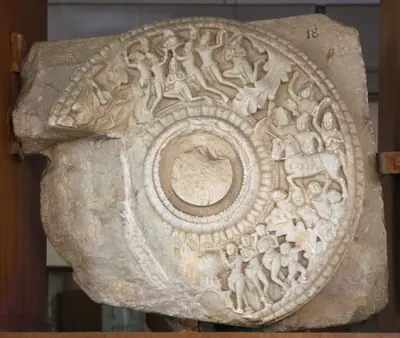 Amaravati roundel, c. 150 CE (Government Museum, Chennai)Photograph · 2019
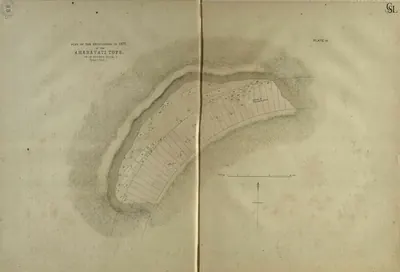 Amaravati: "Plan of the excavations in 1877 at the Amaravati Tope, on an enlarged scale" (Pl. III) (Sewell 1880, Pl. III (PDF p. 40))Plan · 1880
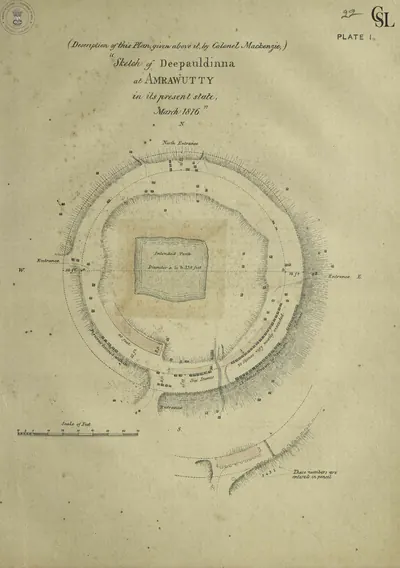 Amaravati: "Sketch of Deepauldinna at Amrawutty in its present state, March 1816", description by Colonel Mackenzie (Pl. I) (Sewell 1880, Pl. I (PDF p. 21))Plan · 1880
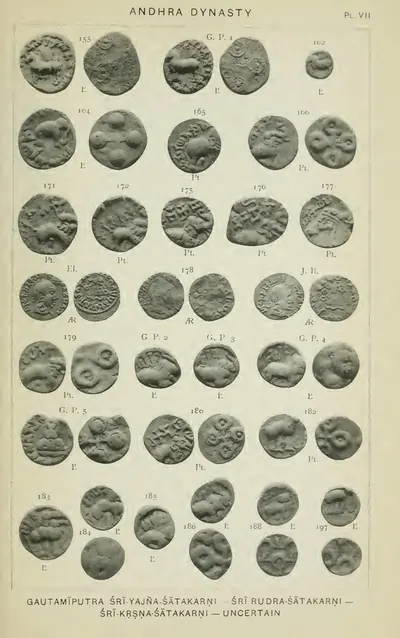 Coins of "Gautamiputra Sri-Yajna-Satakarni - Sri Rudra-Satakarni - Sri-Krsna-Satakarni - uncertain" (Rapson 1908, Pl. VII)Coin · 1908
Show all (19)
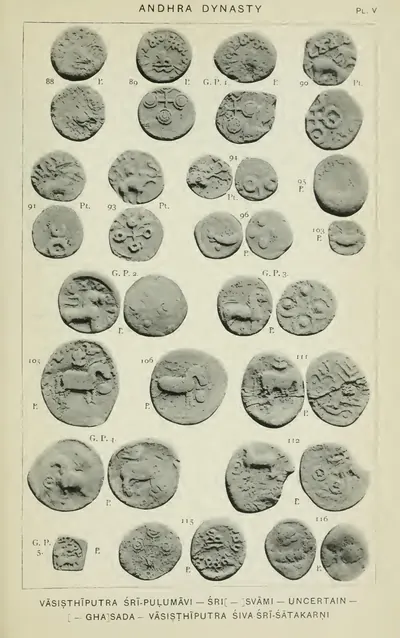 Coins of "Vasisthiputra Sri-Pulumavi - Sri[ ]svami - uncertain - [ ]ghasada - Vasisthiputra Siva Sri-Satakarni", including two-masted ship coins (Rapson 1908, Pl. V)Coin · 1908
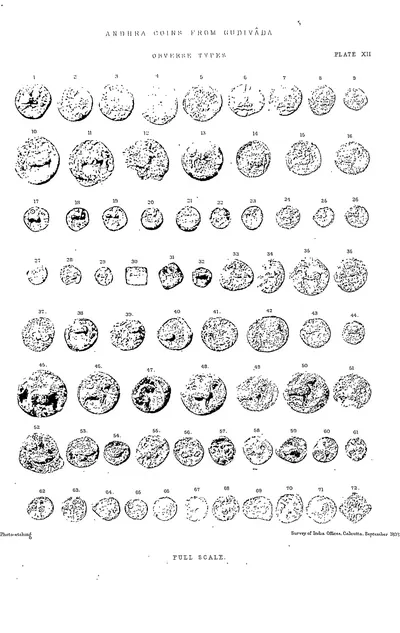 Gudivada: Andhra coins (obverse types) (Rea 1894, Pl. XII)Coin · 1894
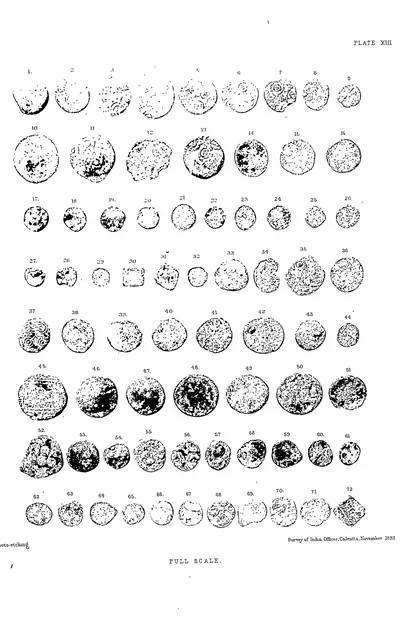 Gudivada: Andhra coins (reverse types) (Rea 1894, Pl. XIII)Coin · 1894
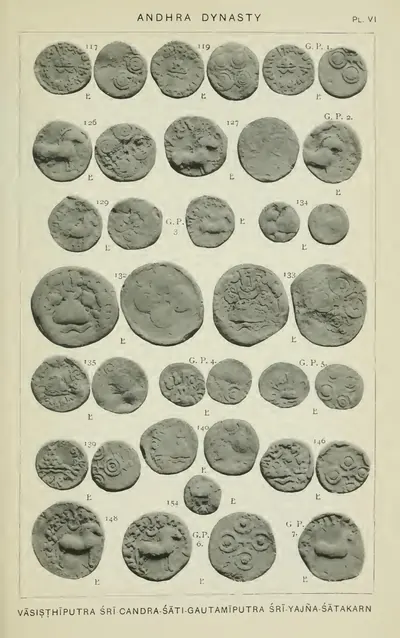 Lead coins of "Vasisthiputra Sri Candra-Sati" and "Gautamiputra Sri-Yajna-Satakarni" from the Kistna and Godavari districts (Rapson 1908, Pl. VI)Coin · 1908
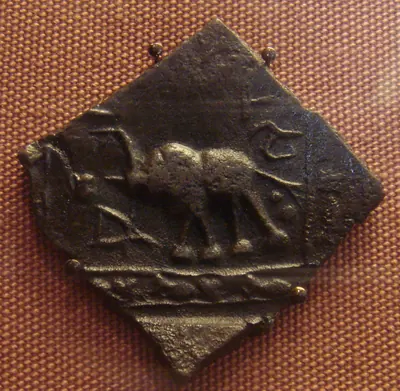 Satavahana copper coin, 1st century BCECoin · 1st century BCE
 Silver portrait coins of Gautamiputra Sri-Yajna-Satakarni, catalogued under Surastra (Rapson 1908, Pl. VII, row 4)Coin · 1908
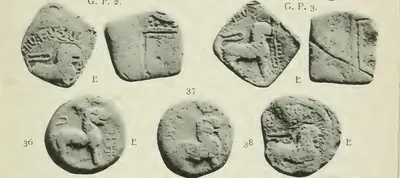 Square and round lead coins with a lion and a tree in railing, name uncertain ("perhaps Sakasada or Sakasena"), Kistna and Godavari districts (Rapson 1908, Pl. III, G.P. 2-3, Nos. 36-38)Coin · 1908
References
Notes (0)
Sources (28)
Spotted an error on this page? Tell us
Last updated: