Alamanda
Village in the old Sringavarapukota taluk of the Vizagapatam district, now in the Vizianagaram district. Copper plates of the Ganga king Anantavarman, son of Rajendravarman, were found underground here in the early 1890s. They are dated in the 304th year of the Gangeya race.
E. Hultzsch reported on three copper plates in Epigraphia Indica III (1894–95).1 They had been “found underground while excavating a site near Alamanda in the Sringavarapukota taluka of the Vizagapatam district”.1 The Collector sent them to him.1
The plates record a grant made at Kalinganagara by the Ganga king Anantavarman, son of Rajendravarman.12 It is dated in “the three-hundred-and-fourth year of the reign of the G[a]ngeya race”.12 The Vizagapatam district gazetteer of 1907 names Alamanda and Visakhapatnam (then Vizagapatam) as the two places in the district where inscriptions of the early Ganga kings had been found.3 See the Alamanda plates and the Eastern Gangas.
Footnotes
-
E. Hultzsch, “Alamanda Plates of Anantavarman”, Epigraphia Indica III (1894–95), p. 17 (archive.org (opens in a new tab)). ↩ ↩2 ↩3 ↩4 ↩5
-
Hultzsch, “Alamanda Plates of Anantavarman” (1895), p. 18 (archive.org (opens in a new tab)). ↩ ↩2
-
W. Francis, Madras District Gazetteers: Vizagapatam, Vol. I (1907), p. 26 (archive.org (opens in a new tab)). ↩
Photos
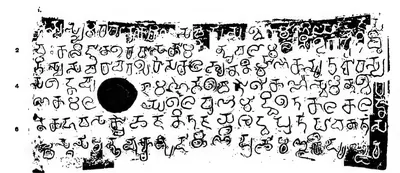 "Alamanda Plates of Anantavarman.—The Year 304", first plate (lines 1-7) (Epigraphia Indica III, plates between pp. 18 and 19, PDF p. 40)Inscription rubbing · 1895
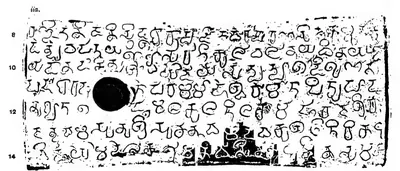 "Alamanda Plates of Anantavarman.—The Year 304", first side of the second plate (lines 8-14) (Epigraphia Indica III, plates between pp. 18 and 19, PDF p. 40)Inscription rubbing · 1895
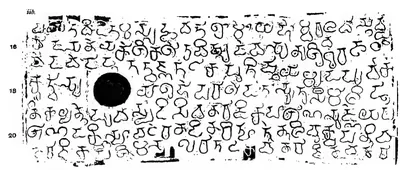 "Alamanda Plates of Anantavarman.—The Year 304", second side of the second plate (lines 15-21) (Epigraphia Indica III, plates between pp. 18 and 19, PDF p. 41)Inscription rubbing · 1895
References
Notes (0)
Sources (2)
Spotted an error on this page? Tell us
Last updated: