Alamanda plates of Anantavarman
A copper-plate grant of the Ganga king Anantavarman, son of Rajendravarman, found near Alamanda in the Vizagapatam district (now Vizianagaram). It was issued from Kalinganagara on a solar eclipse at the consecration of a tank, and it gives the village of Medelaka to a Brahmin. It is dated in the 304th year of the reign of the Gangeya race, one of the clearest references to a Ganga era.
Discovery and description
The three copper plates of this grant were “found underground while excavating a site near Alamanda in the Sringavarapukota taluka of the Vizagapatam district”.1 The Collector, W. A. Willock, sent them to E. Hultzsch, who edited them in Epigraphia Indica III (1894–95).1
The plates are strung on a plain ring, which had been cut before Hultzsch received them.1 The rims are slightly raised to protect the writing, “which is in nearly perfect preservation”.1 The language is “very incorrect Sanskrit”, in prose except for two imprecatory verses (curses).1 See Alamanda.
The grant
The donor is “the glorious Anantavarmadeva”, son of the Maharaja Rajendravarman, “the ornament of the spotless family of the Gangas”.2 The donor is a devout worshipper of Mahesvara, who bows to the god Gokarnasvamin “established on the sinless peak of the Mahendra mountain”.2 The order is issued “from the victorious residence Kalinganagara”.2
The order tells the cultivators of the village of Medelaka, in the district of Tirikatu, that their village was given away.2 The gift was made “at the consecration of a tank, (which took place) at an eclipse of the sun”.2 The donee was Sridhara-Bhatta, son of Vishnudeva, of the Vajasaneya school and the Kausika gotra (clan), who lived at Homvaravala.2 The boundaries include the Chatera river to the south and two tanks to the west and north-west.2
The edict closes with the date: “the year three hundred and four of the prosperous and victorious reign of the G[a]ngeya race”.3
The era and the king
Hultzsch observed that the passage praising the king is word for word the same as in a grant of Devendravarman, son of Anantavarman, published by J. F. Fleet.4 Fleet intended to treat the chronology of the Gangas.4 So Hultzsch refrained “from attempting any conjectures regarding the date”.4
But Hultzsch pointed out that the grant seemed to use the same era as Fleet’s grant of the year 254.4 He concluded that this Anantavarman must be later than, and distinct from, the father of Devendravarman.4 On V. V. Mirashi’s epoch of the Ganga era, 498, the year 304 falls in about 802.5 The date on this page follows that epoch. See the Eastern Gangas for the other views.
Kalinganagara
Hultzsch wrote in a footnote that Kalinganagara was “probably the modern Calingapatam”.4 Two years later G. V. Ramamurti argued that the Ganga capital was at Mukhalingam instead.67 The Imperial Gazetteer of 1908 accepted this identification.67 See Kalingapatnam.
Other notices
The Vizagapatam district gazetteer of 1907 names Alamanda and Visakhapatnam (then Vizagapatam) as the places in that district where inscriptions of the early Gangas had been found.8 V. Rangacharya’s list of 1919 summarises the grant under Alamanda in the Sringavarapukota taluk.9
Footnotes
-
E. Hultzsch, “Alamanda Plates of Anantavarman”, Epigraphia Indica III (1894–95), p. 17 (archive.org (opens in a new tab)). ↩ ↩2 ↩3 ↩4 ↩5
-
Hultzsch, “Alamanda Plates of Anantavarman” (1895), p. 20, translation (archive.org (opens in a new tab)). ↩ ↩2 ↩3 ↩4 ↩5 ↩6 ↩7
-
Hultzsch, “Alamanda Plates of Anantavarman” (1895), p. 21, translation of line 28 (archive.org (opens in a new tab)). ↩
-
Hultzsch, “Alamanda Plates of Anantavarman” (1895), p. 18 and note 1 (archive.org (opens in a new tab)). ↩ ↩2 ↩3 ↩4 ↩5 ↩6
-
V. V. Mirashi, “Epoch of the Ganga Era”, Epigraphia Indica XXVI (1941–42), p. 333 (archive.org (opens in a new tab)). Paraphrased. ↩
-
G. V. Ramamurti, “Nadagam Plates of Vajrahasta; Saka-Samvat 979”, Epigraphia Indica IV (1896–97), pp. 187–188 (archive.org (opens in a new tab)). ↩ ↩2
-
Imperial Gazetteer of India, Provincial Series: Madras, Vol. I (1908), p. 228 (archive.org (opens in a new tab)). ↩ ↩2
-
W. Francis, Madras District Gazetteers: Vizagapatam, Vol. I (1907), p. 26 (archive.org (opens in a new tab)). ↩
-
V. Rangacharya, A Topographical List of the Inscriptions of the Madras Presidency, Vol. III (1919), p. 1671, Vizagapatam No. 36-A (archive.org (opens in a new tab)). ↩
Photos
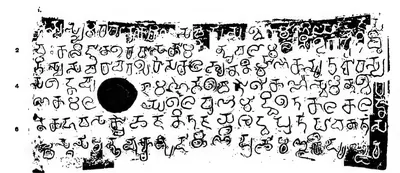 "Alamanda Plates of Anantavarman.—The Year 304", first plate (lines 1-7) (Epigraphia Indica III, plates between pp. 18 and 19, PDF p. 40)Inscription rubbing · 1895
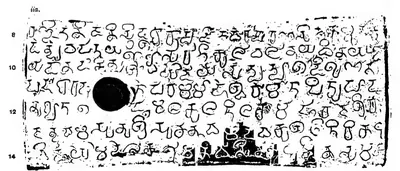 "Alamanda Plates of Anantavarman.—The Year 304", first side of the second plate (lines 8-14) (Epigraphia Indica III, plates between pp. 18 and 19, PDF p. 40)Inscription rubbing · 1895
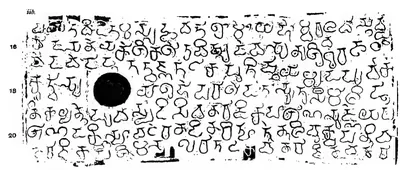 "Alamanda Plates of Anantavarman.—The Year 304", second side of the second plate (lines 15-21) (Epigraphia Indica III, plates between pp. 18 and 19, PDF p. 41)Inscription rubbing · 1895
References
Notes (0)
Sources (6)
Spotted an error on this page? Tell us
Last updated: