Ahobilam
Village and temple of Narasimha on the Nallamalai hills in the Kurnool district, 'the most sacred Vaishnava shrine' of the district. Reddi records credit Prolaya Vema with a flight of steps there. Kataya Vema gave it villages named after Kumaragiri in 1410, and Errapragada dedicated his Narasimha Purana to its god.
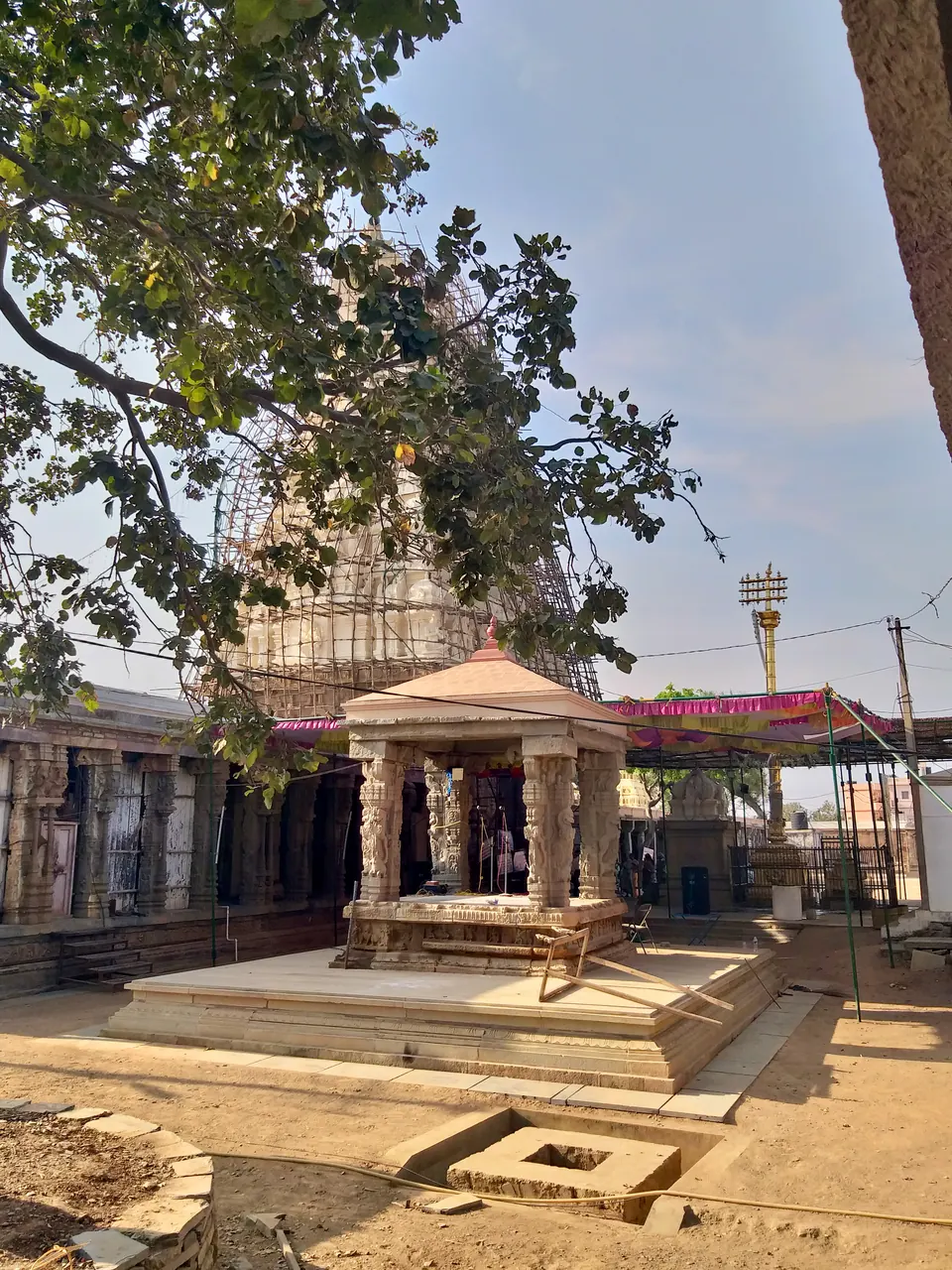
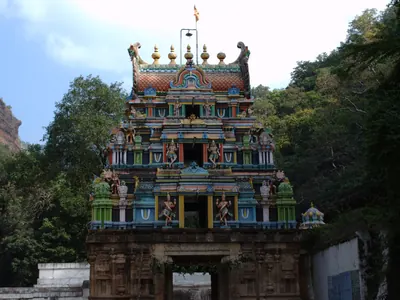
The Imperial Gazetteer of 1908 describes Ahobilam as a village and temple in the Sirvel taluk of the Kurnool district, at 15°8′ N, 78°45′ E, on the Nallamalais.1 It says: “The temple is the most sacred Vaishnava shrine in the District, and has three parts”.1 These are:1
- “Diguva (lower) Ahobilam temple at the foot of the hills”
- “Yeguva (upper) Ahobilam about 4 miles higher up”
- “a small shrine on the summit”1
The lower temple has reliefs of scenes from the Ramayana.1 It has two great stone halls on pillars “8 feet in circumference, hewn out of the rock”.1
The Reddis at Ahobilam
In 1906 J. Ramayya noted that the Amaravati inscription mentions Vema’s building of steps leading to the temples “at Srisailam and Ahobalam”.2 His own grant of 1345 does not mention them.2
The Pedapalakaluru plates of 1378 say that Vema built two flights of steps, at Srigiri and Ahobilagiri, as lasting pillars of victory.34 Their donee was honoured as if he were Narasimha of Ahobilam.34 Robert Sewell wrote that Prolaya Vema is widely remembered for steps leading up to the temples at Srisailam and Ahobilam.5 The poet Errapragada dedicated his Narasimha Purana to the god Narasimha of Ahobilam.67
Kataya Vema’s gift
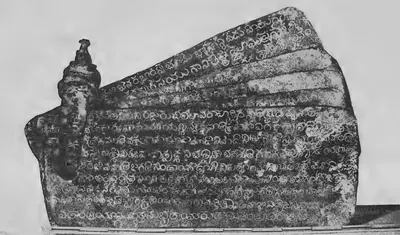
In 1410 Kataya Vema, ruler of Rajahmundry, gave the village of Kaluvacheru, renamed Komaragiripuram, to the god Ahobaladeva.8 It was to provide daily offerings to the god, for the merit of Komaragiri Reddi.8 The inscription is on a slab on the way to the Pamuleti-Narasimha shrine.8
It also lists the villages of “Komaragiri-mandalam” that he had given to temples and Brahmans for the merit of his master and brother-in-law.8 It records gifts by his wives as well.8 See the Reddis of Rajahmundry and Kumaragiri Reddi.
Footnotes
-
Imperial Gazetteer of India: Madras, Vol. I (1908), p. 424 (archive.org (opens in a new tab)). ↩ ↩2 ↩3 ↩4 ↩5 ↩6
-
J. Ramayya, Madras Museum Plates of Vema, A.D. 1345, Epigraphia Indica VIII (1905–06), p. 12 (archive.org (opens in a new tab)). ↩ ↩2
-
N. Ramesan, Copper Plate Inscriptions of Andhra Pradesh Government Museum, Hyderabad, Vol. I (1962), p. 189 (archive.org (opens in a new tab)). ↩ ↩2
-
Ramesan, Copper Plate Inscriptions, Vol. I (1962), p. 190 (archive.org (opens in a new tab)). ↩ ↩2
-
Robert Sewell, The Historical Inscriptions of Southern India (1932), p. 183 (archive.org (opens in a new tab)). ↩
-
H. K. Narasimhaswami, Koduru Grant of Ana-Vota-Reddi; Saka 1280, Epigraphia Indica XXV (1939–40), p. 138 (archive.org (opens in a new tab)). ↩
-
Narasimhaswami, Koduru Grant of Ana-Vota-Reddi (1939–40), p. 139 (archive.org (opens in a new tab)). ↩
-
V. Rangacharya, A Topographical List of the Inscriptions of the Madras Presidency, Vol. II (1919), p. 975, Kurnool No. 598 (archive.org (opens in a new tab)). ↩ ↩2 ↩3 ↩4 ↩5
Photos
Related
People
Errapragada
c. 1280–1350 CE
Telugu poet of the 14th century, the third of the 'Kavitraya' who completed the Telugu Mahabharata. He finished the Aranya Parva that Nannaya had left incomplete. He was a Niyogi Brahman of Gudluru in the Nellore country and a devotee of Siva (Sambhudasa). He was attached to Prolaya Vema, the founder of the Reddi kingdom, and dedicated his Harivamsa to him. He also wrote a Ramayana and the Narasimha Purana for the god of Ahobilam.
Prolaya Vema Reddi
c. 1325–1353 CE
Founder of the Reddi kingdom of Addanki and Kondavidu (c. 1325–1353). He took over the country between Srisailam and the sea after the fall of the Kakatiyas. His grants of 1345 and 1346 say he restored the Brahman villages seized by the Muslim conquerors of Warangal. Later records remember him for the flights of steps at Srisailam and Ahobilam, and the poet Errapragada dedicated his Harivamsa to him.
Kataya Vema
c. 1386–1415 CE
Minister and brother-in-law of Kumaragiri of Kondavidu. He received 'the eastern country' with Rajahmundry as its capital in the 1380s, and ruled the Godavari delta and the coast to Simhachalam until about 1414–16. A grandson of Prolaya Vema through his mother, he was also a Sanskrit scholar. He wrote the Kumaragirirajiyam, a commentary on Kalidasa's plays.
Saluva Narasimha
c. 1485–1492 CE
Chief of the Saluva family of Chandragiri. He drove the Gajapatis of Orissa back up the coast towards Rajahmundry and faced the Bahmani sultan there in the 1470s. In 1485–86 he took the throne of Vijayanagara from the last Sangama king and founded the second, Saluva, dynasty. He died in 1492–93 and left his young sons in the charge of his general Narasa Nayaka. Whether he recovered Udayagiri from Orissa is disputed.
Monuments
Inscriptions
References
Notes (0)
Sources (6)
Spotted an error on this page? Tell us
Last updated: