Darsi
Town formerly in the Podili division of the Nellore district, now in Prakasam, where the first plate of a lost Pallava grant issued from Dasanapura was found in a tobacco field. V. Venkayya suggested that Dasanapura, one of the camps of the Pallava kings of the Nellore–Guntur country, was the old name of Darsi itself.
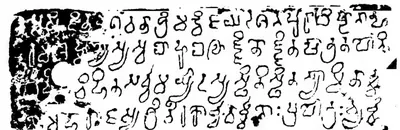
Darsi was a village of the Nellore district when E. Hultzsch reported in 1892 that the first plate of a Pallava copper-plate grant had been “found lying in a tobacco field” there. The plate went to the Madras Museum.1 D. C. Sircar placed Darsi in the Podili division of the Nellore district.2 See the Darsi plate.
Dasanapura
The plate was issued “from the prosperous and victorious residence of Dasanapura” by a great-grandson of the Pallava Maharaja Virakorchavarman.3 Dasanapura was also the place from which the Pallava king Simhavarman issued his Mangalur grant.3 V. Venkayya suggested that Dasanapura was the ancient name of Darsi, which is called Darsi and Darisi in inscriptions of the 14th century found there. He thought it may have been the capital when the Mangalur grant was issued.4 Sircar and the Nellore gazetteer of 1942 reported this identification.56
Later history
The Nellore gazetteer noted records of the Chalukyas in the Darsi taluk, among them an Eastern Chalukya inscription at Bodanampadu.78
Footnotes
-
E. Hultzsch, “A Plate of a Pallava Copper-plate Grant”, Epigraphia Indica I (1892), p. 397 (archive.org (opens in a new tab)). ↩
-
D. C. Sircar, The Successors of the Satavahanas in Lower Deccan (1939), p. 202 (archive.org (opens in a new tab)). ↩
-
Hultzsch, “A Plate of a Pallava Copper-plate Grant” (1892), pp. 397–398 (archive.org (opens in a new tab)). ↩ ↩2
-
R. Gopalan, History of the Pallavas of Kanchi (1928), p. 62 (archive.org (opens in a new tab)). ↩
-
Sircar, Successors of the Satavahanas (1939), p. 211 (archive.org (opens in a new tab)). ↩
-
Gazetteer of the Nellore District, brought up to 1938, Vol. A (1942), p. 30 (archive.org (opens in a new tab)). ↩
-
Gazetteer of the Nellore District (1942), p. 33 (archive.org (opens in a new tab)). ↩
-
Gazetteer of the Nellore District (1942), p. 35 (archive.org (opens in a new tab)). ↩
Photos
References
Notes (0)
Sources (4)
Spotted an error on this page? Tell us
Last updated: