Mangalur grant of Simhavarman
A Sanskrit copper-plate grant issued from Dasanapura in the eighth year of the Pallava king Simhavarman, son of the crown prince Vishnugopa. It gives the village of Mangadur in Vengorashtra to eight Brahmans. J. F. Fleet published it in 1876 from Sir Walter Elliot's facsimiles. D. C. Sircar took Vengorashtra to be the southern edge of the Vengi country, and V. Venkayya suggested that Dasanapura was Darsi.
The Mangalur grant is one of four surviving grants of the Pallava king Simhavarman, son of the crown prince Vishnugopa. Like the Uruvupalli grant, it was published by J. F. Fleet in 1876 from Sir Walter Elliot’s collection of facsimiles.1 Fleet worked from the facsimile and recorded no findspot.1
Description
There are six plates.1 To judge from their numerals, the writing begins on the outside of the first plate and ends on the outside of the last, as in the Uruvupalli grant.1 The facsimile shows no device on the seal.1
E. Hultzsch noted that its alphabet is very like those of the Uruvupalli and Pikira grants.2 He also noted that both looped and unlooped forms of ta are used.2
Content
In Fleet’s translation, the grant was issued “from the glorious and victorious city of Dasanapura” by Simhavarman.3 Simhavarman was the great-grandson of the Great King Viravarman, grandson of the Great King Skandavarman and son of the yuvaraja (crown prince) Vishnugopa.3 The grant is addressed to the villagers of Mangadur in the country of Vengorashtra and to the officials.3
The king made the gift on the fifth day of the bright fortnight of Chaitra, in the eighth year of his reign.4 He gave the village to eight Brahmans, free of taxes and except for the land of the god.4 The eight were these:4
- Rudrasarma, Turkasarma, Damasarma and Yajnasarma4
- Bhavakotigopa, Bhartrisarma, Sivadatta and Shashthikumara4
The grant ends with the usual verses and the words “This has been engraved by Nemi at the personal command of the king.”4 C. R. Krishnamacharlu noted that its wording is quite unlike that of the king’s other grants.5 It reads as if Nemi had composed it in a style of his own.5
The places
Fleet did not know where Dasanapura was, and wondered whether the name might be a Sanskrit form of a Kannada name meaning “the village of the tooth”.1 Hultzsch thought Dasanapura, like Palakkada and Menmatura, still unidentified.6
R. Gopalan reported V. Venkayya’s suggestion that Dasanapura was the old name of Darsi.7 Darsi is called Darsi and Darisi in 14th-century inscriptions.7 In Venkayya’s suggestion, it was perhaps the capital when this grant was made.7
D. C. Sircar placed Mangadur in the southern edge of the old Salankayana kingdom of Vengi.8 He found in this grant no evidence that the Pallavas ever held the city of Vengi itself.9
Date
The grant is dated only in Simhavarman’s regnal years. Fleet placed it with the Uruvupalli grant in the same family.1 He suggested that its Simhavarman was the son of Vishnugopa, whereas the king of the Uruvupalli grant was Vishnugopa’s elder brother.1
Hultzsch gave this grant and the Pikira grant to the same Simhavarman, and Sircar did the same.210 Its date therefore depends on the disputed date of that king: see Simhavarman II.210
Footnotes
-
J. F. Fleet, “Sanskrit and Old-Canarese Inscriptions, No. XV”, Indian Antiquary V (1876), p. 154 (archive.org (opens in a new tab)). ↩ ↩2 ↩3 ↩4 ↩5 ↩6 ↩7 ↩8
-
E. Hultzsch, “Pikira Grant of Simhavarman”, Epigraphia Indica VIII (1905–06), p. 160 (archive.org (opens in a new tab)). ↩ ↩2 ↩3 ↩4
-
Fleet, “Sanskrit and Old-Canarese Inscriptions, No. XV” (1876), p. 156, translation (archive.org (opens in a new tab)). ↩ ↩2 ↩3
-
Fleet, “Sanskrit and Old-Canarese Inscriptions, No. XV” (1876), p. 157, translation (archive.org (opens in a new tab)). ↩ ↩2 ↩3 ↩4 ↩5 ↩6
-
C. R. Krishnamacharlu, “Vilavatti Grant of Pallava Simhavarman”, Epigraphia Indica XXIV (1937–38), p. 299 (archive.org (opens in a new tab)). ↩ ↩2
-
Hultzsch, “Pikira Grant of Simhavarman” (1906), p. 161 (archive.org (opens in a new tab)). ↩
-
R. Gopalan, History of the Pallavas of Kanchi (1928), p. 62 (archive.org (opens in a new tab)). ↩ ↩2 ↩3
-
Sircar, Successors of the Satavahanas (1939), p. 212 (archive.org (opens in a new tab)). ↩
-
D. C. Sircar, The Successors of the Satavahanas in Lower Deccan (1939), p. 70 (archive.org (opens in a new tab)). ↩
-
Sircar, Successors of the Satavahanas (1939), p. 211 (archive.org (opens in a new tab)). ↩ ↩2
Photos
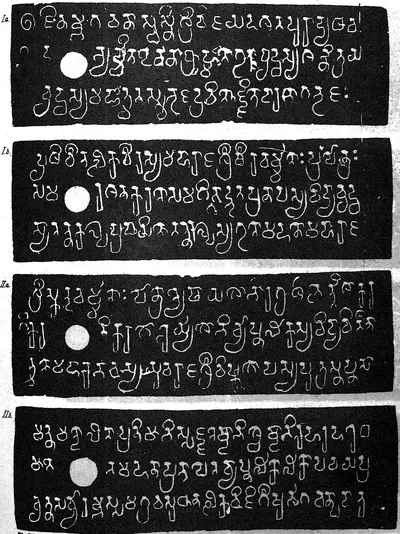 "Copper-plate Grant of the Pallava Dynasty" (the Mangalur grant of Simhavarman), plates I a, I b, II a and II b (Indian Antiquary V, 1876, plate at p. 154 (PDF p. 186))Inscription rubbing · 1876
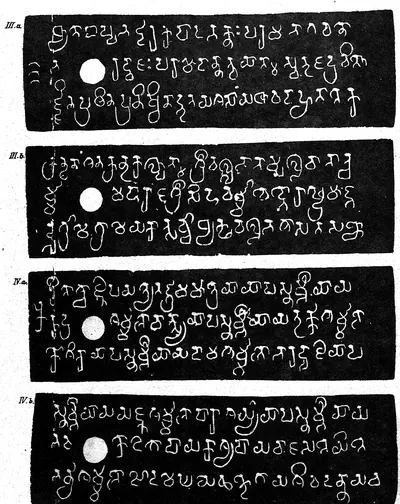 "Copper-plate Grant of the Pallava Dynasty" (the Mangalur grant of Simhavarman), plates III a, III b, IV a and IV b (Indian Antiquary V, 1876, plate at p. 155 (PDF p. 187))Inscription rubbing · 1876
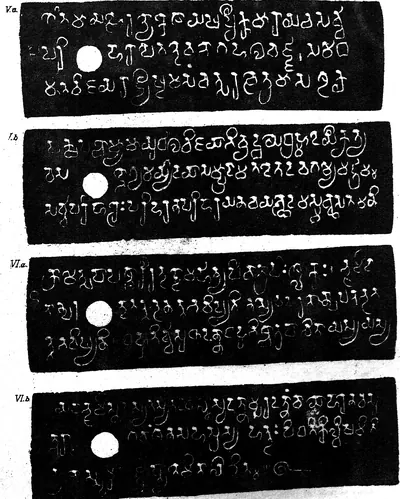 "Copper-plate Grant of the Pallava Dynasty" (the Mangalur grant of Simhavarman), plates V a, V b, VI a and VI b (Indian Antiquary V, 1876, plate at p. 156 (PDF p. 190))Inscription rubbing · 1876
References
Notes (0)
Sources (5)
Spotted an error on this page? Tell us
Last updated: