Simhavarman II (Pallava)
Pallava king of the Nellore–Guntur country, son of the crown prince Vishnugopa. Four of his grants survive. All give villages in the Guntur and Nellore districts and were issued from camps, not from Kanchi: the second Omgodu grant (year 4), the Pikira grant from Menmatura (year 5), the Mangalur grant from Dasanapura (year 8) and the Vilavatti grant (year 10). Many scholars date his accession to 436 from a Jain work, the Lokavibhaga; others place him about 500.
Simhavarman is the best-documented king of the Pallava line of the Guntur and Nellore country. Four grants in his name survive, all in Sanskrit, and all giving villages in that region.12 This site calls him Simhavarman II after H. Krishna Sastri, who edited his second Omgodu grant, but Robert Sewell and others numbered him differently.13
Family
Simhavarman was the son of the crown prince Vishnugopa.41 His Pikira, Mangalur and Omgodu grants all name his father Vishnugopa, his grandfather Skandavarman and his great-grandfather Viravarman.41 See Vishnugopa (Pallava crown prince).
Vijaya-Vishnugopavarman, the issuer of the Chura grant, calls himself the son of a Simhavarman, grandson of a Maharaja Vishnugopavarman and great-grandson of a Skandavarman.56 C. R. Krishnamacharlu and D. C. Sircar took him to be this king’s son.5678
H. Krishna Sastri at first thought him a later king, because the Chura plates are written in later letters and call Vishnugopa maharaja (king), not yuvamaharaja (crown prince).68 Krishnamacharlu saw no real difficulty in the title.6 Sircar suggested that the Chura plates, like the second Omgodu grant, were a 7th-century copy of an older grant, and that the title was an engraver’s slip.68
The Uruvupalli grant is dated in the 11th year of a Simhavarman.4910 Whether he was this king or an elder brother of his father is disputed. J. F. Fleet and G. Jouveau-Dubreuil held the second view, and E. Hultzsch and Krishnamacharlu the first.4910
His grants
| Grant | Year | Issued from | Village and district |
|---|---|---|---|
| Omgodu No. 2111 | 4th | “the victorious camp” | Omgodu in Karmarashtra |
| Pikira412 | 5th | Menmatura | Pikira in Mundarashtra |
| Mangalur13 | 8th | Dasanapura | Mangadur in Vengorashtra |
| Vilavatti142 | 10th | Paddukkara | Vilavatti in Mundarashtra |
Krishna Sastri thought the second Omgodu grant a 7th-century copy of an older grant.1 His reasons were that its letters are a century later than those of the first Omgodu grant, and it has many mistakes.1
In the Pikira grant the king calls himself a fervent bhagavata, a devotee of Vishnu, “devoted to the feet of the lord (his) father”.15 The grant also calls the Pallavas performers of many horse sacrifices.15 Sircar concluded that he was a Vaishnava.1516
Date
A Jain work, the Lokavibhaga, says that it was completed in the 22nd year of Simhavarman, lord of Kanchi, equated with Saka 380 (458; Saka is an Indian way of counting years).1117 Fleet, Krishna Sastri and R. Gopalan took this Simhavarman to be Vishnugopa’s son and dated his accession to 436.1117
Krishna Sastri thought the second Omgodu grant was made on an eclipse.111819 He objected that this eclipse did not fall in 440, the king’s fourth year by that reckoning.111819 Gopalan replied that the grant was not made on an eclipse at all.111819 Krishnamacharlu answered that an eclipse did occur in 440, accepted 436, and dated the Vilavatti grant to 446.2
Jouveau-Dubreuil distrusted the Lokavibhaga, because it does not say which Simhavarman is meant. He counted back 25 years a generation from Mahendravarman I, and so dated Vishnugopa’s son 500–525.2021 Sircar accepted the date of 436 but gave it to a different Simhavarman, of the Kanchi line: the father of the Skandavarman named in the Udayendiram plates.2223
The Gangas of Penukonda
Copper plates of the Western Ganga king Madhava were found at Penukonda, in the Anantapur district.11 They say that the Pallava Simhavarman anointed Madhava’s father Ayyavarman, and the Pallava Skandavarman anointed Madhava himself.11
Krishna Sastri, Gopalan and Sewell took this Simhavarman to be the king of the Lokavibhaga, about the middle of the 5th century.11173 Jouveau-Dubreuil placed the plates about 500.2425 He took their Simhavarman to be the king of the Uruvupalli grant, whom he made the elder brother of Vishnugopa.2425
Footnotes
-
H. Krishna Sastri, “Two Pallava Copper-plate Grants”, Epigraphia Indica XV (1919–20), p. 252 (archive.org (opens in a new tab)). ↩ ↩2 ↩3 ↩4 ↩5 ↩6 ↩7
-
Krishnamacharlu, “Vilavatti Grant” (1938), p. 301 (archive.org (opens in a new tab)). ↩ ↩2 ↩3
-
Robert Sewell and S. Krishnaswami Aiyangar, The Historical Inscriptions of Southern India (1932), p. 18 (archive.org (opens in a new tab)). ↩ ↩2
-
E. Hultzsch, “Pikira Grant of Simhavarman”, Epigraphia Indica VIII (1905–06), p. 160 (archive.org (opens in a new tab)). ↩ ↩2 ↩3 ↩4 ↩5
-
C. R. Krishnamacharlu, “Chura Grant of Pallava Vijaya-Vishnugopavarman”, Epigraphia Indica XXIV (1937–38), p. 138 (archive.org (opens in a new tab)). ↩ ↩2
-
Krishnamacharlu, “Chura Grant” (1938), p. 139 (archive.org (opens in a new tab)). ↩ ↩2 ↩3 ↩4 ↩5
-
D. C. Sircar, The Successors of the Satavahanas in Lower Deccan (1939), p. 172 (archive.org (opens in a new tab)). ↩
-
Sircar, Successors of the Satavahanas (1939), p. 173 (archive.org (opens in a new tab)). ↩ ↩2 ↩3
-
G. Jouveau-Dubreuil, Ancient History of the Deccan (1920), p. 63 (archive.org (opens in a new tab)). ↩ ↩2
-
Krishnamacharlu, “Vilavatti Grant” (1938), p. 299 (archive.org (opens in a new tab)). ↩ ↩2
-
Krishna Sastri, “Two Pallava Copper-plate Grants” (1920), p. 253 (archive.org (opens in a new tab)). ↩ ↩2 ↩3 ↩4 ↩5 ↩6 ↩7 ↩8 ↩9
-
Hultzsch, “Pikira Grant of Simhavarman” (1906), p. 161 (archive.org (opens in a new tab)). ↩
-
J. F. Fleet, “Sanskrit and Old-Canarese Inscriptions, No. XV”, Indian Antiquary V (1876), p. 154 (archive.org (opens in a new tab)). ↩
-
C. R. Krishnamacharlu, “Vilavatti Grant of Pallava Simhavarman”, Epigraphia Indica XXIV (1937–38), pp. 296–297 (archive.org (opens in a new tab)). ↩
-
Hultzsch, “Pikira Grant of Simhavarman” (1906), pp. 162–163, translation (archive.org (opens in a new tab)). ↩ ↩2 ↩3
-
Sircar, Successors of the Satavahanas (1939), p. 205 (archive.org (opens in a new tab)). ↩
-
R. Gopalan, History of the Pallavas of Kanchi (1928), p. 66 (archive.org (opens in a new tab)). ↩ ↩2 ↩3
-
Gopalan, History of the Pallavas of Kanchi (1928), p. 67 (archive.org (opens in a new tab)). ↩ ↩2 ↩3
-
Gopalan, History of the Pallavas (1928), p. 68 (archive.org (opens in a new tab)). ↩ ↩2 ↩3
-
G. Jouveau-Dubreuil, The Pallavas (1917), p. 18 (archive.org (opens in a new tab)). ↩
-
Jouveau-Dubreuil, Ancient History of the Deccan (1920), p. 68 (archive.org (opens in a new tab)). ↩
-
Sircar, Successors of the Satavahanas (1939), p. 177 (archive.org (opens in a new tab)). ↩
-
Sircar, Successors of the Satavahanas (1939), p. 178 (archive.org (opens in a new tab)). ↩
-
Jouveau-Dubreuil, The Pallavas (1917), p. 25 (archive.org (opens in a new tab)). ↩ ↩2
-
Jouveau-Dubreuil, The Pallavas (1917), p. 26 (archive.org (opens in a new tab)). ↩ ↩2
Photos
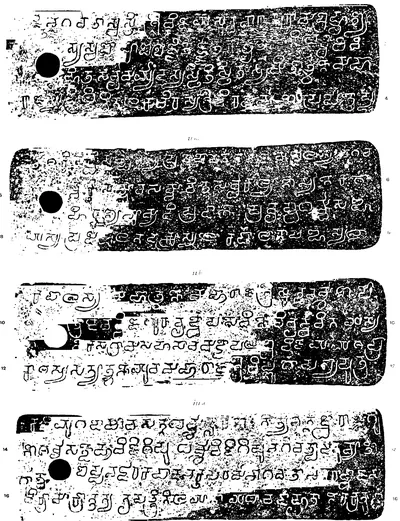 "Omgodu Grant of the Pallava Simhavarman II: the 4th year", first page, lines 1-16 (Epigraphia Indica XV, plate with No. 11 (PDF p. 304))Inscription rubbing · 1920
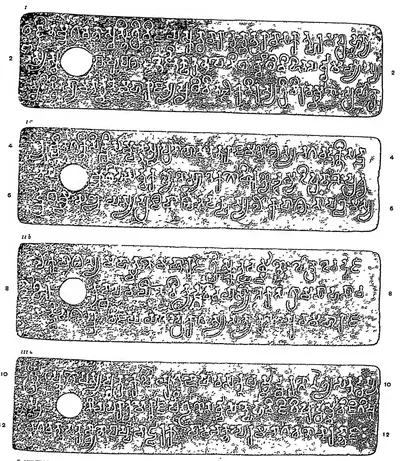 "Pikira grant of Simhavarman", plates i, ii a, ii b and iii a (Epigraphia Indica VIII, plate with No. 15 (PDF p. 201))Inscription rubbing · 1906
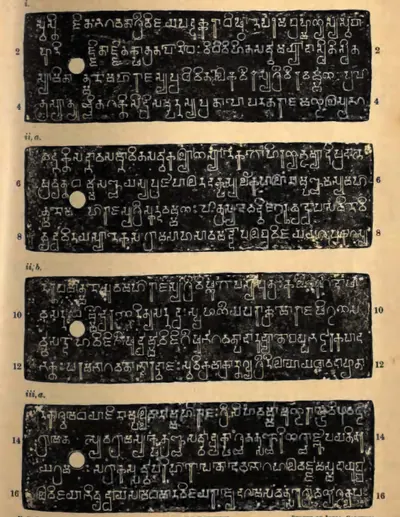 "Vilavatti Grant of Pallava Simhavarman", plates i, ii a, ii b and iii a (Epigraphia Indica XXIV, plate with No. 43 (PDF p. 382))Inscription rubbing · 1938
Related
Dynasties

References
Notes (0)
Sources (9)
Spotted an error on this page? Tell us
Last updated: