Devarakonda
Town and hill fort in the south-west of the Nalgonda district. From Mada Nayaka in the 1360s it was the seat of the Devarakonda branch of the Recherla Velamas. In 1459 its chief, with an army from Orissa, routed a Bahmani force sent against it. Sultan Quli of Golconda took it early in the sixteenth century.
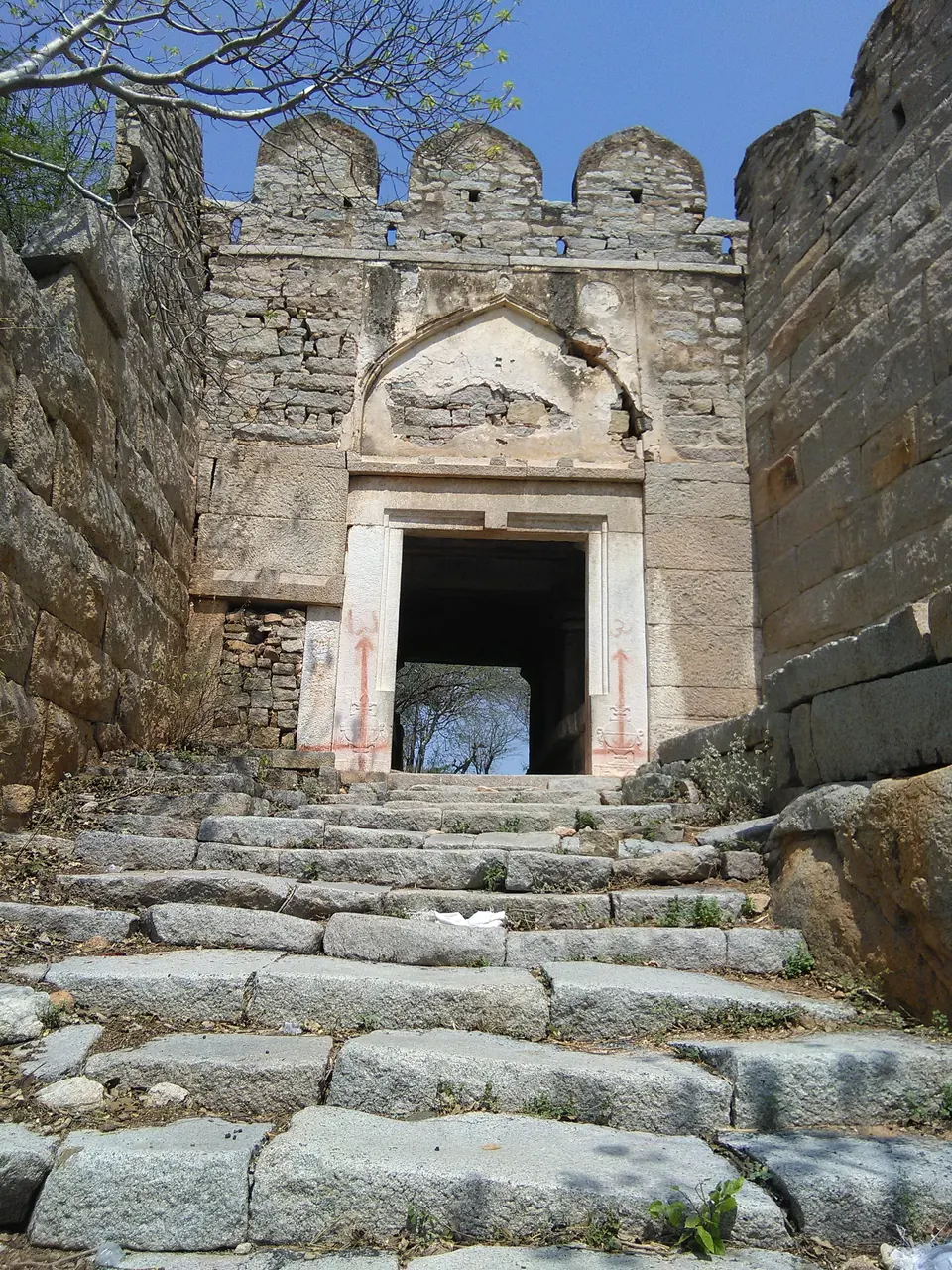
Devarakonda was the headquarters of the south-western taluk of the Nalgonda district, a hilly country on the Krishna.1 In 1901 the town had 3,186 people.1 The Imperial Gazetteer of 1909 counted its fort, “surrounded by seven hills”, among the chief antiquities of the district.2 It said that the fort was “at one time considered a formidable stronghold, but is now in ruins”.2
The Kandikonda inscription of 1375 calls the place Devagiri, the god’s hill.3 Epigraphia Telanganica, summarising another reading of the same record, calls it Devapuri.4
Seat of the Devarakonda branch
The family chronicle printed in 1910 says that after the victories of 1361 Anapota Nayaka made his brother Mada Nayaka ruler of Devarakonda.5 The same book prints Mada’s inscription at Umamahesvaram (1377).6 It places his throne at Madhavapura, the town named after him, south of Devanaga, the god’s hill.6 Epigraphia Telanganica calls Mada the real founder of the Devarakonda branch.7
By his order his son Venna, who had been living at Devagiri, went to govern Kandikonda.3 According to Epigraphia Telanganica, the family genealogy Velugotivari Vamsavali says that Mada’s son Peda Vedagiri succeeded him at Devarakonda.8 A tank inscription of 1427 at Sarikonda traces the descent of Lingama Nayaka from this Vedagiri.9 See the Recherla Velamas.
The fort
Alladi Jagannatha Sastri wrote the history of the Venkatagiri family in 1922.10 He called Devarakonda a natural fort, almost impregnable (impossible to take).10 He described it like this:10
- it was divided into 360 blocks
- it had nine main and thirty-two lesser entrances
- it had a granary for 125,000 putties of grain
- it had nine sardars (commanders), each at the head of 12,000 troops, whose descendants still held jagirs (land grants) granted by the Recherla kings10
From a Nizam’s tahsildar (revenue officer) he had a list of the chiefs who had reigned there.11 The list ended with a Lakshmana Rao, from whom, he said, the Nawab of Hyderabad finally took the fort.11
Jagannatha Sastri also wrote about the founder of the Velugoti line of the sixteenth century, Nirvana Rayappa Naidu.12 He said that Nirvana Rayappa Naidu lived at Devarakonda before he moved his capital to Velugodu in the Kurnool district.12
The siege of 1459
The Burhan-i Ma’asir names the “Rayas of Devarkonda and Rajkonda” among the chiefs who agreed to pay tribute to the Bahmani sultan Ahmad Shah after his invasion of Telingana.13 Under Humayun Shah the Bahmani general Khwaja Jahan arrived before “the fort of Davarakonda, which owing to its immense strength had never been taken by any conqueror”.14 “It was excessively lofty and had a deep aqueduct running into it.”14
Ferishta says that the fortress belonged to a zemindar (landholder) of Telingana who had supported the rebel Sikandar Khan.15 He says that it was “situated among high mountains and difficult woods”.15 The defenders bought help from the Raja of Orissa.1516 When his troops arrived, the garrison sallied out, and the Bahmani cavalry could not act in the broken ground.1516 The besiegers were routed and pursued for eighty miles, to Warangal.1516
The Kistna district manual dates the expedition against “the revolted Telugu fortress of Devarakonda” to 1459.17 Ferishta calls him only “a zemindar of Tulingana” and does not name him.15
An inscription in Warangal fort records that Ambira-deva, a son of the Gajapati king Kapilendra of Orissa, captured the fort of Warangal. The Archaeological Department of the Nizam’s Dominions, in its report for 1934–35, suggested that the Orissan force which relieved Devarakonda went on to take Warangal from the Bahmanis.18
Later history
John Briggs translated a Golconda chronicle.19 It relates that Sultan Quli Qutb Shah, after taking Rajconda, reduced the fortress of “Dewurconda, strongly situated on the top of a hill”, after a long siege.19 By his orders its Hindu palaces and temples were burnt, and mosques were built in their place.19 See the Qutb Shahis. In 1940–41 the Nizam’s Archaeological Department photographed the fort walls, its gateways and a tomb known as the Cobbler’s tomb.20
Footnotes
-
Imperial Gazetteer of India: Hyderabad State (1909), p. 159 (archive.org (opens in a new tab)). ↩ ↩2
-
Imperial Gazetteer of India, Provincial Series: Hyderabad State (1909), p. 152 (archive.org (opens in a new tab)). ↩ ↩2
-
P. Sreenivasachar (ed.), A Corpus of Inscriptions in the Telingana Districts of Andhra Pradesh, Part III (1956), p. 5, No. Km. 3 (archive.org (opens in a new tab)). Paraphrased. ↩ ↩2
-
Gajjala Vasanta Lakshmi (ed.), Epigraphia Telanganica, vol. 4 (2023), p. 20, No. 7. Cite-only; paraphrased. ↩
-
Vellala Sadasiva Sastri, Velugotivari Vamsacaritramu (1910), pp. 32–33 (archive.org (opens in a new tab)). Telugu; paraphrased. ↩
-
Sadasiva Sastri, Velugotivari Vamsacaritramu (1910), appendix, p. 31, inscription No. 10 (archive.org (opens in a new tab)). Telugu; paraphrased. ↩ ↩2
-
Epigraphia Telanganica, vol. 4 (2023), p. 26, No. 10. Cite-only; paraphrased. ↩
-
Epigraphia Telanganica, vol. 4 (2023), p. 31, No. 12. Cite-only; paraphrased. ↩
-
Epigraphia Telanganica, vol. 4 (2023), pp. 33–35, Nos. 16–17. Cite-only; paraphrased. ↩
-
Alladi Jagannatha Sastri, A Family History of Venkatagiri Rajas (1922), p. 24 (archive.org (opens in a new tab)). ↩ ↩2 ↩3 ↩4
-
Jagannatha Sastri, Family History of Venkatagiri Rajas (1922), p. 25 (archive.org (opens in a new tab)). ↩ ↩2
-
Jagannatha Sastri, Family History of Venkatagiri Rajas (1922), p. 34 (archive.org (opens in a new tab)). ↩ ↩2
-
J. S. King, The History of the Bahmani Dynasty, founded on the Burhan-i Ma’asir (1900), p. 52 (archive.org (opens in a new tab)). ↩
-
King, History of the Bahmani Dynasty (1900), p. 83 (archive.org (opens in a new tab)). ↩ ↩2
-
Muhammad Qasim Ferishta, tr. John Briggs, History of the Rise of the Mahomedan Power in India, Vol. II (1829), p. 456 (archive.org (opens in a new tab)). ↩ ↩2 ↩3 ↩4 ↩5 ↩6
-
Ferishta, tr. Briggs, Vol. II (1829), pp. 457–458 (archive.org (opens in a new tab)). ↩ ↩2 ↩3
-
Gordon Mackenzie, A Manual of the Kistna District (1883), p. 17 (archive.org (opens in a new tab)). ↩
-
Annual Report of the Archaeological Department of His Exalted Highness the Nizam’s Dominions, 1344 F. (1934-35) (1938), p. 30 (archive.org (opens in a new tab)). Paraphrased. ↩
-
Ferishta, tr. Briggs, Rise of the Mahomedan Power, Vol. III (1829), p. 355 (archive.org (opens in a new tab)). ↩ ↩2 ↩3
-
Annual Report of the Archaeological Department of H.E.H. the Nizam’s Dominions, 1350 F. (1940-41) (1942), p. 31, Appendix D (archive.org (opens in a new tab)). Paraphrased. ↩
Photos
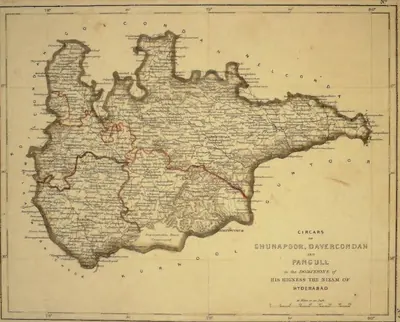 "Circars of Chunapoor, Davercondah and Pangull, in the Dominions of His Highness the Nizam of Hyderabad" (map No. 3, atlas presented to the Nizam, 1865); Davercondah is Devarakonda and Pangull Panagal (identifications ours)Map · 1865
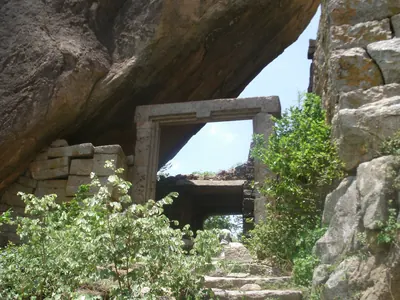
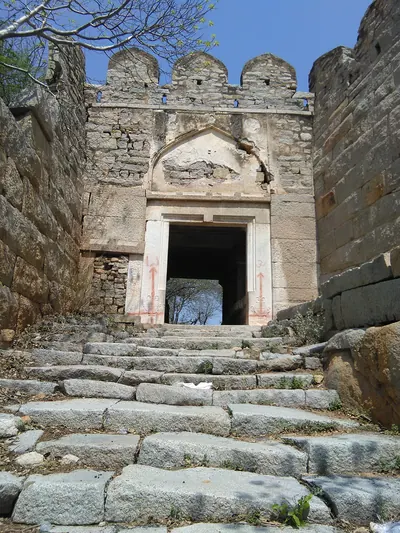 A gateway on the way up Devarakonda FortPhotograph · 2019
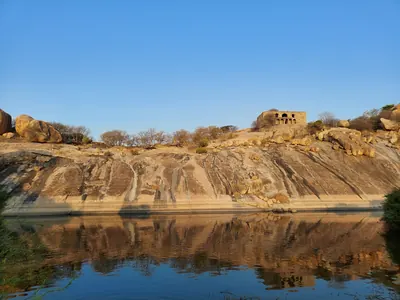 Devarakonda Fort hill above a pondPhotograph · 2021
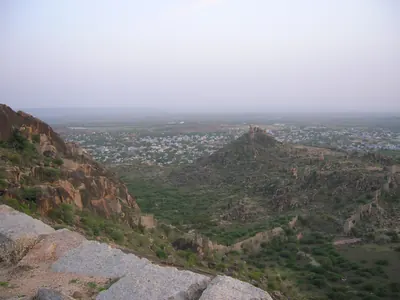 Devarakonda town seen from the fort hillPhotograph · 2007
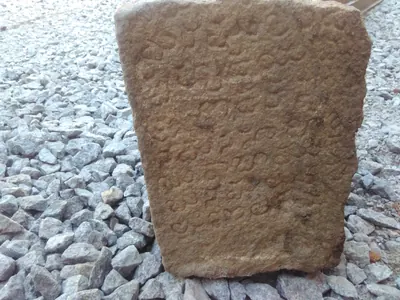 Inscribed stone at the entrance of Devarakonda FortPhotograph · 2017
Related
Dynasties
People
Mada Nayaka (Recherla)
c. 1361–1384 CE
Recherla Velama chief (r. c. 1361–1384), younger son of Singama Nayaka and brother of Anapota. He ruled from Devarakonda and is counted as the founder of the Devarakonda branch. His inscription of 1377 records a pavilion he built at Umamahesvaram, the northern gateway of Srisailam. His son Venna governed Kandikonda.
Peda Vedagiri (Recherla)
c. 1384–1410 CE
Recherla Velama chief of Devarakonda (r. c. 1384–1410), son of Mada Nayaka. An inscription of 1399 calls him ruler of the land between Srisailam and the Vindhyas. The family chronicle credits him with a victory near Warangal in the war against Kapaya Nayaka.
Ahmad Shah I
1422–1435 CE
Ninth Bahmani sultan (1422–1435), called Wali, 'the Saint'. He took the throne from his brother Firuz and defeated Vijayanagara. In 1424 or 1425 he took Warangal, killing its raja, and the Velama rayas of Devarakonda and Rachakonda then paid him tribute. He moved the capital from Gulbarga to Bidar. He had to march into Telangana again to put down the chiefs who rose while he fought Gujarat and Malwa.
Lingama Nayaka (Recherla)
c. 1427–1475 CE
Recherla Velama chief of Devarakonda in the fifteenth century, and a great-great-grandson of Mada Nayaka according to an inscription of 1427. He is known from two tank inscriptions of 1427 and from a long list of victories in the family chronicle. The chronicle makes him a rival of the Reddi kings and a contemporary of the Vijayanagara king Praudha Devaraya.
Kapilendra (Kapilesvara)
c. 1434–1470 CE
Founder of the Suryavamsi Gajapati dynasty of Orissa, who took the throne of the last Eastern Ganga king in 1434–35 and reigned until about 1470. He conquered the Reddi kingdoms of Rajahmundry and Kondavidu, and governed them through his nephew Raghudeva and his kinsman Ganadeva. He relieved Devarakonda from the Bahmanis in 1459, and his son Hamvira and Raghudeva took Warangal in 1460. His records credit him with conquests down the coast to the Kaveri.
Humayun Shah
1458–1461 CE
Eleventh Bahmani sultan (1458–1461), remembered as Zalim, 'the Cruel'. In Telangana he put down the revolt of his cousin Sikandar Khan, who claimed the province. He sent an army against the Velama fort of Devarakonda, which was routed by its defenders and an Orissan relief force in 1459. He camped at Warangal, left Mahmud Gawan to hold Telangana, and returned to Bidar to take a savage revenge on a rising there.
Ibrahim Qutb Shah
1530–1580 CE
Fourth Qutb Shahi sultan of Golconda (1550–1580), a younger son of Sultan Quli. He spent seven years as an exile at Vijayanagara under Rama Raya. He came back to take the throne with the help of the Telugu foot soldiers who held the forts. He joined the alliance that destroyed Vijayanagara at Talikota in 1565, and he conquered Rajahmundry, the northern coast and Kondavidu. Telugu poets dedicated works to him and to his officers, and Telugu records call him Ibharama. A Sanskrit copper-plate grant from Nellore calls him Malikibharama.
Jamshid Quli Qutb Shah
before 1550 CE
Second Qutb Shahi sultan of Golconda (1543–1550), the third son of Sultan Quli. The Golconda chronicle says he had his father killed at prayer and blinded the heir, his brother Qutb-ud-din. His reign was spent in wars with Bidar and Bijapur, and his younger brother Ibrahim fled to Vijayanagara. He died of a long illness in 1550.
Mahmud Gawan
before 1481 CE
Persian merchant who became chief minister of the Bahmani sultanate (c. 1461–1481). He was regent for two boy kings, fought in Telangana and on the west coast, reorganised the provinces and the army, and founded a great college at Bidar. Muhammad Shah III had him executed on a forged charge of treason in 1481.
Sultan Quli Qutb-ul-Mulk
before 1543 CE
Persian-born officer of the Bahmani sultanate who governed Telingana from Golconda. He conquered much of Telangana and the Krishna–Godavari coast, and founded the Qutb Shahi dynasty. He was assassinated in 1543. According to the Golconda chronicle, he was killed at prayer in the mosque of Golconda fort. According to Ferishta, a slave killed him while he was examining jewels.
References
Notes (0)
Sources (11)
Spotted an error on this page? Tell us
Last updated: