Ederu (Edara)
Village near Agiripalle in the former Nuzvid zamindari of Kistna district, about 15 miles north-east of Vijayawada. Two Eastern Chalukya copper-plate grants were found there about 1871–73, those of Vijayaditya II and Amma I, and the zamindar of Nuzvid gave both to the Madras Museum.
Ederu is a village in the old Nuzvid zamindari (landholder’s estate) of Krishna (then Kistna) district. Robert Sewell placed it “near Akiripalle”, 15 miles north-east of Vijayawada (then Bezwada).1 F. Kielhorn located it on sheet 94 of the Indian Atlas at longitude 80° 48′ E, latitude 16° 43′ N.2 V. Rangacharya, in 1919, listed it under the Nuzvid taluk as “(Ederu) Idara”. He noted that the village was said to be in the Nuzvid zamindari but was not found in the alphabetical list of inscriptions.3
Two Eastern Chalukya grants
The village is known for two copper-plate grants of the Eastern Chalukyas. The grant of Amma I, in Sewell’s words, “was found at the close of the year 1871 buried in the ground in a field in the village of Ederu”. He added that the village lay “in the heart of the Eastern Chalukyan country”.14 Kielhorn wrote in 1899 that the grant of Vijayaditya II had been found at Ederu “about twenty-five years ago”.2 The zamindar (landholder) of Nuzvid sent both sets, with a later grant, to the Madras Museum. A government order of 7 April 1873 recorded the gift.15
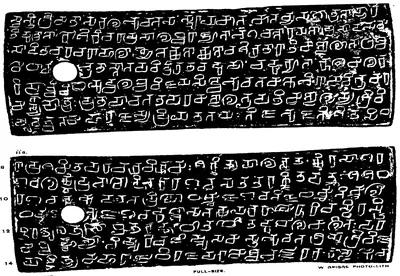
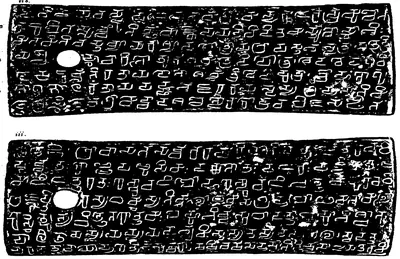
- Ederu plates of Vijayaditya II: three roughly engraved plates recording the gift of a field in Vandrupiteyu to a Brahmin on a solar eclipse.65
- Ederu plates of Amma I: five finely engraved plates giving the village of Gonturu, with twelve hamlets, to the military officer Bhandanaditya.78
Both grants are addressed to the people of the Kanderuvadi district (vishaya). Kielhorn could not identify the district or any of the places named in the grant of Vijayaditya II.68
Footnotes
-
Robert Sewell, Lists of the Antiquarian Remains in the Presidency of Madras, Vol. II (1884), p. 25 (archive.org (opens in a new tab)). ↩ ↩2 ↩3
-
F. Kielhorn, “Six Eastern Chalukya Copper-plate Inscriptions”, Epigraphia Indica V (1898–99), p. 118 (archive.org (opens in a new tab)). ↩ ↩2
-
V. Rangacharya, A Topographical List of the Inscriptions of the Madras Presidency, Vol. II (1919), p. 904 (archive.org (opens in a new tab)). ↩
-
E. Hultzsch, South-Indian Inscriptions, Vol. I (1890), p. 36 (archive.org (opens in a new tab)). ↩
-
Sewell, Lists of the Antiquarian Remains, Vol. II (1884), p. 26 (archive.org (opens in a new tab)). ↩ ↩2
-
Kielhorn, “Six Eastern Chalukya Copper-plate Inscriptions” (1899), p. 119 (archive.org (opens in a new tab)). ↩ ↩2
-
Hultzsch, South-Indian Inscriptions I (1890), p. 37 (archive.org (opens in a new tab)). ↩
-
Hultzsch, South-Indian Inscriptions I (1890), p. 38 (archive.org (opens in a new tab)). ↩ ↩2
Photos
References
Notes (0)
Sources (4)
Spotted an error on this page? Tell us
Last updated: