Ederu plates of Vijayaditya II
Three undated Sanskrit copper plates of the Eastern Chalukya king Vijayaditya II Narendramrigaraja (reigned about 799–843). They were found about 1873 at Ederu in the Nuzvid zamindari, Kistna district. They record the gift, on a solar eclipse, of a field and a house site in the village of Vandrupiteyu to a Brahmin. F. Kielhorn re-edited them in 1899. J. F. Fleet later doubted that they were genuine.
These three plates are one of the two known grants of Vijayaditya II, the Eastern Chalukya king whom other records call Narendramrigaraja.12 They are undated, and their date rests on the length of his reign, which J. F. Fleet put at about 799–843.34
Discovery
F. Kielhorn wrote in 1899 that the plates “were found, about twenty-five years ago, at the village of Ederu” in the Nuzvid zamindari (landholder’s estate) of Krishna (then Kistna) district.3 He placed the village on sheet 94 of the Indian Atlas, at longitude 80° 48′ E, latitude 16° 43′ N.3 By then the plates were in the Madras Museum.3
Robert Sewell’s list of 1884 records that the zamindar (landholder) of Nuzvid sent them to the Museum.5 They went together with the Ederu plates of Amma I and a later grant (see G.O. No. 367, Public, of 7 April 1873).5 V. Rangacharya, in 1919, entered the findspot under the Nuzvid taluk as “(Ederu) Idara”.6 He noted that the village was said to be in the Nuzvid zamindari but did not appear in the alphabetical list of inscriptions.6 See Ederu.
Pandit S. M. Natesa Sastri first published the inscription in the Indian Antiquary (Vol. XIII, p. 55).3 Kielhorn re-edited it from “an excellent impression” supplied by E. Hultzsch.3
Description
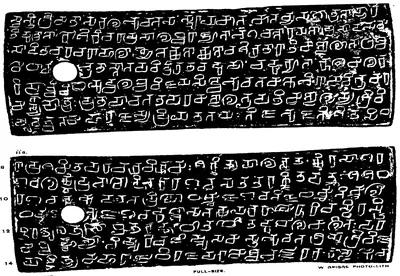
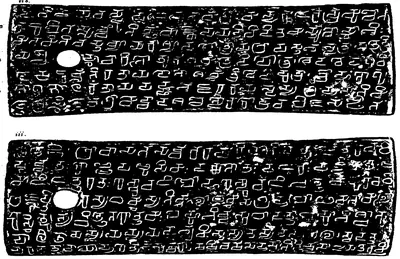
There are three plates, the first and last written on one side only.31 Each is about 7 inches broad and 2⅞ inches high, with slightly raised rims.31 They hang on a ring about 3¾ inches across, which had not been cut when Hultzsch took his impression.1 The ring’s ends are fixed in an oval seal, about 2 by 1¾ inches.1 Across the seal runs the legend Sri-Tribhuvanankusa, with an open lotus below it and the sun within the crescent moon above.1
Kielhorn found the writing “rather roughly engraved”, but well preserved on the whole.15 Sewell had called the plates “very roughly executed”.15 The letters are of the southern class, of the regular type of their period and region.1 Kielhorn noted older square forms of several letters.1 He also noted the open form of b that is already used throughout in the Chipurupalle plates of Vishnuvardhana I of 632.1
Language and content
The language is Sanskrit, in prose except for three verses at the end.1 Kielhorn found the text plain but full of careless mistakes by the writer or engraver.1 It traces the king’s descent only two generations back.1 In Kielhorn’s abstract, Vijayaditya is “the son’s son of Vikramarama” and “the dear son of the Maharaja Vishnuvardhana”.7 He bears the titles Maharajadhiraja, Paramesvara and Bhattaraka.7 Kielhorn read the grandfather’s name as Vikramarama and took it to mean, “apparently”, Vijayaditya I.1
The king speaks to the cultivators of the village of Vandrupiteyu in the Kanderuvadi district (vishaya).7 He announces a gift, made on an eclipse of the sun, to a Brahmin named Palla-bhattaraka, of Minamini.7 He has given him a dwelling-place and a field large enough to be sown with twelve khandikas of udrava grain, free of all taxes.7
- the boundary-line of Korraparu on the east78
- a tank on the south78
- Ramati on the west78
- Renduvati and Bolarenduvati on the north78
The officer who conveyed the order (ajnapti) was Bolama.78 Kielhorn could identify none of these places, but noted that the Kanderuvadi district appears in other Eastern Chalukya grants.1 The king’s other known grant mentions Vandrupiteyu and Korraparu too.1
Is the grant genuine?
In 1891 Fleet listed the grant among the records of Vijayaditya II, and quoted it from his own reading of the plates, without questioning it.2 Writing in 1902–03, however, he described it as “a record which purports to be of the same period” but “is of somewhat doubtful authenticity”.9 He set it beside a doubtful grant ascribed to Jayasimha I.9 He did not give his reasons in that passage. Kielhorn’s edition does not raise the question.1
The king’s reign
Fleet noted that the grants disagree on the length of Vijayaditya II’s reign:4
He preferred 44.4 He suggested that four earlier years as crown prince (yuvaraja) had been added in some records and wrongly taken away in others.4 That gave the dates 799–843.4 Rangacharya gave the reign as 794–842.6
Footnotes
-
Kielhorn, “Six Eastern Chalukya Copper-plate Inscriptions” (1899), p. 119 (archive.org (opens in a new tab)). ↩ ↩2 ↩3 ↩4 ↩5 ↩6 ↩7 ↩8 ↩9 ↩10 ↩11 ↩12 ↩13 ↩14 ↩15 ↩16 ↩17 ↩18
-
Fleet, “The Chronology of the Eastern Chalukya Kings” (1891), p. 101 (archive.org (opens in a new tab)). ↩ ↩2
-
F. Kielhorn, “Six Eastern Chalukya Copper-plate Inscriptions”, Epigraphia Indica V (1898–99), p. 118 (archive.org (opens in a new tab)). ↩ ↩2 ↩3 ↩4 ↩5 ↩6 ↩7 ↩8
-
J. F. Fleet, “The Chronology of the Eastern Chalukya Kings”, Indian Antiquary XX (1891), p. 100 (archive.org (opens in a new tab)). ↩ ↩2 ↩3 ↩4 ↩5 ↩6 ↩7 ↩8
-
Robert Sewell, Lists of the Antiquarian Remains in the Presidency of Madras, Vol. II (1884), p. 26, No. 180 (archive.org (opens in a new tab)). ↩ ↩2 ↩3 ↩4
-
V. Rangacharya, A Topographical List of the Inscriptions of the Madras Presidency, Vol. II (1919), p. 904 (archive.org (opens in a new tab)). ↩ ↩2 ↩3
-
Kielhorn, “Six Eastern Chalukya Copper-plate Inscriptions” (1899), p. 121, text and abstract of contents (archive.org (opens in a new tab)). ↩ ↩2 ↩3 ↩4 ↩5 ↩6 ↩7 ↩8 ↩9 ↩10 ↩11
-
Kielhorn, “Six Eastern Chalukya Copper-plate Inscriptions” (1899), p. 122 (archive.org (opens in a new tab)). ↩ ↩2 ↩3 ↩4 ↩5 ↩6
-
J. F. Fleet, “Kaluchumbarru Grant of Vijayaditya-Amma II”, Epigraphia Indica VII (1902–03), p. 184 (archive.org (opens in a new tab)). ↩ ↩2
Photos
References
Notes (0)
Sources (5)
Spotted an error on this page? Tell us
Last updated: