Vijayawada (Bezwada)
Town on the north bank of the Krishna, where the river passes through a gap in the hills. Eastern Chalukya records call it Vijayavada, and the British called it Bezwada. Copper plates of Chalukya-Bhima I were found in a quarry chamber here in 1897. A pillar in its Mallesvara temple carries one of the earliest Telugu verse inscriptions, of the Eastern Chalukya Yuddhamalla.
Vijayawada lies on the north bank of the Krishna at the foot of a low range of hills.12 The Imperial Gazetteer of 1908, under its older name Vijayawada (then Bezwada), places it at 16°31′ N, 80°37′ E.12 It had 24,224 inhabitants in 1901, and had grown remarkably since 1881.12
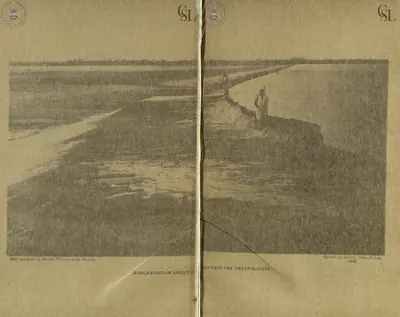
According to the gazetteer, railways from Madras, Calcutta, the Nizam’s Dominions and the Ceded Districts met at the town.12 The great anicut (dam) across the river at the town was the head of the Krishna delta canals.12
Gordon Mackenzie’s Kistna manual of 1883 thought that the convenient ferry would have drawn a town to the spot “in very early times”.3 It noted that excavations showed a large city had once stood on the site of the present town.4
Vijayavada in the Eastern Chalukya records
The Eastern Chalukya grants call the town Vijayavada. A grant of Vijayaditya II, edited by E. Hultzsch, was written by an engraver “who dwelt at Vijayavada”.5 J. F. Fleet, discussing the same grant, wrote that Vijayavada “must be the modern Bezwada”.6
In 1897 a set of five copper plates of the king Chalukya-Bhima I was found “in the rock-hewn chamber of the quarry-compound at Bezvada”.7 F. Kielhorn edited it from Hultzsch’s impression.7
The Mallesvara temple
The temple of Mallesvara holds the town’s best-known Eastern Chalukya record. A pillar there carries a Telugu verse inscription of the king Yuddhamalla, edited by J. Ramayya Pantulu in 1920.8 A Tamil record on the back of the same pillar is of the 41st year of the Chola-Chalukya king Kulottunga I.8 It names the god as Mallisvaram-udaiya-Mahadeva “at Vijaiavadai, surnamed Rajendra-Sola-puram”.8
The Telugu verses record that Yuddhamalla built a temple and monastery at Bejavada for the god Kumarasvamin.91011 In the editor’s reading, the god had come from Chebrolu.91011 H. Krishna Sastri thought it was the king who came.91011 The verses also record a tower that Yuddhamalla added to a temple built by his grandfather Mallapa.91011 Ramayya Pantulu noted that even the site of the Kumarasvamin temple was no longer known at Vijayawada.10
The temple’s later endowments reached beyond the town.1213 Rangacharya’s topographical list records a group of inscribed pillars lying in front of the Kesavasvamin temple at Enamalakuduru, in the Nuzvid taluk.1213 They record gifts to the Mallesvara temple at Vijayawada.1213
One pillar, of Saka 1054 (or 1052; Saka is an Indian way of counting years), records a gift by Bhima, son of Boddana.13 Bhima gave “the town Vijayavata (i.e., Bezwada)” to the temple.13 Boddana had acquired the town from the Choda king Tripurantaka of Vengi and from the Karnata king.1213
M. A. Waheed Khan was the Director of Archaeology who introduced M. Rama Rao’s monograph on Eastern Chalukya temples in 1964.14 He mentioned an Eastern Chalukya inscription which says that Ayyana Mahadevi, queen of Kubja-Vishnuvardhana, built a Jain basadi (temple) near Vijayawada.14 He added that no trace of it could now be found.14 See Kubja Vishnuvardhana.
The town in Sewell’s list
Robert Sewell lived at Vijayawada for some years.153 In 1882 he described it as a town that “teems with antiquarian remains”.153 He called it “the religious centre of the kingdom of Vengi”, with Vegi as the capital.153 He dated its capture by the Chalukyas under Kubja-Vishnuvardhana to “605 A.D. or thereabouts”.153 The Godavari gazetteer of 1907 put Pulakesin II’s conquest of the coast about 615 and Vishnuvardhana’s independent rule by 632.16
Sewell listed the temples of Mallesvara, Arjuna and Kanaka Durga, “with a large number of old inscriptions”.15 He also listed small cave temples and rock-cuttings on the hills.15 He recorded several apparently 7th-century inscriptions scattered on the rocks and cliffs round the town, mostly illegible.15 Mackenzie counted 47 inscriptions in Sewell’s list, “with dates from the eleventh century”.4
Xuanzang’s monasteries?
Sewell believed that the Chinese pilgrim Xuanzang (Hiuen Tsiang) stayed for several months in 639 at a Buddhist monastery on the hill east of the town.15 He identified the rock-cuttings on the eastern and western hills with the pilgrim’s Eastern and Western Monasteries.15
Mackenzie reported that James Fergusson did not accept this.3 James Burgess, visiting in December 1881, “declined to see anything in the rock platforms on the Telegraph Hill but an old quarry”.3 Mackenzie also pointed out that the pilgrim never mentions the Krishna.317 He concluded that it was “not safe to build much conjecture on any one phrase” of the narrative.317 The Imperial Gazetteer took the same careful view: “the authorities, however, are not agreed on this point”.2
Later history
Mackenzie described Vijayawada, at a ferry and ringed by hills, as “a constant halting place for all the armies” from the 11th century to 1765.4 Two inscriptions of 1518 at the Kanaka Durga temple on the western hill give a Kshatriya family’s genealogy for eight generations.4 The manual connects this family with the Pusapati Rajas of Vizianagaram.4
In the 17th century, according to the Imperial Gazetteer, the Golconda ministers Akanna and Madanna made Vijayawada their headquarters.18 Across the river stand the rock-cut temples of Undavalli; see Undavalli cave temple.2
Footnotes
-
Imperial Gazetteer of India: Madras, Vol. I (1908), p. 319, s.v. Bezwada Town (archive.org (opens in a new tab)). ↩ ↩2 ↩3 ↩4 ↩5
-
Imperial Gazetteer of India: Madras, Vol. I (1908), p. 320 (archive.org (opens in a new tab)). ↩ ↩2 ↩3 ↩4 ↩5 ↩6 ↩7
-
Gordon Mackenzie, A Manual of the Kistna District (1883), p. 217 (archive.org (opens in a new tab)). ↩ ↩2 ↩3 ↩4 ↩5 ↩6 ↩7 ↩8 ↩9
-
Mackenzie, Kistna District (1883), p. 219 (archive.org (opens in a new tab)). ↩ ↩2 ↩3 ↩4 ↩5
-
E. Hultzsch, South-Indian Inscriptions, Vol. I (1890), No. 35, p. 36 (archive.org (opens in a new tab)). ↩
-
J. F. Fleet, “The Chronology of the Eastern Chalukya Kings”, Indian Antiquary XX (1891), p. 101 (archive.org (opens in a new tab)). ↩
-
F. Kielhorn, “Six Eastern Chalukya Grants: C. Bezvada Plates of Chalukya-Bhima I”, Epigraphia Indica V (1898–99), p. 127 (archive.org (opens in a new tab)). ↩ ↩2
-
J. Ramayya Pantulu, “Bezwada Pillar Inscription of Yuddhamalla”, Epigraphia Indica XV (1919–20), p. 150 (archive.org (opens in a new tab)). ↩ ↩2 ↩3
-
Ramayya Pantulu, “Bezwada Pillar Inscription of Yuddhamalla” (1920), p. 153 (archive.org (opens in a new tab)). ↩ ↩2 ↩3 ↩4
-
Ramayya Pantulu, “Bezwada Pillar Inscription of Yuddhamalla” (1920), p. 156 (archive.org (opens in a new tab)). ↩ ↩2 ↩3 ↩4 ↩5
-
Ramayya Pantulu, “Bezwada Pillar Inscription of Yuddhamalla” (1920), p. 159 (archive.org (opens in a new tab)). ↩ ↩2 ↩3 ↩4
-
V. Rangacharya, A Topographical List of the Inscriptions of the Madras Presidency, Vol. II (1919), p. 904, s.v. Enamalakuduru, No. 320-A (archive.org (opens in a new tab)). ↩ ↩2 ↩3 ↩4
-
Rangacharya, Topographical List, Vol. II (1919), p. 905, No. 321 (archive.org (opens in a new tab)). ↩ ↩2 ↩3 ↩4 ↩5 ↩6
-
M. A. Waheed Khan, foreword to M. Rama Rao, Eastern Calukyan Temples of Andhra Desa (1964), p. i (archive.org (opens in a new tab)). ↩ ↩2 ↩3
-
Robert Sewell, Lists of the Antiquarian Remains in the Presidency of Madras, Vol. I (1882), p. 47, s.v. Bezvada (archive.org (opens in a new tab)). ↩ ↩2 ↩3 ↩4 ↩5 ↩6 ↩7 ↩8 ↩9
-
F. R. Hemingway, Madras District Gazetteers: Godavari (1907), p. 19 (archive.org (opens in a new tab)). ↩
-
Mackenzie, Kistna District (1883), p. 218 (archive.org (opens in a new tab)). ↩ ↩2
-
Imperial Gazetteer of India: Madras, Vol. I (1908), p. 321 (archive.org (opens in a new tab)). ↩
Photos
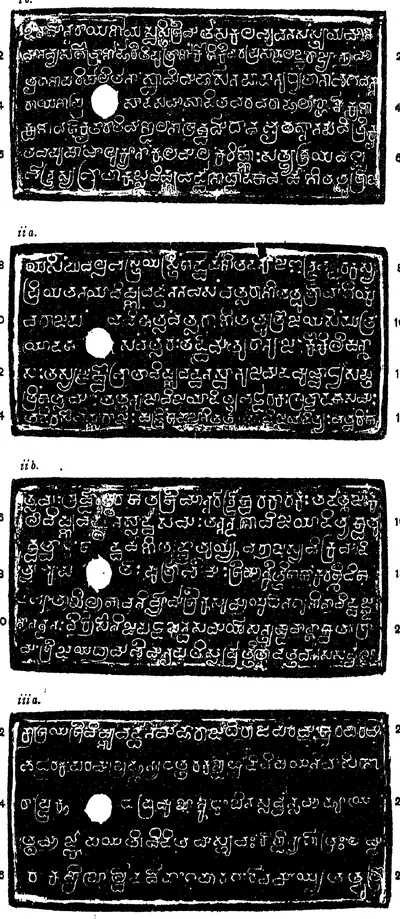 "Bezvada Plates of Bhima I.", plates i b, ii a, ii b and iii a (Epigraphia Indica V, plate between pp. 128 and 129 (PDF p. 178))Inscription rubbing · 1899
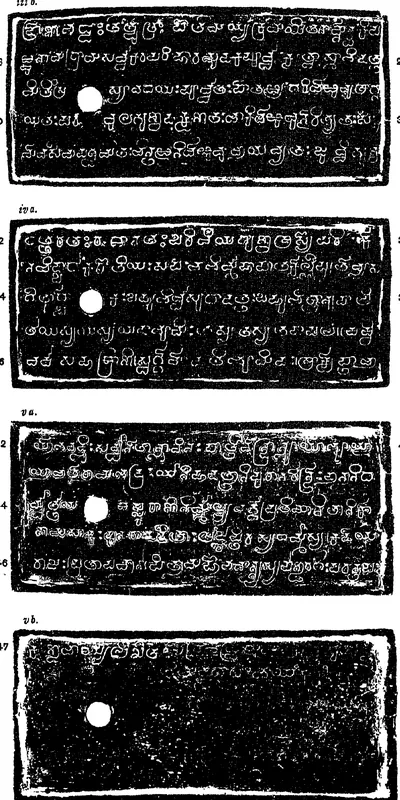 "Bezvada Plates of Bhima I.", plates iii b, iv a, v a and v b (Epigraphia Indica V, plate between pp. 128 and 129 (PDF p. 179))Inscription rubbing · 1899
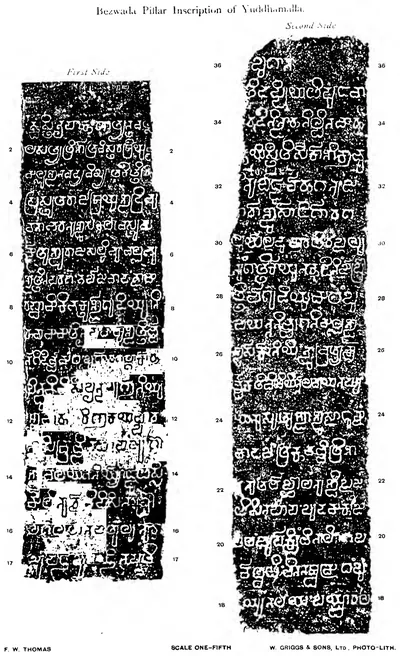 "Bezwada Pillar Inscription of Yuddhamalla" (Epigraphia Indica XV)Book plate · 1920
 "Tandikonda Grant of Ammaraja II.", plates ii a, ii b and iii a (Epigraphia Indica XXIII, plate between pp. 168 and 169 (PDF p. 218))Inscription rubbing · 1936
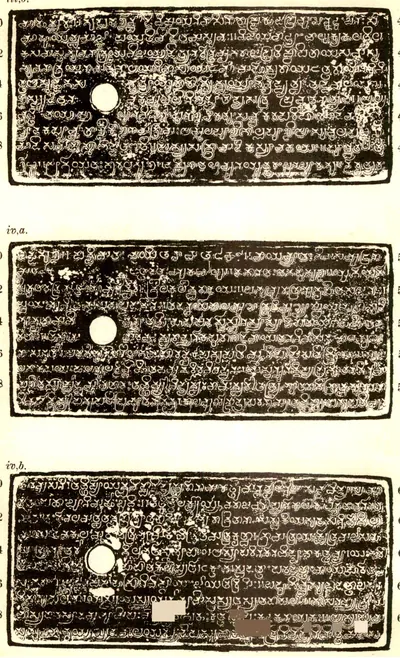 "Tandikonda Grant of Ammaraja II.", plates iii b, iv a and iv b (Epigraphia Indica XXIII, plate between pp. 168 and 169 (PDF p. 219))Inscription rubbing · 1936
Related
People
Virarajendra (Chola)
c. 1063–1070 CE
Chola king from 1062–63 to 1070, probably a younger son of Rajendra I, whose inscriptions give the fullest Chola account of the struggle with the Western Chalukyas of Kalyani for Vengi. He defeated armies sent into Vengi, and in his fifth year his army beat the enemy at Bezwada on the Krishna, marched to the Godavari and through Kalinga, and gave Vengi to a Vijayaditya, whom Hultzsch identified with the Eastern Chalukya Vijayaditya VII. A record of his seventh year, Saka 991, is in the Chittoor district.
Hamvira (Hambira)
c. 1459–1478 CE
Son of the Gajapati king Kapilendra and the leading general of his conquests in the Telugu and Tamil countries. He captured the fort of Warangal on 2 February 1460 and made the Chiruvroli grant on the Krishna in 1461. In 1464 his son Dakshina-Kapilesvara governed Kondavidu and the forts of the south. Ferishta writes of an 'Ambur Ray' who took the Orissan throne with Bahmani help after Kapilendra's death. This man has been identified with Hamvira, but the succession is disputed.
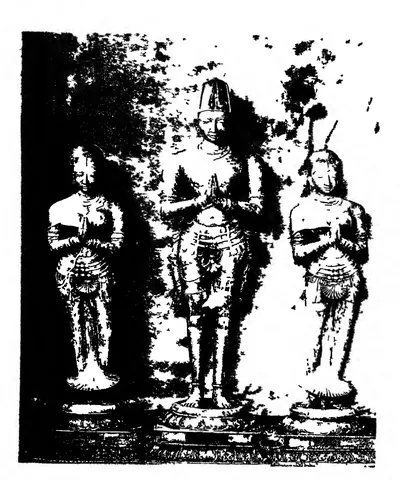
Krishnadeva Raya
1509–1529 CE
King of Vijayanagara from 1509 to 1529, of the Tuluva dynasty, and the most famous ruler of the empire. In 1512–16 he took Udayagiri, Kondavidu and Kondapalli from the Gajapati Prataparudra. He marched to Simhachalam and married the Gajapati's daughter. In 1520 he defeated the Adil Shah at Raichur. He wrote the Telugu poem Amuktamalyada, in which the god says Telugu is the best of the languages of the land. His court, with Allasani Peddana and Nandi Timmana, began the age of the Telugu prabandha (long narrative poem).
Sir Arthur Cotton
1803–1899 CE
Engineer officer of the Madras army (1803–1899). He planned and built the anicut (dam) across the Godavari at Dowlaishweram (1847–1852), which turned the Godavari delta into irrigated rice land. He backed the plan for the Krishna anicut at Bezwada (built 1852–1855). At Vizagapatam he built sea groins and St John's church in 1844. He planned the upper Godavari navigation, of which the Dummagudem anicut survives.
Mutnuri Krishna Rao
1879–1945 CE
Editor of the Krishna Patrika of Machilipatnam (1879–1945), a leading Telugu nationalist paper. He organised Bipin Chandra Pal's tour of the Telugu districts in 1907, helped build the National College at Machilipatnam, and was jailed in the salt satyagraha of 1930, the civil disobedience of 1932 and the individual satyagraha of 1940–41.
Ayyadevara Kaleswara Rao
1881–1962 CE
Congress leader and lawyer of Vijayawada, born in 1881. He took part in every Congress campaign from the Swadeshi movement of 1905 to Quit India, and was jailed in 1922, 1930, 1932, 1933, 1940–41 and 1942–43. He led the Swaraj Party in Andhra, helped the Hyderabad State Congress in 1947–48, and was Speaker of the Andhra Pradesh Legislative Assembly, 1956–62.
Cherukuvada Venkata Narasimham
1887–1964 CE
Congress speaker and writer from Ghantasala in Krishna district (1887–1964). He worked on the nationalist papers Desabhimani and Krishna Patrika, taught at the National College in Machilipatnam, and was jailed for a year each in the non-cooperation movement of 1921, the salt satyagraha of 1930 and the civil disobedience of 1932. He was known as Upanyasa Chakravarti.
Kakani Venkataratnam
1900–1972 CE
Congress leader of Krishna district (1900–1972). He was jailed in the salt satyagraha of 1930 and the civil disobedience of 1932, and detained for three years in the Quit India movement. After independence he was president of the Andhra Pradesh Congress Committee and Minister for Agriculture. He died at Vijayawada on 25 December 1972, during the movement for a separate Andhra State.
Gora (Goparaju Ramachandra Rao)
1902–1975 CE
Teacher, social reformer and atheist of Vijayawada (1902–1975), known as Gora. A science lecturer until 1940, he was jailed in 1943 for celebrating Independence Day and detained twice during the Quit India movement. He worked against untouchability, encouraged his children to marry across caste, edited the Telugu weekly Sangham and the English monthly The Atheist, and wrote Positive Atheism.
Anne Anjayya
1905–1975 CE
Congress and Forward Bloc worker from Mudunur in Krishna district (1905–1975). He trained volunteers from 1920, spread khadi in Hyderabad State in the 1930s, was jailed and fined in the salt satyagraha of 1930 and the civil disobedience of 1932, ran underground papers against the war, and was detained from December 1942 to September 1945.
Akkanna
before 1686 CE
Telugu Brahmin, brother of the minister Madanna, who commanded the army of Abul Hasan Qutb Shah of Golconda in the 1670s and 1680s. With his brother he received Shivaji at Hyderabad in 1677. The Mughal peace terms of 1685 demanded his dismissal with his brother's, and the two were murdered together at Golconda in March 1686.
Madanna
before 1686 CE
Telugu Brahmin who became chief minister (wazir) of Abul Hasan, the last Qutb Shahi sultan of Golconda, about 1673, with the title Surya Prakash Rao. With his brother Akkanna he ran the kingdom for some twelve years. He allied it with the Marathas against the Mughals and kept an office at Bezwada. Aurangzeb made the employment of the two Brahmin brothers a charge against the king. They were murdered at Golconda in March 1686.
Monuments
Inscriptions
Bezwada plates of Chalukya-Bhima I
c. 888 CE
Five Sanskrit copper plates of the Eastern Chalukya king Chalukya-Bhima I (reigned about 888–918). They were found on 25 June 1897 in a rock-cut chamber in the quarry compound at Bezwada (Vijayawada). Issued at his coronation, they give the village of Kukiparru to a Vedic scholar. They were the first record found of this king, and the earliest then known to give the full line of Eastern Chalukya kings with the length of each reign.
Bezwada pillar inscription of Yuddhamalla
c. 890–950 CE
A Telugu verse inscription on a stone pillar in the Mallesvara temple at Bezwada (Vijayawada). It records that a Chalukya king Yuddhamalla built a temple and a monastery for Kumarasvamin (Karttikeya). It also records that a Yuddhamalla later added a front tower to a temple built by his grandfather Mallapa-raju. Its editor J. Ramayya Pantulu (1920) dated it to about 890–930 and called it the earliest Telugu poetry then known. Its date, its division into one or two records and the meaning of its fourth verse were disputed.
Bezwada inscription of Kulottunga I
c. 1111 CE
Tamil inscription of the 41st year of the Chola king Kulottunga I on a pillar in the verandah of the Mallesvara temple at Bezwada (Vijayawada), the same pillar that carries the Telugu verse inscription of the Eastern Chalukya Yuddhamalla. It gives Rajendra-Cholapuram as another name of Bezwada.
References
Notes (0)
Sources (10)
Spotted an error on this page? Tell us
Last updated: