Gangaikondacholapuram
Village in the Tamil country, 38 miles north-east of Tanjore, that was the capital founded by the Chola king Rajendra I and named after his title Gangaikonda-Chola, 'the Chola who took the Ganges'. The later king Virarajendra returned there after his campaign in the Vengi country and displayed the booty he had brought from it.
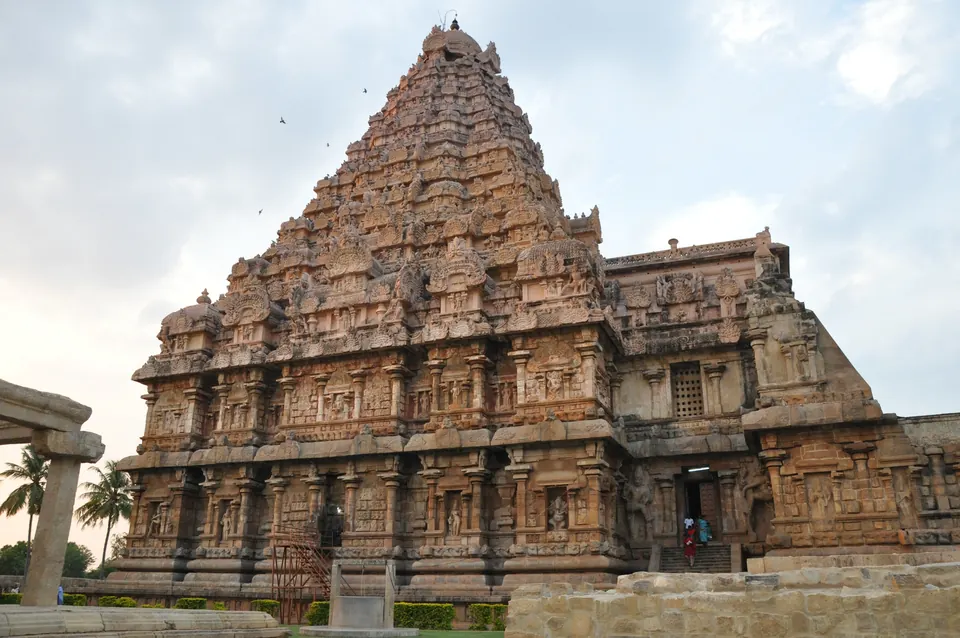
Gangaikondacholapuram, also called Gangapuri, was the capital built by the Chola king Rajendra I.1 It was named after his title Gangaikonda-Chola.1 Chola kings who fought for the Telugu country returned here with their booty.2 See the Cholas of Tanjore.
The capital
E. Hultzsch, writing in 1903 of Rajendra’s grandson Kulottunga I, called Gangapuri a city “founded by his grandfather Rajendra-Chola I. alias Gangaikonda-Chola”.1 H. Krishna Sastri (1920) noted that Mudigondasolan was the name of a hall in the royal palace there.3
James Fergusson’s history, revised by James Burgess in 1910, mentions a temple at Gangaikondapuram, 38 miles north-east of Thanjavur (then Tanjore).4 It thought the temple at least as old as the one at Thanjavur, perhaps older.4
Booty from Vengi
Hultzsch summed up the Manimangalam inscription of Virarajendra.2 His army fought near Vijayawada (then Bezwada), crossed the Godavari and gave Vengi to Vijayaditya.2 Then, “on his return to Gangaikonda-Solapuram the king assumed the surname Rajadhirajaraja and exhibited the booty which he had brought from the country of Vengi”.2 In the translation the king “entered Gangapuri with the goddess of victory”.5
Footnotes
-
Hultzsch, South-Indian Inscriptions III, pt. II (1903), p. 131 (archive.org (opens in a new tab)). ↩ ↩2 ↩3
-
E. Hultzsch, South-Indian Inscriptions, Vol. III, pt. I (1899), p. 65 (archive.org (opens in a new tab)). ↩ ↩2 ↩3 ↩4
-
H. Krishna Sastri, “The Tiruvalangadu Copper-plates of the Sixth Year of Rajendra-Chola I”, South-Indian Inscriptions, Vol. III, pt. III (1920), p. 390, note 4 (archive.org (opens in a new tab)). ↩
-
James Fergusson, rev. James Burgess, History of Indian and Eastern Architecture, Vol. I (1910), p. 366 (archive.org (opens in a new tab)). ↩ ↩2
-
Hultzsch, South-Indian Inscriptions III, pt. I (1899), p. 70, translation of No. 30, l. 31 (archive.org (opens in a new tab)). ↩
Photos
References
Notes (0)
Sources (3)
Spotted an error on this page? Tell us
Last updated: