Rajendra I (Chola)
Chola king from 1012, son of Rajaraja I and founder of Gangaikondacholapuram. As a prince he defeated the Eastern Chalukya Vimaladitya, his sister's husband, and set up a pillar of victory on Mahendragiri. As king he fought the Western Chalukya Jayasimha II and claimed Kollippakkai (Kolanupaka). His general marched to the Ganges while he himself waited on the Godavari, in a campaign that Krishna Sastri dated to 1028. His daughter Ammangadevi married the Eastern Chalukya Rajaraja Narendra and was the mother of Kulottunga I.
Rajendra I followed his father Rajaraja I as Chola king.1 F. Kielhorn placed the start of his reign between March and July 1012.2 He built a new capital, Gangaikondacholapuram.3 His wars took his armies across the Telugu country, and his daughter’s son became the Chola emperor Kulottunga I.41 See the Cholas of Tanjore.
Family
In Hultzsch’s pedigree, Rajendra I was the son of Rajaraja I and the brother of Kundava, the queen of the Eastern Chalukya king Vimaladitya.5 Hultzsch made him the father of Rajadhiraja I, Rajendradeva and a daughter, Ammangadevi, who married Rajaraja.56 This Rajaraja was the Eastern Chalukya king Rajaraja Narendra.7 The Chellur plates say he married “Ammanga-devi, the daughter of a Rajendra-Choda of the solar race”.7
Mahendragiri and Vimaladitya
Inscriptions on the Mahendragiri hill in Ganjam record a victory over Vimaladitya.89 V. Rangacharya summed them up: after defeating his brother-in-law Vimaladitya, Rajendra “set up a pillar of victory on the Mahendra mountain”.8 Below the inscription are the emblems of the Chola and his Pandya vassal, “the tiger and two fishes”.8
V. Venkayya (1901) thought this happened early in Rajendra’s career, while his father was still alive.10 The Godavari District Gazetteer (1907) explained the campaign as an answer to Vimaladitya’s attempt to break free.11 It added that “Vimaladitya was not deposed”.11 See the Mahendragiri inscriptions.
Kollippakkai
Rajendra fought the Western Chalukya king Jayasimha II.12 The Tamil part of his Tiruvalangadu plates names Kollippakkai among his conquests.13 H. Krishna Sastri (1920) accepted Lewis Rice’s identification of Kollippakkai with “Kulpak in the Nizam’s Dominions”, the modern Kolanupaka.14 J. F. Fleet noted that Jayasimha II, in a grant of 1024, claimed to have “fought and subdued the mighty Chola”.15 Robert Sewell thought Rajendra’s claim to the whole Western Chalukya country certainly untrue.16
The march to the Ganges
The Tiruvalangadu plates describe the northern campaign in verse.17 Rajendra ordered his army commander to conquer the kings on the banks of the Ganges.17 The general “reached the celestial river (Ganga)” and had its waters carried to his master.17 Meanwhile “Rajendra-Chola (himself) with a desire to conquer (enemy kings) reached the river Godavari”.4 There he “killed in battle (the lord of) Odda”, with his younger brother and his army.4
Rajendra’s Tamil inscriptions list the places of the campaign.18 The list includes Odda-vishaya, which E. Hultzsch identified with Orissa, Kosalai-nadu and Vangala-desa (Bengal).1918 It does not name Vengi.18
Krishna Sastri wrote in 1929 that “it was a general of the Chola king who conducted this campaign”.20 He dated it to 1028.20 S. Krishnaswami Aiyangar (1911) also wrote that Rajendra “sent his general to the banks of the Ganges”.21 The Kistna District Manual (1883) dates Chola rule over the Vijayawada (then Bezwada) country from 1028.22 Sewell warned that such claims should not be taken as proof of real conquest.23
Inscriptions in the Telugu districts
At Bhimavaram, now part of Samalkot in the Godavari district, the Bhimesvara temple has a record of his reign.2425 It is “in Tamil language and in Telugu characters”.24 See the Bhimavaram inscription. At Kalahasti, records of his 4th to 24th years were copied in 1904.26 One records “a gold diadem” given by the king.26
Two inscriptions at Tirumala are dated in his reign.27 Hultzsch thought they were “modern and faulty copies of Chola inscriptions”.27
Where the sources disagree
- Who defeated Vimaladitya. The Mahendragiri records name a general of Rajendra.9 Rangacharya, Venkayya and the Godavari gazetteer write of Rajendra himself.81011
- Who led the northern campaign. A general, while Rajendra waited on the Godavari (the Tiruvalangadu plates, Krishna Sastri, Aiyangar).42021 Krishna Sastri reported that the epigraphical report of 1918 had suggested Rajendra led it in person.28
Footnotes
-
E. Hultzsch, South-Indian Inscriptions, Vol. III, pt. II (1903), p. 127 (archive.org (opens in a new tab)). ↩ ↩2
-
F. Kielhorn, “Dates of Chola Kings”, Epigraphia Indica IX (1907–08), p. 217 (archive.org (opens in a new tab)). ↩
-
Hultzsch, South-Indian Inscriptions III, pt. II (1903), p. 131 (archive.org (opens in a new tab)). ↩
-
Krishna Sastri, “Tiruvalangadu Copper-plates” (1920), p. 425, vv. 118–120 (archive.org (opens in a new tab)). ↩ ↩2 ↩3 ↩4
-
Hultzsch, South-Indian Inscriptions III, pt. II (1903), p. 196, “Pedigree of the Chola Dynasty” (archive.org (opens in a new tab)). ↩ ↩2
-
Hultzsch, South-Indian Inscriptions III, pt. II (1903), p. 195 (archive.org (opens in a new tab)). ↩
-
E. Hultzsch, South-Indian Inscriptions, Vol. I (1890), p. 51 (archive.org (opens in a new tab)). ↩ ↩2
-
V. Rangacharya, A Topographical List of the Inscriptions of the Madras Presidency, Vol. I (1919), p. 710, Ganjam No. 425 (archive.org (opens in a new tab)). ↩ ↩2 ↩3 ↩4
-
South-Indian Inscriptions (Texts) V (1925), pp. 490–491, Nos. 1351–1352 (archive.org (opens in a new tab)). ↩ ↩2
-
V. Venkayya, “Ranastipundi Grant of Vimaladitya”, Epigraphia Indica VI (1900–01), p. 350 (archive.org (opens in a new tab)). ↩ ↩2
-
F. R. Hemingway, Madras District Gazetteers: Godavari, Vol. I (1907), p. 20 (archive.org (opens in a new tab)). ↩ ↩2 ↩3
-
E. Hultzsch, “Tirumalai Rock Inscription of Rajendra-Chola I”, Epigraphia Indica IX (1907–08), p. 230 (archive.org (opens in a new tab)). ↩
-
Krishna Sastri, “Tiruvalangadu Copper-plates” (1920), p. 430, translation of ll. 131–142 (archive.org (opens in a new tab)). ↩
-
Krishna Sastri, “Tiruvalangadu Copper-plates” (1920), p. 390 (archive.org (opens in a new tab)). ↩
-
J. F. Fleet, “Dynasties of the Kanarese Districts”, Gazetteer of the Bombay Presidency I, pt. II (1896), p. 436 (archive.org (opens in a new tab)). ↩
-
Robert Sewell and S. Krishnaswami Aiyangar, The Historical Inscriptions of Southern India (1932), p. 63 (archive.org (opens in a new tab)). Paraphrased. ↩
-
H. Krishna Sastri, “The Tiruvalangadu Copper-plates of the Sixth Year of Rajendra-Chola I”, South-Indian Inscriptions, Vol. III, pt. III (1920), p. 424, vv. 110–117 (archive.org (opens in a new tab)). ↩ ↩2 ↩3
-
Hultzsch, “Tirumalai Rock Inscription” (1908), p. 233, translation (archive.org (opens in a new tab)). ↩ ↩2 ↩3
-
Hultzsch, “Tirumalai Rock Inscription” (1908), p. 231 (archive.org (opens in a new tab)). ↩
-
H. Krishna Sastri, introduction to South-Indian Inscriptions, Vol. III (1929), p. [20] (archive.org (opens in a new tab)). ↩ ↩2 ↩3
-
S. Krishnaswami Aiyangar, Ancient India (1911), pp. 107–108 (archive.org (opens in a new tab)). ↩ ↩2
-
Gordon Mackenzie, A Manual of the Kistna District (1883), p. 219 (archive.org (opens in a new tab)). ↩
-
Sewell and Aiyangar, Historical Inscriptions of Southern India (1932), pp. 64–65 (archive.org (opens in a new tab)). Paraphrased. ↩
-
V. Rangacharya, Topographical List, Vol. II (1919), p. 715, Godavari No. 25 (archive.org (opens in a new tab)). ↩ ↩2
-
H. Krishna Sastri (ed.), South-Indian Inscriptions (Texts), Vol. V (1925), pp. 15–16, No. 41 (archive.org (opens in a new tab)). ↩
-
Rangacharya, Topographical List I (1919), p. 482, Chittoor No. 85 (archive.org (opens in a new tab)). ↩ ↩2
-
Rangacharya, Topographical List I (1919), p. 473, Chittoor No. 9 (archive.org (opens in a new tab)). ↩ ↩2
-
Krishna Sastri, “Tiruvalangadu Copper-plates” (1920), p. 388 and notes 5–6 (archive.org (opens in a new tab)). ↩
Photos
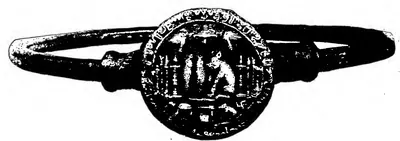 "Ring and Seal" of the Tiruvalangadu copper plates of the Chola king Rajendra I (South-Indian Inscriptions III, pt. III, 1920, Plate XIX)Book plate · 1920
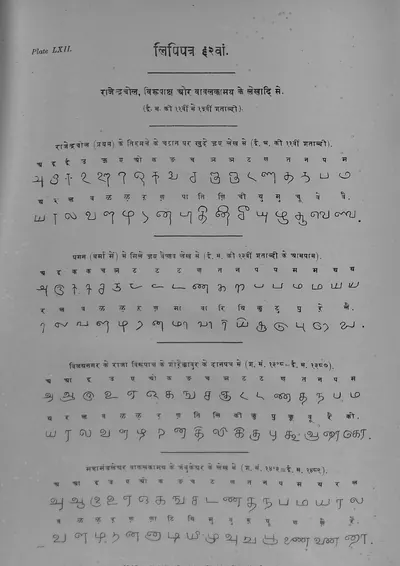 Tamil of the 11th-15th centuries: Tirumalai rock inscription of Rajendra Chola I and later records of 1387 and 1482 (Ojha 1918, Plate 62)Book plate · 1918
References
Notes (0)
Sources (13)
Spotted an error on this page? Tell us
Last updated: