Hemavati
Village in the Madakasira taluk of Anantapur, eight miles south of Amarapuram, identified with Henjeru or Penjeru, a chief town (in H. Krishna Sastri's words 'the capital') of the Nolamba-Pallavas. A pillar there gives the family tree of the Nolamba kings, and two Tamil records of the Chola period and a grant of the Hoysala Vira-Ballala II of 1205–06 are among its later inscriptions. Its temples, with pillars of polished black stone, include the Doddesvara (or Nonesvara), the Mallesvara, the Virupakshesvara and the Siddhesvara.
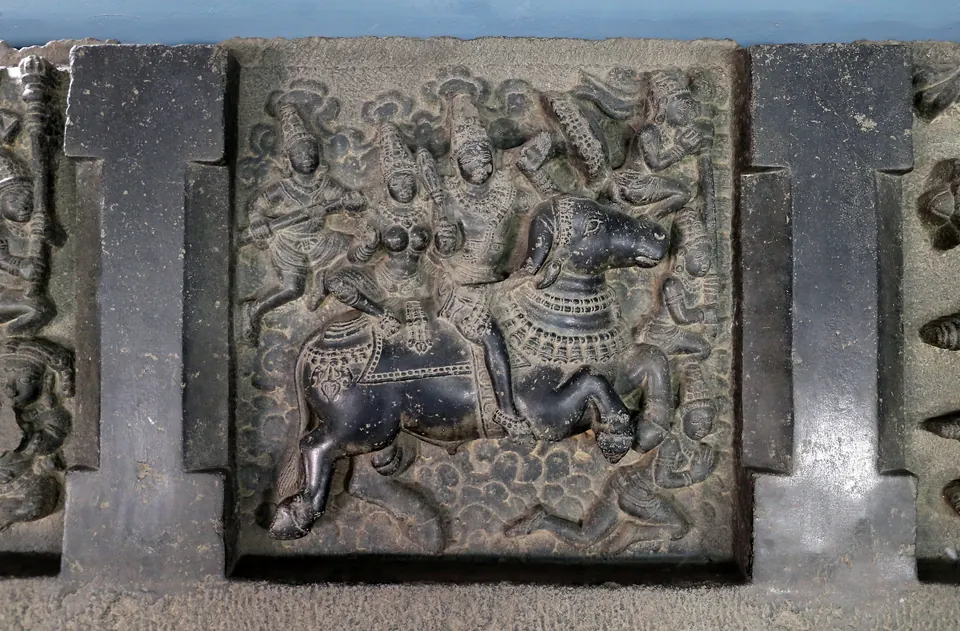
Hemavati is a village in the Madakasira taluk of the Anantapur district, eight miles south of Amarapuram.1 It has been identified with Henjeru or Penjeru, a chief town of the Nolamba-Pallavas in the 9th and 10th centuries.12 The Anantapur gazetteer of 1905 said it had “as ancient a history as any place in the district”.1
Henjeru of the Nolambas
B. Lewis Rice identified Hemavati with the Penjeru or Henjeru of the inscriptions.1 A hamlet a short way south of the village was still called Henjeru in 1905.1 H. Krishna Sastri (1910) called Henjeru “the capital of the Nolambas”.2
Three inscriptions of the Nolamba line had been copied there by 1905.1 One gives a long family tree of its kings.1 Krishna Sastri printed this tree from a Hemavati pillar, from the Pallava ancestor Trinayana down to Dilipa (Iriva-Nolamba).3 The inscription of Dilipa is dated Saka 864 (942–43; Saka is an Indian way of counting years).3 Krishna Sastri noted that Rice had printed the Hemavati pillars in his Tumkur volume.2
Later records
The Anantapur gazetteer listed these later inscriptions at Hemavati:1
- records of a Western Chalukya king1
- two Tamil records of a Chola ruler, one of them of the reign of a Kulottunga-Chola14
- a grant of the Hoysala king Vira-Ballala II, of 1205–06, to the Nolambesvara temple41
The gazetteer thought this Nolambesvara temple was probably the present Doddesvara shrine.4 V. Rangacharya (1919) also listed a record there of a chief named Mallideva Choda Maharaja, dated Saka 1090.5 Rice wrote that in 1072 a chief named Udayaditya ruled Nolambavadi from Penjeru.6
The temples
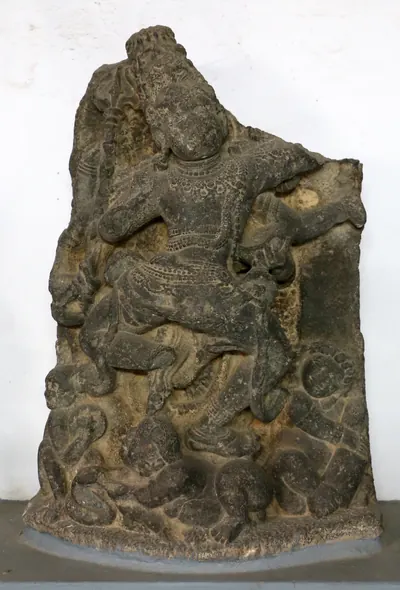
The chief temples stand in a group to the north-east of the village.1 The gazetteer noted their delicate carving and their many massive pillars of polished black stone.1 The village houses were often built of carved stones from vanished shrines.1
The Doddesvara (or Nonesvara) temple is small and low.17 Its large stones are carved to look like slender pillars set into the wall.7 In front of the gate is a bull of dark granite, about eight feet long.7 Inside is a porch on twenty black stone pillars, carved with scenes from the Mahabharata and Ramayana.7 The other temples of the group are those of Mallesvara, Virupakshesvara and Siddhesvara.7
Footnotes
-
Francis, Anantapur (1905), p. 180 (archive.org (opens in a new tab)). ↩ ↩2 ↩3 ↩4 ↩5 ↩6 ↩7 ↩8 ↩9 ↩10 ↩11 ↩12 ↩13 ↩14 ↩15
-
H. Krishna Sastri, “Two Nolamba Inscriptions from Dharmapuri”, Epigraphia Indica X (1909–10), p. 57 (archive.org (opens in a new tab)). ↩ ↩2 ↩3
-
Krishna Sastri, “Two Nolamba Inscriptions” (1910), p. 58 (archive.org (opens in a new tab)). ↩ ↩2
-
Francis, Anantapur (1905), p. 16 (archive.org (opens in a new tab)). ↩ ↩2 ↩3
-
V. Rangacharya, A Topographical List of the Inscriptions of the Madras Presidency, Vol. I (1919), p. 22, Anantapur No. 139 (archive.org (opens in a new tab)). ↩
-
B. Lewis Rice, Mysore and Coorg from the Inscriptions (1909), p. 59 (archive.org (opens in a new tab)). ↩
-
Francis, Anantapur (1905), p. 181 (archive.org (opens in a new tab)). ↩ ↩2 ↩3 ↩4 ↩5
Photos
Related
Dynasties
People
Mahendra I (Nolamba)
c. 878–904 CE
The most powerful king of the Nolamba-Pallavas, son of Polalchora Nolambadhiraja and the Ganga princess Jayabbe. His records run from Saka 800 (878–79), and a pillar at Kambaduru in Anantapur is dated in his reign in Saka 805 (883). He invaded Pulinadu, the country of the Banas round Punganur, and called himself 'destroyer of the Mahabali race'. After a quarrel with his Ganga overlords he was defeated by Butuga and killed by the Ganga prince Ereyappa, before about 904.
Iriva-Nolamba (Dilipa)
c. 943–966 CE
Nolamba-Pallava king, younger son of Ayyapa and grandson of Mahendra I, who succeeded his brother Anniga after the Rashtrakuta Krishna III defeated Anniga in 940. B. Lewis Rice gives him dates from 943 to 966. The genealogy on the Hemavati pillar ends with him, in a record of Saka 864 (942–43), and a record of his reign stands below the tank at Hindupur. The Vaidumbas served him, and a Bana chief ruled a district under him in 961. His grandson Polalchora set up a pillar at Kambaduru in 965.
Ballala II (Hoysala)
1173–1220 CE
Hoysala king, crowned at Dorasamudra on 22 July 1173, who defeated the Seuna army at Soratur, took the Pandya fortress of Uchchangi and pushed his frontier to the Bhima river. He took Nolambavadi: his records in the Anantapur country are at Parigi (Saka 1100, 1178) and Hemavati (1205–06), and an inscription at Harihar claims that he took Gooty. B. Lewis Rice dates his reign 1173–1220.
References
Notes (0)
Sources (4)
Spotted an error on this page? Tell us
Last updated: