Madanur
Village about ten miles from Ongole. The copper plates of the Maliyapundi grant of the Eastern Chalukya king Amma II (945–970) were found in its Ramalingesvara temple. The temple also has a stone inscription recording a gift of the village in the Vijayanagara period.
Madanur (Madanuru) is a village about ten miles from Ongole.12 Before 1905 V. Venugopal Chetty found the five copper plates of the Maliyapundi grant of the Eastern Chalukya king Amma II in its Ramalingesvarasvami temple.12 No information was available on when the temple had come by them.12 The grant does not concern Madanur. It gives a village called Maliyapundi to a Jain temple south of Dharmapuri.1 Butterworth and Venugopaul Chetty placed Maliyapundi more than twenty miles away.1 See the Maliyapundi grant of Amma II.
The temple inscription
V. Rangacharya’s list of 1919 records a stone inscription in Telugu and Sanskrit in the temple of Ramalingesvara at Madanuru.3 As he summarised it, the inscription records that in Saka 1421 (Saka is an Indian way of counting years), on the occasion of a lunar eclipse, Saluva Timmarasu gave Madanuru to Katta Malaya.3 The gift was to provide sacred food and all enjoyments for the god, for the religious merit of “Sri Krishnadeva Maharaya”.3
Where the sources disagree
The date in Rangacharya’s summary does not fit the king it names:345
- Rangacharya gives the date as Saka 1421, in the cyclic year Isvara.3
- In the tables of Sewell and Dikshit, Saka 1421 falls in 1498–99, but the year Isvara falls in 1517–18.46
- Robert Sewell’s lists put the start of Krishnadeva Raya’s reign in 1509.5
Footnotes
-
A. Butterworth and V. Venugopaul Chetty, A Collection of the Inscriptions on Copper-Plates and Stones in the Nellore District, Part I (1905), p. 164, copper-plate No. 19 (archive.org (opens in a new tab)). ↩ ↩2 ↩3 ↩4 ↩5
-
E. Hultzsch, “Maliyapundi Grant of Ammaraja II”, Epigraphia Indica IX (1907–08), p. 47 (archive.org (opens in a new tab)). ↩ ↩2 ↩3
-
V. Rangacharya, A Topographical List of the Inscriptions of the Madras Presidency, Vol. II (1919), p. 793, Guntur district, Ongole taluk, No. 398 (archive.org (opens in a new tab)). ↩ ↩2 ↩3 ↩4 ↩5
-
Robert Sewell and S. B. Dikshit, The Indian Calendar (1896), Table I, p. lxxvi (archive.org (opens in a new tab)). ↩ ↩2
-
Robert Sewell, ed. S. Krishnaswami Aiyangar, The Historical Inscriptions of Southern India (1932), p. 401 (archive.org (opens in a new tab)). ↩ ↩2
-
Sewell and Dikshit, The Indian Calendar (1896), Table I, p. lxxviii (archive.org (opens in a new tab)). ↩
Photos
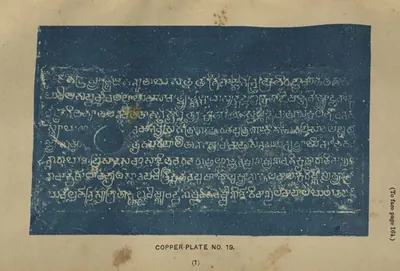 "Copper-plate No. 19" (Malliyapundi grant of Amma Raja II, East Chalukyan king) (Butterworth & Chetty 1905, to face p. 164 (PDF p. 219))Inscription rubbing · 1905
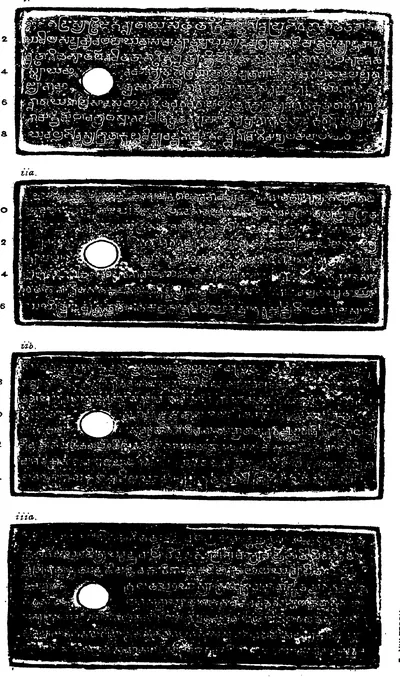 "Maliyapundi grant of Ammaraja II.", plates i, ii a, ii b and iii a (Epigraphia Indica IX, plate between pp. 52 and 53 (PDF p. 75))Inscription rubbing · 1908
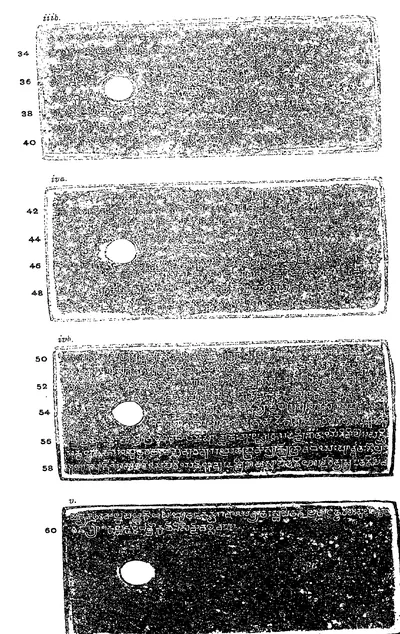 "Maliyapundi grant of Ammaraja II.", plates iii b, iv a, iv b and v (Epigraphia Indica IX, plate between pp. 52 and 53 (PDF p. 76))Inscription rubbing · 1908
References
Notes (0)
Sources (5)
Spotted an error on this page? Tell us
Last updated: