Maliyapundi grant of Amma II
Five Sanskrit copper plates of the Eastern Chalukya king Amma II (crowned 945), found in the Ramalingesvara temple at Madanur near Ongole. On the winter solstice the king gives the small village of Maliyapundi, near Dharmavaram in the Addanki country, to a Jain temple called Katakabharana. Durgaraja founded the temple; he was a great-grandson of Pandaranga, the general of Gunaga Vijayaditya III. The grant was first published in the Nellore District Inscriptions (1905), and E. Hultzsch re-edited it in 1908. It explains the Kataka-raja title and makes Pandaranga the burner of Kiranapura.
This grant of Amma II, the Eastern Chalukya king crowned in 945, is a gift to a Jain temple.123 Its preamble (opening part) adds new details to the history of the dynasty.123 Its account of the donor’s family explains an official title that appears in many of the dynasty’s grants.123
Like most of Amma II’s grants, it is not dated.4 Its first editors noted that it must be later than Saka 867 (945; Saka is an Indian way of counting years), the year of the king’s coronation, which it records.4
Discovery and editions
The plates were “discovered by Mr. Venugopal Chetti in the Ramalingesvarasvami temple at Madanur, a village about 10 miles from Ongole”.56 A. Butterworth and V. Venugopaul Chetty published them in 1905, with photographs, as copper-plate No. 19 of their Nellore District Inscriptions.56 They added that no one knew when the temple had acquired them.56 The Raja of Venkatagiri lent the plates for their transcript.56
E. Hultzsch re-edited the inscription in 1908 from ink impressions supplied by V. Venkayya.6 Butterworth had sent the original plates to Venkayya.6 V. Rangacharya listed it in 1919 under the Ongole taluk, then in the Guntur district.7 See Madanur.
Description
There are five plates, measuring about 9½ by 4¼ inches.61 The first and last are inscribed only on their inner faces.61 Venkayya found that the ring appeared to have been cut and soldered again before the plates reached him.61 Its ends are fixed in an eight-petalled lotus, to which a round seal is soldered.61
The seal bears the legend Sri-Tribhuvanankusa, with a lotus below.61 Above it is a boar facing left, with an elephant-goad in front of the boar and a crescent behind its tail.61
Hultzsch described the alphabet as “of the same Telugu type as in other grants of the same dynasty and period”.1 The language is Sanskrit prose with twenty verses.1 Some names of villages, tanks and fields at the end are in their Telugu forms.1 The curse verses and the names of the executor, composer and writer, usual at the end, are missing.1
The gift
Because the grant is to a Jain temple, it opens with an invocation of the religion of Jina.18 The king addresses the ryots (farmers) of the Kamma-nandu district, headed by the rashtrakutas (district officers).9
The grant then sets out the donor’s family over four generations:9
- Pandaranga burnt Kiranapura, the residence of Krishnaraja9
- his son Niravadyadhavala bore the fillet (head-band) of the Kataka-raja9
- Niravadyadhavala’s son was the Katakadhipati Vijayaditya9
- Vijayaditya’s son was Durgaraja9
Durgaraja founded a Jain temple, “marked with the auspicious name of Katakabharana”, on the south side of Dharmapuri.9 Its priest was Srimandiradeva, a disciple of Divakara.92 Divakara was the first disciple of Jinanandin of the Nandi gachchha and the Yapaniya samgha (Jain orders).92
The Kataka-raja asked the king for a gift, and on the winter solstice the king gave the temple the small village of Maliyapundi.9 The village was free of all taxes.9 The gift was to pay for repairs, offerings, worship and an alms-house.9
The village’s boundaries were:9
The village
Hultzsch noted that Dharmavuramu is the Telugu form of Dharmapuri, south of which the temple stood. The Nellore District Inscriptions placed both Dharmavaram and Kalvakuru in the Addanki division of the Ongole taluk.3
Maliyapundi itself no longer existed.54 But Butterworth and Venugopaul Chetty thought its position could be fixed from its boundaries.54 They said it lay more than twenty miles from Madanur.54
Hultzsch added that the Kamma-nandu district is the Kamma-rashtra or Kammaka-rashtra of other inscriptions.3 He noted two stone inscriptions at Dharmavaram that mention Gunaga Vijayaditya III, Pandaranga and the burning of Kiranapura.3 See the Addanki inscription of Pandaranga.
The officer called Kataka-raja
J. F. Fleet had noticed that the grants of Amma I and Amma II name a Kataka-raja, Katakesa or Katakadhisa as executor.3 He had concluded that these were titles, not names.3
Hultzsch rendered the title “superintendent of the royal camp”.3 He argued that the Maliyapundi grant showed three holders of it: the three direct descendants of Pandaranga, Niravadyadhavala, Vijayaditya and Durgaraja.3 In his view each Kataka-raja of the earlier grants was one of them.3 Pandaranga himself appears as executor in a grant of Gunaga Vijayaditya III.3
Butterworth and Venugopaul Chetty took the executor of this grant to be the Kataka-raja.4 They understood kataka as a fixed place, a fort, “probably Kocherlakota”.4 They thought “fort” a better rendering than “royal camp”, which suggests a temporary camp.4 They pointed to the temple’s name, “the ornament of the Kataka”.4
V. Rangacharya’s summary of 1919 differs from Hultzsch’s reading in two names. It calls Durgaraja the great-grandson of “Krishnaraja” and names the temple’s priest Dhiradeva.79
The history in the preamble
Hultzsch drew attention to two passages. The first describes Gunaga Vijayaditya III, who is given the surname Parachakrarama. The grant says that he ruled for forty-four years.82 In that time he killed Mangi, “the king of the great Nodamba-rashtra”, in a great battle.82 He defeated “the Gangas who took refuge on the peak of Gangakuta”.82 He also terrified “Sankila, the lord of the excellent Da[ha]la, who was joined by the fierce Vallabha”.82
From this Hultzsch took Mangi to be a Pallava of Nolambavadi.1 He took Sankila to be a chief of Dahala (Chedi), whom he identified with the Kalachuri Sankuka or Sankaragana.1 The grant calls Sankila’s ally a Vallabha, that is, a Rashtrakuta.1 So Hultzsch withdrew his own earlier identification of the Krishna of other records with a Paramara king, as one that “must be wrong”.1 He accepted Fleet’s identification of this Krishna with the Rashtrakuta Krishna II.1
Two other grants say the king himself burnt Kiranapura.29 But verse 15 of this grant gives the burning to his officer Pandaranga.29 Robert Sewell later noted that the grant calls Mangi ruler of the “Nodamba” country, for Nolamba.10
The second passage describes the struggle after the death of Vikramaditya II. Five years passed in fighting between rival kinsmen, among them Yuddhamalla, Rajamartanda and Kanthika-Vijayaditya.82 Then Rajabhima (Chalukya-Bhima II) killed Rajamartanda.82 He drove Kanthika-Vijayaditya and Yuddhamalla into a foreign country.82
Hultzsch identified Kanthika-Vijayaditya with Kanthika-Beta, Vijayaditya V, son of Amma I and ancestor of the Pithapuram branch.2 When editing the Kolavennu plates, he had mistaken Rajamartanda for a surname of Chalukya-Bhima II.2 He admitted this, because this grant showed Rajamartanda to be a separate person.2 Sewell numbers the king Chalukya-Bhima III, and he followed the grant in saying that Beta was banished and Rajamartanda killed.11
The grant gives Amma II’s coronation in the same two verses as his Padamkaluru grant.189 He was crowned in the twelfth year from his birth, in Saka 867, in the month of Margasirsha.189 Hultzsch’s translation gives the weekday as Thursday.189
The king’s name and number
Hultzsch called the donor Samastabhuvanasraya Vijayaditya (VI) or Ammaraja (II).12 He numbered Kanthika-Vijayaditya as Vijayaditya V, as this site does.12 Sewell’s “Chalukya Bhima III” is this site’s Chalukya-Bhima II.11
Footnotes
-
Hultzsch, “Maliyapundi Grant of Ammaraja II” (1908), p. 48 (archive.org (opens in a new tab)). ↩ ↩2 ↩3 ↩4 ↩5 ↩6 ↩7 ↩8 ↩9 ↩10 ↩11 ↩12 ↩13 ↩14 ↩15 ↩16 ↩17 ↩18 ↩19 ↩20 ↩21 ↩22 ↩23 ↩24
-
Hultzsch, “Maliyapundi Grant of Ammaraja II” (1908), p. 49 (archive.org (opens in a new tab)). ↩ ↩2 ↩3 ↩4 ↩5 ↩6 ↩7 ↩8 ↩9 ↩10 ↩11 ↩12 ↩13 ↩14 ↩15 ↩16 ↩17 ↩18 ↩19
-
Hultzsch, “Maliyapundi Grant of Ammaraja II” (1908), p. 50 (archive.org (opens in a new tab)). ↩ ↩2 ↩3 ↩4 ↩5 ↩6 ↩7 ↩8 ↩9 ↩10 ↩11 ↩12
-
Butterworth and Venugopaul Chetty, Nellore District Inscriptions, Part I (1905), p. 167 (archive.org (opens in a new tab)). ↩ ↩2 ↩3 ↩4 ↩5 ↩6 ↩7 ↩8 ↩9
-
A. Butterworth and V. Venugopaul Chetty, A Collection of the Inscriptions on Copper-Plates and Stones in the Nellore District, Part I (1905), p. 164, copper-plate No. 19 (archive.org (opens in a new tab)). ↩ ↩2 ↩3 ↩4 ↩5 ↩6 ↩7
-
E. Hultzsch, “Maliyapundi Grant of Ammaraja II”, Epigraphia Indica IX (1907–08), p. 47 (archive.org (opens in a new tab)). ↩ ↩2 ↩3 ↩4 ↩5 ↩6 ↩7 ↩8 ↩9 ↩10 ↩11 ↩12
-
V. Rangacharya, A Topographical List of the Inscriptions of the Madras Presidency, Vol. II (1919), p. 793, Guntur district, Ongole taluk, No. 397 (archive.org (opens in a new tab)). ↩ ↩2
-
Hultzsch, “Maliyapundi Grant of Ammaraja II” (1908), p. 55, abridged translation (archive.org (opens in a new tab)). ↩ ↩2 ↩3 ↩4 ↩5 ↩6 ↩7 ↩8 ↩9 ↩10 ↩11
-
Hultzsch, “Maliyapundi Grant of Ammaraja II” (1908), p. 56, abridged translation (archive.org (opens in a new tab)). ↩ ↩2 ↩3 ↩4 ↩5 ↩6 ↩7 ↩8 ↩9 ↩10 ↩11 ↩12 ↩13 ↩14 ↩15 ↩16 ↩17 ↩18 ↩19 ↩20 ↩21 ↩22 ↩23
-
Robert Sewell and S. Krishnaswami Aiyangar, The Historical Inscriptions of Southern India (1932), p. 35 (archive.org (opens in a new tab)). ↩
-
Sewell and Aiyangar, Historical Inscriptions of Southern India (1932), p. 44 (archive.org (opens in a new tab)). ↩ ↩2
Photos
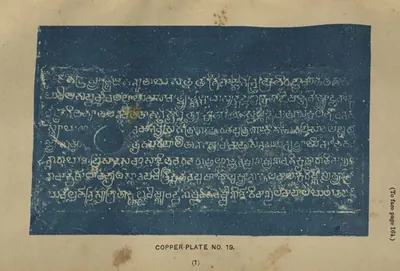 "Copper-plate No. 19" (Malliyapundi grant of Amma Raja II, East Chalukyan king) (Butterworth & Chetty 1905, to face p. 164 (PDF p. 219))Inscription rubbing · 1905
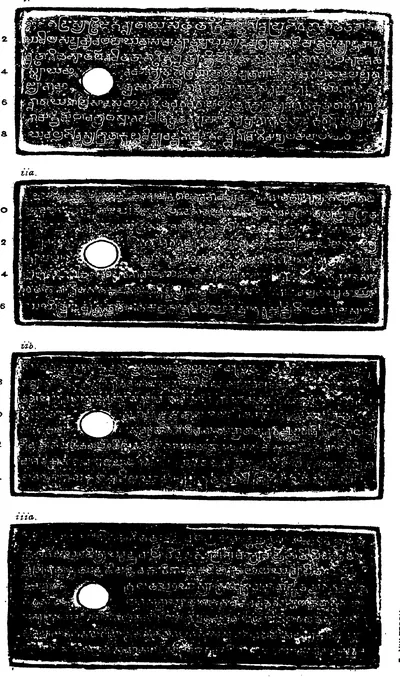 "Maliyapundi grant of Ammaraja II.", plates i, ii a, ii b and iii a (Epigraphia Indica IX, plate between pp. 52 and 53 (PDF p. 75))Inscription rubbing · 1908
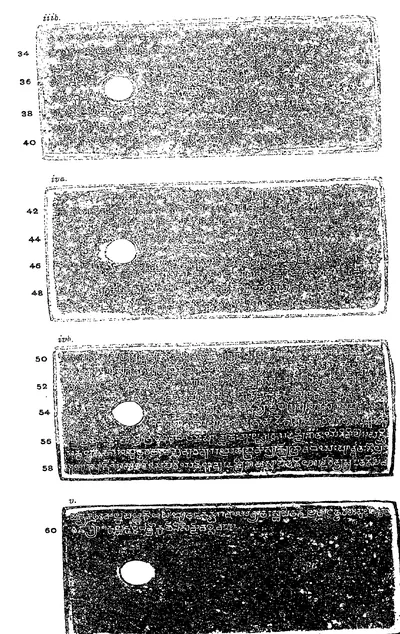 "Maliyapundi grant of Ammaraja II.", plates iii b, iv a, iv b and v (Epigraphia Indica IX, plate between pp. 52 and 53 (PDF p. 76))Inscription rubbing · 1908
References
Notes (0)
Sources (4)
Spotted an error on this page? Tell us
Last updated: