Madakasira
Town at the foot of a fortified rock in the south of the Anantapur district, near the Mysore border. Its fort belonged to a family of chiefs from Sira, whom the Bijapur kings left with Madakasira and Ratnagiri. Morari Rao of Gooty made them his tributaries. Haidar Ali took the rock by bombardment in 1762, lost it to Morari Rao and took it again in 1776. Mysore held it until 1799, when it went to the Nizam's share of Tipu Sultan's lands.
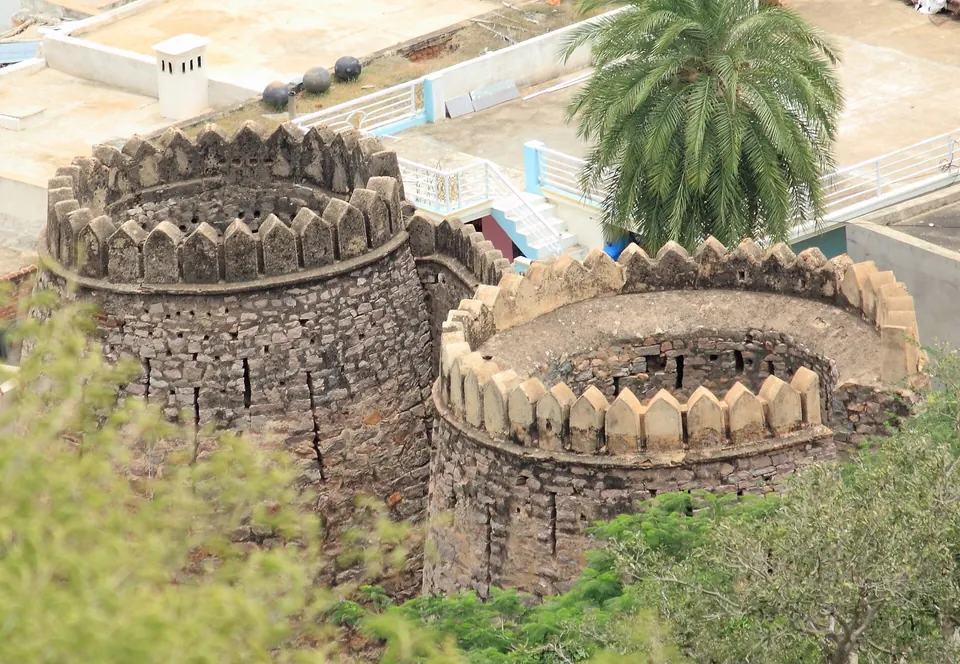
Madakasira lies on the Mysore border in the south-west of the Anantapur district.1 It stands below a steep hill “formed of gigantic rocks which rise sheer from the lower slopes”.1 The Anantapur gazetteer of 1905 describes the fort that crowns the two peaks of the hill.1
A southern path leads up “through narrow passages which a few resolute men could have held against an army”.1 In one place it is “only a few feet in width and … walled in by perpendicular rocks which must be 50 feet in height”.1 From the top Penukonda hill could be seen to the east.1 See Mysore under Haidar Ali and Tipu Sultan.
The chiefs of Sira
According to a tradition that the Anantapur gazetteer records, the present town was built by the chiefs of Sira in Mysore.12 The gazetteer summarises Munro’s report of 1802 on their family.2 It traced them to Hira Udaiyar, who under the Vijayanagara kings held twelve villages in Chitaldurg for military service and built the old fort at Sira.2 When the Bijapur kings conquered the country, the family were “given Ratnagiri and Madakasira in exchange”.2
The Imperial Gazetteer adds that Hira Udaiyar served Vijayanagara with a thousand peons (foot soldiers).3 The chief temple is of Venkataramanasvami.1 People in the town say that it was built by a blind minister of Morari Rao, whose sight was restored by the god of Tirupati.1
Morari Rao and Haidar Ali
The gazetteer says: “In 1741 Morári Rao reduced the place and made the poligar pay tribute”.2 His father Siddoji Rao, known as Hindu Rao, is said to be buried in the tomb east of the taluk office.2
The Imperial Gazetteer gives a different order.3 It says that the Marathas took Madakasira in 1728.3 Morari Rao took Ratnagiri in 1741 and imposed a tribute of Rs 8,000.3 See Gooty.
In 1762 Haidar Ali was angry at Morari Rao for helping the poligar (local military chief) of Chikballapur against him.2 He swept through the south of Anantapur.2 Wilks lists “Merg Sera” among the places he took that year.4
The gazetteer follows Kirmani’s history of Haidar.56 Kirmani says that the commandant “was a brave man”, whose guns and musketry “killed a great many of the Nawaub’s troops”.5 Haidar mounted large guns on the hill to the north.6 He ordered his gunners to fire at the rocks above the houses of the fort.6 Kirmani writes that “as these rocks were knocked to pieces by the cannon balls, the fragments killed a number of the besieged, and scattered the rest”.6 The commandant surrendered on a promise of his men’s lives, and he was allowed his life and property.6
Haidar’s hold did not last.2 Morari Rao recovered the place a year or two later.2 In 1776, “like the rest of the district”, it fell again to Haidar.2 The Imperial Gazetteer says that Haidar then demanded a tribute of Rs 15,000.3 When it was not paid on time, he sent the chief and his five sons prisoners to Srirangapatna (then Seringapatam).3
1799
The Musalmans held Madakasira until 1799.3 In the partition treaty of that year, “Murrugseera” appears in the Nizam’s share next to Penukonda, valued at 8,000 Kanthiraya pagodas.7 The Anantapur gazetteer says that the rest of the district went to the Nizam in 1799 and passed to the Company in 1800.8 See Penukonda.
Footnotes
-
W. Francis, Madras District Gazetteers: Anantapur (1905), p. 182 (archive.org (opens in a new tab)). ↩ ↩2 ↩3 ↩4 ↩5 ↩6 ↩7 ↩8 ↩9
-
Francis, Anantapur Gazetteer (1905), p. 183 (archive.org (opens in a new tab)). ↩ ↩2 ↩3 ↩4 ↩5 ↩6 ↩7 ↩8 ↩9 ↩10 ↩11
-
Imperial Gazetteer of India, Provincial Series: Madras, Vol. I (1908), p. 492 (archive.org (opens in a new tab)). ↩ ↩2 ↩3 ↩4 ↩5 ↩6 ↩7
-
Mark Wilks, Historical Sketches of the South of India, Vol. I (1810), p. 446 (archive.org (opens in a new tab)). ↩
-
Mir Husain Ali Khan Kirmani, The History of Hydur Naik, tr. W. Miles (1842), p. 122 (archive.org (opens in a new tab)). ↩ ↩2
-
Kirmani, History of Hydur Naik, tr. Miles (1842), p. 123 (archive.org (opens in a new tab)). ↩ ↩2 ↩3 ↩4 ↩5
-
C. U. Aitchison, A Collection of Treaties, Engagements and Sanads, Vol. IX (4th ed., 1909), p. 63, partition treaty of Mysore, Schedule B (archive.org (opens in a new tab)). ↩
-
Francis, Anantapur Gazetteer (1905), p. 23 (archive.org (opens in a new tab)). ↩
Photos
Related
People
Morari Rao Ghorpade
c. 1741–1776 CE
A Maratha soldier who fought for pay, of the Ghorpade family. He was lord of Gooty from the 1740s until Haidar Ali took the fortress in 1776. The Marathas left him as governor of Trichinopoly in 1741. He gave it up to the first Nizam in the mid-1740s and was accepted as chief of Gooty under the subahdar of the Deccan. His horsemen, whom Orme thought the best Indian soldiers of the day, fought in the Carnatic wars for Muhammad Ali and the English, for Mysore and for the French. Later they fought with the English against Haidar. He held Penukonda and Madakasira and took tribute from the Anantapur poligars. After a long siege of Gooty he surrendered to Haidar and died a prisoner at Kabbaldurga.
Haidar Ali
1761–1782 CE
A soldier who made himself master of Mysore in 1761 and ruled it until he died in December 1782. In the Telugu country he took Penukonda and Madakasira from the Maratha Morari Rao in 1762. He won back Gurramkonda through his brother-in-law Mir Sahib in 1768, took Bellary in 1775 and took Gooty from Morari Rao in 1776. In 1779 he conquered the Nawab of Cuddapah, and the Nawab of Kurnool and the poligars of the Bellary and Anantapur country paid him tribute. His invasion of the Carnatic in 1780 began the Second Mysore War.
References
Notes (0)
Sources (5)
Spotted an error on this page? Tell us
Last updated: