Mayidavolu
Village about twelve miles east of Narasaraopet, formerly in the Kistna and later the Guntur district, where the Prakrit copper plates of the Pallava crown prince Sivaskandavarman, the earliest Pallava charter, were dug up in 1899 on the site of an abandoned village with the ruins of a small old temple.
Mayidavolu is a small village twelve miles east of Narasaraopet, which was the headquarters of a taluk of the Krishna (then Kistna) district when E. Hultzsch described it in 1901.1 G. Jouveau-Dubreuil placed it in the Guntur district, on the southern bank of the Krishna.2
The Pallava plates
About the middle of 1899 a man digging in a field on the site of an abandoned village north of Mayidavolu found a set of copper plates. The site, about four acres in extent, contained the ruins of a small old temple.1 The plates were the Prakrit grant of the Pallava crown prince Sivaskandavarman, issued from Kanchipura to his officer at Dhannakada about the village of Viripara in Andhrapatha.3 J. Ramayya brought them to notice, and their owner, Mayidavolu Jaya Ramayya, later gave them to the Madras Museum.13 See the Mayidavolu plates.
Footnotes
-
E. Hultzsch, “Mayidavolu Plates of Sivaskandavarman”, Epigraphia Indica VI (1900–01), p. 84 (archive.org (opens in a new tab)). ↩ ↩2 ↩3
-
G. Jouveau-Dubreuil, The Pallavas (1917), p. 1 (archive.org (opens in a new tab)). ↩
-
Hultzsch, “Mayidavolu Plates of Sivaskandavarman” (1901), p. 85 (archive.org (opens in a new tab)). ↩ ↩2
Photos
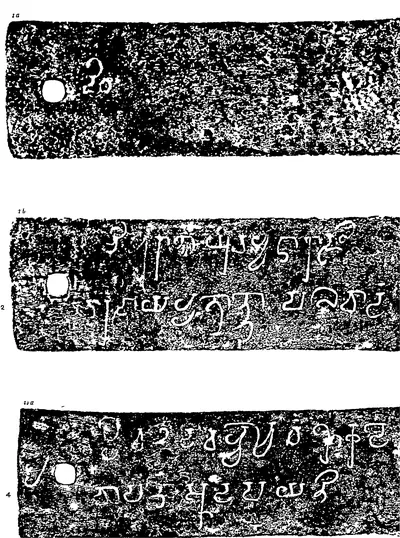 "Mayidavolu Plates of Sivaskandavarman", plates i a, i b and ii a (Epigraphia Indica VI, plate between pp. 84 and 85 (PDF p. 112 of the archive.org scan in.ernet.dli.2015.56212))Inscription rubbing · 1901
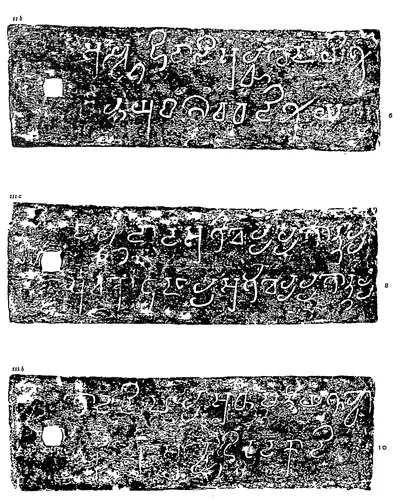 "Mayidavolu Plates of Sivaskandavarman", plates ii b, iii a and iii b (Epigraphia Indica VI, plate between pp. 84 and 85 (PDF p. 113 of scan in.ernet.dli.2015.56212))Inscription rubbing · 1901
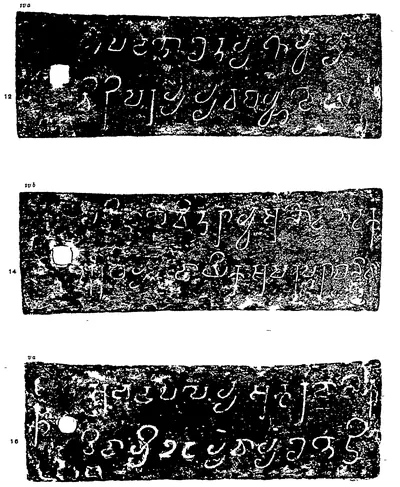 "Mayidavolu Plates of Sivaskandavarman", plates iv a, iv b and v a (Epigraphia Indica VI, second plate between pp. 86 and 87 (PDF p. 116 of scan in.ernet.dli.2015.56212))Inscription rubbing · 1901
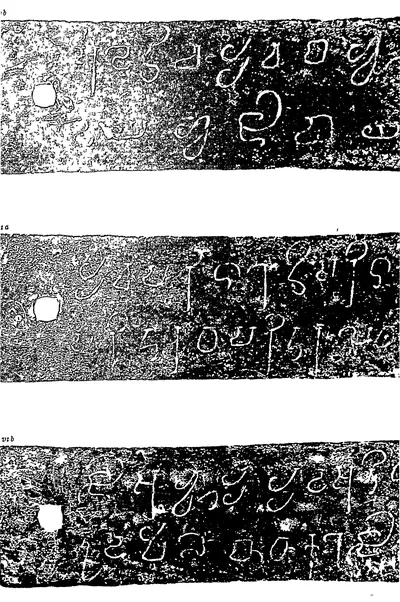 "Mayidavolu Plates of Sivaskandavarman", plates v b, vi a and vi b (Epigraphia Indica VI, second plate between pp. 86 and 87 (PDF p. 117 of scan in.ernet.dli.2015.56212))Inscription rubbing · 1901
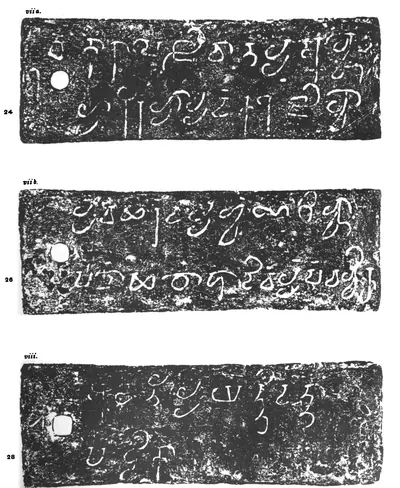 "Mayidavolu Plates of Sivaskandavarman", plates vii a, vii b and viii (Epigraphia Indica VI, third plate (PDF p. 115 of the archive.org scan EpigraphiaIndicaVol6))Inscription rubbing · 1901
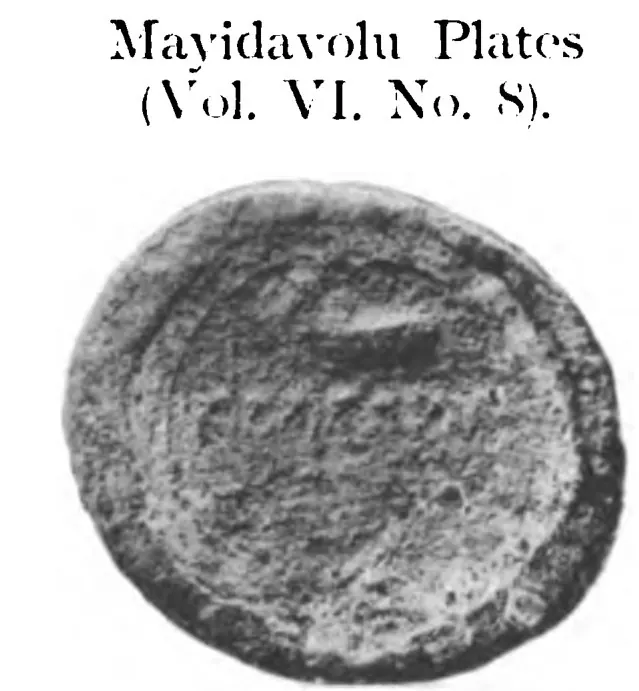
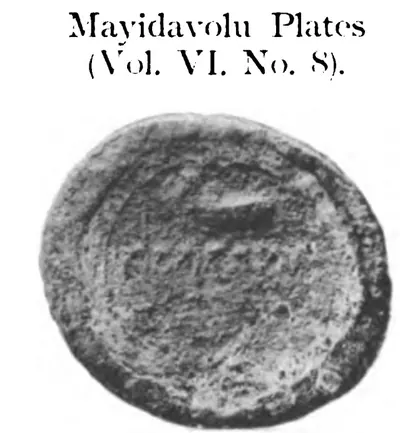 Seal of the Mayidavolu plates of Sivaskandavarman: "Mayidavolu Plates (Vol. VI, No. 8)", from the plate "Seals. Full-size" (Epigraphia Indica VI, plate of seals printed with No. 28 (PDF p. 369 of the archive.org scan EpigraphiaIndicaVol6))Historic photograph · 1901
Related
People
Inscriptions
References
Notes (0)
Sources (2)
Spotted an error on this page? Tell us
Last updated: